• About

Cinezine Kane

Cinezine Kane

Category Archives: Reviews

Review: Coogan soars in faltering GREED

06 Friday Mar 2020

Posted by cinepam in Reviews

≈ Leave a comment

Tags

Greed, Isla Fisher, Michael Winterbottom, Steve Coogan

1Greed plays to Steve Coogan’s strengths. He is an actor able to embody repellent characters but layer them with enough charm that an audience will keep watching and even begrudgingly like even the complete bastards he sometimes plays. And so it is with Greed, Michael Winterbottom’s latest, a misfire in which Coogan soars as billionaire jerk Sir Richard “Greedy” McCreadie even as the film flails around him in a mostly unsuccessful attempt to satirize the super-rich while calling attention to the injustices built into the garment industry.

This is Greedy McCreadie: He’s the type of person spending millions to throw himself a 60th birthday party on the Greek island of Mykonos with a guest list that includes plenty of celebrities to reflect their stardust back at him and an ancient Roman gladiator theme (complete with lion). He’s the kind of guy who upon seeing a group of Greek refugees on the beach has the police remove lest they disturb his guests’ view with their… poverty. He is someone who has built his own wealth partially by dodging taxes in Monaco but mostly by hardball bargaining with the owners of Sri Lankan sweatshops who provide the clothing for his stores. He is a vain man with blinding white teeth, who traded in his wife Samantha (Isla Fisher) for Naomi (Shanina Shaik), a girl young enough to be his daughter. Oh, and he’s such a genius businessman that as revealed through the time-shifting narrative, he has presided over serial bankruptcies of once high-flying fashion chains (gee, that scenario is somehow so familiar).

So far, so much wretched excess. Coogan knocks it out of the park, at once absolutely repulsive yet somehow oddly likeable. Winterbottom chose well in casting Jamie Blackley as Greedy’s younger self, an avaricious brat even at a tender age. Fisher is an apt match for Coogan, playing Samantha as someone who embraces her greed with cheerful amorality. The sun-drenched Mykonos setting perfectly encapsulates the rewards that accrue to those who give no thought to the rest of the world in their full embrace of the greed-is-good ethos. And if a soundtrack that includes The Flying Lizards’ “Money (That’s What I Want)” and ABBA’s “Money Money Money” is sometimes a little on the nose, it is apt.

Greed gets that much right, but it all falls apart in the film’s storytelling. Winterbottom is attempting to satirize the super-rich, but the problem is the lives so breathlessly reported by the tabloids already resemble satire. How do you exaggerate the already exaggerated?

By focusing on Greedy McCreadie Winterbottom is obscuring his own point. He wants to say something about the exploitation of labor by people like Greedy whose negotiations with sweatshop owners drive down his price , but also the conditions and pay under which the people who actually make the clothing he sells work. Even when his party manager Amanda (Dinita Gohil) relates a heartfelt story of a tragedy that rose out of one of Greedy’s deals, it feels at a remove. A drama about garment workers and their travails may not as be as sexy as a quasi-comedy about a larger-than-life lowlife (but nevertheless captivating) billionaire, but to make a story about their exploitation, it really ought to be told through their eyes. Otherwise, the real message of Greed is clear. The world belongs to people like Greedy McCreadie. The rest of us are bit players in their drama. –Pam Grady


Share this:

  • Share on Facebook (Opens in new window) Facebook
  • Share on X (Opens in new window) X
  • Email a link to a friend (Opens in new window) Email
  • Print (Opens in new window) Print
  • Share on LinkedIn (Opens in new window) LinkedIn
  • Share on Tumblr (Opens in new window) Tumblr
  • Share on Reddit (Opens in new window) Reddit
  • Share on Pinterest (Opens in new window) Pinterest
Like Loading...

Grandpa, is that you? Decoding the shared DNA of MARRIAGE STORY’s Charlie and STAR WARS’ Kylo Ren

19 Thursday Dec 2019

Posted by cinepam in Reviews, Uncategorized

≈ Leave a comment

Tags

Adam Driver, Marriage Story, Star Wars: The Rise of Skywalker

Marriage Story 7-horzSpoiler alert: The following discusses certain aspects and plot points of Marriage Story and Star Wars: The Rise of Skywalker.
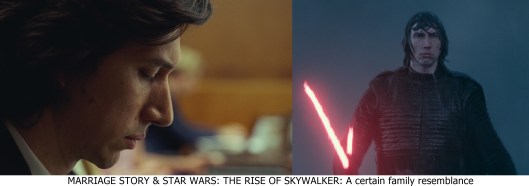
2019 has been the year of Adam Driver with five movies hitting US theaters: Terry Gilliam’s The Man Who Killed Don Quixote, in which he plays a megalomaniac film director; Scott Z. Burns’ The Report that casts the actor as real-life Senate investigator Daniel Jones; Jim Jarmusch’s The Dead Don’t Die, where Driver partners with Bill Murray and Chloë Sevigny as police fighting a zombie invasion; Noah Baumbach’s Marriage Story, in which he is a theater director going through a divorce; and he reprises his role of villain Kylo Ren in Star Wars: The Rise of Skywalker. Already a Golden Globe and Screen Actors Guild best actor nominee for Marriage Story, Driver is all but a lock for an Oscar nomination.

It’s truly been a stellar year for Driver, but here’s the weird thing: Marriage Story and Star Wars: The Rise of Skywalker would make one of the oddest yet most oddly compelling double bills of all time for those remaining rep houses that still book them. On the surface, the two films have nothing in common other than a single actor. But the men Driver plays in them share certain personality traits that make it all too easy to imagine that Charlie, the theater director, is the great-great-to-however-many-powers grandfather of Kylo Ren. The seed for all that intergalactic strife was planted in 21st century New York.

Unlikely, you say? Check it out: They share the same defining personality trait, petulance. Charlie sulks his way through his divorce, further alienating his ex, Nicole (Scarlett Johansson). Centuries later, Kylo’s peevishness leaves him to reject his parents Han Solo (Harrison Ford) and Leia Organa (Carrie Fisher), embrace his dark side, and eventually murder his father in Star Wars Episode VII – The Force Awakens. Despite the power he’s amassed since, Kylo’s mood hasn’t improved in The Rise of Skywalker. Instead of acting the winner, he’s a whiner.

Of course, I’m sure there are those that would defend Charlie and Kylo as emo rather than pouty, and maybe they would have a point. At least, it would explain their jobs. Charlie is supposed to be some kind of theater savant, he even wins a MacArthur “genius” grant during the course of Marriage Story. But Charlie is awkward and stunted, and it is hard to imagine that his theater doesn’t reflect that. Part of the reason Nicole leaves is because she feels smothered and much of that has to do with her work in his theater, the place pretentiousness and self-seriousness call home.

As for Kylo, sure, he embraces evil and he’s always attacking his mother’s forces, but his ways clearly don’t spark joy. One wonders what Darth Vader, the granddad he worships, would say about this sad boi, this gangly perpetual teenager who always seems on the verge of bursting into tears. Is this villainy or merely pique? You can almost hear him screaming at his mother, “I don’t want to be a Jedi and you can’t make me!”

Charlie and Kylo also share a certain sense of it is all-about-me-ness when it comes to the women they profess to love. Charlie is left poleaxed by Nicole leaving him, because he never saw it coming, never really saw her, never saw that she was unhappy in her role as an extension of his work, and ultimately, of him.

Kylo’s intensity toward Jedi warrior Rey (Daisy Ridley) is that of a stalker as he insists on their future together despite her protests. And what a future! The only thing he can imagine is the two of them sitting on the Palpatine throne as Sith king and queen. That Rey doesn’t want to embrace her own dark side and has worked damned hard to become a Jedi matters not to Kylo. Nor does it dawn on him that Rey isn’t someone likely to embrace a fate that would involve the wholesale slaughter of her friends. Of course not, because, really, it’s all about Kylo and what he wants. He’s a bad boyfriend.

There you have it. In a galaxy far, far away is a troubled man. And the seeds of that trouble aren’t in his turning his back on the Jedi and his parents or even in killing his dad, but in a theater director in our own galaxy and our own time. That ambition to conquer Broadway sprouts many years later as an ambition to conquer worlds. It’s family. It’s legacy. There is no escape. It’s family dysfunction for the ages. –Pam Grady

Share this:

  • Share on Facebook (Opens in new window) Facebook
  • Share on X (Opens in new window) X
  • Email a link to a friend (Opens in new window) Email
  • Print (Opens in new window) Print
  • Share on LinkedIn (Opens in new window) LinkedIn
  • Share on Tumblr (Opens in new window) Tumblr
  • Share on Reddit (Opens in new window) Reddit
  • Share on Pinterest (Opens in new window) Pinterest
Like Loading...

Review: Crime family dysfunction interrupts Line of Descent

13 Friday Dec 2019

Posted by cinepam in Reviews, Uncategorized

≈ Leave a comment

Tags

Ali Haji, Brendan Fraser, Line of Descent, Neeraj Kabi, Prem Chopra, Rohit Karn Batra, Ronit Roy

Similarities between the great mob classic The Godfather and Rohit Karn Batra’s debut feature Line of Descent probably aren’t coincidental. Like Francis Coppola’s gangland epic, Batra’s New Delhi-set thriller starts with a family celebration, in this case, a toddler’s birthday part, that introduces the viewers to three disparate brothers. And like the Corleone siblings, the Sinha’s are part of their father’s criminal enterprise. But Line of Descent is not The Godfather. Rather than a sweeping saga, it is tense, blood-spattered portrait of resentment and family dysfunction the plays out against the passing of the torch from one generation to the next.

What sets Line of Descent into motion is a father’s will. In life, Bharat Sinha (Prem Chopra) directed the strongarm activities of his two elder sons, level-headed Prithvi (Ronit Roy) and volatile Siddharth (Neeraj Kabi). Half-brother Suraj (Ali Haji) is much younger and has yet to join the family business. Bharat’s death shouldn’t leave a vacuum—he has set up his estate so that Prithvi is in charge. But the decision enrages Siddharth, who becomes even angrier when Prithvi has no interest in his scheme to sell arms. Not only that, Prithvi has lost his taste for crime and wants to pull the Sinhas out of the life and transform the family’s legitimate front, an electronics store, into its sole business. It is a set up for a tragedy of Shakespearean proportions.

Kabi is scarily good at playing a psychopath willing to put his ambitions before his family, and he’s equipped with two Lady Macbeths in his wife and his mistress. If Prithvi’s urge is to protect, Siddharth’s is to destroy anything in his path that might thwart him. He is oblivious, to the idea that the police (in the form of Abhay Deol’s Officer Raghav) might be investigating the Sinhas or that Charu (an exuberant Brendan Fraser), the American he chooses for his partner, might have second thoughts about hitching his fate to someone so mercurial.

Batra excels at atmosphere, particularly in scenes set in the bars and clubs of New Delhi nightlife where so much illicit business is conducted. If the central conflict between Prithvi and Siddharth is clear-cut, the way it plays out is less so. Bullets fly. Bodies fall. If Michael Corleone was able to build an empire out of his particular brand of grandiose psychosis in The Godfather, Siddharth hardly seems that smart or that lucky. But in tracking this crime family sibling rivalry, Batra builds a nail-biter out of a war between brothers where Siddharth might yet prevail—although perhaps not in the way he planned. –Pam Grady

Line of Descent is playing in selected theaters and on VOD.

Share this:

  • Share on Facebook (Opens in new window) Facebook
  • Share on X (Opens in new window) X
  • Email a link to a friend (Opens in new window) Email
  • Print (Opens in new window) Print
  • Share on LinkedIn (Opens in new window) LinkedIn
  • Share on Tumblr (Opens in new window) Tumblr
  • Share on Reddit (Opens in new window) Reddit
  • Share on Pinterest (Opens in new window) Pinterest
Like Loading...

The French Had a Name for It 6 brings noir and Aznavour to the Roxie

14 Thursday Nov 2019

Posted by cinepam in News, Reviews

≈ Leave a comment

Tags

Alain Delon, Charles Aznavour, Jane Fonda, Jean-Luc Godard, Joy House, Le Petit Soldat, Lola Albright, Objective 500 Million, One Does Not Bury Sunday, The Fabiani Affair, The French Had a Name for It

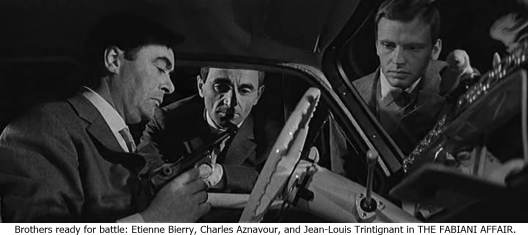
horace-62_01When Charles Aznavour died just over a year ago in October 2018, it brought the end of not just one of the world’s great singers but also an actor of considerable charisma. That quality is on full display in The Fabiani Affair (1962), a tense crime drama that is one of 15 1960s Gallic film noirs screening at The French Had a Name For It 6, Thursday, Nov. 14-Monday, Nov. 18 at San Francisco’s Roxie Theater.

Made two years after Aznavour starred as Charlie, the musician swept up in his brothers’ criminal activities, in François Truffaut’s sublime thriller Shoot the Piano Player, The Fabiani Affair once more casts the actor as a man entangled with his siblings in a violent clash. Aznavour plays Horace Fabiani, one of three Corsican brothers living in Paris and the latest generation to become enmeshed in a feud with the rival Colonna family that dates back to the old country. Horace is reluctant to join in; he has a family and among the opposing set of brothers the Fabianis will battle is their sister’s husband Noel (Raymond Pellegrin). But with the Fabianis’ father (Nerio Bernardi) spoiling for war, Horace really has no choice.

The directing debut of actor André Versini, The Fabiani Affair builds suspense over a long night in Paris as the two sets of brothers alternately hunt for one another. None of them really seem to have their hearts into the fight, but their clash is a matter of family honor and destiny, so they drive on. Versini displays a gift for setting atmosphere with Marcel Grignon’s striking cinematography and Paul Mauriat’s evocative jazz score. Aznavour further amps the tension through his performance as a man increasingly giving himself over to the despair of an untenable situation in a film that is as downbeat as it is suspenseful.

Among other highlight of The French Had a Name for it 6:

Joy House (1964): One of the biggest, sexiest French stars of the 1960s, Alain Delon (Purple Noon, Le Samouraï) stars alongside Americans Lola Albright and Jane Fonda in René Clement’s sly thriller. On the run from gangsters who mean him harm, Delon’s Marc thinks he has found the perfect hideout and a sweet situation when he signs on as chauffer to rich widow Barbara (Albright) and her pretty young cousin Melinda (Fonda). Perhaps Melinda’s obsessive attentions and Barbara’s one-sided dialogue with her dead husband should clue Marc into the idea that his refuge isn’t the oasis from danger it seems. But beauty doesn’t always equate with brains, and certainly not in this delicious little drama.

Le Petit Soldat (1963): Originally shot in 1960 as Jean-Luc Godard’s follow-up to his immortal Breathless, this war drama was banned by French authorities for three years. The director’s sin? Depicting torture and other war crimes in context of the then raging Algerian War. Michel Subor is a photographer in Geneva, Switzerland, who comes to grief at his other job working against the Algerians. Godard’s future wife Anna Karina is the model the photographer falls for in a film as stylistically dazzling as the director’s storied feature debut.

One Does Not Bury Sunday (1960): An interracial romantic triangle is at the heart of this downbeat noir in which Gabonese writer Philippe Valence (Philippe Mory) becomes involved with both an au pair (Margaretha Lundal) and a rich married woman (Hella Petri). Sex and murder interrupt an artist’s brilliant future in a drama that grows ever bleaker as the police (and the walls) close in on Philippe.

Objective 500 Million (1966): Pierre Schoendoerffer’s nifty thriller stars Bruno Cremer as Jean, a disgraced former air force captain sucked into a caper that involves both a beautiful femme fatale (Marisa Mell) and the man (Jean-Claude Rolland) responsible for his disgrace and imprisonment during the Algerian War. His share in the heist of millions could go along way toward fixing what’s wrong with Jean’s life but the possibility of revenge motivates him more in a tense crime drama with an arresting climax that alternates between the Paris-to-Bordeaux flight that is ferrying the cash and confederates on the ground awaiting a big payoff. –Pam Grady

The French Had a Name For It 6, Nov. 14-18, Roxie Theater, 3117 16th Street, San Francisco, $12-$14. http://midcenturyproductions.com

Share this:

  • Share on Facebook (Opens in new window) Facebook
  • Share on X (Opens in new window) X
  • Email a link to a friend (Opens in new window) Email
  • Print (Opens in new window) Print
  • Share on LinkedIn (Opens in new window) LinkedIn
  • Share on Tumblr (Opens in new window) Tumblr
  • Share on Reddit (Opens in new window) Reddit
  • Share on Pinterest (Opens in new window) Pinterest
Like Loading...

ANGEL HAS FALLEN and can’t get up

22 Thursday Aug 2019

Posted by cinepam in Reviews

≈ Leave a comment

Tags

Angel Has Fallen, Gerard Butler, Morgan Freeman, Nick Nolte, Piper Perabo

angel

Secret Service Agent Mike Banning (Gerard Butler) is having a very bad week in Angel Has Fallen, presumably the last chapter in the series that includes Olympus Has Fallen (2013) and London Has Fallen (2016). President Allan Trumbull (Morgan Freeman) has offered him a promotion to head of the agency, which his wife Leah (Piper Perabo in the thankless helpmate role) would love but would take Mike out of the thick of things—no easy transition for an adrenalin junkie who is used to being the one guy who can save the world. Plus, he’s having concussion-related migraines that he’s told no one about as he’s become one of those doctor-shopping pillheads in search of relief. Plus, he reunites with his long-estranged father who turns out to be Nick Nolte and not the Nick Nolte of The Prince of Tides and Affliction, but the Nick Nolte with the crazed eyes in tabloid mug shots (but the paranoid old coot, character name Clay, does have a way with incendiary devices). To top it all off, someone has tried to kill the president in a tech-savvy Rube Goldberg operation with a flamboyant body count and a tight frame around Mike. Angel has fallen, indeed.

Lean into the ridiculous premise, just go with it.  Angel Has Fallen masquerades as an action thriller, but it is less that and more of a guilty pleasure in the way that movies with big explosions, raging gun battles, and other forms of cartoon violence so often are. It’s often funny and the humor isn’t completely unintentional—there is no way Clay Manning is meant to be anything more than a cross between the Tasmanian Devil, Yosemite Sam, and the Unibomber (the last acknowledged by Mike). The plotting is negligible. There is, after all, only one way for this to end. Mike isn’t going to fall on a grenade, after all. (Or is he?)

And anyone familiar with the cast will have sussed out who the evildoers are before the story has even engaged, further deflating what little suspense the movie has. These guys are good, even great actors, but they are so often cast for their talent for gleefully inhabiting the roles of the absolute scum of the earth. Their characters’ motivations are pretty transparent, too, although it really seems as if one of them had just upped his dose of Viagra, bought a sports car, or joined a paintball team, a lot of the mayhem could have been avoided. But then there wouldn’t be a movie, now would there?

It’s the dog days of August, the month studios dump product deemed defective on multiplex screens in hopes some will somehow capture an audience, anyway. Kind of like the movie versions of seconds, items offered as is, buyer beware. Angel Has Fallen falls neatly into that category, but it might just be one that sticks. Is it good? No. Is it amusing? Heck, yeah. And when else are moviegoers ever going to get to see the awesome sight of Gerard Butler and Nick Nolte lolling in sensory deprivation tanks? Some things are just worth the price of admission. –Pam Grady

Share this:

  • Share on Facebook (Opens in new window) Facebook
  • Share on X (Opens in new window) X
  • Email a link to a friend (Opens in new window) Email
  • Print (Opens in new window) Print
  • Share on LinkedIn (Opens in new window) LinkedIn
  • Share on Tumblr (Opens in new window) Tumblr
  • Share on Reddit (Opens in new window) Reddit
  • Share on Pinterest (Opens in new window) Pinterest
Like Loading...

Bitter architect of her own uprising: WHERE’D YOU GO, BERNADETTE?

15 Thursday Aug 2019

Posted by cinepam in Reviews

≈ Leave a comment

Tags

Billy Crudup, Blue Jasmine, Cate Blanchett, Emma Nelson, Kristen Wiig, Maria Semple, Richard Linklater, Where'd You Go Bernadette

Where’d You Go, Bernadette? A better question is why should anyone care where Bernadette goes? Richard Linklater adapts Maria Semple’s bestseller, making several changes to the novel that don’t serve either the heroine or star Cate Blanchett well. Already a portrait of a family of enormous privilege—who the hell else can afford to take (on only a month’s notice, yet) a vacation to Antarctica—it adds to it an entitled protagonist whose main character trait is pissing people off.

In a way, Bernadette Fox hews close to the template of a difficult, self-involved woman with a talent for alienating people that Blanchett established in her Oscar-winning turn in Woody Allen’s Blue Jasmine. But Bernadette lacks Jasmine’s vulnerability and she’s meaner. She lavishes what tenderness she has on young teen daughter Bee (Emma Nelson) and, to a lesser extent, husband Elgie (Billy Crudup). For the rest of the human population, this embittered architect (a MacArthur genius grant winner, at that) turned stay-at-home mom has nothing but scorn, lavishing particular venom and outright cruelty on her neighbor, Audrey (Kristen Wiig). It is her behavior toward Audrey that at last pushes Elgie into arranging an intervention, which inspires Bernadette to run away from her family.

All roads eventually lead to Antarctica where, at last, Bernadette’s back story and just why she is so acrimonious comes into focus. Too little, too late in terms of having any empathy for the character or caring about what becomes of her. At least the location (apparently really Greenland) is pretty. Shots of Blanchette kayaking among icebergs that open the film and recur later are gorgeous. But the satire falls flat and Bernadette never gives anyone besides her beloved Bee reason to spend time with her. –Pam GradyWHERE'D YOU GO, BERNADETTE

Share this:

  • Share on Facebook (Opens in new window) Facebook
  • Share on X (Opens in new window) X
  • Email a link to a friend (Opens in new window) Email
  • Print (Opens in new window) Print
  • Share on LinkedIn (Opens in new window) LinkedIn
  • Share on Tumblr (Opens in new window) Tumblr
  • Share on Reddit (Opens in new window) Reddit
  • Share on Pinterest (Opens in new window) Pinterest
Like Loading...

Ode to (Good) Boys: Tween Comedy Finds Its Sweet Spot

15 Thursday Aug 2019

Posted by cinepam in Reviews

≈ Leave a comment

Tags

Brady Noon, Evan Goldberg, Gene Stupnitsky, Good Boys, Jacob Tremblay, Jonah Hill, Keith L. Williams, Lee Eisenberg, Seth Rogen, Superbad

Good BoysStealing a beer from my uncle’s fridge and running off to share it among the four of us behind the nearby grammar school used to be a thing for me, my two cousins, and my little sister (who we were corrupting, since we were tweens and she wasn’t). Then one day when they were going to come to my house for a sleepover, we stashed a beer in my sister’s purse where my mom discovered it. Busted. Sleepover canceled. Beer filching days over.

This I write as an intro to Good Boys, a film raucous and ribald and charming and absolutely locked into that moment of transition between childhood and full-on adolescence. Writers Gene Stupnitsky (who makes his feature directing debut) and Lee Eisenberg, both one-time The Office writers, have called forth their inner tweens to regale audiences with the tale of three sixth-graders who are trying to replace a drone they accidentally destroyed before anyone realizes it’s even missing, keep the molly that has fallen into their possession from the teenage girls it belongs to, and go to a kissing party at a cool kid’s house. If this all sounds like Superbad: The Junior High Years, well, Superbad star Jonah Hill and that comedy’s writers, Seth Rogen and Evan Goldberg, are all producers on Good Boys.

Someone in the movie suggests that the lifelong friends at the heart of the movie are only BFFs because they live in the same neighborhood, have always gone to the same schools, and their parents are friends. There may be some truth to that as these kids—who call themselves The Beanbag Boys, because they share beanbag chairs—are so very different. Max (Room’s Jacob Tremblay) is the one in the group the cool kids recognize as one of their own and is the apparent future ladies man of the trio, currently nursing a crush on classmate Brixlee (Millie Davis). Lucas (Keith L. Williams) is tall for his age, making some people mistake him for someone older; grappling with family issues; and he would rather not get involved with some of his friends shenanigans since he likes following the rules. Thor (Brady Noon) is as blustery as his name suggests but also bullied in part because his angelic singing voice makes him stand out.

At heart, this really is a story about good boys. Max, Lucas, and Thor are sweet kids. Their hormones are raging and they try to feign sophistication none of them possess—several jokes revolve around all they don’t know about sex. Their troubles mostly stem from youthful ignorance of consequences (not to mention feelings of invincibility) and they labor under the childish conviction that while they’ve done a wrong thing, they can fix it, effecting a do-over and evading punishment.

The laughs are frequent and long—like Superbad, this is a comedy with scenes designed to make people laugh so hard they cry. And while this is a movie no tween can see—not without a parent or guardian, anyway—it’s one that embraces that age and its last gasp of innocence with affection. It also includes a scene from a middle-school production of the Broadway musical Rock of Ages that alone is worth the price of admission. A period of life most people would not choose to return to proves fertile ground for comic gold. –Pam Grady


Share this:

  • Share on Facebook (Opens in new window) Facebook
  • Share on X (Opens in new window) X
  • Email a link to a friend (Opens in new window) Email
  • Print (Opens in new window) Print
  • Share on LinkedIn (Opens in new window) LinkedIn
  • Share on Tumblr (Opens in new window) Tumblr
  • Share on Reddit (Opens in new window) Reddit
  • Share on Pinterest (Opens in new window) Pinterest
Like Loading...

That’s Entertainment! Show biz films in the spotlight at SF Jewish Film Festival

17 Wednesday Jul 2019

Posted by cinepam in Reviews, Uncategorized

≈ Leave a comment

Tags

Alfred Lion, Anton Yelchin, Beyond the Bolex, Blue Note Records, Casablanca, Curtiz, Francis Wolff, It Must Be Schwing - The Blue Note Story, Love Antosha, Michael Curtiz, Pauline Kael, San Francisco Jewish Film Festival, What She Saide: The Art of Pauline Kael

The 39th edition of the San Francisco Jewish Film Festival, July 18-Aug. 4, kicks off with Fiddler: A Miracle of Miracles, a documentary about Fiddler on the Roof, the musical that became a Broadway phenomenon and later a 1971 Oscar-winning film. That opener sets the stage for a festival rife with films about the business of show, its personalities, indelible moments in entertainment history, and even a documentary about a camera beloved by filmmakers and its inventor. Here is a report on five of the most notable, followed by a list of the remaining show biz titles. –Pam Grady

Beyond the Bolex

Beyond the Bolex2

The world may be increasingly digital, but celluloid still exists, and the Bolex 16mm movie camera is still manufactured. The story of that camera and its inventor, Russian-born Jacques Bolsey, is the subject of this enchanting documentary. Made by Bolsey’s great-granddaughter Alyssa Bolsey, who had access to Jacques’ journals, schematics, cameras, and footage (generously employed throughout the documentary), Beyond the Bolex is both industrial history and the personal story of the Bolsey family. It is also, in a way, a fascinating detective story as Alyssa Bolsey unravels the enigma of a man she never knew but with whom she shares a deep love for the beauty of the analog image.

Curtiz

Curtiz2

Director Michael Curtiz’s (Ferenc Lengyel) battles with studio and government interference over the production of his latest film, Casablanca, are only the start of the filmmaker’s troubles in this elegant, noirish Hungarian production. Supercilious government suit Johnson (Declan Hannigan) insists the movie should be wartime propaganda. Curtiz resists the reduction of his work to knee-jerk jingoism even as he wrestles with how to end the picture. Complicating matters is the appearance of his estranged daughter Kitty (Evelin Dobos), demanding attention he scarcely has time to give. Luminously shot in black and white (with the occasional red flourish to suggest shooting in progress) with an evocative score by Gábor Subicz, the drama does not gloss over the less savory aspects of Curtiz’s personality while also depicting him as a strong-willed artist unafraid of ruffling powerful feathers.

It Must Be Schwing – The Blue Note Story

schwing

Not to be confused with Blue Note Records: Beyond the Notes, the other recent documentary about the legendary New York jazz label, this entertaining German import more tightly focuses on the label’s founders, Alfred Lion (1908-1987) and Francis Wolff (1907-1971). United in friendship by their love of jazz from the time they were teenagers and Jews forced to flee Hitler’s Germany, the two made their passion into their business in forming the label that would record such artists as Thelonious Monk, Art Blakey, Lee Morgan, Herbie Hancock, and so many more jazz giants. Eric Friedler’s delightful doc employs what one would expect from a film of this nature, a lot of archival footage, bursts of the music upon which Blue Note made its name, and interviews with music historians, Blue Note recording engineer Rudy Van Gelder, and plenty of musicians, including Quincy Jones, Sonny Rollins, and Hancock. But to fully tell Lion and Wolff’s story, Friedler turns to animation, a stroke of inspiration that brings the men and their fascinating story to vivid life.

Love, Antosha

Love, Antosha - Still 1

The actor, Anton Yelchin, who died in 2016 at 27, has 68 credits on the IMDB, an astonishing number for someone so young and encompassing shorts, TV shows, and movies ranging from small indies to the latest Star Trek franchise. Garret Price’s moving documentary, produced by Yelchin’s Like Crazy director Drake Doremus, suggests the promise unfulfilled: the parts he had left to play, the directorial debut he was planning, his immersion into photography. More vitally, this heartfelt film—chockful of clips from Yelchin’s films, including his own boyhood efforts—reveals Anton as a bright, curious, and caring personality in stories told by his friends, coworkers, and his heartbroken parents, figure skaters Viktor and Irina Yelchin.

What She Said: The Art of Pauline Kael

Jewish Film Fest 2019_05

In time for Pauline Kael’s centennial birthday comes Rob Garver’s documentary that will appeal to Paulettes everywhere, a film that spins the story of one of the last of the truly influential film critics. A poultry farmer’s daughter from Petaluma, she got her start on the radio at KPFA in Berkeley before pulling up stakes and heading East where she eventually rose to prominence at The New Yorker. Sarah Jessica Parker voices Kael’s words in a film that combines archival footage of Kael and others, clips from many of the movies that she reviewed, and interviews with her daughter Gina James and writers and filmmakers, including Camille Paglia, James Wolcott, Carrie Rickey, Paul Schrader, Francis Ford Coppola, and John Boorman.

More SFJFF show business-themed films:

The Amazing Johnathan Documentary

Before You Know It

Carl Laemmle

The Humorist

The Mamboniks

Shut Up and Play the Piano

Standing Up and Falling Down

Tel Aviv on Fire


Share this:

  • Share on Facebook (Opens in new window) Facebook
  • Share on X (Opens in new window) X
  • Email a link to a friend (Opens in new window) Email
  • Print (Opens in new window) Print
  • Share on LinkedIn (Opens in new window) LinkedIn
  • Share on Tumblr (Opens in new window) Tumblr
  • Share on Reddit (Opens in new window) Reddit
  • Share on Pinterest (Opens in new window) Pinterest
Like Loading...

Incandescent Jessie Buckley steps up to the mic in WILD ROSE

28 Friday Jun 2019

Posted by cinepam in Reviews, Uncategorized

≈ Leave a comment

Tags

Country Music, Jessie Buckley, Julie Walters, Nashville, Ryman Auditorium, Wild Rose

Wild RoseIn a key moment of Wild Rose, aspiring country singer Rose-Lynn Harlan (Jessie Buckley) travels to London—probably the farthest she’s been outside of her hometown of Glasgow—to meet one of her heroes, real-life BBC The Country Show radio host Whispering Bob Harris—who tells her that if she is serious about making it in country music she needs to write her own songs. It is a suggestion that flummoxes her; she feels she has nothing to write about. She can’t see what the audience sees: Her life is a country song. And so is this movie, the story of a working-class heroine who can’t seem to get out of her own way, whose life would utterly defeat most other people, but whose hope and big dreams remain undistinguished.

The juxtaposition of Scotland and Nashville, where Rose-Lynn hopes to eventually hang her hat, may seem incongruous, but Glasgow has a thriving country scene where Rose-Lynn has been a star at a local pub, which just happens to be named Grand Ole Opry, since she was a teenager. Country (not “country ‘n western,” Rose-Lynn emphatically insists) is also music that celebrates hardscrabble lives and hers has been more hardscrabble than most. The single mother of two before she was 18 years old—her daughter Wynonna (Daisy Littlefield) is eight and her son Lyle (Adam Mitchell)—she has never settled into the role of parent, to her mother Marion’s (Julie Waters) consternation. She drinks too much, breaks promise after promise, and places her own interests front and center, always.

Recently paroled from prison after spending a year there on a drug charge, the kids are last on her list of priorities. She is a heat-seeking missile of inchoate ambition, confident in her talent if utterly clueless on how to make what passes for her life plan a reality. A job as a maid with Susannah (Sophie Okonedo) feels like a big step backward, but Susannah is the first person out of Rose-Lynn’s own circle to recognize that the young woman isn’t fooling herself. She is the real deal, whether anything come of it or not.

Wild Rose is a movie with a big heart and a big performance at its heart. Buckley, who has extensive stage musical experience and who is best known to audiences from 2016’s War and Peace and the recent Chernobyl HBO miniseries, is electrifying. Playing a personality as vivid as her flaming red hair, she is by turns empathetic, entrancing, and enraging, forthrightly portraying the unsavory aspects of Rose-Lynn’s narcissism and neglect of her children.  And when it comes to the music (with many songs co-written by Buckley with screenwriter Nicole Taylor, singer-songwriter Ian W. Brown, and guitarist Simon Johnson), Buckley is the real deal. When she sings, she is simply stunning.

All roads eventually lead to Nashville and a moment of catharsis on the stage of the Ryman Auditorium, the original home of the Grand Ole Opry. But nothing in this movie is as it seems. It may have the contours of a Scottish A Star Is Born, but it confounds those expectations. What Taylor and helmer Tom Harper (Buckley’s War and Peace director) have created is more in line as a miniature portrait of what Robert Altman portrayed in his sprawling Nashville. Show business in general and Nashville in particular attract strivers and dreamers and Rose-Lynn is one of those. But she also has a life in opposition to her ambitions. It is a dilemma worthy of a heart-wrenching tune by Patsy Cline or Tammy Wynette. And it is one that won’t leave a dry eye in the house as Rose-Lynn gives voice to that song. –Pam Grady

Share this:

  • Share on Facebook (Opens in new window) Facebook
  • Share on X (Opens in new window) X
  • Email a link to a friend (Opens in new window) Email
  • Print (Opens in new window) Print
  • Share on LinkedIn (Opens in new window) LinkedIn
  • Share on Tumblr (Opens in new window) Tumblr
  • Share on Reddit (Opens in new window) Reddit
  • Share on Pinterest (Opens in new window) Pinterest
Like Loading...

TOY STORY 4: Pixar visits the Island of Misfit Toys

21 Friday Jun 2019

Posted by cinepam in Reviews, Uncategorized

≈ Leave a comment

Tags

Annie Potts, Christina Hendricks, Jordan Peele, Keanu Reeves, Keegan-Michael Key, Pixar, Tim Allen, Tom Hanks, Tony Hale, Toy Story 4

TOY STORY 4Rankin-Bass probably doesn’t have cause for action, but it is impossible not to feel the influence of Rudolph the Red-Nosed Reindeer in this fourth Toy Story adventure. The world Woody (Tom Hanks) stumbles on where toys go unloved and unwanted is not an island nor toy world unto itself, but a dusty antique store where toys go unloved and unwanted. For Woody, beginning to contemplate his own obsolescence and a time when no child will call him his own, the place is a revelation. If this is truly Woody’s last roundup, he goes out in a blaze of laughter and tears.

There are five types of toys in Toy Story 4: the traditional playthings that belong to one child, represented by Woody, Buzz Lightyear (Tim Allen), and the rest of the usual Toy Story crew; the antique store misfits that include Gabby Gabby (Christina Hendricks), a talking doll with a broken voice box, and her army of spooky ventriloquist dummies; feral toys in the wild that any child may pick up and play with, the place to where Woody’s old friend Bo Peep (Annie Potts), now missing an arm, has fallen; unobtainable toys that are carnival game “prizes” that no one can ever win like Ducky (Keegan Michael-Key) and Bunny (Jordan Peele); and crafts, crude toys made by children themselves, in this case Forky (Tony Hale), a spork with mismatched googly eyes, a misshapen clay mouth, pipe cleaner arms, and Popsicle-stick feet.

It is Woody’s determination that Forky, the current favorite among the child Bonnie’s toys, not become lost during a family vacation that leads to the antique store and a reunion with Bo in a nearby park. Gabby Gabby, with an eye toward Woody’s working voice box, conspires to keep him near, while a Buzz Lightyear reconnaissance mission connects the toys to the carnival crew.

There is a lot of inspired hilarity in Toy Story 4. Allen’s Buzz Lightyear has some wonderful moments after misunderstanding what Woody meant when he tells him to always listen to his inner-voice if he is unsure what to do. Key and Peele delightfully reunite as the cuddly and cute and oh-so-aggressive stuffed animals who deliver some of the film’s most inspired comic moments with their vivid and cartoon-violent imaginations. Hale is both moving and howlingly funny as the little spork who is not sold on this toy business. And coming hot on the heels of John Wick: Chapter 3 – Parabellum and Always Be My Maybe, Toy Story 4 adds to Keanu Reeves’ current moment with his brilliant and side-splitting turn as Duke Kaboom, a Canadian Evel Knievel-like stuntman toy who can strike a lot of poses but can’t quite nail his stunts.

But this is a Pixar movie and one that deals with a key moment in childhood, at that, when a child either outgrows or grows bored with a toy. It is set aside, never to be played with again. It happens to all toys sooner or later – the Island of Misfit Toys is real, only its residents aren’t just faulty; some are playthings that were once cherished only to be abandoned. That is what Woody is facing. Bonnie plays with him less and less and sometimes leaves him alone all day in the closet. She prefers a spork to his company. In Woody’s drooping posture, in his expressions, the toy’s sadness is evident. When he opens his mouth to speak, the poignancy is complete. This is Hanks at his best, suggesting the weight of the world resting on that little doll’s shoulders.

But cowboy Woody is not a pessimist by nature and he is a problem solver. What Toy Story 4 wrestles with is what comes next when you realize the life you’ve always known may not work anymore. It is a familiar situation and not just to toys. How Woody faces his future is at the heart of Toy Story 4 and it is his sometimes faltering steps to plan his tomorrow that is the beating heart of the movie. –Pam Grady

Share this:

  • Share on Facebook (Opens in new window) Facebook
  • Share on X (Opens in new window) X
  • Email a link to a friend (Opens in new window) Email
  • Print (Opens in new window) Print
  • Share on LinkedIn (Opens in new window) LinkedIn
  • Share on Tumblr (Opens in new window) Tumblr
  • Share on Reddit (Opens in new window) Reddit
  • Share on Pinterest (Opens in new window) Pinterest
Like Loading...
← Older posts
Newer posts →

Categories

  • Interviews
  • News
  • Reviews
  • Short Takes
  • Uncategorized

Recent Posts

  • A Stamp of Approval
  • Life is messy & so is ‘Megalopolis’
  • A star discovers too late there are worse things than aging in the black comic body horror ‘The Substance’
  • A young teen nurses a crush when he finds himself among ‘Big Boys’
  • The stunt man becomes the star as Ryan Gosling becomes THE FALL GUY

Archives

Blog at WordPress.com.

  • Subscribe Subscribed
    • Cinezine Kane
    • Join 48 other subscribers
    • Already have a WordPress.com account? Log in now.
    • Cinezine Kane
    • Subscribe Subscribed
    • Sign up
    • Log in
    • Report this content
    • View site in Reader
    • Manage subscriptions
    • Collapse this bar
 

Loading Comments...
 

    %d