
 Moses (Toby Wallace, Boys in Trees) is every parent’s worst nightmare: A feral, homeless, and heavily tattooed drug dealer with sticky fingers and a terrible mullet. At 23, he is also far too old for 15-year-old Milla (Eliza Scanlen, Little Women‘s Beth). But the heart wants what it wants and Milla wants Moses and she is seriously ill, leaving psychiatrist Henry (Ben Mendelsohn, Animal Kingdom) and classical musician Anna (Essie Davis, The Babadook) to feel they have little choice but to let the ebullient felon into their lives. In the world of Shannon Murphy’s Babyteeth that accommodation to a situation neither parent wants is a moment of clarity: Henry and Anna cannot fix what is wrong with Milla, but they can allow her a small bit of control in a situation in which she otherwise has none.
The word “cancer” is never uttered in Rita Kalnejais’ script adapted from her own play. Nor are there any scenes in hospital. When Milla is first introduced on a Sydney train platform, only a nosebleed suggests she is any different than any other schoolgirl. But it is not long before her golden tresses are only a wig covering a bald pate. She still goes to school and takes her violin lessons in a bid for a sense of normalcy, but her alliance with Moses is not simply a crush on a bad boy. He is freedom and escape from everyday routine and from illness. Moses’ vivacious nature also appeals, a marked contrast from her parents’ obsessive worry. Besides, in a weird way, Moses fits right in with the dysfunctional family dynamic, everyone sharing a certain bent for chemical relief, whether through pot or pharmaceuticals.
Given the heaviness of the subject matter, Babyteeth is often surprisingly light. It is a story not without humor. The four leads are outstanding, particularly Wallace, winner of the Marcello Mastroianni Award for Best Young Actor at the Venice Film Festival. Moses is a tricky character, as changeable as the weather, sometimes appearing to be the warmhearted boy Milla needs him to be, while other times showing a manipulative side that lives down to Henry and Anna’s low expectations. That his own mother will not allow him in her home speaks to trouble he appears to accumulate. Wallace nails all those many shadings.
Babyteeth is not a complete success. The film is broken into chapters, each with a name coyly hinting at what is about to unfold. It is a convention that grates, irritatingly twee. The same can also be said of some unfortunate soundtrack choices. Climactic scenes create an abrupt tonal shift that widens the focus from the family to incorporate others in their orbit. Rather than create a feeling of community around Milla, those scenes simply create questions. Babyteeth is an evocation of family, those we are born into and those we create, but that works best in the context of the four central characters.
The film never turns into a tearjerker and that is among its strengths. Milla cuts a vibrant figure. Whether she lives or dies, she wants to set the terms of the time she has, pulling her parents and Moses along for the ride. Her lack of sentimentality sets the tone for her story. That Babyteeth a most unusual cancer kid movie. That is refreshing. – Pam Grady
Babyteeth is playing at select theaters and is available on VOD platforms.
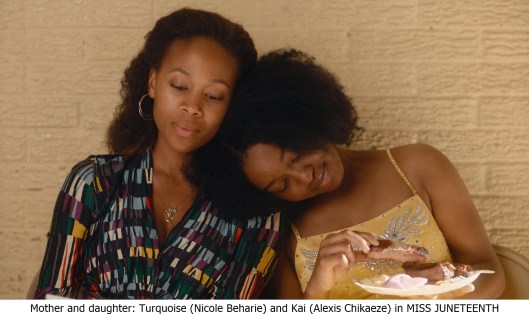 42‘s Nicole Beharie and newcomer Alexis Chikaeze deliver incandescent turns as mother and daughter in writer/director Channing Godfrey Peoples’ arresting feature debut. Using a small Texas town’s Miss Juneteenth pageant as the lens from which to view a complicated parent-and-child relationship and a mom’s attempt to secure her progeny’s future, Peoples limns an indelible portrait of family and community life.
 There is a sizeable cast in director/co-writer Patrick Vollrath’s breathtaking feature debut, set on a flight from Berlin to Paris in mostly real time, but only one actor who really counts: Joseph Gordon-Levitt as the flight’s co-pilot Tobias, an ordinary man thrust into extraordinary circumstances. Hijacking dramas are nothing new but this is not the stuff of a Steven Seagal or Kurt Russell movie. 7500 is not an action picture, but rather a slow-burn psychological thriller in which the hero’s defining trait is an ability to hold fear at bay on the worst day of his life.
 Family, syn., blood, clan, kin, linage, tribe. Disappearance, syn., loss, concealment, hiding. Eccentric, syn., bizarre, erratic, off-kilter, off-the-wall, peculiar. Family, disappearance, and eccentric and their synonyms are words at the heart of this offbeat British melodrama in which an online Scrabble game reenergizes a father’s search for a long-lost son even as it stirs resentment in the child who remained home. Sometimes Always Never flirts with being twee (syn., cutesy, cloying, gooey), but never quite crosses that line, thanks to welcome doses of humor and assured performances form stars Bill Nighy and Sam Riley.





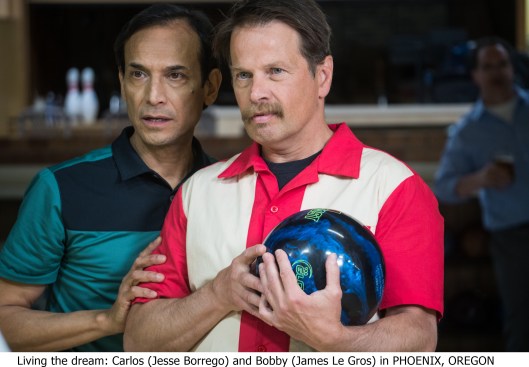 Two middle-aged men decide to take a chance on themselves, swapping their dead-end lives for a shot at controlling their own destiny in an affable comedy that stars James Le Gros and Jesse Borrego. A throwback of sorts, Phoenix, Oregon tonally fits the types of indies Borrego (Lone Star, I Like it Like That) and especially Le Gros (Living in Oblivion, Floundering) made back in the 1990s, big-hearted and full of idiosyncratic characters.
 Most of us would be appalled to win a prize called “Asshole of the Year.” In general, no one wants to be that asshole. But in Coky Giedroyc’s acerbically funny adaptation of Caitlin Moran’s novel How to Build a Girl, rock scribe Johanna Morrican aka Dolly Wilde (Beanie Feldstein) accepts the dubious honor exultantly as a measure of her success. The bullied has become the bully and it feels good – a momentary rush inside the fantasy Johanna’s built for herself until stark reality intrudes in a comedy that tracks where one teenager’s inchoate ambition to be freed of her circumstances leads.

