• About

Cinezine Kane

Cinezine Kane

Category Archives: Reviews

Cold War thrilling: BRIDGE OF SPIES

15 Thursday Oct 2015

Posted by cinepam in Reviews

≈ Leave a comment

Tags

Bridge of Spies, Mark Rylance, Steven Spielberg, Tom Hanks

bridge-of-spies

Bridge of Spies begins with a man, later revealed as Rudolph Abel (Mark Rylance), using a mirror to paint a self-portrait. It is a simple image of an artist at work, an ordinary guy, but as he steps out of his studio in Manhattan’s Fulton Fish Market area circa 1957, he picks up the first of several tails. Appearance can be deceiving. It’s a subtle and powerful start to what is Steven Spielberg’s most satisfying film in years, a Cold War thriller inspired by actual events.

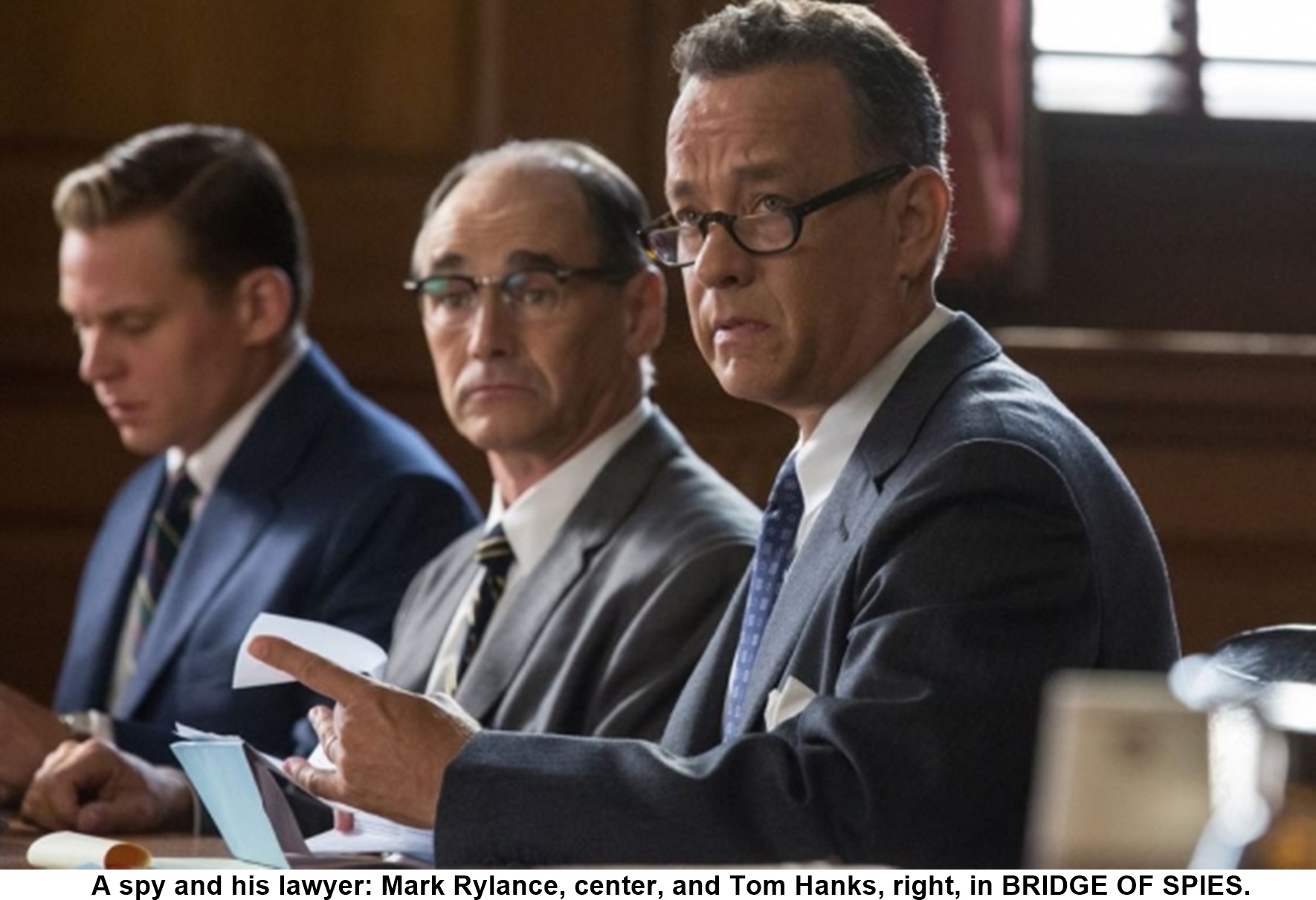
By now, you’ve probably seen the trailer where Tom Hanks’s character James B. Donovan avers, “I’m an insurance lawyer,” this his initial answer when he is asked to defend Abel after he’s arrested as a Soviet spy. The reality is not so simple. Donovan was on the prosecution team at the Nuremberg war crimes trials. He is also a crafty litigator. Pay attention when he debates definitions of an accident with an opposing counsel in an early scene, because his philosophy in the realm of car crashes extends to foreign policy. Donovan is exactly the right man for the job he’s been asked to do, but not in the way the people who recruit him to do it—including his law partner Thomas Watters Jr. (Alan Alda)—mean it. They simply want Donovan to give a respectable sheen to a done deal—see, in America, even a filthy Russian operative gets a fair shake in court, too bad he got the electric chair—but Donovan doesn’t see it that way. He maybe reluctant to take the case, but once he’s in, he approaches Abel like any other client in need of his services. One of the delights of Bridge of Spies is watching Hanks and Rylance together and watching that wary relationship change over time.

And if the Soviets hadn’t shot down pilot Francis Gary Powers (Austin Stowell) and his U-2 spy plane in 1960, Donovan and Abel’s place in history might have ended with his trial. But with each side holding one of the other’s agents and those men being privy to state secrets, a prisoner exchanges seems prudent. Donovan is once again pressed into service and sent to East Germany to broker the deal. He has his marching orders from the US government. The Soviets have their own expectations. But Donovan, like Spielberg, is a big-picture guy and he has his own ideas about the negotiations going in, turning a simple exchange into a high-stakes gamble.

The film could use a less of Thomas Newman’s saccharine score, and while the script—credited to Matt Charman and Joel and Ethan Coen—dials back on Spielberg’s usual sentimentality, it’s still there, particularly in relation to Donovan’s family. Amy Ryan plays Donovan’s wife, Mary, and it’s always great to see her, but with little to do other than worry over her husband and beg him to put their family first, Mary is a thankless role. It’s easy to overlook those minor flaws, though, particularly when Donovan is in the heat of negotiations and the stakes seem higher than just prisoners gaining their freedom and getting to go home or in any scene with Donovan and Abel. Mostly, Bridge of Spies is tense and thrilling in a way that few films are now, the suspense arising not from pointed guns but from people talking—what they say and what they don’t. It’s almost a throwback to certain spy thrillers of the ’60s and ’70s and a welcome return.—Pam Grady

Share this:

  • Share on Facebook (Opens in new window) Facebook
  • Share on X (Opens in new window) X
  • Email a link to a friend (Opens in new window) Email
  • Print (Opens in new window) Print
  • Share on LinkedIn (Opens in new window) LinkedIn
  • Share on Tumblr (Opens in new window) Tumblr
  • Share on Reddit (Opens in new window) Reddit
  • Share on Pinterest (Opens in new window) Pinterest
Like Loading...

Down in the depths with CRIMSON PEAK

15 Thursday Oct 2015

Posted by cinepam in Reviews

≈ Leave a comment

Tags

Charlie Hunnam, Crimson Peak, Guillermo del Toro, Jessica Chastain, Jim Beaver, Mia Wasikowska, Tom Hiddleston

Crimson Peak

“Is this Rebecca or Notorious?” a friend whispered at a certain point while watching Guillermo del Toro’s new ghost story Crimson Peak. It’s a little of both, plus Suspicion, Psycho, Shadow of a Doubt, and probably more of the Hitchcock canon. Del Toro paying homage to Hitchcock and adding his own supernatural twist—think Devil’s Backbone—ought to be a glorious thing, but instead despite a thoroughbred cast, gorgeous production design, and exquisite cinematography, the whole thing collapses under the weight of its own silliness. Fans hoping for a return to del Toro’s Pan’s Labyrinth form are in for a disappointment.

The trouble with Crimson Peak is that it is one of those films that is entirely dependent on otherwise smart characters turning suddenly stupid. That Thomas Sharpe (Tom Hiddleston), a penniless baronet who comes to 1901 Buffalo, NY, ostensibly to raise funds for a new mining process to extract rich red clay from beneath his land, would turn Edith Cushing’s (Mia Wasikowska) head is understandable. He is handsome and charming and is the only person besides her industrialist father (Jim Beaver) and childhood friend, Dr. Alan McMichael (Charlie Hunnam), who takes her writing ambitions seriously.

But besotted as she is, it’s hard to fathom why Edith finds nothing creepy about Thomas’ possessive sister Lucille (Jessica Chastain) or why—once the action moves to England—she would agree to stay in complete isolation in a crumbling house where she observes that it’s colder inside that it is outside. Evil doesn’t even have to be lurking. Edith is a literate woman. She’s surely read the Brontes and knows what happened to those women, and Allerdale Hall, the Sharpe family estate, has all the earmarks of a conduit to death by consumption. As it happens, something is amiss with the Sharpe siblings and their grandly decaying home, but even with ghosts crawling out of the walls and her growing suspicion that something is not right with Lucille, Edith stays put. She’s smarter than that and she’s a woman of means, so what gives?

As one incident piles on another, Crimson Peak doesn’t just jump one shark, but an entire school of them. Any film that incorporates del Toro’s own supernatural obsessions and this much Hitchcock in it ought to at least be suspenseful. Instead, moments clearly meant to frighten an audience, invite howls of laughter. Casting Hiddleston and Wasikowska together only invites memories of Only Lovers Left Alive, and makes one yearn for Jim Jarmusch’s offbeat sensibility. One wonders what he might have done with this material. Perhaps Jarmusch would have been kinder to Chastain, who couldn’t be more cartoonish if she was playing Jessica Rabbit. Del Toro set the bar high for himself like The Devil’s Backbone and Pan’s Labyrinth. In not reaching those lofty heights, Crimson Peak is a tremendous letdown.–Pam Grady

Share this:

  • Share on Facebook (Opens in new window) Facebook
  • Share on X (Opens in new window) X
  • Email a link to a friend (Opens in new window) Email
  • Print (Opens in new window) Print
  • Share on LinkedIn (Opens in new window) LinkedIn
  • Share on Tumblr (Opens in new window) Tumblr
  • Share on Reddit (Opens in new window) Reddit
  • Share on Pinterest (Opens in new window) Pinterest
Like Loading...

MISSISSIPPI GRIND: A winning gamble

02 Friday Oct 2015

Posted by cinepam in Reviews

≈ Leave a comment

Tags

Anna Boden, Ben Mendelsohn, California Split, Mississippi Grind, Robert Altman, Ryan Fleck, Ryan Reynolds

MSG_D11_0045_rgbMississippi Grind, the latest from Ryan Fleck and Anna Boden (Half Nelson, Sugar), is getting a lot of props for the way it evokes the rhythms and naturalism of the best films of the storied ‘70s. And it does—and should, since it borrows so liberally from Robert Altman’s 1974 drama California Split, another tale of degenerate gamblers meeting over cards and forming a fast friendship. That doesn’t take anything away from Mississippi Grind, which is a sharp character study and a gift to stars Ben Mendelsohn and Ryan Reynolds, but let’s give credit where credit is due.

The characters played by George Segal and Elliott Gould in Altman’s film were more up-market and could afford their addictions—at least, up to a point. The same cannot be said for Gerry (Mendelsohn), a down-at-the-heels real estate agent, and Curtis (Ryan Reynolds), a well-heeled drifter whose habit of ordering top-shelf bourbon masks a threadbare life. When they meet over a poker game in a Dubuque, Iowa bar—Gerry lives in the town, Curtis is just passing through—it seems like fate. Gerry, who is as addicted to a CD lecture on the subject of “tells” as he is to gambling, sees it as a sign that both of them are the only ones at the table who noticed a rainbow the day before. Subsequent events only confirm a cosmic connection between them in his mind and he begins to see handsome, strapping Curtis—who towers over his own diminutive self—as his personal lucky leprechaun. The pot of gold at the end of their personal rainbow is a card game in New Orleans with a $25,000 buy-in. Not that they have the money, but they figure they can earn it gambling their way down south in a road trip built on sheer bravado.

There is nothing that happens on Gerry and Curtis’s journey that could not be predicted. They are, after all, compulsive gamblers. Their greatest skill is in in self-delusion, but they are no slouches when it comes to lying or stealing to further their agendas. Gerry is the needier of the two, desperate to get out from under the mess he’s made of his life and buying into Curtis’s elaborate stories. These guys don’t just have a lot of baggage. They have great big steamer trunks of past mistakes, present disasters, and future cataclysms strapped to their backs, but despite that—or maybe because of it—genuine feelings form between them. One of the great joys of Mississippi Grind is watching that relationship unfold even in moments when one or the other seems intent on screwing the other over. Aussie actor Mendelsohn (Animal Kingdom, The Place Beyond the Pines) and Reynolds, in his meatiest role since 2007’s The Nines, are terrific as two beautiful losers who’ve always been willing to wager on anything, now betting—for a while, at least—on each other.

As they demonstrated with Half Nelson and Sugar, Fleck and Boden have an unerring feel for mood and place and that does not fail them here. Bars, card rooms, racetracks, casinos, and the meandering Mississippi are Gerry and Curtis’s natural habitat. That milieu, exquisitely photographed by the directors’ frequent collaborator, cinematographer Andrij Parekh, itself speaks volumes about these men. The filmmakers may have started with an idea cadged from Robert Altman, but as they layer on detail after detail, they eventually transform the story into a tawdry yet somehow gorgeous portrait of these two men’s lives. Like Gerry and Curtis, they aren’t above a little larceny, but like their protagonists, their hearts are in the right place. The payoff is a movie as transcendent as Mississippi Grind. And that’s huge.—Pam Grady

Share this:

  • Share on Facebook (Opens in new window) Facebook
  • Share on X (Opens in new window) X
  • Email a link to a friend (Opens in new window) Email
  • Print (Opens in new window) Print
  • Share on LinkedIn (Opens in new window) LinkedIn
  • Share on Tumblr (Opens in new window) Tumblr
  • Share on Reddit (Opens in new window) Reddit
  • Share on Pinterest (Opens in new window) Pinterest
Like Loading...

Ultimate cool cat comes to SF: Jeff Goldblum at Feinstein’s

30 Sunday Aug 2015

Posted by cinepam in Reviews

≈ Leave a comment

Tags

Dan Feiszli, Feinstein's at Hotel Nikko, James King, Jeff Goldblum, John Storie, Kenny Elliott, Lincoln Adler, Mildred Snitzer Orchestra

buckaroo 2

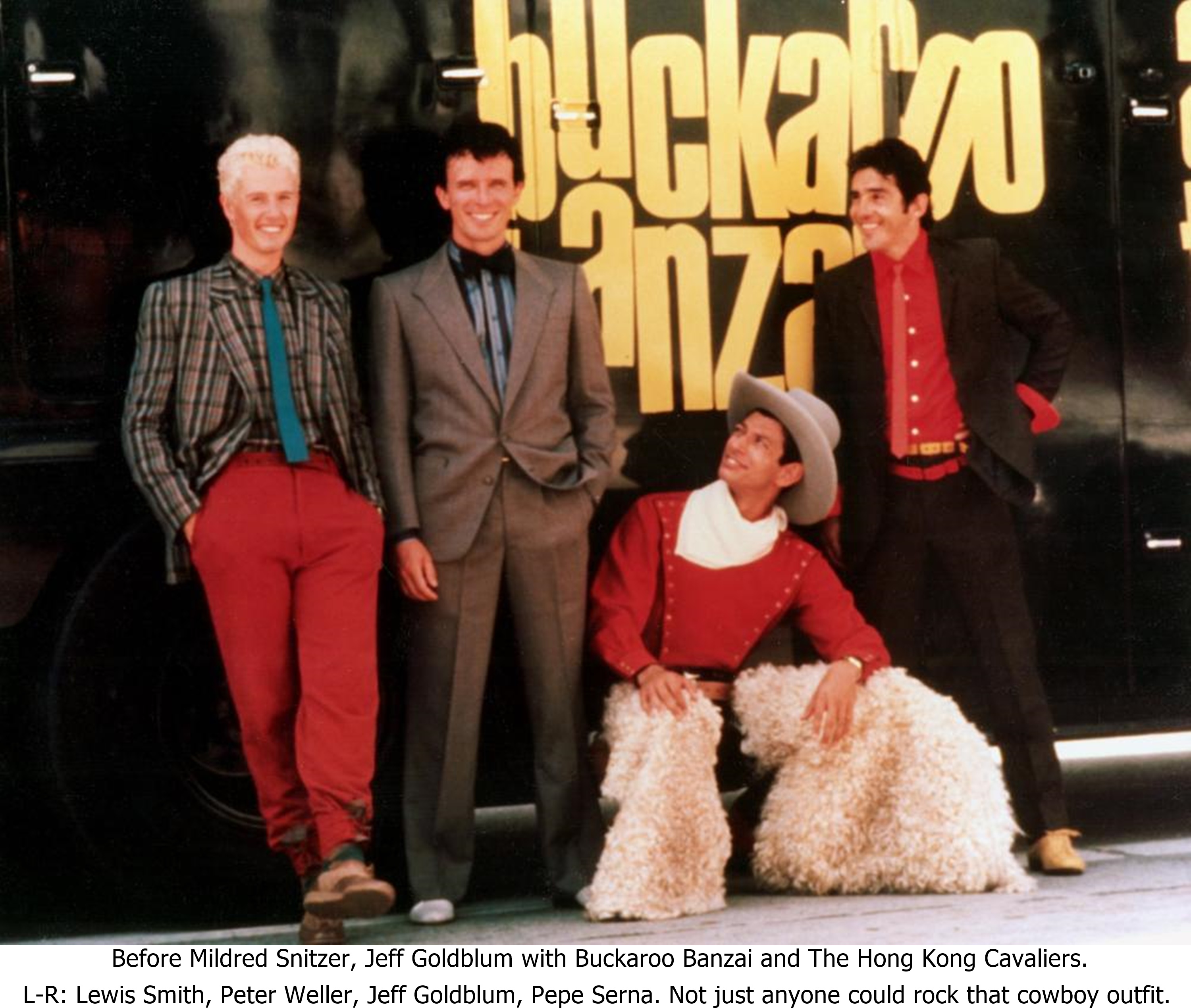
Jeff Goldblum has a seven-week-old son at home, but if he’s feeling the exhaustion of a new parent, he hides it well during the final performance of his weekend engagement at San Francisco’s Hotel Nikko. The headliner at Feinstein’s cabaret, the 62-year-old pianist and his jazz band, The Mildred Snitzer Orchestra—guitarist John Storie, tenor saxophonist James King,  and drummer Kenny Elliott, and joined this evening Bay Area musicians, bassist Dan Feiszli and saxophonist Lincoln Adler—have already played one show earlier in the evening before taking the stage again at 10pm.

Well, technically, the show starts at 10pm, but Goldblum begins working the room a good 20 minutes before that, playing a kind of six-degrees-of-Jeff-Goldblum movie trivia game and chatting with fans. His conversation is free form: He hates stays in his collars and always removes them from his shirts. (He had sent out his white shirt to be cleaned at the hotel and was amused/bemused that it come back with stays inserted.) He thinks he looks like a Jewish school student in his classic black suit, glasses, and porkpie hat. At one point, he asks for someone to name a standard. I call out “Stardust,” and he sings the Hoagy Carmichael classic a cappella to my section at the very back of the room.

Throughout the evening, Goldblum will digress with movie trivia (San Francisco edition and quotes); debate with fans who ask him if he prefers noodles or sandwiches, but who muddy the water by insisting pizza is a sandwich (Goldblum disagrees); chat with songwriter Dick Holler, the writer of Dion’s ‘60s hit “Abraham, Martin and John,” when the man’s companion points him out at the front of the stage; and in general, play the bandleader and show host delivering on his promise to keep his audience entertained.

With his mix of bonhomie and ineffable cool, Goldblum is the consummate showman. Not that The Mildred Snitzer Orchestra needs him to be that. When the band gets down to business, they are all business. Playing regular gigs at Rockwell Table and Stage in Los Angeles, they’ve honed themselves into a tight, soulful outfit. An elegant, intimate room like Feinstein’s suits the ensemble well, whether doing Thelonious Monk proud or performing an impromptu cover of Billy Joel’s “Just the Way You Are.”

Being out among people, Goldblum is in his element. The show ends up with a rendition of the Duke Ellington standard “Caravan” that is both awesome and epic, allowing very member of the outfit a moment. But it’s not over for the actor/musician, who stations himself in the middle of the room for pictures, autographs, or to just mingle with any fan who approaches him. It’s a long line, he’s been hard at it for two hours or more, and he’s still as energetic and even-keeled as ever. There are cool cats. Then there’s Jeff Goldblum.—Pam Grady

Share this:

  • Share on Facebook (Opens in new window) Facebook
  • Share on X (Opens in new window) X
  • Email a link to a friend (Opens in new window) Email
  • Print (Opens in new window) Print
  • Share on LinkedIn (Opens in new window) LinkedIn
  • Share on Tumblr (Opens in new window) Tumblr
  • Share on Reddit (Opens in new window) Reddit
  • Share on Pinterest (Opens in new window) Pinterest
Like Loading...

Pastoral thriller: TOM AT THE FARM

16 Sunday Aug 2015

Posted by cinepam in Reviews

≈ Leave a comment

Tags

Evelyyne Brochu, Gabriel Yared, Lise Roy, Pierre Yves-Cardinal, Tom at the Farm, Xavier Dolan

08-TOM-AT-THE-FARMA young man reeling after his lover dies travels to a remote farm to pay his respects to the family and finds himself in a twilight zone of anger, grief, and denial, and seemingly powerless to leave, in Xavier Dolan’s Tom at the Farm. Made between Laurence Anyways and Mommy, this adaptation of a play by Michel Marc Bouchard with a screenplay by Dolan and Bouchard, is a compact, terrifically creepy psychological thriller made all the more disturbing by Tom’s passivity and its seemingly serene bucolic setting.

Tom (a bleached blond Dolan) is in for a couple of shocks when he arrives at the farm. The first is that apparently his lover, Guillaume, never told his mother Agathe (Lise Roy) that he was gay. Instead, she rails against the absent Sarah, the woman she believes to be her son’s girlfriend. The second is Francis (Pierre Yves-Cardinal), the brother Guillaume never told Tom he had, a glowering brute that, as becomes apparent at the funeral, the entire town avoids. The relationship between Francis and Tom is dangerous from the start. Intimidating and terrorizing others are as natural to Francis as breathing, and Tom is his special project. That there really is a Sarah (Orphan Black’s Evelyne Brochu) further complicates matters.

Why Tom puts up with what Francis dishes out is part of the mystery. There is little hint to his and Guillaume’s backstory, beyond the fact that at least one of them was good at keeping secrets, and little to indicate what Tom is like in his daily life in Montreal when his judgment is not clouded by grief. For now, he is rooted to the spot. He could flee from Francis’ bullying and brutality, but it is almost as if he is mesmerized by the man’s cruelty. And despite Francis’ evident homophobia, there is an erotic charge between the hulking farmer and the petite city slicker that makes the situation that much more combustible.

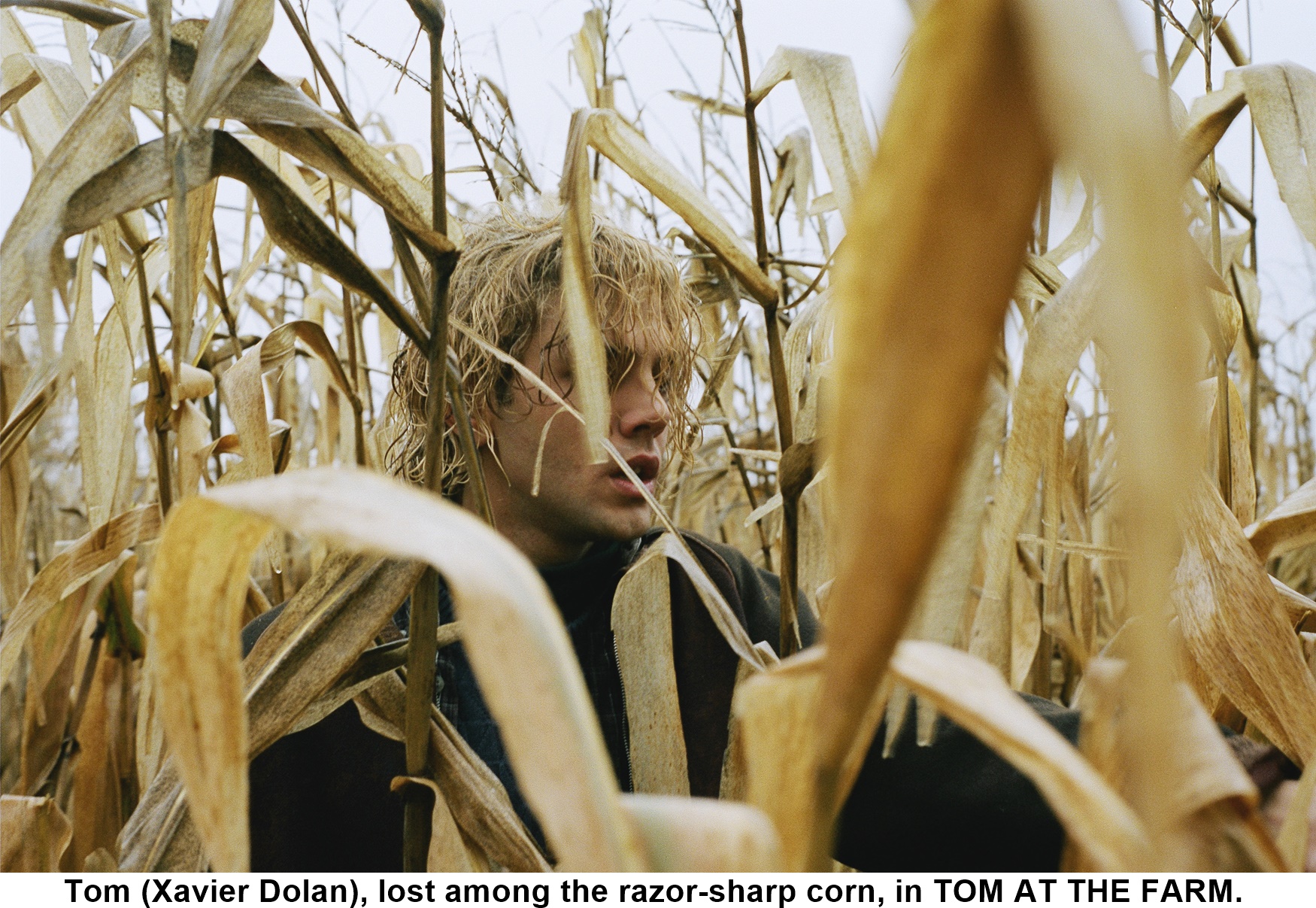
Despite opening the play up to encompass the entire property (including a cornfield where the withered plants’ leaves are razor-sharp) and forays into town, the overriding feeling of Tom at the Farm is one of claustrophobia, which only amps up the tension as Tom becomes more and more ensnared into this unhealthy household. Dolan sets a dolorous tone from the opening scene as Tom drives to the farm and an a capella version of Michel Legrand’s “Les moulins de mon cœur” (better known to English-speaking audiences as “The Windmills of Your Mind”) plays on the car stereo, while Gabriel Yared’s evocative score continually amps the tension. Ray, who originated the role of Agathe on the stage, and Brochu are both terrific, but the drama hinges on the relationship between the two men. Yves-Cardinal strikes the right note of danger as the unsettling, possibly unhinged Francis, and Dolan did not cast himself purely out vanity or economic necessity. He’s pitch-perfect as a man out of sorts and out of balance seemingly reacting to his situation out of pure, if faulty, instinct.

Like Joel Edgerton’s recent The Gift, Tom at the Farm is a corker of a thriller that extracts chills from the collision of personalities and the machinations of an unstable individual. These are dramas of the everyday, the mundane, and all the more distressing for it. What happens to Tom could happen to anybody.—Pam Grady

Share this:

  • Share on Facebook (Opens in new window) Facebook
  • Share on X (Opens in new window) X
  • Email a link to a friend (Opens in new window) Email
  • Print (Opens in new window) Print
  • Share on LinkedIn (Opens in new window) LinkedIn
  • Share on Tumblr (Opens in new window) Tumblr
  • Share on Reddit (Opens in new window) Reddit
  • Share on Pinterest (Opens in new window) Pinterest
Like Loading...

Stylish, shiny, and pointless: THE MAN FROM U.N.C.L.E. reboot

13 Thursday Aug 2015

Posted by cinepam in Reviews

≈ Leave a comment

Tags

Alicia Vikander, Armie Hammer, Guy Ritchie, Henry Cavill, Hugh Grant, The Man from U.N.C.L.E.

UNCLE

Guy Ritchie should pay his production designer, cinematographer, and art and costume departments boatloads of money. They make his films look so great. The Man from U.N.C.L.E. is a case in point. Look at it too closely and it’s possible to convince yourself that when Shakespeare wrote those immortal words in Macbeth, “full of sound and fury, signifying nothing,” he was anticipating Ritchie. There’s a lot of action, but not much point to the director’s reboot of the 50-year-old TV series, but it looks dazzling. It’s the movie equivalent of presents sitting under a Christmas tree, the gorgeous wrapping promising so much and delivering…socks.

In this origin tale, CIA agent Napoleon Solo (Henry Cavill) and KGB agent Illya Kuryakin (Armie Hammer, wrestling mightily and not always successfully with a thick Russian accent) meet cute when Kuryakin trails Solo to a meeting with East German mechanic Gaby (It Girl of the moment Alicia Vikander), who Solo plans to get over the Berlin Wall. Solo is a spy, but only because he’s been blackmailed into service after being caught out as a black marketeer after World War II. (Does this mean that Solo is really The Third Man’s Harry Lime?) Kuryakin is a whiz at planting bugs, but he’s a hitter who is most comfortable in hand-to-hand combat. The two men hate each other—clearly the start of a beautiful friendship as their respective handlers insist they partner up and work with Gaby to bring down a conspiracy involving Nazis, rich Italians, a nuclear bomb, a computer disc, and Gaby’s atomic scientist dad.

Vikander is the best thing going in the movie. Given the chance to demonstrate her comic chops, she steals every scene she’s in, particularly one where she tries to drunkenly seduce Kuryakin. Cavill does what he can with a character that is all style and no substance, but at least he’s not stuck like poor Hammer playing someone who substitutes feats of strength for a personality. Hugh Grant makes a welcome appearance as Waverly, a man who is a complete mystery to Solo and Kuryakin, but not to anyone who has seen the original TV series. Expect to see much more of him if sequels ensue.

If The Man from U.N.C.L.E. should beget a franchise, maybe Ritchie should invest in hiring better screenwriters. The script he collaborated on with producer Lionel Wigram is a collection of spy movie clichés. There is a lot of action, a lot of chases, a touch of romance, plenty of double-dealing, and the obligatory torture scene and not a frame of it is original. It is pretty and pretty empty. The cast—and movie audiences—deserve better than this empty exercise in style.—Pam Grady

Share this:

  • Share on Facebook (Opens in new window) Facebook
  • Share on X (Opens in new window) X
  • Email a link to a friend (Opens in new window) Email
  • Print (Opens in new window) Print
  • Share on LinkedIn (Opens in new window) LinkedIn
  • Share on Tumblr (Opens in new window) Tumblr
  • Share on Reddit (Opens in new window) Reddit
  • Share on Pinterest (Opens in new window) Pinterest
Like Loading...

Jemaine Clement nurses broken heart in PEOPLE PLACES THINGS

13 Thursday Aug 2015

Posted by cinepam in Reviews

≈ Leave a comment

Tags

James C. Strouse, Jemaine Clement, Jessica Williams, People Places Things, Regina Hall, Stephanie Allynne

people-places-things

When last seen on American screens, Jemaine Clement was gleefully ripping into flesh as a Kiwi vampire in What We Do in the Shadows. That character’s razor-sharp incisors would have come in handy for his new role as a heartbroken comic-book artist and single dad in James C. Strouse’s comedy drama People Places Things who is too accommodating by half in accepting whatever fate (or his ex-wife) throws at him. This is a guy who could use a little bite.

But destiny isn’t done with Clement’s Will Henry yet. A year after his marriage to Charlie (Stephanie Allynne) imploded on their twin daughters’ fifth birthday, she’s moved on, ensconced with her portly monologist lover Gary (Michael Chernus) and finding herself through improv classes. But Will is spinning his wheels, still mourning the loss of his settled family life; working as a teacher as well as an artist; stuck in a crappy apartment in Astoria, Queens; perpetually short on funds; and missing daily contact with his little girls. One of his students, Kat (Jessica Williams), identifying his loneliness, sets him up on a date with her mother, Columbia American lit professor Diane (Regina Hall), an awkward evening to add to his sense of futility.

Strouse previously made the John Cusack vehicle Grace is Gone, a road movie that similarly dealt with a husband and father of daughters shocked to find himself suddenly a single dad. People Places Things is a lighter affair, buoyed by Will’s basic decency and the sense of humor that never quite deserts him even at the worst of times. Clement delivers a warm, affable performance as the beleaguered Will, and he receives great support from Williams, Hall, and the adorable kids playing his daughters, Gia and Aundrea Gadsby. Composer Mark Orton’s (Nebraska) score adds one layer of whimsy, while cartoon panels that reflect Will’s predicament adds another. People Places Things is a small film, but it’s one with immense heart.—Pam Grady

Share this:

  • Share on Facebook (Opens in new window) Facebook
  • Share on X (Opens in new window) X
  • Email a link to a friend (Opens in new window) Email
  • Print (Opens in new window) Print
  • Share on LinkedIn (Opens in new window) LinkedIn
  • Share on Tumblr (Opens in new window) Tumblr
  • Share on Reddit (Opens in new window) Reddit
  • Share on Pinterest (Opens in new window) Pinterest
Like Loading...

FANTASTIC Bore

07 Friday Aug 2015

Posted by cinepam in Reviews

≈ Leave a comment

Tags

Fantastic Four, Jamie Bell, Kate Mara, Michael B. Jordan, Miles Teller, Toby Kebbell

FF1

Fantastic Four has a thoroughbred cast—Miles Teller as Reed Richards, Jamie Bell as Ben Grimm, Michael B. Jordan as Johnny Storm, and Kata Mara as Sue Storm—but they are saddled with a script worthy only of nags. The latest reboot of the Marvel franchise is an origins story that is practically stillborn, a tale that spends more time with the construction of a teleporting machine than it does giving the quartet anything “fantastic” to do.

This is an adventure story in search of an adventure, which it only finds well into its third act, long after it is possible to care about the characters or what happens to them. At that point, angered that government suit Dr. Allen (Tim Blake Nelson) wants to take their toy and give it to NASA, Reed, Johnny, and arrogant cohort Victor Von Doom (Toby Kebbell), with Reed’s childhood BFF Ben in tow, suit up and make a drunken journey to the far-off world their lab monkey so recently visited. Depending on one’s viewpoint about body-altering superpowers, the trip is a disaster, particularly for poor Ben who becomes the rock creature The Thing. Billy Elliot will never dance again.

Naturally, the government sees the military potential for a big rock man who can smash whole battalions to pieces in a matter of minutes; generate fire as Johnny now can; make like a human Stretch Armstrong like Reed; and become invisible and create force fields like Sue. And naturally, Victor, thought dead, isn’t. He reappears with the greatest superpower of them all—a really bad attitude. At last, some action! Too little, too late. Aside from the endless set-up, there are too many not-so-special-effects, and way too much bad dialogue:

Reed: “You were my best friend.”

Ben: “Look at me. I’m not your friend. You turned me into something else.”

Reed: “Yes. Now, you’re my pet rock.”

OK, that last line is made up, but those are the kinds of things that get jotted down in the dark when the promised action movie turns out to be something far drearier. Fantastic Four isn’t a Marvel movie. An anti-Marvel movie is more like it, a cynical exercise to cash in on a beloved franchise.—Pam Grady

Share this:

  • Share on Facebook (Opens in new window) Facebook
  • Share on X (Opens in new window) X
  • Email a link to a friend (Opens in new window) Email
  • Print (Opens in new window) Print
  • Share on LinkedIn (Opens in new window) LinkedIn
  • Share on Tumblr (Opens in new window) Tumblr
  • Share on Reddit (Opens in new window) Reddit
  • Share on Pinterest (Opens in new window) Pinterest
Like Loading...

RICKI AND THE FLASH: Great bar band in search of a better script

07 Friday Aug 2015

Posted by cinepam in Reviews

≈ Leave a comment

Tags

Audra McDonald, Jonathan Demme, Kevin Kline, Mamie Gummer, Meryl Streep, Rick Springfield, Ricki and The Flash

Ricki 2

Poor Rick Springfield. He must have thought he struck gold when he was cast in Ricki and The Flash opposite the doyenne of American movies, Meryl Streep, in a film directed by Jonathan Demme and written by Diablo Cody, Oscar winners all. For the frosting on the cake, the supporting cast includes Streep’s daughter Mamie Gummer, Kevin Kline, and Broadway diva Audra McDonald. This should have been another high point to Springfield’s career, at least as satisfying for him as his soap stardom on General Hospital and his 1981 number one, Grammy-winning hit, “Jessie’s Girl.” With all of the talent involved, Ricki must have seemed like a can’t-miss. But, man, does it ever.

Springfield has nothing to be ashamed of. He is one of the best parts of the film, delivering an effective performance and providing the movie with a sorely needed dose of charisma. He plays Greg to Streep’s Ricki, her guitar player and lover that she takes for granted both on stage and off. Once upon a time, she was apparently an upper-middle-class wife and mother in Indiana, but gave it all up to pursue rock stardom in California. Now 60-something, she’s estranged from her kids and ekes out a bare-bones income as a grocery cashier and lives for the nights when she sings covers at the bar where she and the Flash are the house band.

Despite the fact that her kids can’t stand her, her ex-husband Pete (Kline) gets the bright idea to fly her out to Indiana to deal with their daughter, Julie (Gummer), who has moved back home and sunk into depression after the break-up of her marriage. His wife, Maureen (McDonald), is away and he doesn’t feel equipped to handle Julie. That brings Ricki back into her family’s orbit and eventually to her son Joshua’s (Sebastian Stan) wedding. And none of it seems real. Not the manufactured family relationships or the ersatz family trauma or character behavior at odds with the real world. (Greg asking if the drinks are free at Joshua’s nuptials is one small example. Surely, even an aging, down-market rocker is familiar with the concept of an open bar. He’s been to weddings. He’s probably played a few and been a groom himself a time or two.) Most of the time, Ricki and The Flash plays like an overlong sitcom of the type that undercuts its tacky humor with sentimentality.

Perhaps predictably, for a movie coming from Demme and named for a band, the movie’s most engaging moments are when Ricki is on stage. The director whose oeuvre includes The Talking Heads film Stop Making Sense, several collaborations with Neil Young, and other music docs, is an ace at shooting performance and he captures the excitement and joy of musicians going about their business. The songs—that range from classics like “Drift Away,” the ballad made famous by Dobie Gray that becomes a duet for Ricki and Greg, to newer material like Pink’s “Get the Party Started,” performed to appeal to the bar’s younger drinkers—are well-chosen. Streep sings well and learned to play guitar for the film. Best of all, Demme surrounds her with ringers that include, in addition to Springfield, drummer Joe Vitale, keyboard player Bernie Worrell, and late bassist Rick Rosas. If Ricki was a real person, she would not be able to believe her luck at such at outfit. When The Flash is on stage, the movie is enchanting. They aren’t on stage often enough. –Pam Grady

Share this:

  • Share on Facebook (Opens in new window) Facebook
  • Share on X (Opens in new window) X
  • Email a link to a friend (Opens in new window) Email
  • Print (Opens in new window) Print
  • Share on LinkedIn (Opens in new window) LinkedIn
  • Share on Tumblr (Opens in new window) Tumblr
  • Share on Reddit (Opens in new window) Reddit
  • Share on Pinterest (Opens in new window) Pinterest
Like Loading...

THE END OF THE TOUR: Epic conversation makes for riveting drama

07 Friday Aug 2015

Posted by cinepam in Reviews

≈ Leave a comment

Tags

Although Of Course You End Up Becoming Yourself, David Foster Wallace, David Lipsky, Infinite Jest, James Ponsoldt, Jason Segel, Jesse Eisenberg

End of the Tour 1

You have to wonder what David Foster Wallace was thinking when he consented to have Rolling Stone journalist David Lipsky following him for five days in 1996 as he wrapped up his Infinite Jest book tour. Of course, it was a different world then. The internet was just starting to make inroads to world domination. Print was still king and Lipsky’s employer was a player. Whatever the reason, Wallace agreed to the epic interview. It never appeared in the magazine, but after Wallace committed suicide in 2008, Lipsky turned it into a book, Although OF Course You End Up Becoming Yourself. It is that book that serves as the basis of Spectacular Now director James Ponsoldt’s riveting new drama The End of the Tour.

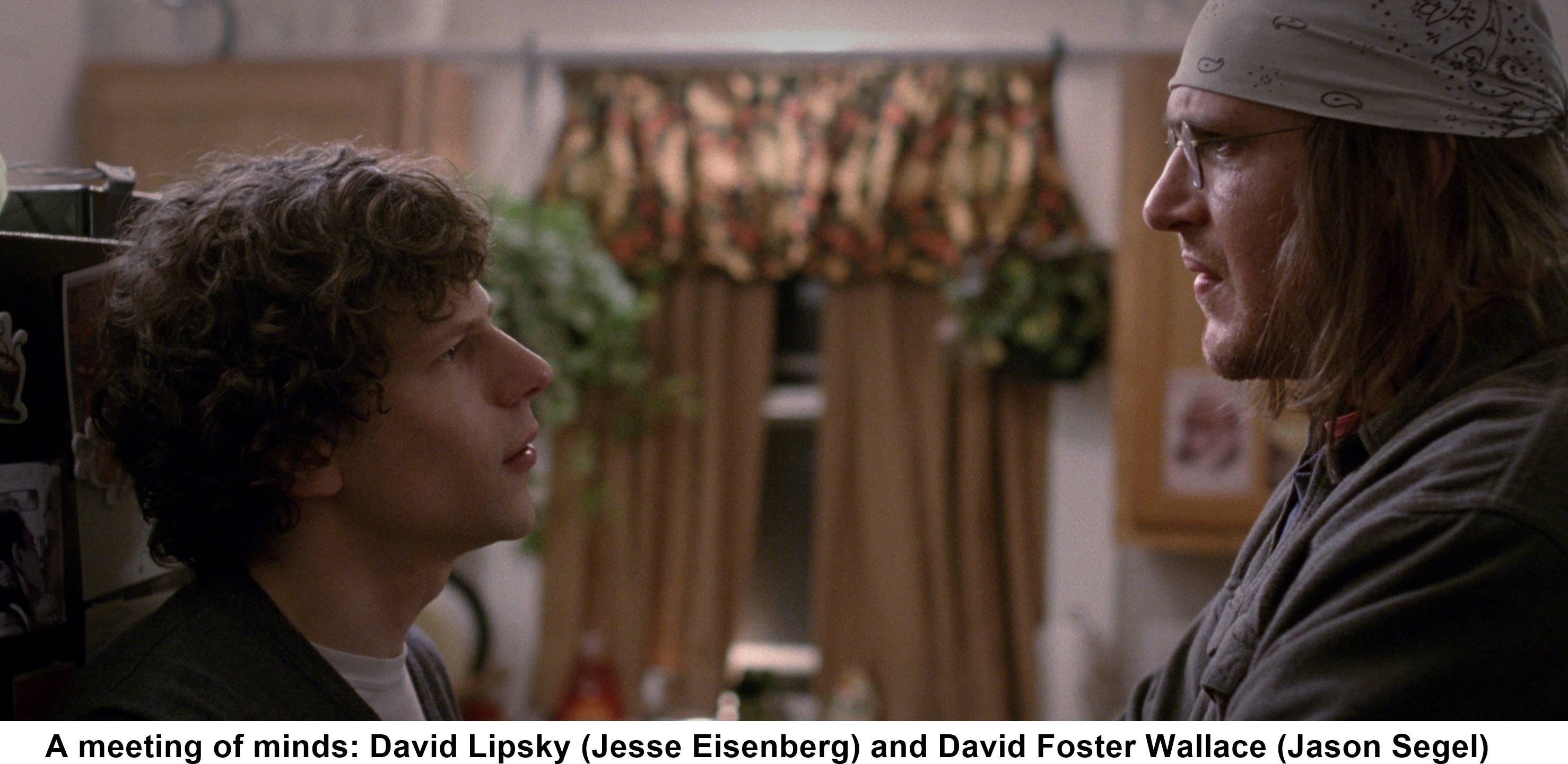
Jason Segel is perfectly cast as Wallace, enjoying and enduring the kind of success most writers never experience. Infinite Jest was one of those books that only comes along only once or twice in a generation, one that doesn’t just make an impact on critics and readers, but also on other writers. Lipsky (Jesse Eisenberg) understands that. It’s one of the reasons he pitches the interview to his editor (Ron Livingston). But he is also both in awe and jealous of Wallace’s achievement. Lipsky himself has just published a novel, The Art Fair, to good reviews but little fanfare. Both men are whip-smart and competitive. Wallace is a little freaked out by the enormity of his success, counting the days until the tour ends, and now he has to deal with a reporter coming at him with the dogged determination of a zealous puppy nipping at his ankles. (Whatever the size differential between Wallace and Lipsky might have been in real life, the fact that Segel towers over the diminutive Eisenberg adds another layer of complication to the relationship that develops between the two men.)

Directing his Yale playwriting teacher Donald Margulies’ screenplay, Ponsoldt sets the stage as close to reality as possible, right down to shooting in northern Michigan in the frigid winter of 2014 mirroring the conditions of the 1996 interview. Just looking at the screen in some scenes can raise goosebumps. And with that stage set, Ponsoldt lets his actors loose. Under other circumstances, the two Davids might have become friends. They have enough in common, but between Lipsky’s barely concealed envy, Wallace’s wariness, and the differences in their stations in life, that just isn’t the cards. For five days, they make do with sometimes brilliant banter. The actors are both spot-on in their performances, but this is Segel’s movie and he delivers an outstanding performance as a complex man navigating the unfamiliar territory of sudden fame. Both he and the drama are pitch-perfect in a film that pays homage not just to a great writer but to the art of conversation. –Pam Grady

Share this:

  • Share on Facebook (Opens in new window) Facebook
  • Share on X (Opens in new window) X
  • Email a link to a friend (Opens in new window) Email
  • Print (Opens in new window) Print
  • Share on LinkedIn (Opens in new window) LinkedIn
  • Share on Tumblr (Opens in new window) Tumblr
  • Share on Reddit (Opens in new window) Reddit
  • Share on Pinterest (Opens in new window) Pinterest
Like Loading...
← Older posts
Newer posts →

Categories

  • Interviews
  • News
  • Reviews
  • Short Takes
  • Uncategorized

Recent Posts

  • A Stamp of Approval
  • Life is messy & so is ‘Megalopolis’
  • A star discovers too late there are worse things than aging in the black comic body horror ‘The Substance’
  • A young teen nurses a crush when he finds himself among ‘Big Boys’
  • The stunt man becomes the star as Ryan Gosling becomes THE FALL GUY

Archives

Blog at WordPress.com.

  • Subscribe Subscribed
    • Cinezine Kane
    • Join 48 other subscribers
    • Already have a WordPress.com account? Log in now.
    • Cinezine Kane
    • Subscribe Subscribed
    • Sign up
    • Log in
    • Report this content
    • View site in Reader
    • Manage subscriptions
    • Collapse this bar
 

Loading Comments...
 

    %d