• About

Cinezine Kane

Cinezine Kane

Category Archives: News

FIFTH ESTATE trailer: Cumberbatch channels Assange

17 Wednesday Jul 2013

Posted by cinepam in News

≈ Leave a comment

Tags

Benedict Cumberbatch, Bill Condon, Julian Assange, The Fifth Estate

Benedict Cumberbatch stars as Julian Assange in Bill Condon’s drama, opening October 18. (Just before my birthday, how did Dreamworks know a new Benedict Cumberbatch movie was exactly what I wanted?)

Share this:

  • Click to share on Facebook (Opens in new window) Facebook
  • Click to share on X (Opens in new window) X
  • Click to email a link to a friend (Opens in new window) Email
  • Click to print (Opens in new window) Print
  • Click to share on LinkedIn (Opens in new window) LinkedIn
  • Click to share on Tumblr (Opens in new window) Tumblr
  • Click to share on Reddit (Opens in new window) Reddit
  • Click to share on Pinterest (Opens in new window) Pinterest
Like Loading...

Down Those Dark Streets: I Wake Up Dreaming 2013

10 Friday May 2013

Posted by cinepam in News

≈ Leave a comment

Tags

Blues in the Night, Elliot Lavine, film noir, I Wake Up Dreaming 2013, Roxie Theater

bluesLeave it to Elliot Lavine to emphasize the 99 44/100% aspect of his latest tour down cinema’s darkest, loneliest and most dangerous streets when he opens “I Wake Up Dreaming 2013: 99 44/100% Noir” – running May 10 through May 23 at San Francisco’s Roxie Theater – with Blues in the Night, a 1941 musical.

Harold Arlen and Johnny Mercer’s title tune that cautions against getting involved with a “sweet talkin’” woman pretty much sums up what happens to pianist Jigger Pine (Richard Whorf) when he meets sultry chanteuse Kay Grant (Betty Field) at a New Jersey roadhouse appropriately enough called The Jungle. Before riding the rails into Jersey, Jigger and his band – a quintet that includes the aptly named singer Character (Priscilla Lane), drummer Peppi (Billy Halop), trumpet player (and Character’s husband) Leo (Jack Carson) and clarinetist Nickie (future directing great and HUAC snitch Elia Kazan) – are footloose but poor. The Jungle signals a welcome change in fortunes, but then two things happen: Kay gets her hooks into Jigger and their boss, Del Davis (Lloyd Nolan), shows his true, ugly self.

Blues in the Night is no “Guys and Dolls.” There are some laughs and the tone at times, especially, at the start is deceptively light, but Jigger is on a treacherous path and the gambling den Del presides over is fraught with violence and danger. “Noir musical” might seem like an oxymoron, but direction by Anatole Litvak (“Sorry, Wrong Number,” “The Snake Pit”), a tight script by Robert Rossen (“Johnny O’Clock,” “All the King’s Men” and another who would later name names before HUAC), a fabulous Arlen and Mercer soundtrack (five songs total with the title tune, a recurring theme) and a crackerjack ensemble combine for a tense rhythmic journey to the murky side of life.

Much more murder and mayhem unfold, of course, over the course of the two-week festival. Among the other highlights:

I Wake Up Screaming (1941) – Sharing the bill with Blues in the Night” is this nifty little thriller starring Victor Mature as a man accused of murdering a model (Carole Landis). Her sister (Betty Grable) starts to believe his innocence, but the detective in charge of the case (creepy Laird Cregar, reason enough to see the movie) has already made up his mind to do everything in his power to send Mature to the death chamber. Edgy and atmospheric, the film costars Elisha Cook Jr., Alan Mowbray and Allyn Joslyn.

Johnny O’Clock (1947) – This genuine rarity stars Dick Powell (Murder My Sweet‘s Philip Marlowe) as the title character, a gambler who co-owns a casino with the shady Guido Marchettis (Thomas Gomez). When crooked cop Chuck Blayden (Jim Bannon) tries to horn in on the casino action and Blayden’s girl Harriet Hobson (Nina Foch) turns up dead not long after, dogged homicide cop Inspector Koch (Lee J. Cobb) is convinced that Johnny is the doer. If that wasn’t enough grief, Johnny also has business troubles with his partner and two women – Marchettis’ heedless wife Nelle (Ellen Drew) and the dead girl’s sister Nancy (Evelyn Keyes) – competing for his attention. Robert Rossen wrote the screenplay and made his directing debut with this thriller that traps Johnny in a nasty little web of intrigue.

The Monster and the Girl (1941) – Weird and wonderful, this hybrid blend of crime drama and horror, stars Ellen Drew as a country girl whose move to the big city comes to disaster when she is forced into prostitution. It only gets worse when her brother (Phillip Terry) is framed for murder by her gangster pimps and executed. So far, so noir – but then a gorilla nursing a grudge declares war on the mob.

Night Has a Thousand Eyes (1948) – Edward G. Robinson stars as a carny fortuneteller who gradually realizes that he has an actual gift for foreseeing the future – and that is not necessarily a good thing. After retreating from society for decades, his visions lead him back to Los Angeles first to a Bunker Hill flophouse and then to a mansion where he tries to convince a police detective (William Demarest) that his prophecies are real and that his late best friend’s heiress daughter (Gail Russell) is in mortal danger.

Black Angel (1946) – Dan Duryea is terrific as an alcoholic musician who has no memory of the night his stone-hearted wife was murdered, apparently by a man (John Phillips) she was blackmailing. Duryea offers to help the wife (June Vincent) of the condemned man clear his name, only to be plunged into a nightmare that his blackout has kept hidden.

All Through the Night (1941) – Humphrey Bogart is Gloves Donahue, a New York gambler on the hunt for cheesecake who stumbles on a Nazi conspiracy instead in this breezy, action-packed comic noir. Deprived of dessert, the Damon Runyon-esque man about Manhattan instead rallies his buddies to take on the spies. Conrad Veidt and Peter Lorre are two of the Nazis, while Bogie’s pals include William Demarest, Jackie Gleason and Phil Silvers.

Sweet Smell of Success (1957) – Alexander Mackendrick’s evocative portrait of black-hearted Walter Winchell-like New York columnist J.J. Hunsecker (Burt Lancaster) and his “cookie full of arsenic” publicist toady Sidney Falco (Tony Curtis) is one of cinema’s great achievements, the perfect blend of cast, director, screenplay (by Clifford Odets and Ernest Lehman), cinematography (James Wong Howe), score (Elmer Bernstein) and the drama’s uncredited star – Manhattan in the 1950s.

Autumn Leaves (1956) – A year after the one-two punch in the gut of “Kiss Me Deadly” and “The Big Knife,” director Robert Aldrich returned with this romantic melodrama full of noirish foreboding as Joan Crawford plays a middle-aged spinster typist swept off her feet by the charming, younger Cliff Robertson. It isn’t tell after the couple has said their “I dos” that she begins to suspect that there is something off about her new husband, a revelation that could endanger more than just her new marriage. Nat King Cole sings the title song, providing an elegant counterpoint to some nasty bits of business.

My Gun Is Quick (1957) – Little-known Robert Bray steps into Mike Hammer’s gumshoes in this obscure Mickey Spillane adaptation. After a woman he briefly encounters in a diner turns up dead, Hammer is on the hunt for her killer in this low-budget, but thrilling and moody noir that gets a lot of mileage out of its Los Angeles’ locations.

Criss Cross (1949) – Lavine brings the 2013 edition of “I Wake Up Screaming” to a close with one of noirdom’s all-time greats. “The Killers” (1946) team of director Robert Siodmak and star Burt Lancaster reunite for this taut, complex drama that casts Lancaster as an armored car driver who will go to any length to win back his former wife (Yvonne DeCarlo) – even going so far as to plot an armored car heist with her new husband (Dan Duryea). What could possibly go wrong?

*For more information about “I Wake Up Dreaming 2013: 99 44/100% Noir” or to buy tickets, visit roxie.com.
Share this:

  • Click to share on Facebook (Opens in new window) Facebook
  • Click to share on X (Opens in new window) X
  • Click to email a link to a friend (Opens in new window) Email
  • Click to print (Opens in new window) Print
  • Click to share on LinkedIn (Opens in new window) LinkedIn
  • Click to share on Tumblr (Opens in new window) Tumblr
  • Click to share on Reddit (Opens in new window) Reddit
  • Click to share on Pinterest (Opens in new window) Pinterest
Like Loading...

Skyped Polanski charms SF crowd with CHINATOWN memories

07 Sunday Apr 2013

Posted by cinepam in News

≈ 2 Comments

Tags

Chinatown, Jack Nicholson, Robert Evans, Robert Towne, Roman Polanski, Roxie Theater, Thom Mount

Roman at the RoxieRoman Polanski and screenwriter Robert Towne fought over the ending of Chinatown. Towne wanted a happy ending, and Polanski—in a Skype conversation with former Universal Pictures head (and producer on several Polanski films, including Frantic and Death and the Maiden) Thom Mount before a packed and ecstatic audience at San Francisco’s Roxie Theater on Saturday, April 6—agrees that that is what audiences typically want.

“They will always choose the happy version with no conflict from the beginning to the end,” he says. “In fact, that would be more or less like Muzak in an elevator.”

chinatownPolanski prevailed with the darker ending he envisioned and a classic was born. The film screened just prior to the Skype call, part of a weekend-long retrospective of the director’ work, and it is one of those movies that retains its power even through repeated viewings (maybe 30 for this writer). This tragic neo-noir about a private eye’s involvement with political scandal and a client’s personal tragedy is as close to perfection as cinema ever gets, the perfect blend of director, screenwriter,producer (then Paramount Pictures head Robert Evans), cast (stars Jack Nicholson, Faye Dunaway and John Huston were never better, and neither was a supporting cast that included Diane Ladd, Burt Young, Perry Lopez, John Hillerman, Bruce Glover, Richard Bakalyan and Joe Mantell), cinematographer (John A. Alonzo), composer (Jerry Goldsmith), production designer (Richard Sylbert), editor (Sam O’Steen) and 1930s Los Angeles setting.

“That L.A. existed,” Polanski bristles when Mount suggests Chinatown‘s Los Angeles is make believe. “We were trying to be historically correct. Bob loves the city of Los Angeles and he was inspired by it.”

Chinatown began with a group of friends—Polanski, Towne, Nicholson and Evans—who wanted to make a movie together. It was shortly after Polanski’s wife, actress Sharon Tate, and their unborn child became victims to Charles Manson and his followers during their 1969 murder spree. In his grief, Polanski had moved to Rome and really didn’t want to return to Los Angeles. Ideas were proposed and rejected, then Nicholson lured his friend back to California when he called to tell Polanski about Towne’s latest screenplay, one that both he and Evans were high on.

“I read the script. It was quite a long draft and needed lots of work,” Polanski says. “But the film was there, the idea was there, the dialogue was terrific. Robert Towne has a great talent for dialogue.”

It was enough to lure Polanski back to the United States and a meeting with his friends at Nate ‘n Al’s delicatessen in Beverly Hills where it was decided that Towne would rewrite his script. He did, but his new draft was still too lengthy to shoot.

“At that point, Bob Evans said we just had to sit together and try to pull a draft together that was tighter and more shootable,” says Polanski. “That’s what happened. I sat with Bob for eight weeks. There was a tremendous heat in L.A., I remember. We worked very hard on the script, which we finally shot. But it wasn’t completed. We had some divergency on a couple of things. One was whether they should go to bed together. The other was the ending.

“We started shooting without having completed the script. I said, ‘OK, don’t worry. I’ll come up with some ideas.’ Bob Evans was getting more and more preoccupied as we progressed and at some point he said, ‘Roman, we need the ending. We must have the ending.’

“My point was that we must have at least a scene in Chinatown or it makes no sense to call it Chinatown. I wanted to make the ending in Chinatown.

“I wrote the ending briefly and I told Jack, ‘I’ll bring you the dialogue and you fix it your way.’ By that point Robert was not involved at all in the making of the film, Robert Towne, the screenwriter. On the night, I gave those three or four pages to Bob Evans and to Jack, literally in his trailer, and Jack somehow adapted the dialogue for his voice. We shot it in one night, maybe two. We did it very quickly.”

Polanski’s instincts about the ending turned out to be spot on. Chinatown is a high point in a lot of storied careers; gorgeous, tragic and resonant. Roxie patrons on Saturday were lucky, not just for the rare chance to see and hear an exiled artist talk about his work live, but also for the rare opportunity to view this masterpiece on the big screen. – Pam Grady


Share this:

  • Click to share on Facebook (Opens in new window) Facebook
  • Click to share on X (Opens in new window) X
  • Click to email a link to a friend (Opens in new window) Email
  • Click to print (Opens in new window) Print
  • Click to share on LinkedIn (Opens in new window) LinkedIn
  • Click to share on Tumblr (Opens in new window) Tumblr
  • Click to share on Reddit (Opens in new window) Reddit
  • Click to share on Pinterest (Opens in new window) Pinterest
Like Loading...

Sundance 2013: Swag, Skype and Pussy Riot

19 Saturday Jan 2013

Posted by cinepam in News

≈ Leave a comment

Tags

Maxim Pozdorovkin, Mike Lerner, Pussy Riot, Pussy Riot: A Punk Prayer, Sundance Film Festival

Pussy RiotThe first swag of Sundance 2013 is hilarious, the Pussy Riot: A Punk Prayer balaclava in neon pink, just like the brightly colored ones that the Pussy Riot collective members wear in performance as a sign, so says Pussy Riot’s Nadia in the film of their intent to “bring joy to the world.” My joke is that everyone who gets one of these should participate in a flash mob – robbing banks. We’d get caught, of course, and go to prison, but at least we’d have committed an actual crime, unlike Nadia, Masha and Katia, imprisoned ostensibly for a 40-second performance in Moscow’s Christ the Savior Cathedral that offended the faithful. There is much more to it than that, of course, as directors Mike Lerner and Maxim Pozdorovkin demonstrate in their insightful, thoroughly entertaining, and enraging documentary.
Watching Pussy Riot: A Punk Prayer is a little bit like falling down a rabbit hole as the Russian state and the Russian Orthodox church ally themselves against these three young women – proving the point of the performance that church and state are far too entwined. It was not just that performance that got the trio and their confederates (their unindicted co-conspirators as it were, since they were never caught) into trouble, but that was the tipping point. Feminist performance artists in firm opposition to Russian President Vladimir Putin, the women of Pussy Riot had a loud and flamboyant way of getting their point across, upsetting a society that values social order. Or as the prosecutor in their trial put it, “We want to live in a calm place where we can feel protected.”

While Nadia and Masha still languish in prison after their convictions for “hooliganism,” Katia was released on appeal and made an appearance at Sundance via Skype. She laughed when asked if she and the others ever debated whether they deserved any punishment for their actions.

“We used to joke about this a lot,” she says. “No, we didn’t deserve any punishment. We were just performing feminist art.” – Pam Grady

Share this:

  • Click to share on Facebook (Opens in new window) Facebook
  • Click to share on X (Opens in new window) X
  • Click to email a link to a friend (Opens in new window) Email
  • Click to print (Opens in new window) Print
  • Click to share on LinkedIn (Opens in new window) LinkedIn
  • Click to share on Tumblr (Opens in new window) Tumblr
  • Click to share on Reddit (Opens in new window) Reddit
  • Click to share on Pinterest (Opens in new window) Pinterest
Like Loading...

Bang, Bang: Not Necessarily Noir 3 blasts its way into the Roxie

19 Friday Oct 2012

Posted by cinepam in News

≈ Leave a comment

Tags

Elliot Lavine, Ferde Grofe Jr., Not Necessarily Noir 3, Quentin Tarantino, Reservoir Dogs, The Day of the Wolves

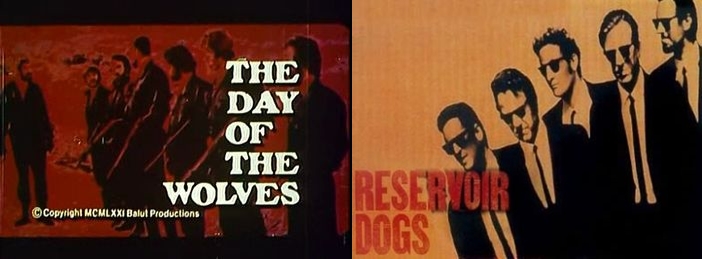
This band of thieves doesn’t know each other’s real names or much of anything about one another’s past crimes. They have been brought together by a criminal mastermind whose meticulously planned “perfect” heist goes awry. Sound familiar? It is the plot of Reservoir Dogs, Quentin Tarantino’s indelible 1992 debut, but it also describes Ferde Grofe’s little-known crime drama, 1971’s The Day of the Wolves. One of the many influences that went into the recipe that Tarantino transformed into something uniquely his own, it is also, along with Reservoir Dogs, one of the opening night features of “Not Necessarily Noir 3.” Elliot Lavine’s latest series highlighting crime and horror in the contemporary era – 26 movies over 13 nights – opens Friday, October 19 at San Francisco’s Roxie Theater and runs through Halloween.

The series gets off to a memorable start with the heist movie pairing. Grofe is not the artist Tarantino is. Heck, he is barely a craftsman, and yet The Day of the Wolves is compulsively watchable, a modest B-movie that moves briskly and offers a novel twist on the genre – these thieves have their sights set not on a mere bank or business, but on an entire town. No. 1 (Jan Murray) recruits six strangers for the job, sending them plane tickets and ordering them to grow beards, identifying them each by numbers instead of names, making them wear gloves to conceal their fingerprints and even blindfolding them to keep the location of their hideout a secret. His plan is such that even if one or more of them is caught, no one will have enough information to rat out any of the others. On the surface, the plot to rob the isolated, desert community that No. 1 has identified seems foolproof.

Lawrence Tierney’s Joe Cabot in Reservoir Dogs similarly tries to insure himself against capture by also recruiting strangers and using colors in place of real names. There are more variables to the bank job he plans, though, and some of the biggest are in the gang itself. In putting less than the ideal crew together, Cabot is already halfway to hell before the movie even begins.

The contrasts between The Day of the Wolves and Reservoir Dogs is fascinating and not just because while Tarantino populated his thieves with a fledgling auteur’s dream of a cast including noir great Tierney, Harvey Keitel, Tim Roth, Steve Buscemi and Michael Madsen, Frode had to make do with the likes of Murray (a stand-up comedian who made 248 appearance on Hollywood Squares, according to the IMDB), San Francisco native Richard Egan on the downside of his career and journeyman actor Rick Jason. The approaches the two filmmakers (both of whom penned their scripts) to violence is another telling difference, Tarantino’s ebullient embrace of gore is a million miles away from Grofe’s reticence to shed blood at all. Reservoir Dog‘s sharp dialogue, heightened suspense, arresting imagery and unforgettable performances put it in another league from The Day of the Wolves, but both movies are tense and entertaining in their very different ways and it is kick to see just where Tarantino took some of his inspiration.

All of the pairings in “Not Necessarily Noir 3” – a bargain at $11 per double feature – are as beguiling as opening night. Lavine has crafted an irresistible group of double features: dangerous, dark, devastating and wildly thrilling – oh, and nearly all are being projected in 35mm, just the way the movie gods intended. — Pam Grady

For tickets or further information about Not Necessarily Noir 3, visit www.roxie.com.


Share this:

  • Click to share on Facebook (Opens in new window) Facebook
  • Click to share on X (Opens in new window) X
  • Click to email a link to a friend (Opens in new window) Email
  • Click to print (Opens in new window) Print
  • Click to share on LinkedIn (Opens in new window) LinkedIn
  • Click to share on Tumblr (Opens in new window) Tumblr
  • Click to share on Reddit (Opens in new window) Reddit
  • Click to share on Pinterest (Opens in new window) Pinterest
Like Loading...

Elliott Gould and THE LONG GOODBYE that almost wasn’t

23 Monday Jul 2012

Posted by cinepam in News

≈ Leave a comment

Tags

Elliott Gould, Peter Bogdanovich, Robert Altman, San Francisco Jewish Film Festival, The Long Goodbye

The Long Goodbye almost didn’t happen, at least not the version that eventually emerged with Elliott Gould as Raymond Chandler’s private eye Philip Marlowe reinvented as perhaps the last principled man in the cynical post-Watergate 1970s. Gould graced the cover of Time magazine in 1970 as “The Star of an Uptight Age.” That same year he received a Best Supporting Actor Oscar nomination for Bob & Carol & Ted & Alice and he starred in M*A*S*H. He was on top of the world. A couple of years later, he was just another unemployed actor when then-United Artists head David Picker told him about the Chandler film, which was then attached to director Peter Bogdanovich. Gould wanted the part and he needed the job, but Bogdanovich had other ideas.

“Bogdanovich couldn’t see me in it,” Gould recalls during a Q&A at the San Francisco Jewish Film Festival where he received the festival’s 2012 Freedom of Expression Award.

The director favored more hard-boiled casting. He wanted Lee Marvin or Robert Mitchum (who would go on to play Marlowe twice in 1975’s Farewell, My Lovely and 1978’s The Big Sleep).

“I couldn’t argue with that. They were like my uncles,” Gould says, but he adds, “We’ve seen them, but you haven’t seen me.”

But then Bogdanovich was out and Robert Altman, who had already directed Gould in M*A*S*H took over the reins.

“You are that guy,” said Altman.

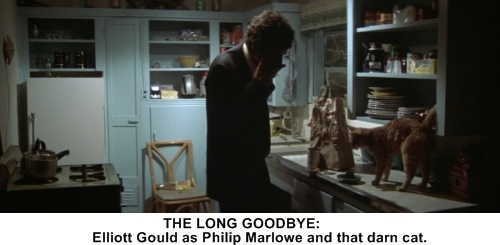
“That guy” in this case being a slobby loner with an obnoxious orange tabby for a roommate, who just can’t let it go when his good friend Terry Lennox (ex-baseball player and Ball Four author Jim Bouton) gets into trouble, even at the expense of his own hide.

That Gould’s Marlowe is not so tough as the traditional Marlowe can perhaps best be summed up by the one question about a costar asked of Gould at the film festival event. Bouton, classic tough guy Sterling Hayden, Laugh-In comedian Henry Gibson, director Mark Rydell, and fraudster Clifford Irving’s mistress Nina Van Pallandt were all part of The Long Goodbye cast. None of them rated a query. No, what inquiring minds wanted to know was, what was it like to work with that scene-stealing cat?

“You can’t lie to nature,” answered Gould. “Nature will take its course.” – Pam Grady

Share this:

  • Click to share on Facebook (Opens in new window) Facebook
  • Click to share on X (Opens in new window) X
  • Click to email a link to a friend (Opens in new window) Email
  • Click to print (Opens in new window) Print
  • Click to share on LinkedIn (Opens in new window) LinkedIn
  • Click to share on Tumblr (Opens in new window) Tumblr
  • Click to share on Reddit (Opens in new window) Reddit
  • Click to share on Pinterest (Opens in new window) Pinterest
Like Loading...

Pre-Code at the Roxie: Call Her Savage

01 Thursday Mar 2012

Posted by cinepam in News

≈ Leave a comment

Tags

Call Her Savage, Clara Bow, Elliot Lavine, Gilbert Roland, Pre-Code, Roxie Theater

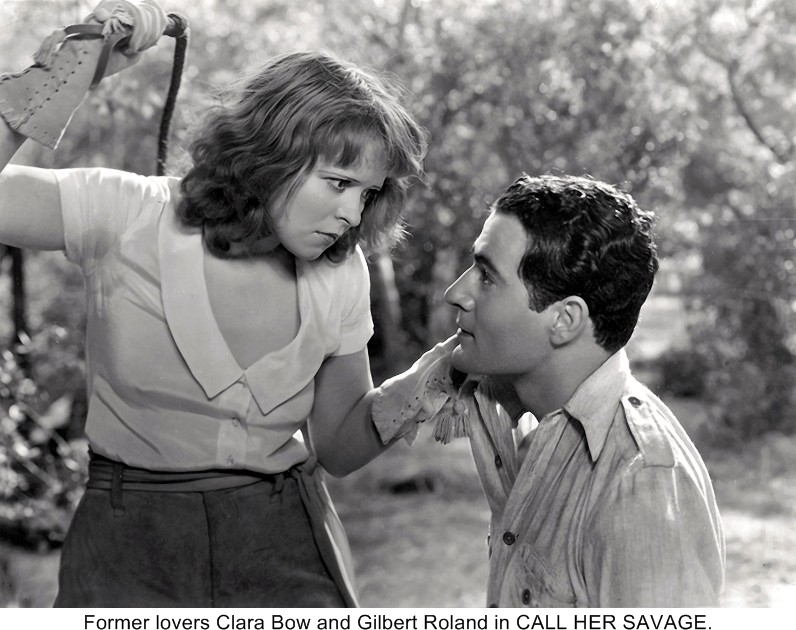
Image1931 was a bad year for Jazz Age “It” girl Clara Bow. Her friend and assistant Daisy DeVoe embezzled from her and tried to blackmail her, lurid details of Bow’s private life leaking out during the sensational trial that followed. Paramount Pictures, the studio that made her a star, declined to renew her contract. If that wasn’t enough, a scandal sheet, the Pacific Coast Reporter, ran a dubious expose that purported to lift the lid off a va-va-voom sex life that the tabloid claimed was rife with multiple affairs, orgies, incest, even a tryst with her pet Great Dane. 1932’s Call Her Savage, screening Wednesday, March 7 at San Francisco’s Roxie Theater as part of Elliot Lavine’s latest program, “Hollywood Before the Code: Nasty-Ass Films for a Nasty-Ass World,” plays like a sardonic commentary on the flame-haired actress’ very bad year. Her career was nearly over. She was about to fade into obscurity and a lifetime plagued by mental health issues, but for her penultimate moment in the spotlight, Bow remained unbowed.

In some ways, Call Her Savage comes across like a direct taunt at Bow’s detractors. Her character, Nasa Springer, even romps suggestively with a large dog, and Gilbert Roland, a former lover of Bow’s, shows up as one of the men in Nasa’s life. The Brooklyn-born Bow plays Nasa as a Texas wild child, a spoiled, impetuous heiress whose frustrated father ships her off to school in Chicago where her carousing and brawling earn her gossip column inches and the nickname “Dynamite.” She even manages to get into a fist fight at her debutante party.

Nasa’s lack of decorum is the least of it. What’s worse is her terrible judgment when it comes to men. With the exception of Moonglow (Roland), the boy she leaves back home, her taste runs to creeps with money. One, Lawrence Crosby (Monroe Owsley) marries her just to make another woman jealous. Another, Jay Randall (Anthony Jowitt), says he’s in love with her – until he realizes that she’ll never fit into his high society world. Most of the men in her life treat her badly, including her railroad baron father Pete Spring (Willard Robertson), who disowns her. Nasa teeters often on the brink of disgrace and disaster, but she is a survivor.

There are lots of goodies in the Roxie’s Pre-Code program, among them the original Scarface, the eerie Island of Lost Souls, the breezy musical Murder at the Vanities, and the melodramatic Ladies of the Big House, but Call Her Savage is in a class by itself. It hits many of the Pre-Code highlights, those elements that the Production Code would soon banish from Hollywood movies for decades to come. There is adultery, unmarried cohabitation, miscegenation, prostitution, and rape. But what makes the film stand out is Bow, blurring the line between fact and fiction, a scandalized girl playing a scandalized girl, a woman unafraid of making the most of a bad reputation. – Pam Grady

Hollywood Before the Code: Nasty-Ass Films for a Nasty-Ass World, March 2-8, Roxie Theater, 3117 16th Street, San Francisco. For tickets and further information, visit roxie.com.

Share this:

  • Click to share on Facebook (Opens in new window) Facebook
  • Click to share on X (Opens in new window) X
  • Click to email a link to a friend (Opens in new window) Email
  • Click to print (Opens in new window) Print
  • Click to share on LinkedIn (Opens in new window) LinkedIn
  • Click to share on Tumblr (Opens in new window) Tumblr
  • Click to share on Reddit (Opens in new window) Reddit
  • Click to share on Pinterest (Opens in new window) Pinterest
Like Loading...

When Ewan met Iggy

18 Friday Nov 2011

Posted by cinepam in News

≈ Leave a comment

Tags

Beginners, Ewan McGregor, Iggy Pop, Todd Haynes, Velvet Goldmine

The release of the Beginners DVD this week reminded me of a story that Ewan McGregor told on himself when he came through San Francisco in April for that film’s opening night screening at the San Francisco International Film Festival. The conversation turned to Todd Haynes’ Velvet Goldmine and his role as Iggy Pop-like rock icon Curt Wild. For the actor, making the movie was a singular experience in which he got to sing live, dropping his trousers while singing The Stooges’ “TV Eye” during his character’s memorable introduction at an outdoor music festival and later performing “Gimme Danger” at Brixton Academy.

“I really did it. I told Todd Haynes, ‘I’ll only do this if you let me sing live,’ and he did,” McGregor said.

Several years later, he heard that Iggy was going be playing at a fashion show and he jumped at the chance to meet Curt Wild’s real-life counterpart.

“I had never been a fashion show. It was back in the day and I was very, very drunk,” he recalled.

It didn’t dawn on him until he was backstage that Iggy Pop maybe hadn’t seen Velvet Goldmine and wouldn’t necessarily understand the connection between his legendary self and his eager (if tipsy) young visitor.

“He didn’t remember that I had played him in the movie or that he’d given his permission to use all his songs,” McGregor said, cringing at the memory. “I’m standing there in this dressing room, Iggy Pop’s dressing room, after the show, I kind of came to and I was doing him for him. I was doing Iggy Pop in front of him, and I went, ‘What the fuck am I doing?’

“I got out of there as quickly as I could before I died of embarrassment. It was horrible.” – Pam Grady

Share this:

  • Click to share on Facebook (Opens in new window) Facebook
  • Click to share on X (Opens in new window) X
  • Click to email a link to a friend (Opens in new window) Email
  • Click to print (Opens in new window) Print
  • Click to share on LinkedIn (Opens in new window) LinkedIn
  • Click to share on Tumblr (Opens in new window) Tumblr
  • Click to share on Reddit (Opens in new window) Reddit
  • Click to share on Pinterest (Opens in new window) Pinterest
Like Loading...

TV Noir returns to the Roxie

30 Friday Sep 2011

Posted by cinepam in News

≈ Leave a comment

Tags

Alfred Hitchcock, Dan Duryea, Elliot Lavine, John Frankenheimer, Johnny Legend, Rod Serling, Roxie Theater, Sidney Lumet, TV Noir

TV Noir is back at San Francisco’s Roxie Theater with a week-long slate of doomed men, marked women, and dark drama. Programmed by Elliot Lavine and curated by Johnny Legend, who will also be on hand every night to introduce the shows, the series runs Sept. 30-Oct. 6. The program gets off to a running start with fan favorite Dan Duryea starring as a man whose life was derailed by a little girl’s vicious fib in “The Lie,” a 1955 episode of The Star and the Story. Beverly Garland is the child all grownup and eager to make amends, but that might not be the wisest course to take with any character essayed by the shifty Duryea. That’s only the beginning. Among the week’s highlights:

“The Haunted Clown,” an episode of the series One Step Beyond: Imagine Of Mice and Men‘s Lenny as the sorriest-looking clown you’ve ever seen. Now imagine that the girl he fancies with evocative jazz score and what you’re left with is this tragic and bizarre 1960 melodrama.

The Plot Thickens: Who killed the seer during the séance? That’s the question in this bizarre little whodunit where a quiz show panel that includes Groucho Marx query the suspects and try to guess the killer. Horror maestro William Castle created this 1963 one-off that blends murder with the celebrity panel game show format of What’s My Line? or To Tell the Truth.

“The System,” an epidsode of the series Danger: In one of his earliest filmed performances, a pugnacious Eli Wallach is a “grease monkey” who refuses to listen to the smitten cigarette girl (Kim Stanley) who warns him that he’s more likely to take a beating or worse than beat the house when he tries to win big at the casino. A 27-year-old Sidney Lumet directs.

“Four O’Clock,” an episode of the series Suspicion: E.G. Marshall is a jealous husband whose plans for getting even with the wife he’s certain is having an affair take an unexpected turn in this compact thriller based on a Cornell Woolrich story. Alfred Hitchcock’s first foray into directing for television also features a young Harry Dean Stanton in a small, but memorable role.

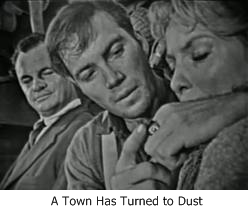
“A Town Has Turned to Dust,” an episode of Playhouse 90: In a town suffering a terrible drought, Mexican immigrants become a scapegoat leading to grotesque tragedy. John Frankenheimer directs a Rod Serling script that still has pointed things to say about xenophobia in the U.S. 53 years after its original 1958 airing. Rod Steiger and William Shatner star.

Legends of Horror Go Noir!: The October 3rd program is devoted to horror’s classic stars. It is a sublime experience to watch Bela Lugosi, Lon Chaney, Jr., Boris Karloff, Vincent Price, and Peter Lorre each take their turn in the spotlight.

“The Night America Trembled,” an episode of Studio One: Orson Welles’ infamous War of the Worlds radio broadcast is both dramatized and put into context (by Edward R. Murrow, no less) in this tantalizing production for the classic drama series. James Coburn (his on-screen debut), Vincent Gardenia, Warren Beatty, Edward Asner, and Warren Oates are among the cast.

“Secret Agent,” an episode of World of Giants: The premiere episode of this short-lived series introduces Marshall Thompson as Mel Hunter, an American spy reduced to only six inches high after an unfortunate brush with radiation. Or maybe not so unfortunate, since even though he’s so tiny that he could be killed by a falling pencil, his neat petite size makes him perfect for certain covert operations. Just watch out for that cat!

“The Big Producer,” an episode of Dragnet: Someone’s pushing pornography to L.A.’s teenagers and Sgt. Joe Friday (Jack Webb) and his partner Frank Smith (Ben Alexander) are on the case in this offbeat 1954 episode of the classic series. Martin Milner and Carolyn Jones play teens caught in scandal, but it is Ralph Moody as a movie producer reduced to publishing dirty books that is the draw. As he explains himself to Friday, he recalls a significant incident from his glory days during the silent era. While the camera records the grim reality of an abandoned Western set, the soundtrack is a symphony of the producer’s vivid memories. It is a bravura moment and a most unusual one in a series that normally rendered the world in the same black-and-white, matter-of-fact tone as Webb’s narration. – Pam Grady

_________________________________________________________________

TV Noir plays Sept. 30-Oct. 6 at the Roxie Theater, 3117 16th Street, San Francisco. For further information, visit http://www.roxie.com.

Share this:

  • Click to share on Facebook (Opens in new window) Facebook
  • Click to share on X (Opens in new window) X
  • Click to email a link to a friend (Opens in new window) Email
  • Click to print (Opens in new window) Print
  • Click to share on LinkedIn (Opens in new window) LinkedIn
  • Click to share on Tumblr (Opens in new window) Tumblr
  • Click to share on Reddit (Opens in new window) Reddit
  • Click to share on Pinterest (Opens in new window) Pinterest
Like Loading...

Simpsons’ Vet Mike Reiss Leads a Toonful Evening

26 Tuesday Jul 2011

Posted by cinepam in News

≈ 1 Comment

Tags

Castro Theatre, Mike Reiss, San Francisco Jewish Film Festival, South Park, The Family Guy, The Simpsons

There were no standing ovations for longtime The Simpsons writer/producer Mike Reiss when he stepped up to the stage of the Castro Theatre on Monday, July 26 as part of the San Francisco Jewish Film Festival’s “Jews in Toons” program, compared to the three standing o’s that greeted movie star Kirk Douglas during SFJFF’s Freedom of Expression ceremony the day before. But Reiss was quick to brag that the cartoon program sold more tickets.

“Take that, Hollywood legend!” he crowed.

Reiss was the closing act for a night that began with “When You Wish Upon a Weinstein, “ a Family Guy episode made in 2000 but not shown until 2003 when the Cartoon Network aired it. Original network Fox left the episode – in which family patriarch Peter seeks a Jewish accountant and attempts to get a quickie Bar Mitzvah for his teenage son Chris – to gather dust after it deemed the episode antisemitic, despite the fact that scriptwriter Ricky Blitt is Jewish and two rabbis vetted the script. That was followed by South Park‘s “The Passion of the Jew,” in which Stan and Kenny attempt to get a refund from an addled Mel Gibson after being appalled by The Passion of the Christ while the movie inspires Cartman to emulate Hitler. Finally, in the 1991 Simpsons’ episode “Like Father, Like Clown,” Bart and Lisa attempt to reunite Crusty the Clown with his long estranged rabbi father.

It was 69 minutes of brilliant TV, but Reiss – who also made this year’s SFJFF “Queer Duck” trailer – was the star of the show, delivering a talk interspersed with clips from The Simpsons, Queer Duck, and the cult series The Critic. He was quick to point out that he is a comedy writer, not a comedian.

“It’s like the difference between phone sex and real sex,” he explained, adding, “In my case, it’s 20 bucks for four minutes either way.”

For a writer not a comedian, Reiss timing was pitch-perfect on lines like, “I’m Jewish. I would never eat a ham sandwich in a synagogue on Yom Kippur – if anyone was watching.”

He was also the master of the dish, revealing that the worst Simpsons guest star ever was a female celebrity he can’t name but whose first name is “Oprah;” his frustration over Paramount’s insistence he remove a Tom Cruise joke from Queer Duck: The Movie; and that if this veteran of Johnny Carson’s Tonight Show writing staff couldn’t write comedy, he’d probably write for Jay Leno.

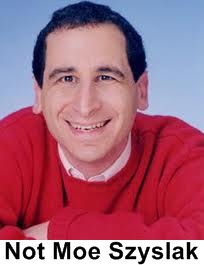
When “Jews in Toons” ran over, there was only time left for one question in an audience Q&A, a woman who wanted to know if Simpsons‘ bartender Moe Szyslak was modeled after Reiss.

“I get that a lot,” he crumbled, insisting Moe was based on no human at all.

“We started with an ape and we shave some fur,” he said, adding, “Chief Wiggum is a pig. Ralph Wiggum is a lamb fetus.” – Pam Grady

Share this:

  • Click to share on Facebook (Opens in new window) Facebook
  • Click to share on X (Opens in new window) X
  • Click to email a link to a friend (Opens in new window) Email
  • Click to print (Opens in new window) Print
  • Click to share on LinkedIn (Opens in new window) LinkedIn
  • Click to share on Tumblr (Opens in new window) Tumblr
  • Click to share on Reddit (Opens in new window) Reddit
  • Click to share on Pinterest (Opens in new window) Pinterest
Like Loading...
← Older posts
Newer posts →

Categories

  • Interviews
  • News
  • Reviews
  • Short Takes
  • Uncategorized

Recent Posts

  • A Stamp of Approval
  • Life is messy & so is ‘Megalopolis’
  • A star discovers too late there are worse things than aging in the black comic body horror ‘The Substance’
  • A young teen nurses a crush when he finds himself among ‘Big Boys’
  • The stunt man becomes the star as Ryan Gosling becomes THE FALL GUY

Archives

Blog at WordPress.com.

  • Subscribe Subscribed
    • Cinezine Kane
    • Join 48 other subscribers
    • Already have a WordPress.com account? Log in now.
    • Cinezine Kane
    • Subscribe Subscribed
    • Sign up
    • Log in
    • Report this content
    • View site in Reader
    • Manage subscriptions
    • Collapse this bar
 

Loading Comments...
 

    %d