• About

Cinezine Kane

Cinezine Kane

Category Archives: Reviews

Wild Horses Couldn’t Drag Me Away: THE MUSTANG 

22 Friday Mar 2019

Posted by cinepam in Reviews, Uncategorized

≈ Leave a comment

Tags

Bruce Dern, Gideon Adlon, Jason Mitchell, Laure de Clermont-Tonnerre, Matthias Schoenaerts, The Mustang

Mustang

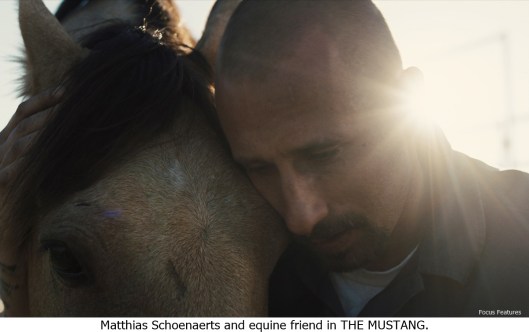
The strong bond between man and animal lives at the heart of actress Laure de Clermont-Tonnerre’s feature directorial debut, The Mustang, a drama with roots in a real prison rehabilitation program in which convicts train wild horses. Shot on location in a decommissioned Nevada prison and grounded by a deeply empathetic performance by Flemish actor Matthias Schoenaerts, the film captures the ugly realities of prison life while depicting one very unusual method for changing lives for the better. While these convicts break horses, the horses in a way are breaking the men and restoring them to humanity. 

Roman (Schoenaerts) could easily be irredeemable. Serving a long sentence for a terrible act of domestic violence and a frequent guest of solitary confinement, he is a sullen man who seems only able to express himself in outbursts of anger. He has a 16-year-old daughter, Martha (Gideon Adlon), with whom he is desperate to connect, but communicating his feelings is a Sisyphean challenge for him. He does not appear to be the most likely candidate for rehabilitation, nevertheless he is chosen for the program in which mustangs—recently captured in their natural habitat throughout the American West—are made ready for auction by getting them comfortable with humans. 

The first meetings between Roman and the irate buckskin who wants nothing to do with people aren’t promising. They are a matched set, as Myles (Bruce Dern), the head of the program, and Henry (Jason Mitchell), a fellow convict who has developed into a talented trainer, can see. Roman, as uncomfortable around animals as he is with people, doesn’t appear to have the skill set for calming a wild animal, not when he doesn’t even know how to calm himself. But that’s the point. In learning how to handle the horse, Roman is learning how to handle himself. 

At times, the story is a little too on the nose with Roman and the horse he names Marquis being so perfectly in sync in their temperaments, while a subplot involving a prison drug ring adds an unnecessary element of melodrama. Those are minor quibbles. With Schoenaerts, Dern, Mitchell, and a terrific supporting cast (including some non-actors, ex-convicts who graduated from programs like the one depicted and have successfully reentered society), The Mustang is a film with a lot of heart and one with an unusual take on America’s prison-industrial complex. The world tends to fixate on punishment, but most prisoners get out at some point, and then what? 

Beautifully shot by cinematographer Ruben Impens, The Mustang makes the most of its desert setting and one terrifically suspenseful scene where a driving storm threatens the horses. Clermont-Tonnerre imbues her film with a variety of tones from the simmering tensions of the prison yard to the uncomfortable atmosphere in the visitors’ room where Roman and his daughter fitfully communicate through his guilt and her anger to the camaraderie and sometimes surprising exuberance to be found among the horse trainers. The Mustang began when the director read an article about programs like the one she portrays and she has parlayed that into an impressive first feature. –Pam Grady 

Share this:

  • Share on Facebook (Opens in new window) Facebook
  • Share on X (Opens in new window) X
  • Email a link to a friend (Opens in new window) Email
  • Print (Opens in new window) Print
  • Share on LinkedIn (Opens in new window) LinkedIn
  • Share on Tumblr (Opens in new window) Tumblr
  • Share on Reddit (Opens in new window) Reddit
  • Share on Pinterest (Opens in new window) Pinterest
Like Loading...

Cinequest review: MINE 9

08 Friday Mar 2019

Posted by cinepam in Reviews, Uncategorized

≈ Leave a comment

Tags

Cinequest, Drew Starkey, Eddie Mensore, Mine 9, Terry Serpico

Mine 9

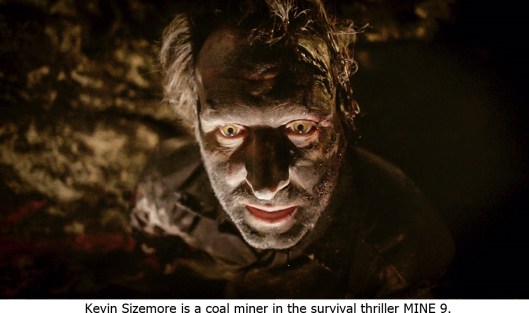
Real coal miners appear on the screen during the closing credits of writer/director Eddie Mensore’s sophomore feature Mine 9, which makes its world premiere March 8 at the Cinequest Film & Creativity Festival in Silicon Valley. They talk about their work and how it is a family tradition and how long a workday is and how many years they’ve been going down in the pit. Mensore pays respect to these men in this way, even as the story he has just spun is chilling and leaves the viewer with a question: Why in the world would anyone do this kind of work?

Set in a bucolic Appalachian community and against an evocative soundtrack of country, folk, and blues songs – a few originals, mostly traditional – performed by Atlanta musician Max Godfrey, Mine 9 neatly sets up the circumstances facing a group of miners. They know conditions aren’t safe, but they don’t really have much of a choice except to descend two miles down into the earth and go back to work. Economic conditions are so harsh in the region that the choice comes down to risking one’s life for the sake of a job or starve. All except 18-year-old Ryan (Drew Starkey), joining the family business as he starts his first day of work, have families to feed.

Mensore paints a vivid picture. From the grime that encrusts the men from head to foot to the claustrophobic conditions of working in the pit, this is pitiless, backbreaking work. And that’s before the methane explosion that leaves them with caved in walls and scant oxygen. Given that the concerns expressed by Zeke (Terry Serpico), the miners de facto leader, have been utterly ignored by management, can they even expect rescue or are they truly on their own?

Mine 9 delivers on its premise as a thriller. Mensore’s storytelling is economical as he sets up a situation in which survival is always in question. Characters are only lightly sketched, but terrific performances by Serpico, Starkey, and the rest of the cast give the tale emotional weight. Mine 9 isn’t a horror movie, precisely, but it might as well be. It is certainly horrifying. –Pam Grady


Share this:

  • Share on Facebook (Opens in new window) Facebook
  • Share on X (Opens in new window) X
  • Email a link to a friend (Opens in new window) Email
  • Print (Opens in new window) Print
  • Share on LinkedIn (Opens in new window) LinkedIn
  • Share on Tumblr (Opens in new window) Tumblr
  • Share on Reddit (Opens in new window) Reddit
  • Share on Pinterest (Opens in new window) Pinterest
Like Loading...

Mikkelsen battles the elements in ARCTIC 

07 Thursday Feb 2019

Posted by cinepam in Reviews

≈ Leave a comment

Tags

Arctic, Joe Penna, Mads Mikkelsen, Ryan Morrison

ARCTIC_HS_040317__DSC8682 copy

Six years ago, writer/director J.C. Chandor placed an elderly sailor played by Robert Redford in the middle of the sea on a yacht steadily taking on water in the tense and nearly wordless All Is Lost. As a tale of a man trying to survive against all odds it was irresistible. Arctic, from director Joe Penna and his co-writer Ryan Morrison, is another such indelible story with similar notes to Chandor’s story but taking place in a remote, frozen wilderness after a plane crash. Mads Mikkelsen rivets in this suspenseful drama as a resourceful man who refuses to surrender to the apparent hopelessness of his situation. 

The film opens sometime after the crash. Who Mikkelsen is, what his role was on the plane, and how many people died in the disaster are questions Penna and Morrison never attempt to answer. Instead, we are introduced to this sole survivor stomping through the snow to write “SOS” in large enough letters to be seen by passing aircraft and checking fishing lines sunk into holes cut into the ice, the catch his only source of food. How long he’s been stranded is open to question, but when he strips off his socks at night before getting into his sleeping bag, he reveals feet ruined by frostbite. 

Circumstances eventually force him out of the relative safety of the plane fuselage and into the wilderness in search of a settlement where he will find rescue. Blowing snow, subzero temperatures, a questionable map, a hungry polar bear, and a blanketed topography that hides unseen dangers might end the man’s life at any moment. Still, he perseveres. Rarely has the adage, “Where there’s life, there’s hope,” been better illustrated. 

São Paulo, Brazil, native Penna makes his feature debut in this icy climate, shooting on a forbidding volcanic plateau in Iceland a world away from the sunny, subtropical temperatures of his homeland. Stunning cinematography by Tómas Örn Tómasson depicts an endless, snow-draped landscape of lethal beauty. That this was a shoot with a high degree of difficulty is evident in every frame, a situation which only underlines the dire straits Mikkelsen’s character faces. That thin line between life and death that accompanies us all every day of our existence is frayed, stretched, and nearly obliterated, but the man soldiers on. 

With little dialogue and no back story to speak of, Mikkelsen nevertheless creates a character we come to care about, his actions pointing to someone whose life we would like to see saved even as the odds against just that continue to grow. This is one of the Danish actor’s great performances. Penna and Morrison set the stage in writing a tale of nonstop suspense, but it is Mikkelsen who transforms an ice-bound thriller into something bigger, a saga of a human being reaching beyond his limits through his sheer will to live. —Pam Grady 


Share this:

  • Share on Facebook (Opens in new window) Facebook
  • Share on X (Opens in new window) X
  • Email a link to a friend (Opens in new window) Email
  • Print (Opens in new window) Print
  • Share on LinkedIn (Opens in new window) LinkedIn
  • Share on Tumblr (Opens in new window) Tumblr
  • Share on Reddit (Opens in new window) Reddit
  • Share on Pinterest (Opens in new window) Pinterest
Like Loading...

She Who Laughs Last: WHAT MEN WANT

07 Thursday Feb 2019

Posted by cinepam in Reviews

≈ Leave a comment

Tags

Alan Shankman, Aldis Hodge, Taraji P. Henson, Tracy Morgan, What Men Want

WHAT MEN WANT

Taraji P. Henson is a blast as Ali in the breezy screwball comedy What Men Want, a quasi-remake of the 2000 Mel Gibson comedy What Women Want. As Ali, a female sports agent in a male-dominated profession who is so laser-focused on overcoming her colleagues’ sexism and becoming partner that it leads her to ignore her friends; browbeat her loyal assistant, Brandon (Silicon Valley’s John Brener); and use her new man, single dad Will (Aldis Hodge), and his young son to further her campaign to sign basketball phenom Jamal Barry (Shane Paul McGhie). Add to the mix a sudden ability to read men’s minds—thanks to an accident and some sips of a psychic’s (Erykah Badu) funky tea—and the stage is set for laughs, which the movie mostly delivers.

“Mostly.” Clocking it at one hour, 57 minutes, What Men Wantis one of those movies that would have benefited with some judicious pruning. Most of the fat is on the front end. Director Adam Shankman (Hairspray) and a team of screenwriters take their time setting up Ali’s situation, which makes for a flaccid initial half hour until the plot fully kicks in.

Luckily, the film’s virtues far outweigh its faults. Henson is a pure delight, throwing herself with abandon into the movie’s physical comedy and delivering her tart dialogue with aplomb. Brener is equally hilarious in a lower key as the long-suffering Brandon and so is Tracy Morgan as Jamal’s controlling, LaVar Ball-like father, while Hodge is pure sexy charm. Badu has some wonderfully daffy moments (including during the end credits) as the woman who sets the whole plot in motion. And simmering beneath the laughs is a pointed critique of the work environment that the real Alis of the world face when they are forced to compete on an uneven playing field that has been rigged against them. –Pam Grady

Share this:

  • Share on Facebook (Opens in new window) Facebook
  • Share on X (Opens in new window) X
  • Email a link to a friend (Opens in new window) Email
  • Print (Opens in new window) Print
  • Share on LinkedIn (Opens in new window) LinkedIn
  • Share on Tumblr (Opens in new window) Tumblr
  • Share on Reddit (Opens in new window) Reddit
  • Share on Pinterest (Opens in new window) Pinterest
Like Loading...

Rudd Hot American Summer: Ant-Man and the Wasp, Ideal Home, The Catcher Was a Spy

06 Friday Jul 2018

Posted by cinepam in Reviews

≈ Leave a comment

Tags

Ant-Man and the Wasp, Ideal Home, Moe Berg, Paul Rudd, Steve Coogan, The Catcher Was a Spy

null

Paul Rudd shrinks and supersizes in Ant-Man and the Wasp, but his superhero character Scott Lang aka Ant-Man’s biggest gift remains his amiability in Marvel’s latest adventure, making him the only ant anyone would ever invite to a picnic. But while millions of people will have no trouble finding that insect, no matter how small, in theaters this summer, Rudd has two more movies out now, Ideal Home and The Catcher Was a Spy. And even if one of them presents as more of an intriguing failure than anything else, to play on the title of one of his classic comedies, this season presents a Rudd hot American summer.

null

Ant-Man and the Wasp

Even when he’s on the right side, ex-con Scott can’t help somehow being found in the wrong. Ant-Man and the Wasp opens with Lang nearing the end of house arrest, his punishment for taking part in that little rumble with The Avengers in Captain America: Civil War. He is looking forward to spending time with his daughter Cassie (Abby Ryder Fortson) unrestricted to his own four walls and partnering with Luis (Michael Peña) and their pals on a new security firm. But Dr. Hank Pym (Michael Douglas) and his daughter Hope Van Dyne (Evangeline Lilly), who now has her own suit and superhero identity as the Wasp, have plans for the Ant-Man. Like Michael Corleone in The Godfather: Part III, Scott keeps trying to get out, but they just keep pulling him back in, this time complicated by a corrupt restaurateur (Walton Goggins) and a young woman (Hannah John-Kamen) convinced Pym and Ant-Man hold the key to what ails her.

To say more, would give away too much of the story. Big stunts provide the thrills. If the Ant-Man and the Wasp doesn’t always make full use of its San Francisco setting, it makes up for it with scenes set in Muir Woods and on the famously crooked part of Lombard Street. Jokes, some involving a Pez dispenser and Morrissey, provide the laughs. Director Peyton Reed and a writing team that includes Rudd have a lot of fun with the Alice-in-Wonderland-type possibilities that arise out of people, animals, and objects that enlarge and miniaturize. If there is a race between the humor and the action, it’s a tie. Both are in abundance

Of this, Ideal Home, and The Catcher Was a Spy, this is the most classic Rudd: lovable guy with a killer sense of humor. Plus, he sings a Partridge Family oldie, “Come On, Get Happy.” Just a few bars, but enough to add another layer of giddy fun to the movie. With Ant-Man and his surroundings constantly changing sizes, the Ant-Man movies are clearly as dependent as any of the Marvel movies on special effects to make their larger-than-life tales come alive, yet with Rudd at their center, they are also the most purely human. That’s a wonderful thing.

Rudd 1_home

Ideal Home

Exactly 10 years ago, Rudd starred with Seann William Scott as a pair of boy-men who attempt to influence youth as reluctant volunteers in a Big Brother-type program in Role Models. A decade later and edging ever closer to 50, Rudd’s at it again, this time with Steve Coogan in Ideal Home, streaming on Amazon, iTunes, Vudu, and other platforms. Written and directed by Andrew Fleming, who previously made the underrated Coogan vehicle Hamlet 2, this screwball comedy stars the two as long-time partners who find themselves saddled with a 10-year-old kid who hides his vulnerability behind endless layers of hostility and sass.

The child is actually the grandson of Erasmus, the latest in the long line of comic narcissists that Coogan plays with such brilliance, a Santa Fe chef and host of a cooking show. Rudd is Paul, his long-suffering producer, as well as lover, who keeps threatening to decamp to New York and a job with Rachel Ray. The heart wants what it wants, so he stays. But the arrival of Bill (Jack Gore) throws the couple for a loop. Paul wasn’t even aware that Erasmus had a son from a long ago fling, let alone a grandchild. The imp, who won’t even tell them his name at first and refuses to eat anything but Taco Bell, adds another layer of tension to an already fraught relationship.

There are definite sitcom elements to the story’s unfolding, particularly as it races through its third act. A messier tale would have come to an equally predictable conclusion, but might have had more emotional resonance. Still, it is funny. Some of it is just built-in sight gags, particularly the sight of the oh-so-English Coogan in cowboy duds tooling about Erasmus’ desert home. The tart dialogue is also sharp, made more hilarious by Coogan and Rudd’s dipped-in-acid delivery. As a couple, they are kind of a car wreck, yet they are also a matched set in taste and bitter wit. Neither is exactly parent material – Erasmus admits he never tried to be part of his son’s life – but when presented with a child, paternal instincts kick in.

Just what is the Ideal Home? That’s the question the movie attempts to answer. Bill has clearly had a rough upbringing, but then so has dad Beau (Jake McDorman). How much of that might have to do with Erasmus’ total neglect, the movie doesn’t attempt to answer. But as Erasmus and Paul face teachers, social workers, courts, and Beau in their quest to make a home for the boy, they have to define for themselves as much as for anyone else just what a family is. And like those man-children in Role Models, it is from learning through sometimes disastrous interactions with a child, that these middle-aged adolescents might finally grow up themselves.

CATCHER_D018_IMG_3863.CR2

The Catcher Was a Spy

Rudd stretches his dramatic muscles to play a pro baseball player turned covert World War II agent in The Sessions‘ director Ben Lewin’s The Catcher Was a Spy. Unfortunately, the film—in limited release and streaming – serves neither actor nor subject well. What ought to be a rip-roaring yarn simply isn’t. Lewin was probably the wrong director for a story requiring a level of suspense, but the screenplay is also at fault. In adapting Nicholas Dawidoff’s book, screenwriter Robert Rodat never finds a way to make the cipher at the center of this tale a flesh-and-blood human being. Rudd’s considerable charm can only do so much.

The reality of Moe Berg was this. He was never a star, retiring with a .243 batting average. Nevertheless, he hung on through 15 seasons and four teams before finishing his career in 1939 with the Boston Red Sox. He was also a multilingual Princeton graduate with a law degree. His intellectualism made him an odd duck in dugouts, but so did the way he lived his life. He never married. The film intimates that he was bisexual (there is a frank sex scene with a live-in girlfriend played by Sienna Miller, but the drama is far more discreet in intimated same-sex encounters). And when war broke out, Berg joined the OSS, the precursor to the CIA where his ease with languages made him an asset in Europe.

The bulk of The Catcher Was a Spy follows Berg on a wartime mission to suss out where the Germans are in their attempts to beat the Allies to the development of the atom bomb. If Nazi success looks imminent, he has orders to kill Nobel Prize-winning physicist Werner Heisenberg (Mark Strong), the scientist spearheading the program. This should be thrilling stuff with Berg and his cohorts evading death on the battlefields they must traverse and detection as they close in on their quarry. But the tension never rises. And because Berg himself is so opaque, we never get a sense of the urgency of the mission or Berg’s own feeling of danger.

The Catcher Was a Spy is an interesting story told in the most uninteresting way. Berg deserved better and so did the actor in role. –Pam Grady

Share this:

  • Share on Facebook (Opens in new window) Facebook
  • Share on X (Opens in new window) X
  • Email a link to a friend (Opens in new window) Email
  • Print (Opens in new window) Print
  • Share on LinkedIn (Opens in new window) LinkedIn
  • Share on Tumblr (Opens in new window) Tumblr
  • Share on Reddit (Opens in new window) Reddit
  • Share on Pinterest (Opens in new window) Pinterest
Like Loading...

Nothing SMALL TIME about exquisite John Hawkes in rural thriller

19 Friday Jan 2018

Posted by cinepam in Reviews

≈ Leave a comment

Tags

Anthony Anderson, Clifton Collins Jr., Dale Dickey, Eshom Nelms, Ian Nelms, Jeremy Ratchford, John Hawkes, Michael Vartan, Octavia Spencer, Robert Forster, Small Time Crime

null

An ex-cop whose alcoholism cost him his job, the respect of his colleagues, and his partner’s life finds redemption in the darkest of places in writer/director Eshom and Ian Nelms’ deep dive beneath the placid surface of a rural California town. Prostitution, blackmail, and murder might make the Chamber of Commerce quail, but for Mike Kendall (John Hawkes), those felonies represent a second chance.

That Mike might even want a second chance is not evident at Small Time Crime’s start. Waking out of his latest drunken blackout to find he’s rammed his muscle car into his own fence, Mike simply shrugs and starts drinking again. A round of job interviews reveals one thing: Here is a man desperate to maintain a lifestyle that seems to consist of collecting unemployment checks that will keep him in his perpetually inebriated state. Mike touched bottom a long time ago, now he’s busy trying to see if there’s a bottom beneath the bottom. Except for his sister Kelly (Octavia Spencer), brother-in-law Teddy (Anthony Anderson), and sympathetic police detective Crawford (Michael Vartan), Mike is pretty much friendless and too snockered to mind.

That changes when he finds a dying girl by the side of the road one morning. Old instincts kick in and take over. Despite being warned off by Crawford and his partner (Daniel Sunjata), Mike can’t help himself. In pretending to be a private detective, he becomes one. He also kicks a hornet’s nest as his investigation is one more thorn in the side of people trying to keep a secret buried.

Mike might wear a cheap suit—as the dead girl’s pimp Mood (Clifton Collins, Jr.) churlishly points out—  but this character is exquisitely tailored to Hawkes, one of the greatest character actors working today. A lifetime of hurt has rendered him a shambling wreck of a man, one who can barely function unless he’s well-oiled. And, yet, when his investigative juices start flowing, he is virtually unstoppable, even as he begins to realize that there is a price to be paid for his meddling.

The Nelms brothers grew up in California’s Central Valley and clearly have an eye for small-town eccentricity and empathy for dead-end lives. They have surrounded Hawkes with a terrific supporting cast that in addition to Spencer (who also executive produced), Anderson, Vartan, and Collins, includes Robert Forster as the dead girl’s vengeance-seeking grandfather, Dale Dickey as a no-nonsense bartender, and Jeremy Ratchford as a thorn in Mike’s side. These fine actors and more populate this suspenseful, sun-drenched neo-noir that charts not just the aftermath of a crime, but one lost man’s surprising discovery that he is not as far gone as he thinks. –Pam Grady

Share this:

  • Share on Facebook (Opens in new window) Facebook
  • Share on X (Opens in new window) X
  • Email a link to a friend (Opens in new window) Email
  • Print (Opens in new window) Print
  • Share on LinkedIn (Opens in new window) LinkedIn
  • Share on Tumblr (Opens in new window) Tumblr
  • Share on Reddit (Opens in new window) Reddit
  • Share on Pinterest (Opens in new window) Pinterest
Like Loading...

Introducing Lemmy Caution at SF Gallic noir film fest THE FRENCH HAD A NAME FOR IT 4

02 Thursday Nov 2017

Posted by cinepam in News, Reviews

≈ Leave a comment

Tags

Alphaville, Eddie Constantine, Jean Gabin, Jean-Claude Brialy, Jeanne Moreau, Lemmy Caution, The French Had a Name for It, This Man Is Dangerous

French 4-Constantine

Eddie Constantine looked like the love child of Jack Palance and Ernest Borgnine, a real tough guy. In truth, he was the American-born son of a Russian father and Polish mother who trained as an opera singer. He pursued his career in Europe where he sang cabaret. Then, nearing 40, he switched gears and turned to acting. Cinema buffs know him from Jean-Luc Godard’s 1965 dystopian sci-fi/film noir hybrid Alphaville where he played secret agent Lemmy Caution.

But Alphaville was not the first nor the last time Constantine would play Lemmy Caution. In all, he played the character 14 times, the last time only two years before his 1993 death in another Godard film Germany Year 90 Nine Zero. Now, during the Fri Nov 3-Mon Nov 6 The French Had a Name for It 4 French noir film festival at San Francisco’s Roxie Theater, is a chance to see Constantine’s Lemmy Caution from the legendary character’s beginning.

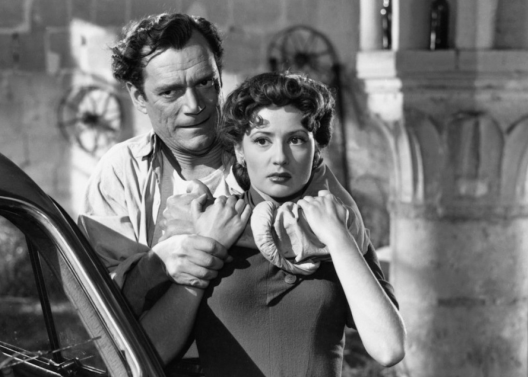
Constantine first stepped into Lemmy Caution’s shoes in 1953 in two adaptation of British author Peter Cheyney’s novels, Poison Ivy and This Man Is Dangerous. The French Had a Name for It 4 is screening the latter that opens with news of American convict Lemmy Caution’s prison escape and flight to Europe. And sure enough, wicked charm with the ladies aside, Caution seems for all the world like a bad guy. The multilingual tough guy is certainly fluent in violence and he eagerly enters into a plot to kidnap an American heiress. But people on both sides of the law would be well advised to note that name, “Caution,” and take heed. It’s not so easy to get a handle on just who or what Lemmy is.

This Man Is Dangerous is a terrific introduction to Lemmy Caution, full of actions and plot twists. It is also a great introduction to Constantine and his gruff charm. On the other end of the double bill is another Constantine vehicle, Lucky Jo (1965). This late noir displays a different, more vulnerable side of the actor. As the ironically named titular character, Constantine a petty crook who can’t give up on the life even as every scheme ends in disaster and his confederates abandon him, certain that he is a jinx.

Other highlights of The French Had a Name for It 4 include Claude Chabrol’s Le Beau Serge (1958), starring Jean-Claude Brialy who returns to his home village to find his best friend Serge (Gerard Blain) has become an embittered drunk; The Night Affair (1958), starring the great Jean Gabin as a cop investigating a jazz world murder who falls for a young junkie (Nadja Tiller); Gigolo (1951), starring legendary Arletty as a pimp who brings a young man (Georges Marchal) to debauched ruin; and The Strange Mr. Steve (1957) and Mademoiselle (1966), showing two different sides of Jeanne Moreau, as a sophisticated femme fatale in the former, and, in the latter, an adaptation of Jean Genet story scripted by Marguerite Duras and directed by Tony Richardson, as a school teacher who unleashes evil on her small village and is obsessed with a local woodsman. –Pam Grady

For tickets and further information about The French Had a Name for It 4, visit http://www.roxie.com/ai1ec_event/french-name-4/?instance_id=23567

Share this:

  • Share on Facebook (Opens in new window) Facebook
  • Share on X (Opens in new window) X
  • Email a link to a friend (Opens in new window) Email
  • Print (Opens in new window) Print
  • Share on LinkedIn (Opens in new window) LinkedIn
  • Share on Tumblr (Opens in new window) Tumblr
  • Share on Reddit (Opens in new window) Reddit
  • Share on Pinterest (Opens in new window) Pinterest
Like Loading...

Sibling Felony: LOGAN LUCKY & GOOD TIME

18 Friday Aug 2017

Posted by cinepam in Reviews

≈ Leave a comment

Tags

Adam Driver, Benny Safdie, Channing Tatum, Daniel Craig, Good Time, Josh Safdie, Logan Lucky, Robert Pattinson, Steven Soderbergh

Sibling Felony

How funny to have two films out at the exact same moment in which siblings—mainly brothers—resort to committing felonies as a career choice. Not that the two have much in common beyond that. Steven Soderbergh’s “comeback” after his insistence that he was retiring from feature filmmaking, Logan Lucky, is a joyful, rural romp as Channing Tatum’s Jimmy Logan masterminds the takedown of the Charlotte Motor Speedway during a NASCAR race and enlists his brother and sister (among others) into the scheme. Benny and Josh Safdie’s Good Time is a gritty urban crime drama in which Robert Pattinson’s Connie Nikas masterminds a Queens bank robbery—although it is quickly apparent Connie is no master nor does he have much of a mind. Each in its own, very different way is a completely captivating, tremendous achievement. Each stands to get lost in the late summer box-office doldrums. Which would be a tragedy.

And Introducing Daniel Craig as Joe Bang

The credit reads like a joke. After all, movie fans know Craig. Who doesn’t know James Bond? But, then, that’s the point. With his hair bleached white and sporting Strother Martin’s accent, Joe Bang is a Daniel Craig we’ve never seen before, a Southern reprobate who seems to have stepped right out of the 1967 classic convict drama Cool Hand Luke (the hardboiled eggs in the scene in which Joe Bang is introduced is no coincidence). Recruited for the job Jimmy has in mind while he is serving a prison sentence, the explosive expert looks askance at Jimmy, “I am in-car-ser-ray-ted.” To hear Craig draw out those syllables is worth the price of a movie ticket alone. This is an actor having fun playing a guy who no doubt prefers moonshine to martinis.

In fact, the entire cast seems to be having a blast—save for poor Katie Holmes, saddled with playing Jimmy humorless ex-wife Bobbie Jo. But then Bobbie Jo doesn’t have a lot to do, whereas most of the rest of the cast gets to enjoy taking part in the Rube Goldbergian plot machinations as Jimmy, a one-time West Virginia coal miner and frustrated at not being able to provide for his young beauty pageant-crazy daughter Sadie (Farah Mackenzie), hits on the idea of robbing the racetrack. His one-armed war vet brother, bartender Clyde (Adam Driver), is dubious—the Logans are noted for their terrible luck. But his ebullient hairdresser sister Melly (Riley Keough) is all for it. And once Jimmy agrees to bring Joe Bang’s idiot brothers Fish (Jack Quaid) and Sam (Brian Gleeson) into the operation, Joe’s down with it, too.

Logan Lucky seems to have been inspired by Stanley Kubrick’s classic 1956 noir The Killing, in which Sterling Hayden’s Johnny Clay similarly plans a racetrack robbery, but the similarities end there. For one thing, there is not even a hint of noir in the script credited to Rebecca Blunt—apparently a pseudonym for perhaps Soderbergh himself or his wife Jules Asner or maybe someone else entirely. The tone is light and breezy. For another, the details of the heist are far more complicated with a lot of moving parts and ancillary characters, such as Dwight Yoakam’s prison warden, who have no idea that they are playing a part in Jimmy’s grandiose scheme.

It is all a blast to watch. At the same time, for all the complex mechanics of the plot, the characters are not forgotten. Jimmy, in particular, is sharply etched, introduced describing to Sadie how the John Denver song “Take Me Home, Country Roads” came to be written. The song is his mantra, the daughter keeps him tethered. He has no prospects in his home state, but he can’t leave. His motivation in turning to a life of crime couldn’t be clearer. Tatum, looking a good deal heavier and far less fit than he did in his previous Soderbergh collaborations as Magic Mike, is pitch perfect as a good ol’ boy with a brain and an eye for the main chance. And he is surrounded by one heck of an ensemble. Every single one of the actors, even those in the tiniest of roles, delivers a knockout performance.

Really, Connie, You’ve Never Heard of Dye Packs?

After attaining superstardom as the dreamy vampire Edward in the Twilight movie, Robert Pattinson continues to reinvent himself as a character actor. To such films as David Cronenberg’s Cosmopolis where he played a psychopathic, master-of-the-universe businessman and James Gray’s The Lost City of Z, in which he played a 20th-century explorer, he adds Good Time’s fast-talking, thickheaded Connie Nikas. This is Jimmy Logan’s opposite, a guy who doesn’t think things throughs. Otherwise, he wouldn’t have insisted that his mentally disabled brother Nick (Benny Safdie) accompany him to something as high risk as a bank robbery. Oh, and he would’ve done a little bit of research into banks and their theft deterrence methods. Really, Connie, you’ve never heard of dye packs?

The robbery portion of Good Time only takes a few minutes of screen time. Heavily disguised, the siblings might’ve stood the chance of getting away the robbery if only Connie had done a little bit of due diligence and considered contingencies. Poor Nick is the one who gets pinched, leaving Connie to figure out some way to get his brother out of the joint. He doesn’t have enough money for bail. But he does have an inflated ego, a mistaken belief in his own competence, and a half-baked plan to spring his sibling that eventually involves him with a naïve teenager (Taliah Webster) and Ray (Buddy Duress, who made his acting debut in the Safdie brothers’ 2015 junkie drama Heaven Knows What), a parolee who introduces Connie to a cache of liquid LSD they can sell. As with the bank robbery, the question looms, “What could possibly go wrong?” That is followed by the same answer, “Connie.”

Pattinson is brilliant playing a guy who is not even half as smart as he thinks he is. This is an actor without vanity, delivering the goods as a guy not quite bright enough to get out of his own way. Working with the Safdies was a wise choice. The brothers with their very specific take on their native New York and the hardscrabble characters that populate their films are building an independent cinema that can stand with the best of those gritty urban thrillers of the 1970s. It is easy to imagine Good Time on a double bill with something like Across 110th Street, The French Connection, or Mean Streets. Or better yet, Dog Day Afternoon. And not just because both movies are about bank robberies. No, it’s just that Dog Day Afternoon’s Sonny Wortzik and Good Time’s Connie Nikas are brothers from another mother, and unforgettable characters in indelible movies. –Pam Grady

Share this:

  • Share on Facebook (Opens in new window) Facebook
  • Share on X (Opens in new window) X
  • Email a link to a friend (Opens in new window) Email
  • Print (Opens in new window) Print
  • Share on LinkedIn (Opens in new window) LinkedIn
  • Share on Tumblr (Opens in new window) Tumblr
  • Share on Reddit (Opens in new window) Reddit
  • Share on Pinterest (Opens in new window) Pinterest
Like Loading...

DUNKIRK: Thrills, but no beating heart in Nolan’s WWII epic

21 Friday Jul 2017

Posted by cinepam in Reviews

≈ 1 Comment

Tags

Christophr Nolan, Cillian Murphy, Dunkirk, Fionn Whitehead

BB-Day54-0187.dng

Framed as a World War II epic and a thriller, Christopher Nolan’s Dunkirk is that at first glance. But beyond the derring-do of Royal Navy men, fighter pilots, and civilian sailors as 400,000 men await rescue on a beach after a disastrous battle, is a more intimate drama of courage and cowardice and emotions in between. That is the most intriguing aspect of Nolan’s ambitious film, and the one where it falls down, betrayed by a dearth of real flesh-and-blood characters.

The outcome of the 1940 battle around the northern French village leaves the defeated Allied soldiers stranded a scant 26 miles away from the English coast, or as one officer observes, “You can almost see home.” But with few ships available in the area that, at any rate, can’t land on the beach and with precious little air support to provide cover, the British hit on an outside-the-box solution to the problem. The Navy drafts fishing boats and pleasure craft and their crews, a civilian armada that can go where destroyers can’t.

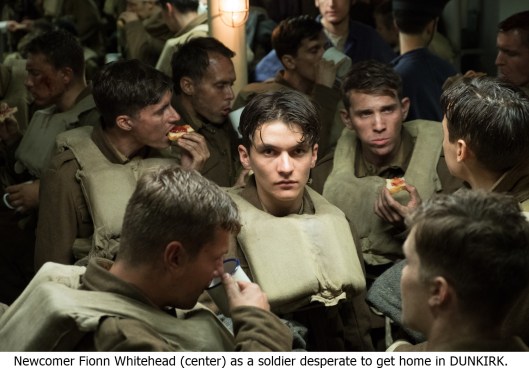
Nolan fashions a sometimes-discombobulating story that zigzags back and forth between three separate strands. There are the men on the beach. Among them are a group of young infantrymen that include newcomer Fionn Whitehead and One Direction singer Harry Styles (in his acting debut), who are loathe to wait for rescue. They want to go home. Now. In contrast are the officers, including Colonel Winnant (James D’Arcy) and Commander Bolton (Kenneth Branagh), who embody courage in the worst-case scenario as they discuss the long odds facing them.

In the air, a small contingent of Spitfires, including pilots played by Tom Hardy and Jack Lowden, engage in dogfights with German Messerschmitts, a desperate skirmish to keep themselves airborne while protecting the ships at sea. On the water, Mr. Dawson (Mark Rylance), the skipper of a yacht heading toward Dunkirk with his 19-year-old son Peter (Tom Glynn-Carney) and 17-year-old family friend George (Barry Keoghan), is the representative of the civilian volunteers.

Clocking in at under two hours, Dunkirk, nevertheless, occupies a large canvas. The cinematography, production values, and special effects are breathtaking. The air skirmishes are thrilling, the drama’s overall vibe is tense. The disaster looming at sea, from a small, leaky boat threatening to capsize to destroyers mortally struck by bombs, bucking and listing as they sink into the water, is palpable. Dunkirk may not reinvent the war movie, but it is effective.

What the film lacks is the human element. There are no fully formed characters in the movie. Everyone is a type. Some actors are able to transcend the script’s limitations. Whitehead is especially effective in conveying sheer terror and his character’s commitment to survival. Cillian Murphy is also very good as a shell-shocked soldier reduced to a ball of quivering panic. But most of the cast, including actors of the caliber of Branagh and Rylance are stuck with cliched dialogue to go with their hoary stiff upper lips.

That lack of humanity is costly. For all its thrilling spectacle, Dunkirk has none of the power of an All Quiet on the Western Front, Gallipoli, or Saving Private Ryan. The stakes in Dunkirk are every bit as high as they are in those and countless other war movies. But it is hard to care when there is no beating heart in the movie. That is a flaw that prevents Dunkirk from achieving the greatness to which Christopher Nolan so clearly aspires. –Pam Grady


Share this:

  • Share on Facebook (Opens in new window) Facebook
  • Share on X (Opens in new window) X
  • Email a link to a friend (Opens in new window) Email
  • Print (Opens in new window) Print
  • Share on LinkedIn (Opens in new window) LinkedIn
  • Share on Tumblr (Opens in new window) Tumblr
  • Share on Reddit (Opens in new window) Reddit
  • Share on Pinterest (Opens in new window) Pinterest
Like Loading...

A primate’s tragedy packs an emotional wallop in WAR FOR THE PLANET OF THE APES

14 Friday Jul 2017

Posted by cinepam in Reviews

≈ Leave a comment

Tags

Andy Serkis, Apocalypse Now, Matt Reeves, Rise of Planet of the Apes, Steve Zahn, War for Planet of the Apes, Woody Harrelson

war-for-the-planet-of-the-apes-hft_shots_sgr_0240_15_1029_rgb

Caesar (Andy Serkis), the ape who has pushed for peace between his kind and man, pays a high price for his tolerance even as humans continue to hunt his kind in War for the Planet of the Apes, the third film in the Planet of the Apes reboot that began with Rise of the Planet of the Apes (2011). Director Matt Reeves and his co-screenwriter Mark Bomback gift Steve Zahn with his most memorable role in years and allow Woody Harrelson, playing a crazed human soldier, to riff on Marlon Brando and Apocalypse Now. But what makes this movie the best of the trio and elevates it to something truly magnificent is Caesar. It should now be apparent to the entire movie-going world that Serkis could easily play King Lear as a motion-capture ape. He has that much gravity.

Caesar’s own good nature is what leads to disaster when he expects kindness shown to humans to be returned. Instead, his actions rain holy hell down on the apes. It is a disaster for the tribe and a personal tragedy for Caesar whose roiling anger leads to both questionable decisions and a looming confrontation with the Colonel (Harrelson), a human dedicated to eradicating apes. With visions of the late, murderous chimpanzee Koba (Toby Kebbell) and his warning about the true nature of man/ape relations dancing in his head, Caesar is a man on a mission. But even as he determines to extract a terrible revenge on his enemies, Caesar’s own true nature can’t help but assert itself, especially when it comes to a little girl (Amiah Miller) who comes to depend on the kindness of primates and Bad Ape (Zahn), a mangy, fearful former zoo animal who has internalized every human insult.

As with the previous chapters in this Apes saga, the line between motion-capture apes and human actors is seamless as Reeves plunges us into a wholly believable world. The nod to Apocalypse Now, which is driven home with a hammer (let’s just say a particular piece of graffiti is wholly unnecessary—we get it), is a bit heavy-handed but still apt. Zahn is terrific, providing some comic relief and also a great deal of poignancy as a frightened creature who discovers reserves of courage he never realized he had. War for the Planet of the Apes’ action scenes pack a wallop, and even relative minor moments are filled with tension. The stakes are the highest for Caesar and the rest of the apes, and the film never loses sight of that.

Then there’s Serkis, proving once more that CGI skin in no way compromises performance. This is an actor at the top of his game and he proves it each time he returns to Caesar. That so far he’s been ignored during awards season is a scandal that ought to be rectified. As a motion-capture actor, as an actor, period, Serkis is second to none and he has never been better than in War for the Planet of the Apes as he fully inhabits Caesar’s huge heart, revealing his grief, rage, pain, and also his valor and love and dedication to his ape family (and those he embraces as extensions of his family). War for the Planet of the Apes packs an emotional wallop and Serkis is a big reason for that. This may be a summer popcorn movie; it is also one of the best films of the year. –Pam Grady

Share this:

  • Share on Facebook (Opens in new window) Facebook
  • Share on X (Opens in new window) X
  • Email a link to a friend (Opens in new window) Email
  • Print (Opens in new window) Print
  • Share on LinkedIn (Opens in new window) LinkedIn
  • Share on Tumblr (Opens in new window) Tumblr
  • Share on Reddit (Opens in new window) Reddit
  • Share on Pinterest (Opens in new window) Pinterest
Like Loading...
← Older posts
Newer posts →

Categories

  • Interviews
  • News
  • Reviews
  • Short Takes
  • Uncategorized

Recent Posts

  • A Stamp of Approval
  • Life is messy & so is ‘Megalopolis’
  • A star discovers too late there are worse things than aging in the black comic body horror ‘The Substance’
  • A young teen nurses a crush when he finds himself among ‘Big Boys’
  • The stunt man becomes the star as Ryan Gosling becomes THE FALL GUY

Archives

Blog at WordPress.com.

  • Subscribe Subscribed
    • Cinezine Kane
    • Join 48 other subscribers
    • Already have a WordPress.com account? Log in now.
    • Cinezine Kane
    • Subscribe Subscribed
    • Sign up
    • Log in
    • Report this content
    • View site in Reader
    • Manage subscriptions
    • Collapse this bar
 

Loading Comments...
 

    %d