
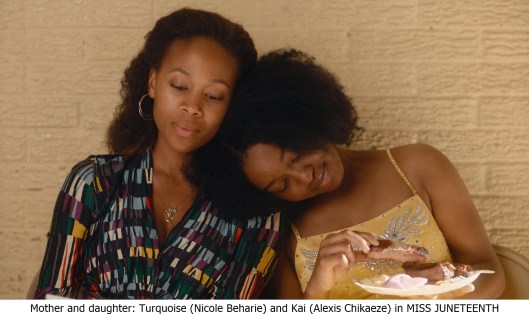
 42‘s Nicole Beharie and newcomer Alexis Chikaeze deliver incandescent turns as mother and daughter in writer/director Channing Godfrey Peoples’ arresting feature debut. Using a small Texas town’s Miss Juneteenth pageant as the lens from which to view a complicated parent-and-child relationship and a mom’s attempt to secure her progeny’s future, Peoples limns an indelible portrait of family and community life.
Once upon a time Turquoise Jones (Beharie) was Miss Juneteenth. The scholarship pageant was supposed to be her ticket to a bright future. Other Miss Juneteenths went on to great personal and professional success. But that was not Turquoise’s fate. Oh, she still has the drive of a Miss Juneteenth. That is evident in everything she does as she manages a bar and BBQ joint, works on call as an aesthetician for a funeral home, does what can for her alcoholic mother (Lori Hayes), and raises daughter Kai (Chikaeze) with only unreliable support from Ronnie (Kendrick Sampson), her on-again/off-again partner and Kai’s dad.
Now, Turquoise’s ambition is burning again at the idea that Kai could be the next pageant winner. Her intention is not to relive her own youth through her daughter, only that Kai should have the future Turquoise was denied. Fourteen-year-old Kai is not so enthusiastic. She resents that her mother does not support her passion for dance and actively shoos away the boy she likes. Pageant-mandated etiquette lessons Kai finds humiliating when a vicious former competitor of her mom’s—now a pageant bigwig—delights in calling her out when the teenager makes mistakes. Turquoise means well, but she is also overly controlling, right down to insisting that Kai recite Maya Angelou’s “Phenomenal Woman” during the pageant’s talent competition, the same poem Turquoise performed in her day.
The mother-daughter relationship is beautifully expressed in all its messiness. Kai is at an age where she wants to start claiming her own place in the world, while Turquoise is afraid of where that measure of independence might lead. There is a generation gap to negotiate and a refusal on both sides to acknowledge the other’s position. Yet there is no doubting the bond between parent and child. Perhaps learning from her difficult relationship with her own mother, Turquoise has built a connection with her daughter that is built to withstand arguments and tension.
Among Miss Juneteenth‘s strengths is its depiction of the community around Turquoise and Kai. The film offers a nearly tactile portrayal of life in a small town where the Juneteenth parade is a celebration not just of history but of the town, pride expressed in marching bands, floats, and local horsemen showing off their steeds. It is the type of place where people help one another out in times of trouble. And while the ladies at the Miss Juneteenth pageant may look down at Turquoise for not fulfilling the promise of her reign, she is, in fact, one of the town leading citizens by dint of her always doing for others despite her own troubles.
With this first feature, Peoples, an award-winning maker of short films, establishes her mastery of place and mood. Gorgeously shot, beautifully acted, Miss Juneteenth won the Louis Black/Lone Star Award for Best Texan Film at SXSW, that spring pageant for independent movies. It deserved that tiara. Like Turquoise Jones, Miss Juneteenth is all heart and that heart is most definitely in the right place. –Pam Grady
Miss Juneteenth is available at the Roxie Virtual Cinema and other on-demand platforms.
 There is a sizeable cast in director/co-writer Patrick Vollrath’s breathtaking feature debut, set on a flight from Berlin to Paris in mostly real time, but only one actor who really counts: Joseph Gordon-Levitt as the flight’s co-pilot Tobias, an ordinary man thrust into extraordinary circumstances. Hijacking dramas are nothing new but this is not the stuff of a Steven Seagal or Kurt Russell movie. 7500 is not an action picture, but rather a slow-burn psychological thriller in which the hero’s defining trait is an ability to hold fear at bay on the worst day of his life.
 Family, syn., blood, clan, kin, linage, tribe. Disappearance, syn., loss, concealment, hiding. Eccentric, syn., bizarre, erratic, off-kilter, off-the-wall, peculiar. Family, disappearance, and eccentric and their synonyms are words at the heart of this offbeat British melodrama in which an online Scrabble game reenergizes a father’s search for a long-lost son even as it stirs resentment in the child who remained home. Sometimes Always Never flirts with being twee (syn., cutesy, cloying, gooey), but never quite crosses that line, thanks to welcome doses of humor and assured performances form stars Bill Nighy and Sam Riley.





 Two middle-aged men decide to take a chance on themselves, swapping their dead-end lives for a shot at controlling their own destiny in an affable comedy that stars James Le Gros and Jesse Borrego. A throwback of sorts, Phoenix, Oregon tonally fits the types of indies Borrego (Lone Star, I Like it Like That) and especially Le Gros (Living in Oblivion, Floundering) made back in the 1990s, big-hearted and full of idiosyncratic characters.
 Most of us would be appalled to win a prize called “Asshole of the Year.” In general, no one wants to be that asshole. But in Coky Giedroyc’s acerbically funny adaptation of Caitlin Moran’s novel How to Build a Girl, rock scribe Johanna Morrican aka Dolly Wilde (Beanie Feldstein) accepts the dubious honor exultantly as a measure of her success. The bullied has become the bully and it feels good – a momentary rush inside the fantasy Johanna’s built for herself until stark reality intrudes in a comedy that tracks where one teenager’s inchoate ambition to be freed of her circumstances leads.

 Cinezine Kane