• About

Cinezine Kane

Cinezine Kane

Category Archives: Interviews

An Epic Done at Epic Scale: Simon Pegg & John Cho on STAR TREK INTO DARKNESS

16 Thursday May 2013

Posted by cinepam in Interviews

≈ 1 Comment

Tags

J.J. Abrams, John Cho, Simon Pegg, Star Trek Into Darkness

startrekintodarkness1In 2007’s Run, Fatboy, Run, Simon Pegg played a security guard training for a marathon, but even there he never ran the way he runs in Star Trek Into Darkness when his character, Enterprise chief engineer Scotty, sprints down a long corridor at full speed. The afternoon he shot that scene he thought he was going to be filming a lot of dialogue, but director J.J. Abrams had other ideas.

“I ran the length of it three times,” Pegg says on a recent visit to San Francisco. “J.J. said, ‘You have to run from there to there,’ and I did it once and I’ve run as fast as I’ve ever run since I was a kid. The quad bike that was filming couldn’t keep up. I just completely went for it. I felt so free. It was like being a child again.

“I got to the end and all the crew applauded. I felt so good about myself. Then J.J. said. ‘That was great. Can you do it again?’ ‘Yeah, no worries. Give me one minute.’ I did it after that and felt slightly funny after that, like something wasn’t right. And then J.J. said, ‘Just once more,’ and I did it, and I was convinced by the time I slowed down that something was going to happen, so I walked off set very quietly and just waved to everybody. And threw up.”

In a weird way, Pegg’s discomfort is a tribute to the sheer scale of the movie. As Capt. James T. Kirk (Chris Pine) and his crew face a mortal threat in John Harrison (Benedict Cumberbatch) and even greater forces, the story is epic. But so is the filmmaking behind it.

“The set we have now is biggest ever rendering of the Starship Enterprise in the history of the Star Trek story,” says Pegg. “We had a bridge that was connected to a corridor that went through to Med Bay, Engineering and the transporter room. So we could do long talking and walking scenes and have a sense of the ship’s size.”

Other sets were equally massive, including the National Ignition Facility (NIF) at Lawrence Livermore Lab, the massive laser that serves Star Trek Into Darkness as Scotty’s natural habitat, the Enterprise engine room.

“NIF was just extraordinary to be part of,” Pegg says. “ Aesthetically speaking, it formed a brilliant bridge between all the clean lines and that fantastically futuristic bridge to the industrial metal of the engine room, which is what J.J. always wanted it to look like, the guts of the Titanic. But in the middle of this you have the warp core, which kind of looks like a perfect mishmash of the two. You’ve got all this steel and yet it’s all modern looking.”

Adds Pegg’s costar John Cho, Star Trek Into Darkness‘ Sulu, “J.J. Is keen on having as much stuff around you physically as much as is possible and using CG as little as possible. It makes it easier for an actor certainly to look up and see things instead of a green felt cloth.”

The physical space might make it easier for an actor to simply act, but Pegg notes, it could be physically punishing – and not just when called upon to race down a long corridor at full speed for multiple takes. He recalls one scene where Scotty and Pike are running when gravity starts to shift.

“The set was too big to put on a gimbal, which is what you’ve seen in films where – like Inception, say, where there’s a corridor that moves – because the set was too big to move, we are on a wire, running on our sides, which is very hard to do,” Pegg says. “It enabled us to have that sensation, but do it on a much bigger scale. It was hard work.” – Pam Grady

Share this:

  • Share on Facebook (Opens in new window) Facebook
  • Share on X (Opens in new window) X
  • Email a link to a friend (Opens in new window) Email
  • Print (Opens in new window) Print
  • Share on LinkedIn (Opens in new window) LinkedIn
  • Share on Tumblr (Opens in new window) Tumblr
  • Share on Reddit (Opens in new window) Reddit
  • Share on Pinterest (Opens in new window) Pinterest
Like Loading...

Sarunas Marciulionis relives THE OTHER DREAM TEAM

12 Friday Oct 2012

Posted by cinepam in Interviews

≈ Leave a comment

Tags

1992 Barcelona Olympics, Golden State Warriors, Marius A. Markevicius, Sarunas Marciulionis, Sundance Film Festival, The Other Dream Team

Sarunas Marciulionis’ 48-year-old knees don’t appreciate winters in his native Lithuania. So the former NBA guard, whose career began with with the Golden State Warriors, still spends part of every year in sunny California. But sore knees or no, nothing was going to keep Marciulionis away from Park City, Utah this past January where Marius A. Markevicius’ documentary The Other Dream Team was making its world premiere at the Sundance Film Festival. The story of the first ever Lithuanian national basketball team’s Cinderella run in the 1992 Barcelona Olympics (where they won the bronze medal), it also spins Marciulonis’ own story of growing up in Soviet-occupied Lithuania; playing on Soviet teams, including the 1988 Olympics crew that took home the gold; his career in the NBA; his key role in forming that 1992 team in the wake of his country’s liberation in 1990 and his life now as a hotelier and owner/operator of a basketball academy in Lithuania. It is a life and career that he can take pride in and on a snowy afternoon the day after The Other Dream‘s Temple Theatre debut, Marciulonis spent a few a few minutes with me talking about his memories and the documentary’s visit to his storied past.

Q: What was it like to sit down and talk about all those memories after so much time had passed?

A: Those memories, when you know the final result, look like they should be nice, but the reality is you remember the pressure. Those are sleepless nights, aches and pains. It’s connected with really heavy, heavy, heavy physical and mental exertion and stress.

But now, everything is fine, you look back 20 years and go, “What happened?” That’s how I know it was a stressful thing. The happiest thing about it was the victory, the result and independence, 1992. But even the 1988 Olympics, playing for Soviet Russia, it doesn’t matter. It was four years of preparation, of dedication, commitment to what we do best. People sometimes ask, “Which medal is more valuable?” You can’t say gold is more valuable or bronze. Each year has its different story and its different memories and glory.

Q: In ’88, there were four Lithuanian starters on the Soviet team, how did you see yourselves? Did you look on that as some kind of statement?

A: There were three, sometimes four starters, yes. At the time, the dream of independence, that was way too early. Only later on did we say, “Oh, yeah, we were four. Look at our stats!”

Q: You’ve lived through extraordinary times. You grew up in an occupied country, then came to the United States and then your nation was liberated. When you look back on all that, how do you take it all in?

A: I’m close to 50, but I can’t free up my brain. All those things that were put in my head at a young age, those fundamentals, when I was a kid, that you’ll never be free. Even though you’re free, you’re not free in your brain. I’m enjoying life, enjoying the San Diego area, Bay Area, I often come back. I have things in Lithuania that I’m doing, the basketball academy and the hotel business, but there’s still that Soviet part that’s still in me. Free people, kids who are free, the way they act and react – we’re still locked. There’s no key to unlock, I haven’t found it yet. When you change a place, it doesn’t mean you change your head.

Q: You had played a lot internationally with the Soviet team, but what was it like for you those first you those first few weeks or months when you came to the Warriors and began living in the west full time?

A: I can’t say it was culture shock, because culture shock is when you go from good to bad. When you go from bad to good, it’s an adjustment, not a shock. You’re adjusting to good things. There are things you appreciate. You’re excited. That’s the life side. The basketball side, my first year, my world was very small. It was Alameda, Alameda gym, the arena and the airport. That was my life. There was no time for anything else. I was talking to [former Warrior teammate] Chris Mullin before coming here and I said, “I haven’t been to Alcatraz!” Friends come to the Bay Area and they always go to Alcatraz, but I never found the time.

The game is a responsibility when you play, it’s not just for yourself. I was always trying to do my best. If I did wrong, then I felt bad. – Pam Grady


Share this:

  • Share on Facebook (Opens in new window) Facebook
  • Share on X (Opens in new window) X
  • Email a link to a friend (Opens in new window) Email
  • Print (Opens in new window) Print
  • Share on LinkedIn (Opens in new window) LinkedIn
  • Share on Tumblr (Opens in new window) Tumblr
  • Share on Reddit (Opens in new window) Reddit
  • Share on Pinterest (Opens in new window) Pinterest
Like Loading...

Taking a WALTZ with Luke Kirby

09 Monday Jul 2012

Posted by cinepam in Interviews

≈ Leave a comment

Tags

Luke Kirby, Sarah Polley, Take This Waltz

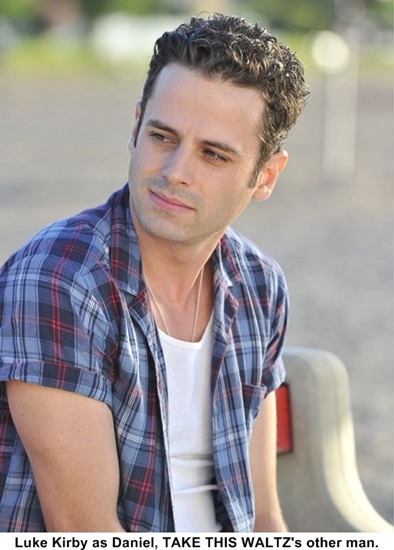
Take This Waltz, Sarah Polley’s second feature, had just made its world premiere the night before at the 2011 Toronto International Film Festival when I sat down to talk to costar Luke Kirby. In casting her romantic drama, Polley first looked toward Hollywood, casting Michelle Williams and Seth Rogen as Toronto couple Margot and Lou. But in filling the role of Daniel, the handsome neighbor who catches Margot’s eye and threatens her ostensibly happy marriage, Polley stuck closer to home and turned to the 34-year-old Hamilton, Ontario native, an old friend. If Kirby – who is best known in the States for his turn as the actor cast as Romeo on the Canadian comedy series Slings and Arrows – was exhausted after the 24-hour whirlwind of premiere and press, he didn’t show it as he waxed enthusiastically about  a film that is dear to his heart and explained how he related it to an actor’s life.

Q: When Margot and Daniel meet, she talks about how much she hates to be in between things. It’s funny that Sarah, an actor, wrote those lines, because that is kind of the actor’s permanent condition. Given how much of the movie is about just that, being in between, how do you feel about that or do you ever even think about it?

A: As I get older, there is this kind of interesting feeling of untetheredness. I’ve been trying to find a home somehow in my own personal life. It’s really been reassuring, life-wise, to know that I can actually attempt that. In many ways, I felt like I was just going to be a vagabond for life. In some ways I will be, but I’ve been really lucky the last couple of years to have a sense of home to some degree that has sort of allowed me to find that, although the die was cast, it isn’t as serious as I thought it was going to be. I think everyone’s sort of allowed to find home.

Q: That’s another interesting thing in the movie, because Margot already has what should be home and she’s rejecting it.

A: She says she doesn’t like being in between places, but she might really like being in between places. For me, I know one of the things that feeds the appetite to do this is kind of enjoying that place. It can feel at times really freeing. It can feel utterly terrifying at other times, but knowing that I can do it inside the context of work is a great place to kind of work through that impulse. But I think Margot, I don’t know if in some ways she likes it necessarily, but her comfort zone kind of is on the ride and she just hates it when it stops.

Q: She is such a piece of work in the way she messes with both guys’ heads, perhaps without meaning to do so, but that’s the effect.

A: It’s interesting. I haven’t been able to quite detach myself when I see it from the experience of doing it, of what Daniel goes through with this kind of light being cast on his otherwise dark world through Margot. I see the kind of beauty of that. I see the poetry of it, but at a distance I can see how incredibly frustrating … she’s in a very frustrating place.

Q: You say that you’ve been trying to find a home. What does home mean to you?

A: For me, family is tied into it somehow, whatever family is. It can be friends. It can be environment, landscape. Flora and fauna can be home. Whatever it is, it’s something that sort of speaks to you and it’s something you feel matches the beat of your heart. That’s that home that we kind of look for that if we were privileged enough to feel that at any time in our childhood, we would consistently want to have something similar somewhere along the line.

Q: How long have known Sarah?

A: Ten years, but she and I have worked together only once prior to this, which was on a film called Luck, and we worked it together as actors. I adore her as an actor. I think she’s a really, really funny person and incredibly bright and intelligent and engaged in a way that’s kind of a little bit off-putting initially, but such a kind of blessing to get to be around.

It was just that one time that we worked together, but over the years, we’d touch base every so often. This was sort of our latest way of touching base, which really, really added to an already delicious cake.

Q: Given your prior relationship, did the two of you talk about this project at all before you read the script?

A: We didn’t talk. I got the script, which I think was probably the right thing to do. Those are the bones of what you’re looking at. You can then see if there is any possibility of fleshing it out or not. I was really somewhat haunted by the story. In many ways – just off the bat, reading it strictly as a reader – I could relate to Margot especially. I knew I couldn’t play her. I knew Sarah wanted me to read for Daniel. But then we actually read some scenes and it flowed very nicely.

I kind of felt, because of the scope of the production, that Sarah was sort of just doing a kindness of involving me on some level. I didn’t really think that it was going to go anywhere.

Q: Why would you think that?

A: It was just one of those things that you tell yourself that, because this profession is so hard to – attachment is so difficult. It’s such an exercise in control and release all the time. When you read something that you feel so attached to, depending on how you work and how quickly you dive in, if you’re not careful, it can be utterly heartbreaking to find out it’s not going to move any further. If you’re not careful, you can fall into a sort of deep melancholy for ages thinking about it. So in some ways, I think I was saying that to keep that from happening, just shut down and keep quiet.

Q: So when you found out it was a go and it was you –

A: I was really, really quite happy.

Q: So who is Daniel to you?

A: I think when we meet him it’s very possible that he’s as lost, if not more lost than Margot. I think he’s a very lonely, lonely man and when he meets Margot, the dawn breaks and his world is filled with light and color. I think he just feels compelled toward her. It isn’t something by design. He isn’t an architect of seduction or anything. He’s caught on the same ride as her. There she is. To him, either the gods have dictated it or the cosmos has dictated it, but it feels like something that he’s been thrust into, that has been unleashed and he can’t look away from it. The siren song has been calling. – Pam Grady

Share this:

  • Share on Facebook (Opens in new window) Facebook
  • Share on X (Opens in new window) X
  • Email a link to a friend (Opens in new window) Email
  • Print (Opens in new window) Print
  • Share on LinkedIn (Opens in new window) LinkedIn
  • Share on Tumblr (Opens in new window) Tumblr
  • Share on Reddit (Opens in new window) Reddit
  • Share on Pinterest (Opens in new window) Pinterest
Like Loading...

Ethan Hawke, Pawel Pawlikowski muse over THE WOMAN IN THE FIFTH

18 Monday Jun 2012

Posted by cinepam in Interviews

≈ Leave a comment

Tags

Ethan Hawke, Kristin Scott Thomas, Pawel Pawlikowski, The Woman in the Fifth

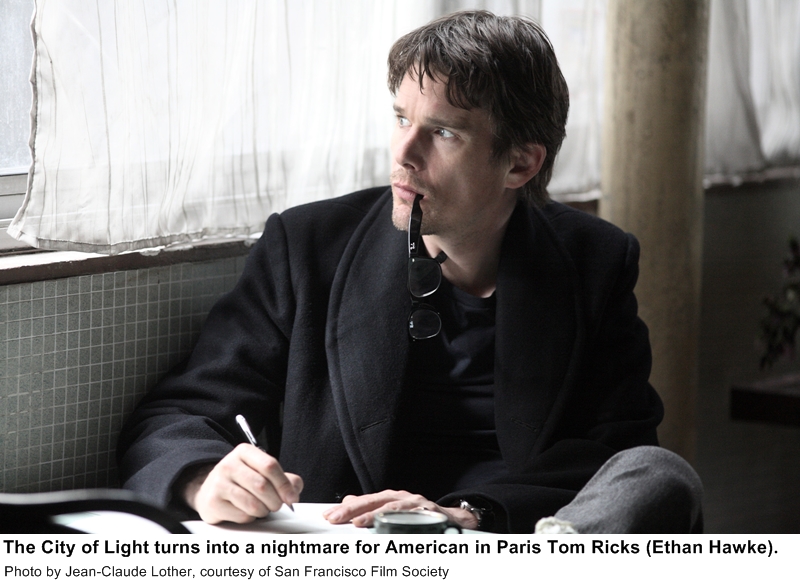
The adventures of an American in Paris, so often cast in a romantic glow in the movies, is reframed as a nightmare with erotic overtones in Pawel Pawlikowski’s sinister thriller The Woman in the Fifth. In the Polish filmmaker’s first film since his acclaimed 2004 coming-of-age drama My Summer of Love, Ethan Hawke plays Tom Ricks, a writer who travels to the City of Light to try to put his life back together and reunite with his estranged wife and young daughter. Things don’t go according to plan and after he’s robbed and left destitute, he is trapped is Paris, living a bleak existence until he meets Margit (Kristin Scott Thomas), a beautiful woman who injects some light into his life – at least that’s the way it appears at first.

At the Toronto International Film Festival where Women in the Fifth made its world premiere, Hawke and his director sat down to discuss some of the implications of a film in which things are rarely what they seem.

Q: Kristin Scott Thomas plays your lover, but at times she almost seems like your mother in some of her interactions with you, Ethan. Once that becomes apparent, then it’s easy to start reassessing Tom’s relationships with all of the women in the film. How did you keep all of the female roles straight in your head, who they were representing and who they actually were?

EH: We struggled a little bit with the title of the movie. Part of the reason why, I think, is because there’s this kind of knee-jerk thought that Kristin is the “woman in the Fifth,” and part of me started thinking that it’s more true that there are these five women: his daughter, his ex-wife, his Polish lover, Kristin and I don’t know who else.

PP: That’s four!

EH: (Laughing) Then himself! He’s the woman in the Fifth, the woman inside him. The point is that they are all these different ways of accessing aspects of himself, who we are to different people. The movie works as this kind of weird, lyrical dance of symbols, anyway. They are all something that is not exactly real. It’s a very difficult thing to verbalize, because as soon as you verbalize it, you kind of box it in.

Q: Pawel, you made a point of staying away from the more familiar landmarks of Paris, except for the Eiffel Tower, but even that is never seen full on. At one point, a chunk of it looms so close outside an apartment window that it could be an adornment in the backyard and then at times we see only the tip of it. Also, there is the visual style where everything in a scene is out of focus except for a focal point.

PP: We wanted to limit the vision of the viewer, because the hero’s vision is kind of limited. We gave Ethan these very thick glasses.

EH: I couldn’t see a thing. The movie looks the way it looks when I was doing it. I couldn’t see anything, then it would be, wow, really big!

PP: It’s a key, metaphorical, but also a literal key to the performance. He doesn’t see in depth. He sees something. He identities one thing and then doesn’t notice the layers and layers behind it. He doesn’t notice some obvious things, because he’s in his head. When you’re in your head, you only notice some things that strike you at the time.

Also, I wanted Paris to be slightly unreal. I’ve seen so many films set in Paris and I had no idea how to do it interestingly. When I went there, I kind of despaired, because I love Paris, but it’s so full of itself, it’s so obviously Paris at ever step, in every direction. It took ages to figure it out. The secret was to find strange little places in Paris that don’t look like Paris. I was looking at places that rang a bell for me, that looked like Eastern Europe from the ’70s or something.

Q: Getting back to Margit, she comes across as lover, mother and muse, a dream figure brought to life, but that’s how an outside observer sees her. How does Tom see her?

EH: It’s kind of amazing to me, as much as a symbol as you feel Kristin is, when she’s sitting there, kind of glowing and ripe asking me to come up the stairway, it’s so beautiful. When she takes him up to the roof and sings him that song, it’s some kind of other metaphor that I’m not sure – it’s not really realism either. It’s like, “What? Who says that?”

Q: He’s so lonely and she’s offering him –

EH: – some kind of solace. He is so alone. And she offers him some understanding and someone to talk poetry with, who’s read his book and says she knows him completely. I love how she says, “It’s so you,” the book. She doesn’t even know him. It’s the kind of thing people say.

PP: She’s fantasizing about him already.

EH: It’s just like women I used to date who would say, “This is just like Before Sunrise!” No, it’s not, actually. – Pam Grady


Share this:

  • Share on Facebook (Opens in new window) Facebook
  • Share on X (Opens in new window) X
  • Email a link to a friend (Opens in new window) Email
  • Print (Opens in new window) Print
  • Share on LinkedIn (Opens in new window) LinkedIn
  • Share on Tumblr (Opens in new window) Tumblr
  • Share on Reddit (Opens in new window) Reddit
  • Share on Pinterest (Opens in new window) Pinterest
Like Loading...

What’s the frequency, Kenneth? A Q&A with SAFETY NOT GUARANTEED director Colin Trevorrow

14 Thursday Jun 2012

Posted by cinepam in Interviews

≈ Leave a comment

Tags

Aubrey Plaza, Colin Trevorrow, Derek Connolly, Eternal Sunshine of the Spotless Mind, Jake M. Johnson, Karan Soni, Mark Duplass, Safety Not Guaranteed

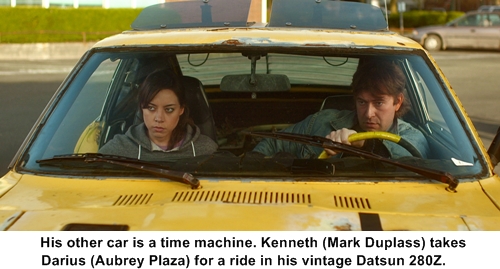
The ad that ran in Backwoods Home back in the mid-1990s began, “WANTED: Someone to go back in time with. This is not a joke.” And while screenwriter Derek Connolly and director  have fashioned their new film inspired by that classified, Safety Not Guaranteed, as a comedy, they don’t treat it as a joke. Instead, they find a lot of heart in this tale of lonely stock clerk and possibly mad, possibly genius Kenneth (the suddenly ubiquitous Mark Duplass) whose invitation to time travel draws downbeat Seattle Magazine intern Darius (Aubrey Plaza), her nerdy colleague Arnau (Karan Soni), and oily journalist Jeff (Jake M. Johnson) into his story, an unexpectedly life-altering experience for all four of them. A San Francisco Bay Area native who now lives in Vermont, Trevorrow recently returned to his former home turf to talk Safety in advance of the Sundance Film Festival hit’s theatrical release.

Q: You and Derek Connolly are writing partners. When he brought you this, how far along in the story had he gotten and were you involved with the writing at all?

A: He came to me with the script, with a draft that we then developed for a while. Derek did all of the actual writing and I think part of the job of a director is to mold the story and build a narrative that’s going to work on screen. That’s what I did, but I respect Derek’s abilities so much and I respected his voice in this so much that I really wanted to make sure that every word was his. He also gave me the gift of being able to direct this film. So we just decided, “OK, we’re both going to be producers and I’ll direct and you’ll be the writer.” It really was a collaboration, not only that part, but on set he was next to me the entire time and I would confer with him daily, even moment to moment. “What would Kenneth say here? What feels honest in this moment? What feels true?” I’m very proud of our collaboration on this movie. It’s very organic.

Q: You juggle a number of genres in the movie. Was that part of it from the start or was that something evolved as the script evolved?

A: The first draft of the script was very much a comedy, mystery, road trip movie. What we really fleshed out of it was the romantic side of it, the love story and issues of emotional time travel and how – right now, Facebook is our time machine in a lot of ways, being able to go back and find people from your past that you otherwise wouldn’t have seen. We took that, but the question of the movie was always the same, “Is this guy crazy or not?” Even though we were going to turn it into a bit more of a love story, we didn’t want to turn it into a romantic comedy where the question is, “Are these two going to end up together?” We wanted to keep the question the sci-fi question and yet still have it supported by a love story. I think in the end it makes for a movie – I don’t know if it’s tonally erratic, but there are a lot of different tones that are coming into play. For me, the big challenge was juggling all these tones and making sure that everything, like a funnel, came down to that last moment where ideally a lot of these various questions you have are going to be answered in a single sequence.

Q: The four characters in this movie are so isolated and lonely and maybe not even aware of how isolated they are until they embark on this mad project …

A: To me, it starts as a movie with a bunch of characters who all need a time machine for a different reason. It really is a movie about self-awareness in a lot of ways. The characters become more self-aware all across the board. We were trying to make a movie that was an emotional time travel film and about why we all have moments that we identify in our past that if we could just go back and change that one thing, things might be different for us. That’s a very universal thing. I find that when I ask people, “What would you do with a time machine?” when they really think about it, it comes down to something deeply personal. “I might not have said that thing to my dad that I said.” “I might not have ended that relationship the way that I did or treated that person the way that I did.” In the same way I think that Eternal Sunshine of the Spotless Mind addresses regret in a time travel kind of scenario, we could do that while also having it be fun and hilarious and have momentum and sci-fi and mystery and all those other things. – Pam Grady

Share this:

  • Share on Facebook (Opens in new window) Facebook
  • Share on X (Opens in new window) X
  • Email a link to a friend (Opens in new window) Email
  • Print (Opens in new window) Print
  • Share on LinkedIn (Opens in new window) LinkedIn
  • Share on Tumblr (Opens in new window) Tumblr
  • Share on Reddit (Opens in new window) Reddit
  • Share on Pinterest (Opens in new window) Pinterest
Like Loading...

Ezra Miller needs to talk about KEVIN

24 Thursday May 2012

Posted by cinepam in Interviews

≈ 2 Comments

Tags

Ezra Miller, John C. Reilly, Lynne Ramsay, Tilda Swinton, We Need to Talk About Kevin

In Lynne Ramsay’s We Need to Talk About Kevin, playing the profoundly disturbed son of Eva (Tilda Swinton) and Franklin (John C. Reilly), Ezra Miller delivers a stunning performance. Kevin is a duplicitous boy, feigning easygoing normalcy for his dad, but baring his true self – a malicious, rage-filled soul – to his horrified mother. For the 19-year-old who only made his big-screen debut four years ago in Antonio Campos’ Afterschool, it is a career high to date, earning him a British Independent Film Awards nomination for Best Supporting Actor. What is most striking about the young actor during a January phone call is the enthusiasm and warmth that blasts through the phone, a marked contrast to the role he so thoroughly inhabited. It is a performance not many have seen yet – the film earned under $2 million at the American box office in a limited release – but that should change now that We Need to Talk About Kevin is available on demand and coming out on DVD on May 29.

Q: How do you get into a character like this, who is so angry and so self-contained?

A: You know there’s a lot in this movie that has to do with memory. Almost the whole movie is told through the hindsight perspective of Eva. For me, the formation of the character came in a similar fashion, where obviously what composes a human being will largely be the experiences of his life before the point that we meet him. In this movie we see really sort of the highlights in Eva’s memory from Kevin’s conception. For me, it was about sort of internalizing those memories and making those memories my own, elaborating on those memories and finding the way the track of this person’s life, in combination with just who he innately was, led him to feel so much rage and aggression and hostility.

A lot of that process is simply sitting and thinking and reminiscing on a lifetime that truly was not my own, was this invented lifetime and finding the way that that forms everything from the way that Kevin moves to the way he talks to the way he looks at his mother.

Q: John C. Reilly has talked about how the story is told through Eva’s eyes and since she is not necessarily a reliable narrator, it skewed the way he played the father. Did you feel that way as well?

A: It was absolutely a matter of at certain times addressing the fact that I was playing a dream figure or a formation of someone’s memory, particularly a memory at a time in her life when she is under the weight of extreme emotions, as sort of polarizing her reminiscence of who Kevin was at various times. I would say polarization would be the most prominent factor when someone’s looking back at this experience that they – because of the nature of an event, you associate all the details with the centerpiece of that event. Perhaps at times his malice is exaggerated in her hindsight. Those were certainly considerations the whole way through except for a single scene that I personally believe to be in real time and actual.

Q: How did this come to you? Was it just another script coming through your agent or was this something you knew about and actively pursued?

A: Oh yes! Initially, it came through an agent just like any other script does, in an email. But I read it and it sort of consumed me. It became instantaneously my most passionate pursuit. I’ve truly never wanted anything more. I vehemently chased this film. I went in and auditioned for it with a casting director. Then I met Lynne the second time I went in. I was very excited about it. I spent a bizarre majority of my time considering the way to approach this character, not knowing we were almost two years away from when the film would actually be made.

The film disappeared for a while, to my absolutely horror. I was pretty consistently annoying my agent when he was trying to show me other wonderful options and things that could be great and fun. I would say, “Yes, sure, cool, whatever. What’s going on with We Need to Talk About Kevin? What’s happening with that?” It vanished for a little while, as a lot of films at that time did – it was around the time of the economic crisis. Several months later it re-emerged and I was ecstatic and then put myself back on the intense regimen of spending most of my day considering how to properly approach this character.

Q: Was the audition process still going on at this point?

A: Yes. I met Lynne for a second time and then for a third time with her companion and co-writer Rory [Kinnear] and then after that, there was a chemistry read with Tilda. So now tensions are heightening and I’m sort of starting to become a nervous wreck in all other aspects of my life. I’m walking around subway platforms terrifying people, because I’m in character. I think when I was going to that chemistry read with Tilda someone actually got out of their seat on the subway platform and moved to the other end of the platform just because I’d been giving them the Kevin stare. Then after the chemistry read, I waited two weeks, just chewing every available part of my body. Any part of my body that my mouth could reach, I would chew incessantly.

Q: Was the chemistry test the end of the auditions?

A: I got a call from Lynne and she just had this specific thing that she really wanted to do. She wanted to see the last scene, because we’d been doing all these other scenes from the film and there’s an extreme difference in that last scene. There’s something new. We see a mask drop, we see a performance slip, Kevin’s performance. That’s really a key factor of that character, that pretty much all of the time that we see him, he is performing. So to see that change, to see that sort of glimpse through the facade, it was essential for Lynne to see.

She told me to come on Saturday and she meant Sunday. I came on Saturday and was waiting in the lobby and she had already left the building, but fortunately, she had forgotten her cell phone, so she came back and saw me there. “Oh my God, I’ve made such a mistake! Oh no, I’m so sorry! Why don’t you just come and have a drink with us?” I was not at the time old enough to drink. I’m still not old enough to drink by technical New York City/United States law, but I came and sat with them in this pub near the place where they were staying and we talked for about four hours about the movie and about the scene we were going to do the next day and the character. I really think that was sort of an invaluable accident. I think we were able to truly connect and understand that we felt and saw many of the same things for this film. So we said goodbye and I came back the next day. We did the scene and by the end of the scene, everybody was crying.

I still had to wait for another two weeks. At this point, most of my my body was down to bone. Then she cast me, so it was fortunate that I chewed myself down to bone, because then I had to lose 20 pounds to be the malnourished Kevin. That’s sort of the epic saga in its entirety.

Q: Lynne has said that one of the things that impressed her about you is that you were not intimidated by Tilda Swinton. Was that true from that first chemistry read or did that just fall away as you got to know her?

A: (Laughs) I wouldn’t say I wasn’t intimidated by Tilda Swinton. That seems like the highest form of hyperbole, but certainly when I entered that chemistry read, I was for the most part sort of within the mind frame of the character. When I met Tilda, obviously I stepped out of the mental initiative of that character and met Tilda, but still in sort of my emotional core was carrying this hatred, disgust and resentment. I think that sort of masked the true emotion, which was absolute admiration and a feeling of laudation toward Tilda, who has been one of my heroes in this art form for a long time. I think it was a convenient deception. It just sort of turned out that way. – Pam Grady

Share this:

  • Share on Facebook (Opens in new window) Facebook
  • Share on X (Opens in new window) X
  • Email a link to a friend (Opens in new window) Email
  • Print (Opens in new window) Print
  • Share on LinkedIn (Opens in new window) LinkedIn
  • Share on Tumblr (Opens in new window) Tumblr
  • Share on Reddit (Opens in new window) Reddit
  • Share on Pinterest (Opens in new window) Pinterest
Like Loading...

Playful Alan Arkin skates on THIN ICE

16 Thursday Feb 2012

Posted by cinepam in Interviews

≈ Leave a comment

Tags

Alan Arkin, An Improvised Life, Billy Crudup, Bob Balaban, David Harbour, Greg Kinnear, Harry Belafonte, Jill Sprecher, Karen Sprecher, Lea Thompson, Little Miss Sunshine, Norman Jewison, Second City, The Russians are Coming The Russians Are Coming, Thin Ice, Thirteen Conversations about One Thing

In the dark crime comedy Thin Ice Alan Arkin plays Gorvy Hauer, an old man in possession of a valuable violin that crooked insurance agent Mickey Prohaska (Greg Kinnear) is desperate to get his mitts on. Director Jill Sprecher shot her Kenosha, Wisconsin-set film in Minnesota in the snowbound winter and the memory of that frigid location elicits a cringe and a snort of laughter from Arkin.

“That was rough,” he says. “That goes on my list of things I don’t want to do anymore. Poor Greg. Greg had it the hardest, because he had to be out on the ice in 10 degree below weather with no coat on and no long johns. He had the roughest time of anybody.”

Arkin is taking a few minutes to chat while he waits for a car that will take him to the Salt Lake City airport after a screening of the movie – then called The Convincer – at the 2011 Sundance Film Festival. He worked with Sprecher and her co-writer sister Karen before on 2001’s Thirteen Conversations about One Thing and that experience was so positive that when he came on board the new movie it was not just as an actor, but as an executive producer. It is only the second time he’s that done that – the last time was in 1979 when he made The In-Laws.

“I helped with the casting to a certain extent,” he says. “I got scripts to people that Jill and Karen didn’t have access to. I felt that it gave me the right to shoot my mouth off every once in a while when I felt a scene needed work, but they didn’t have a problem with that because Jill and I had a very comfortable working relationship from before. It was enormously amicable and comfortable.”

It was also the perfect situation for Arkin, who at 77, no longer wants to tolerate the confinement of a script. He’s an actor who likes to play and Sprecher gave him the room to do that.

“I’m too improvisatory,” he says. “I need to play. I’m not happy being locked into something tightly. And it’s getting more that way. I used to be able to submit to a script word for word. I can’t find it in me to do it anymore.

“My methods are very, very spurious these days. I’m kind of a maverick, I guess” he adds. “This was basically a character I’ve been wanting to play for about 20 years. I used to think in those terms. I used to think of fun characters that I would like to play at some point or another. I looked at the script and I saw that here was a good place to play it. I said, ‘Jill, how would you feel if the character was a guy like this?’ She thought it was great. Basically a Midwestern farmer pushed farther. He has a kind of ridiculous innocence about him that was kind of fun for me – boring to the point of annoying. That kind of tickled me. And sweet – a sweet, little boring guy.”

Arkin made his screen debut in Norman Jewison’s 1966 ensemble Cold War comedy The Russians Are Coming, The Russians Are Coming, garnering a Best Actor Academy Award nomination for his efforts. He won an Oscar for Best Supporting Actor for his role in yet another ensemble comedy 2006’s Little Miss Sunshine, the film that also marked his first time acting opposite Kinnear. Thin Ice with a cast that includes – in addition to Arkin and Kinnear – Billy Crudup, Bob Balaban, David Harbour, and Lea Thompson is another group effort, a further enticement for Arkin to sign on to the movie.

“I think of myself as a team player. I feel like my work is worthless unless I’m working with people I can really bounce off of and get stuff from, get surprises from and throw surprises to,” he says. “That to me is the whole joy of acting. To me, the whole joy of being an actor is ensemble. I teach improvisation and that’s the emphasis I have, how to serve the entity rather than looking for your own self-aggrandizement.”

Arkin’s attitudes about humor, improvisation, ensembles, and an actor’s place within a play or movie were shaped early. In 1960, he joined the fledgling Second City troupe in Chicago. In An Improvised Life, the memoir that he published last year, Arkin wrote that he considers his time with the group to mark the real start or career. He feels that way despite the fact before he joined Second City, he was a musician and composer (he co-wrote “The Banana Boat Song,” made famous by Harry Belafonte) and had even already tasted improv in 1959 when he joined the Compass Players in St. Louis.

“If I know anything at all about comedy it’s from working at Second City,” he says. “I didn’t think I was funny at all when I got there. I had to learn. It came through working on characters. Now I don’t feel like I’m particularly funny as me, but when I put on a particular character I feel like there’s humor in that. In a nutshell, of all the myriad things I learned there, the two most important were, first, we were allowed to fail. People used to come to the theater and know that 30% of what they saw every night was not going to work, because it’s improvisatory and they knew if the first thing’s not going to work, then the next thing might be great, something they’d remember 50 years later. That was an enormous thing, the fact that we took chances every night. That was the first thing.

“The second thing was that on any given night, we would play sometimes 15 or 20 characters, sometimes in a two-minute scene, sometimes in a 15-minute scene. We were doing operas. We were doing pantomimes. We were doing every conceivable kind of theater. I got about 30 years of training in the two years that I spent there. It was a miracle. It was an extraordinary adventure.”

These days he puts that training to use on nearly every movie he makes. He’s written screenplays and directed movies and plays. He can see where scenes need work and dialogue needs tweaking. Before he signs on to a film, he talks it over with his director to make sure that he will have the leeway he needs to improvise.

“People recognize that that’s the way I work and it doesn’t seem to hurt the films adversely, so they take a deep breath and jump in with me,” he says.

“I like working with people that don’t have a big agenda, who have a certain amount of flexibility, who want to play. These days I want to have fun. If the element of play – it’s call a play, after all – isn’t in it, it’s exhausting. I’m too old to be exhausted anymore by the work.” – Pam Grady

Share this:

  • Share on Facebook (Opens in new window) Facebook
  • Share on X (Opens in new window) X
  • Email a link to a friend (Opens in new window) Email
  • Print (Opens in new window) Print
  • Share on LinkedIn (Opens in new window) LinkedIn
  • Share on Tumblr (Opens in new window) Tumblr
  • Share on Reddit (Opens in new window) Reddit
  • Share on Pinterest (Opens in new window) Pinterest
Like Loading...

Werner Herzog stares INTO THE ABYSS

13 Sunday Nov 2011

Posted by cinepam in Interviews

≈ Leave a comment

Tags

Cave of Forgotten Dreams, Death Row, Into the Abyss, Werner Herzog

Next year, Werner Herzog will bring Death Row, four hour-long documentaries spotlighting death row inmates, to television. The case of Michael Perry, who along with a partner murdered three people in Conroe, Texas in a scheme to steal a red Camaro, was to have been part of the series. But the more Herzog delved into it, the more dimensions Perry’s story took on until the filmmaker realized it was a larger tale than the miniseries could contain. His latest feature documentary, Into the Abyss, was born.

“It was so mind-boggling, because of the senselessness of the crime and all of the ramifications and repercussions of it that I thought, ‘This is epic, this is a big movie,” says Herzog during a recent visit to San Francisco.

Herzog’s second documentary this year, Into the Abyss sets up quite a contrast with the first, Cave of Forgotten Dreams, a tour of cave paintings – the earliest human artwork yet discovered – in France’s Chauvet Cave. But while on the surface one film shows the worst of humanity and the other the best, Herzog observes a thematic link between the two.

“Into the Abyss could have been the title of many of my films, let’s face it,” he says. “In some of my feature films, as well, I am always trying to look deep into the human heart, into the human condition – and when you mention Cave of Forgotten Dreams – into the recesses of human prehistory. There’s an always an attempt to try to illuminate what’s deep inside of us, and in this case, of course, a dark side of human existence.”

Herzog is opposed to the death penalty under any circumstance, yet Into the Abyss is no screed. He simply lets the people involved tell their own stories. Among these are Perry, who the director interviewed only once, eight days before his 2010 execution; Perry’s partner Jason Burkett, who is serving a life term; Burkett’s father, Jared, himself a lifer; the daughter and sister of two of the victims; the brother of another; a prison chaplain; and a former head of the “tie-down team,” essentially an executioner. It is a bleak, ugly tale of wasted lives and heartbroken families. Yet within it, Herzog also found something to celebrate.

“In Into the Abyss, you see some of the best of the best,” he insists. “When you look at the former captain of the tie-down team, for me, he’s like a national treasure. His weight should be measured in gold. In early antiquity, you would weigh a good man in gold and he’s one of those. I really like to find these kind people in the heartland of America. I love most of America. I’m not really into Texas bashing – when you look at a man like that, yes, he’s a Texan.

“When you look at the young man [an acquaintance of Perry and Burkett] who was in a fight and stabbed with a 20-inch screwdriver through his chest, in a life-threatening attack and a friend of his throws him a knife, and he looks at the knife at his feet and he doesn’t pick it up, because he wants to see his kids at night, this is a heroic act,” he adds. “ And the man has been an illiterate until recently and you look at him and you see a man who has committed a true heroic act. I really love these people, so it’s not just the dark side. It’s the best of the best.”

Herzog insists that the film is not meant as a commentary on the criminal justice system. The murders occurred in 2001. What happened at Perry’s arrest, his trial, and appeals does not concern him. Instead, the story touched him on a more personal level. He points out that the full title of the film as it unreels in the opening credits is actually Into the Abyss: A Tale of Death, A Tale of Life.

“It has to do with life as much as it has to do with death, of people who were murdered or capital punishment, execution” he says. “There is the urgency of life, which somehow came out of the whole material. It has to do with survivors, it has to do with families of victims of violent crime, and the film is dedicated to them.” – Pam Grady


Share this:

  • Share on Facebook (Opens in new window) Facebook
  • Share on X (Opens in new window) X
  • Email a link to a friend (Opens in new window) Email
  • Print (Opens in new window) Print
  • Share on LinkedIn (Opens in new window) LinkedIn
  • Share on Tumblr (Opens in new window) Tumblr
  • Share on Reddit (Opens in new window) Reddit
  • Share on Pinterest (Opens in new window) Pinterest
Like Loading...

O Stoner Night: John Cho on HAROLD & KUMAR’s Xmas Adventure

04 Friday Nov 2011

Posted by cinepam in Interviews

≈ Leave a comment

Tags

A Christmas Story, A Very Harold & Kumar 3D Christmas, After Hours, Danny Trejo, John Cho, Kal Penn, Martin Scorsese, Neil Patrick Harris

In San Francisco to promote A Very Harold & Kumar 3D Christmas, the third of the outrageous and outrageously funny stoner comedies that he has starred in with Kal Penn, John Cho ponders just what it is that accounts for the success of the franchise.

“I always feel like the key to doing a Harold and Kumar movie is you make it earnest,” he says. “And primarily what we do is make Harold and Kumar’s relationship and friendship believable. If Harold and Kumar are real and set up – as they always are – as a romance between the two guys in a tale of love, then almost anything goes around them. I feel that that’s the key and you just do that. I feel that this a Christmas romance movie between two men. If you just do that and have everything else happen around them, I feel like that’s the formula if there is one.”

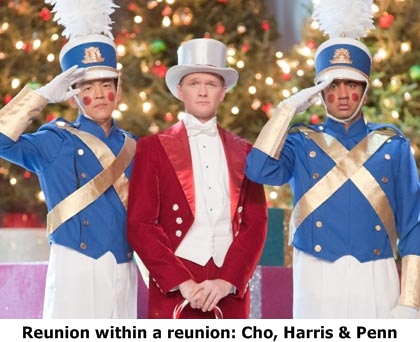
In the latest installment of the pals’ continuing adventures, the movie opens with that bromance on the skids. Kumar (Penn) is still a stoner and a screw-up, while Harold (Cho) is successful in business and in his marriage. The hunt for a Christmas tree good enough to please Harold’s disdainful father-in-law Mr. Perez (Danny Trejo) and perhaps earn Harold a little of the old man’s respect brings them together. Chaos reigns in a movie that could be the Yuletide cousin to Martin Scorsese’s After Hours as bad breaks and bizarre encounters dog them through the night. There is even a reunion within the reunion as Harold and Kumar wander into a theater and are thrust on stage to back up their old friend Neil Patrick Harris in a holiday extravaganza.

“The song-and-dance number was the most delightful thing to film,” Cho says. “I was up close and personal watching the triple threat that is Neil Patrick Harris, the triple-named Neil Patrick Harris. Triple-named, triple threat. It was just so preposterous to me that in a Harold and Kumar movie, I would be doing this old Hollywood dance number. That’s the absurdity of that world, and to me, there’s no better example of that absurdity than us in toy soldier costumes.”

The laughs in A Very Harold and Kumar 3D Christmas are strictly adults only, including a preposterous, ribald tribute to the family classic A Christmas Story. Despite that bawdy humor, the movie perfectly evokes the holiday spirit and Cho thinks he knows why.

“We’re both paying homage to and perverting Christmas tradition,” he says. “Harold and Kumar, and hence the movies, are pretty well meaning. There’s a lot we couldn’t get away with if the movies at their core didn’t have that. There’s an innocence to it. Like this movie is a perversion of Christmas movies, but it’s also very traditional and it affirms family values and it’s about love between the two guys and it’s about love between their significant others. At their heart, that’s what they’re about, strangely enough, and the movies have a rather childlike, innocent attitude about them.” – Pam Grady

“

Share this:

  • Share on Facebook (Opens in new window) Facebook
  • Share on X (Opens in new window) X
  • Email a link to a friend (Opens in new window) Email
  • Print (Opens in new window) Print
  • Share on LinkedIn (Opens in new window) LinkedIn
  • Share on Tumblr (Opens in new window) Tumblr
  • Share on Reddit (Opens in new window) Reddit
  • Share on Pinterest (Opens in new window) Pinterest
Like Loading...

Terror in Three Dimensions: Joe Dante on Making The Hole

07 Friday Oct 2011

Posted by cinepam in Interviews

≈ Leave a comment

Tags

Castro Theatre, Chris Massoglia, Dial M for Murder, Gremlins, Jesse Hawthorne Ficks, Joe Dante, Matinee, Midnites for Maniacs, Nathan Gamble, Small Soldiers, Teri Polo, The Hole

“Joe Dante knows a little something about fear. The director of such movies as Gremlins, Matinee, Small Soldiers and 2009’s The Hole – which makes its U.S. theatrical debut in Digital 3D as part of Jesse Hawthorne Ficks’ Midnites for Maniacs’ series at San Francisco’s Castro Theatre on Friday, October 7 – grew up on the emotion.

“When I was a kid, I was afraid of the bomb dropping, as you can see in Matinee,” he reveals in conversation at the 2009 Toronto International Film Festival where The Hole made its North American premiere. “People forget that kids in the ’50s lived with this knowledge in the back of their heads that any minute the world could end. It was just something that was carried around. We knew it like how you knew your blood worked and stuff. It was just a fact of life.”

Terror is also a fact of life for the siblings at the center of The Hole, brothers Dane (Chris Massoglia) and Lucas (Nathan Gamble). Already upset because their mother Susan (Teri Polo) has uprooted them from Brooklyn’s urban bustle to apparently sleepy Bensonville, life gets more interesting and a heck of a lot scarier when they discover a padlocked door on the floor of the basement. Like modern-day Pandoras, the boys can’t resist peeking and they inadvertently unleash their own worst fears.

Ever since 1984’s Gremlins‘ phenomenal success, Dante has been a go-to guy for producers seeking a director who is good with horror and good with kids. He admits he sometimes get frustrated with the typecasting, but he is always open to a crackerjack script.

“I wish I could say that I am attracted like a moth to the flame to these stories, but that’s not really the truth,” he says. “The truth is I get offered this kind of material, because I’ve done it in the past. And obviously, I can relate to it. I have a dictum that I operate under, which is that I will not make a movie that I wouldn’t go see.

“When I was offered this picture, part of me went, ‘Another movie with kids and special effects?’ But then another part of me went, ‘Gee, this is awfully good and I know I could do something with this.’”

One of the things that struck the director about Mark L. Smith’s screenplay was that even with all the fantasy and horror elements, there was still a core of realism to Dane and Lucas’ situation.

“I could believe this family,” he says. “I could believe the way that they talk, the way that they act. These are not movie kids. This is not a Disney channel idea of life.”

When Dante was growing up in the ’50s, he loved those movies that were the manifestations of the nuclear world that he feared, movies like Them and the other radiated monster movies. The Universal horror movies from the 1930s that he watched on television he describes as his folklore and fairy tales. But he also grew up during the first wave of 3D. With The Hole he was given a chance to use the format for himself. He thought back to those old movies as he decided just how to employ the technology in his own work.

“You can’t constantly throw things at people or else it loses its effectiveness,” Dante observes. “My favorite 3D movie is Dial M for Murder, which was one of the last 3D pictures produced then, not shown in 3D originally, and it saves its breaking the frame stuff for a couple of moments and they’re very striking because there’s not a lot of other stuff like that.

“Also, it’s a movie that’s staged – it’s like a play, really – it’s staged in depth,” he adds. “There are foreground objects that mean something. There are characters standing in front of people or behind people. To me, I think that’s what the future of 3D should be. We all know that you can throw things at people and we all know that we can do breaking-the-frame gags, but I think there’s a drama to storytelling that can be enhanced by 3D. I reject the idea that it’s just for gimmicks and just for exploitation, that it’s just for throwing eyeballs at the audience.”

He had to shoot quickly, so Dante feels he only scratched the surface of 3D’s capabilities, but he is pleased with what he was able to accomplish.

“It’s not an expensive film; we didn’t have much time to make it, but I think given the subject matter, it’s as good as we could make it,” he says.

Dante is scheduled to be on hand for the Midnites for Maniacs The Hole screening and to take part in a Q&A with Jesse Hawthorne Ficks. The Castro Theatre is the perfect venue for the movie’s theatrical premiere, its cathedral-like dimensions reflecting the 64-year-old auteur’s vision of movie going.

He says, “When the lights go down in a theater, to me it’s like going to church.” – Pam Grady

________________________________________________________________

The Hole plays Midnites for Maniacs along with The Goonies and Gremlins 2: The New Batch on Friday, October 7 at the Castro Theatre, 429 Castro Street, San Francisco. For further information, visit http://www.castrotheatre.com.

Share this:

  • Share on Facebook (Opens in new window) Facebook
  • Share on X (Opens in new window) X
  • Email a link to a friend (Opens in new window) Email
  • Print (Opens in new window) Print
  • Share on LinkedIn (Opens in new window) LinkedIn
  • Share on Tumblr (Opens in new window) Tumblr
  • Share on Reddit (Opens in new window) Reddit
  • Share on Pinterest (Opens in new window) Pinterest
Like Loading...
← Older posts
Newer posts →

Categories

  • Interviews
  • News
  • Reviews
  • Short Takes
  • Uncategorized

Recent Posts

  • A Stamp of Approval
  • Life is messy & so is ‘Megalopolis’
  • A star discovers too late there are worse things than aging in the black comic body horror ‘The Substance’
  • A young teen nurses a crush when he finds himself among ‘Big Boys’
  • The stunt man becomes the star as Ryan Gosling becomes THE FALL GUY

Archives

Blog at WordPress.com.

  • Subscribe Subscribed
    • Cinezine Kane
    • Join 48 other subscribers
    • Already have a WordPress.com account? Log in now.
    • Cinezine Kane
    • Subscribe Subscribed
    • Sign up
    • Log in
    • Report this content
    • View site in Reader
    • Manage subscriptions
    • Collapse this bar
 

Loading Comments...
 

    %d