• About

Cinezine Kane

Cinezine Kane

Category Archives: Interviews

Q&A: Andrew Garfield returns to his intimate drama roots with 99 HOMES

02 Friday Oct 2015

Posted by cinepam in Interviews

≈ Leave a comment

Tags

99 Homes, Andrew Garfield, Martin Scorsese, Michael Shannon, Ramin Bahrani, Sacrifice, Tim Guinee

99Homes_00014_lo“We are a sea of Willie Lomans, trying to be known, trying to be known in fucked up ways, in the ways that we’re told to be known through these really fucked up values,” says Andrew Garfield in talking about Dennis Nash, the desperate Everyman he plays in 99 Homes.

Ramin Bahrani’s (Man Push Cart, At Any Price) latest drama is one of the best films of the year, an evocative portrait of the fallout from the 2008 economic meltdown that left so many homeowners with underwater mortgages or facing foreclosure. A construction worker at a time when all construction stops cold, unemployed single-dad Dennis loses the house he grew up in and that he now shares with his mother Lynn (Laura Dern) and his young son. The devil in the form of e-cigarette smoking, amoral realtor Rick Carver (Michael Shannon) offers him a form of “salvation” by giving him a job working on foreclosed homes, assuring him that he’ll earn enough to buy back his. But Dennis is smart and personable and soon Carver recruits him to help him with his main business: repossessing homes and evicting homeowners and their tenants on behalf of the banks. It’s something Dennis believes he has to do in order to take care of his own family, but as he meets more and more people like Frank Green (Tim Guinee)—whose circumstances are similar to Dennis’ own—he begins to question his role in adding to so much pain.

For Garfield, 99 Homes is a return to the kind of intimate dramas he made before the Spider-Man franchise made him a household name. Like the paroled child murderer in Boy A, the reporter trying to expose the crimes of the powerful in the Red Riding trilogy, or the boy born for organ-harvest in Never Let Me Go, Dennis Nash is caught in an impossible circumstance with limited options. On a recent visit to San Francisco, the 32-eyar-old Brit talked about the film and offers some words about working with director Martin Scorsese on his upcoming film Silence.

Q: It struck me that this relates to a lot of work you did earlier in your career, even something like Never Let Me Go, which is an ostensibly dystopian drama—

Andrew Garfield: As is this!

Q: Well, yes, but this is something actually happening. So far, no one’s been born to give their body parts away. But it is kind of the same thing where there are the have-nots that are meant to serve the haves. I was wondering if that theme particularly resonates with you.

AG: Yes, as it obviously does with you. I’m heartbroken, to be honest. Yeah, I’m heartbroken, because there are people that are being born to be sacrificed for someone’s Porsche or yacht or gate around the gate they already have with the barbed wire on top. It’s insidious and it takes real vision to be able to really see it and then what do you with that vision? What the fuck do you do?

I think I feel that split in myself. It’s personal, because it is. I have a friend going through it right now. I have a friend who’s fighting eviction, unlawful, in London right now. She lives in a progressive community in London, which has been there since the ‘50s or ‘60s. And there’s a guy that’s been there for 50 years. That’s his life. That’s his livelihood. That’s his community. That’s his home. This new private housing group is attempting to steal, ostensibly steal their homestead. There’s such inhumanity in it. There’s such distance and separateness and looking down their noses at these people from on high.

I’m not saying anything, apart from I feel it in a very deep way and I don’t know what to do about it. Apart from tell a story, which part of my job here, in this life, is to tell a story and maybe move the conversation forward in a way. In a baby-step way, just as being a part of telling a story.

Q: Can you talk about working with Michael Shannon and Tim Guinee. The three of you are just amazing and I think Tim Guinee is one of the most underrated actors around.

AG: He’s a great actor and such a lovely man, such a good man. I’m glad you said that. Thanks for saying that. Again, with Tim, I had so much fun with Tim. He’s so fun to be with. That nature of the relationship we had to create was really deep. We had to feel like brothers. I had to feel like he was my brother.

With Michael, it was interesting, because obviously I had more time with Michael and there was this deep love and respect that we had for each other. Even as characters, I think, even though it’s never expressed—it got close to being expressed—during the scene on the dock where we’re both a little bit confessional. Working with Michael is always so powerful. He’s got such powerful energy, so I had to make sure that I could match it and kind of crawl out of it somehow or beat my way out of it. That was an awesome challenge, because not only is his stature so big—he’s got big physical stature, but internally as well, he has power. That was a great challenge for me to match and to make sure I was a match for him. Then with Tim, it was just trying to find that deep connection and love and feeling of community.

My favorite times in my life while working is with other artists who are just there and you kind of don’t know where they’re going to go. Thank God, both of them have that ability, so I could follow and then I could lead and then I could follow. We could just dance. That majority was improvised. What I said to Ramin was, ‘I love the script and I love the essence of the journey. If I’m going to do it, I want it to feel found.’ Because as I read it, I knew there were all these vignettes of me doing evictions and me doing cash for keys and all this stuff. And I knew he was going to hire non-actors and I was like, ‘I want to be a non-actor as well. I don’t want to have any baggage. I don’t want to get it right. I want to get it wrong over and over and over again.’ He was really up for that for the most part. I’m lucky. I’m so lucky that I get to—so the short answer is I’m so lucky that I get to work with such great artists.

Q: Do you have a favorite role or is it what you’re working on right now?

AG: Every one is necessary, I think, so far, has been necessary for me to do. I don’t know if I can say a favorite. I can say that some experiences—no, every experience gave me something that I needed to get or that I needed to know. The thing that I just did, this film, Silence, with Martin Scorsese is some kind of rediscovery of how process can be with someone who knows exactly that they don’t know anything. His process is so intuitive and spontaneous and he’s so confident in his roaming and rambling and then he’ll go, ‘OK, no, it’s this. I know exactly what I want. Heheheh.’ Then another scene will come by and he’ll be, ‘I don’t know what this is. How do we do this? OK, what do you think?’ ‘Well, I’ll just do it and you can tell me.’ Then he’s like, ‘That wasn’t really it.’ I’ll go, ‘OK, well, what is it?’ ‘I don’t know.’ I’ll go, ‘OK, how about this?’ ‘That wasn’t it, either. Just keep trying.’ That’s real creativity. It’s not like you hit this, you hit this, and then you hit that. It’s like, ‘Let’s fucking get lost and scared and be in torture and agony until something real happens.’

That’s who he is and that was very fucking special. I think that kind of confidence comes with—not to use the word genius. Genius, I think, in our culture suggests only a few people. Actually, the origins of the word are that everyone has one. We all have the archetype of the genius within us and it’s just a case of finding out what that is individually. Obviously, his genius is filmmaking, storytelling, and that’s where his love and his passion live. So I think it’s possible for him to be in that free-flowing space, because of his genius and because of confidence in his genius to be lost and to roam around and to collaborate and to be open to whatever things are coming.

That’s the kind of creative process that I want to keep practicing as opposed to this rigid, I know I have to get it right, get it right, get it right, fucking nail it. I hate that. ‘You fuckin’ nailed it, bro!’ No! I fuckin’ want to make some wrong hits and then maybe one ‘Ping!’ And then a bunch of wrong hits. Ramin said a very beautiful thing to me when we first started working together. He said, ‘You know, the Persians, the Persian rugs, these really beautiful things, these beautiful, perfect things. They make these things and they turn them over and they get a knife and they slash the back, just so they know that nothing is ever perfect, as a practice, to go perfection is the enemy of the good.’ –Pam Grady


Share this:

  • Share on Facebook (Opens in new window) Facebook
  • Share on X (Opens in new window) X
  • Email a link to a friend (Opens in new window) Email
  • Print (Opens in new window) Print
  • Share on LinkedIn (Opens in new window) LinkedIn
  • Share on Tumblr (Opens in new window) Tumblr
  • Share on Reddit (Opens in new window) Reddit
  • Share on Pinterest (Opens in new window) Pinterest
Like Loading...

The Mountain Men: Q&A with MERU’s Conrad Anker & Jimmy Chin

24 Monday Aug 2015

Posted by cinepam in Interviews

≈ Leave a comment

Tags

Conrad Anker, E. Chai Vasarhelyi, Jimmy Chin, Meru, Renan Ozturk

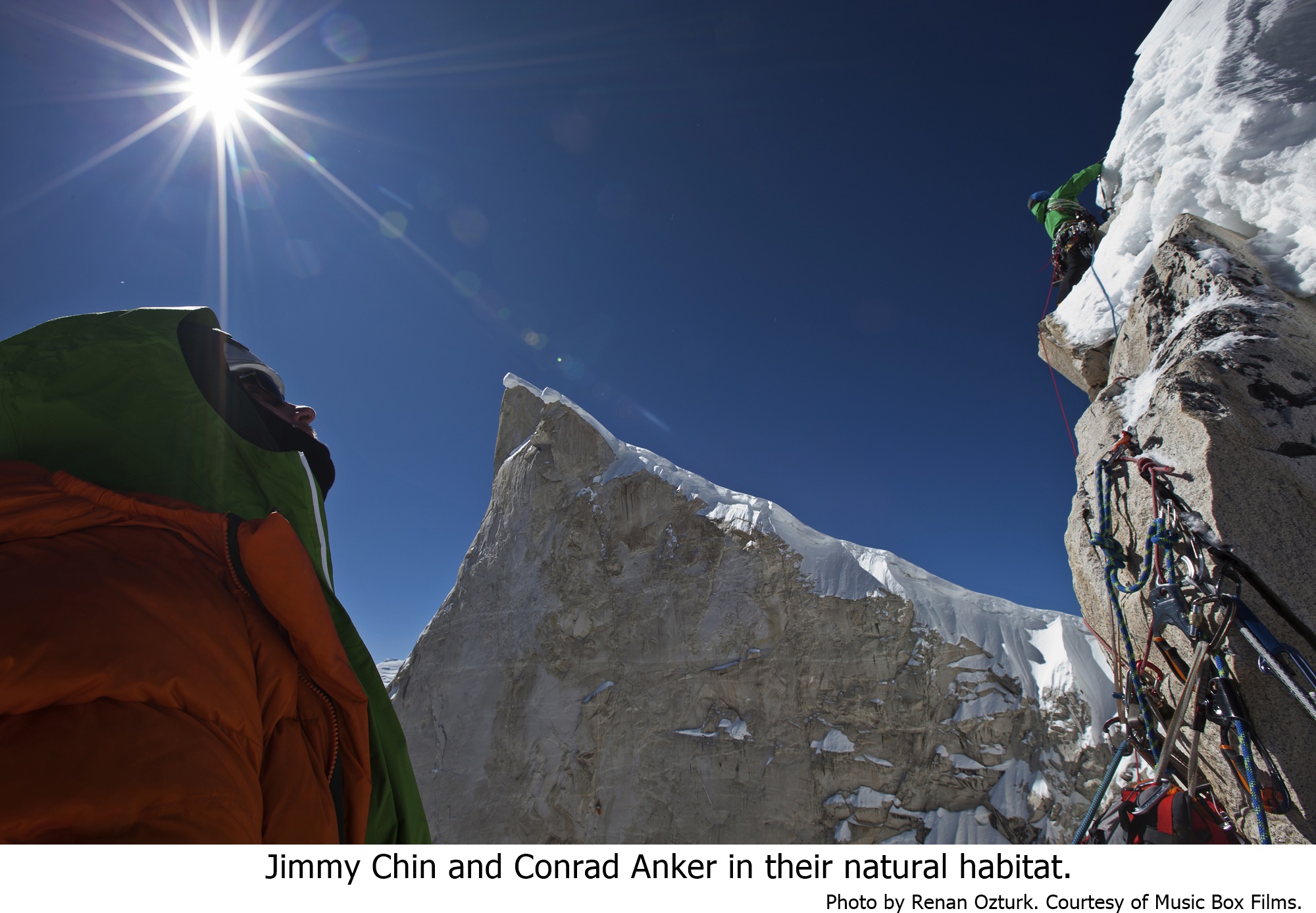
Meru - 2Conrad Anker is one of the greatest mountain climbers on his generation, someone who has scaled peaks from Alaska to Antarctica. In 1999, as part of the Mallory and Irvine Research Expedition to Mount Everest, he found George Mallory’s body 75 years after the pioneering mountaineer vanished during an attempted ascent. Jimmy Chin is a photographer, skier, and climber whose accomplishments have included first ascents in Asia’s Karakoram mountain range and skiing down Everest. Longtime climbing partners, the pair and their friend Renan Ozturk, dreamed of being the first to conquer a peak that has bested many a climber, the Shark’s Fin, a peak on Mount Meru in India, 21,000 feet above the Ganges River. Meru, a breathtaking and intense documentary, directed by Chin and his wife, E. Chai Vasarhelyi, and shot by Chin and Ozturk, spins the tale of two expeditions undertaken by the trio in 2008 and 2011 along with their compelling backstories.

The film, the documentary audience award winner at this year’s Sundance Film Festival, is in theaters now where its awe-inspiring images deserve to be seen. Chin and Anker visited San Francisco recently in support of Meru. They are an amiable pair, which isn’t surprising. The film is as much a record of a friendship as it is breathtaking achievement. Their natural habitat may be a precarious alpine perch, but four years after the second expedition and eight months since they started talking about the film at Sundance, they are happy to sit in the confines of a small office and chat about it some more.

Q: How does it feel to be down on the ground again? Or, I guess I should say, how does it feel when you are down on the ground?

Jimmy Chin: I think we both prefer not be on the ground, normally. We like to be climbing. Your senses are a little bit more firing when you’re climbing. But when we first got down after 2008—I think that feeling’s always very similar. There’s just this tension that, which we love, but after a very sustained amount of time, there’s a big sense of relief. I think the best moment is when we drop the harnesses off and you let them hit the ground. You haven’t been able to drop anything in two weeks. All of the sudden, there’s this moment where you can drop stuff on the ground and it’s almost amusing that you’re not going to lose it forever.

Conrad Anker: Climbing has a nautical background. The word “belay” comes from maritime. Carabiners were adapted from the maritime. All these things, there’s this connection. The metaphor we like to look at it is we are sort of sailors in the sea of gravity. So when you’re out at sea, if you go over the edge of your boat, you’re going to drown or get really cold—it’s not going to be good unless someone rescues you pretty quick. Here, the metaphorical sea is gravity. If we let go of the equipment or drop the rope, we’re going to be stranded there, on this wall. So there’s that same similarity. It’s like when you come back to land, if you’ve been at sea two or three days, the first five minutes you’re walking on land, ‘Is it still the swaying of the boat?’ ‘Are we back down?’

Q: What was the first climb you two did together?

Conrad Anker: We climbed in Tuolumne Meadows probably 15 or 16 years ago. Then we did a trip to the Palisades range in the Sierras here. Then Pakistan, Tibet, yeah, we’ve been—Jimmy’s my main man.

Q: When you are starting a new climbing partnership, how do you do know it’s right? You’re going up with someone you’ve never climbed with before. That takes a great amount of trust.

Conrad Anker: We get to get to know each other on a local cliff and shorter climbs, but I’ll know within 15 minutes if I’m going to spend time with a person. That’s how I survive the mountains, because I’m assessing the situation and things like that…Some climbers are completely scattered and some climbers are accident-prone. Some climbers are full of themselves. I don’t want to go do a climb with them.

Jimmy Chin: Obviously, for me, there was no question about his legacy and his history as a climber. He was clearly one of the great climbers of his generation. The bigger risk was me for him, because I was this kid that just showed up and didn’t have much of a history.

Q: You begin with a shot of the top of Meru and then a shot of your portaledge suspended below the summit. It looks so precarious and really brings home just how vulnerable you are when you’re climbing and exactly what kind of risks you’re taking.

Jimmy Chin: Yeah. The weather conditions up there, if it gets bad, and you’re stuck up high, it’s like a tempest. You are very exposed. You’re in one of the most exposed places in the world. It keeps it interesting.

Q: What kind of extra challenge does it place on you to be filming? And what kind of difference has the advent of lightweight camera made for you?

Jimmy Chin: I think this film is really made possible by the DSLR revolution that happened. The Canon 5D came out and all of the sudden—I’m a still photographer, too—I had this tool that I could shoot both stills and much more cinematic footage that wasn’t possible before. Renan and I would trade cameras. He would shoot when I was climbing and I would shoot when he was climbing. You could shoot this type of material before, but it wouldn’t look the way it does now. That changed, the quality of the footage.

In terms of the extra challenge of shooting, it’s a matter of bandwidth. You’ve got a certain amount of bandwidth and a certain of energy and a certain amount of daylight. You have to parse that out between the climbing and the shooting. On a climb like this, you’re always a climber first. In a way, you have to be hyper-efficient, because it’s through your efficiencies that you can find the bandwidth, the time and moments, to shoot.

Q: At what point, did you realize that you had an extraordinarily dramatic story? Because this movie isn’t just about trying to conquer this apparently unconquerable mountain, all three of you have incredible backstories that makes the film that much more intense.

Jimmy Chin: Probably not fully until 2011, after the second climb. I was pretty much focused on surviving…I did know that I wanted to shoot this in the best possible way. Really, because in 2008 we got this footage and we shot a little bit, mostly for posterity, and we looked at and just like the climb, I was like, ‘Oh man, we could do this so much better.’ I started thinking about it as a shooter, as well as a climber. We thought about the climb the second time, ‘How can we do it better? What can we do with less of? How can we trim this down and create a tighter program?’ It was the same with the shooting. I got motivated to shoot it a lot better, but I wasn’t thinking so much about shooting it a lot better for the sake of a film. I thought of it more as shooting it better for the sake of shooting it better. The idea of putting it all together in a narrative and structurally was beyond the scope of what I was even capable of thinking at the time. I was thinking about too many other things.

Q: What you guys did with these climbs is just so special. There are so few places on the planet that offer the kind of opportunity that Meru did.

Jimmy Chin: Well, it’s just special to get out of a place where there’s cell service now, where you can’t check your social media. That’s become special. We fight really hard to get to those places at this point in our lives, because that’s where we can be calm. Being on the side of a mountain with a lot of exposure, that’s fine. Dealing with the day-to-day stuff…

Q: Looking at this film, you can’t but think about life and how people choose to live their lives.

Jimmy Chin: That’s verbatim what we talk about, Chai and I and Conrad, that the film is about how you choose to live your life, what life you choose to live. But also how complex those decisions are. The thing is, people are always, ‘You’re a climber. You’re one of those crazy climbers!’ Actually, the most successful, the best climbers that I know are hyper-calculated, understand risk at a level that very few people do, and have the capacity to make real complex, logistical decisions—they’re the furthest thing from crazy reckless.

Q: With what you do, you so have to trust and depend on your partner. It’s almost like the level of a relationship that most of us don’t experience, because we’re never in that kind of hyper-intense situation.

Conrad Anker: I started out in sports. I was a hyperactive kid. I played baseball, football, and this was when coaches were tough. I remember when I was in seventh grade, I was, ‘OK, I’m out of football. I’m not into it.’ The coach was like, ‘I knew you never had it in you!’ Encouraging me to come back to the team. Being nice to me didn’t work, so his next thing was just to beat me down so much and fill me with shame that I had to come back to it. But then I got into scouting. I had a great scoutmaster. So when Jimmy and I do a climb, or the three of us if you were to join us, our goal would be to climb El Cap. The adversaries are gravity, the weather, the intensity of the rock, but we’re not trying to outperform each individual. So if you make a mistake, we all pay the consequences, so it’s my goal to make you not make a mistake, whereas if we were to play tennis, my goal is to make you make a mistake, so I get that point. Then I win. It like, ‘Go ego!’

Q: What’s up next for the both of you?

Conrad Anker: I’ve got a trip to Nepal on October 24th. Nepal after the earthquake, see how those folk are doing. It’s always a great place to go. They’re such kind people and resourceful people.

Jimmy Chinn: I’m focused on the release of the film and I’m in development on another project. But I’m ready for another trip, basically. I’ve got to find to an excuse to go somewhere with Conrad, because I’m starting to get antsy. The last serious trip was in 2011. I’ve been to the Bugaboos and I’ve been to Yosemite and done some other climbing, but a real trip where I lose 15 pounds…

Conrad Anker: And come back with some wisdom.

Jimmy Chin: Yeah, I’m ready for something good. It’s like a purge. I’m sure it’s the same for people who need to go on a yoga retreat or go on one of those retreats where you don’t speak for 10 days. It’s like that. They’re so meaningful and they reset the priorities for you. You appreciate food again. You appreciate your friends. There’s a lot of things you get out of it.

Share this:

  • Share on Facebook (Opens in new window) Facebook
  • Share on X (Opens in new window) X
  • Email a link to a friend (Opens in new window) Email
  • Print (Opens in new window) Print
  • Share on LinkedIn (Opens in new window) LinkedIn
  • Share on Tumblr (Opens in new window) Tumblr
  • Share on Reddit (Opens in new window) Reddit
  • Share on Pinterest (Opens in new window) Pinterest
Like Loading...

Q&A: Carlos Marques-Marcet finds the distance in 10,000 KM

09 Thursday Jul 2015

Posted by cinepam in Interviews

≈ Leave a comment

Tags

10000 Km, Carlos Marques-Marcet, David Verdaguer, Natalia Tena

10000KM-3

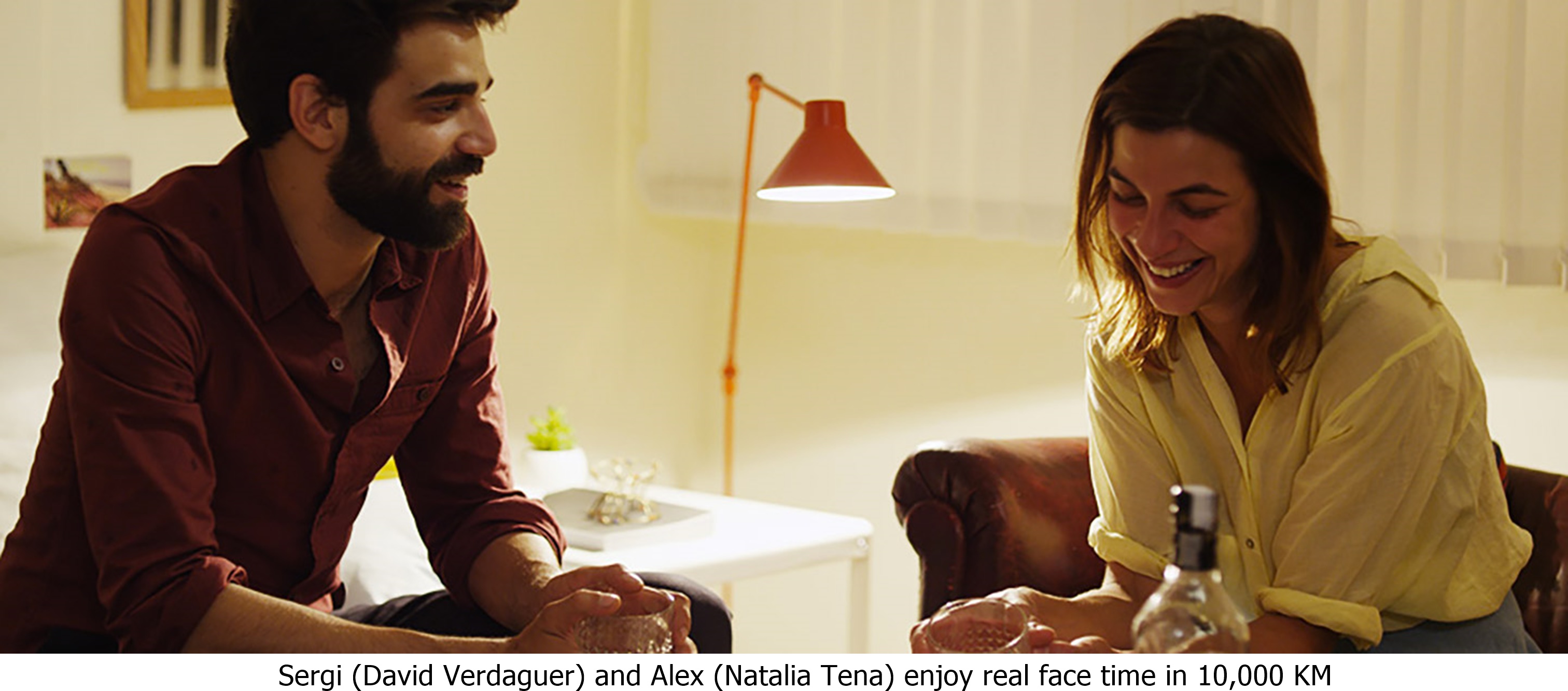
The relationship between Barcelona couple Sergi (David Verdaguer) and his British girlfriend Alex (Natalia Tena) couldn’t be better at the start of Spanish filmmaker Carlos Marques-Marcet’s feature directing debut 10,000 Km. When Alex, a photographer, gets an opportunity to work in Los Angeles for a year, the pair vow to stay together. The internet and their cell phones allow them to text, message, and video chat, promising to make the separation easier. But real life isn’t that simple. During a recent conversation in San Francisco, Marques-Marcet talked about his film and his inspirations drawn from life and technology.

Q: This is a story specific to this technological age. Was your starting point the long-distance relationship or how technology affects those type of relationships?

Carlos Marques-Marcet: It funny. There are other movies about long-distance relationships—but those are really about long-distance love, not relationships. The person you love is abroad; you don’t really have a relationship. But now you can have a relationship.

I moved from Barcelona to Los Angeles and then I had a visit from a friend who is a photographer, who took pictures. At the same time, I was using a lot of Skype with my friends and people in Barcelona. I thought it would be nice to write a story and follow someone through photographs, discovering the city. That was the original idea and then follow all the conversations on Skype—not Skype, because we couldn’t use Skype for the movie, because Skype didn’t want any sex scenes associated with their brand, so we couldn’t use Skype. But that was a little bit the original idea.

We use cameras to say, ‘Hey, how are you?’ We use screens and cameras as a way to communicate. So, I thought why don’t we use that to make a new epistolary genre? It’s funny, I don’t know why they make all these found-footage movies and they are always just horror movies. It’s never used as a way to just show how we live.

Q: You start from a point where everything is going great for them, but then she gets an opportunity to spend a year in the States and at the same time, his work becomes more tentative. The changes in their status could have happened if they were in the same city, but you add extra pressure by separating them.

CMM: That was a big debate for us when we were writing the script. It was difficult to decide what was the conflict, because if you make a movie about a couple that is perfectly fine and then they separate, they are not going to break up. They’re perfectly fine. But at the same time, if you make a movie about a couple that is already breaking up and one moves away, well, they’re going to break up, anyway. You’re not going to make a movie about the distance. We had to find a conflict for them. I found this metaphor, it’s like a house that has cracks. You live with this crack, but then suddenly there’s a lot of humidity or it rains, the circumstances change, and at that moment, these cracks can open and break and create these problems. To me, it was a combination. Couples are not destiny. We have this idea of love, that destiny just chooses us. I don’t think it’s that. I think circumstances are very important and they shape the way we relate to each other.

Q: The fact that she’s English also plays into it. She’s been in Barcelona for seven years, but even with that and even as close as they are, there’s going to be a slight change of viewpoint.

CMM: I was interested in that. There are migrations all around the world and globalization, these inter-cultural relationships happen more and more often. If funny, because even if you think, ‘Oh, Europe,’ but Europe is almost like a fake. The British have much more in common with Americans, even though you are completely different in many ways, but there’s a bigger connection. He feels completely left out, the fact that she’s going to America. It’s a world with a [different] language. And language is important to me, also. It introduces the fact that she has the language and she’s going to that city. She integrates very easily in this new environment, while moving there would be hard for him. Learning a language—it’s a completely new world.—Pam Grady

Share this:

  • Share on Facebook (Opens in new window) Facebook
  • Share on X (Opens in new window) X
  • Email a link to a friend (Opens in new window) Email
  • Print (Opens in new window) Print
  • Share on LinkedIn (Opens in new window) LinkedIn
  • Share on Tumblr (Opens in new window) Tumblr
  • Share on Reddit (Opens in new window) Reddit
  • Share on Pinterest (Opens in new window) Pinterest
Like Loading...

Q&A: Benicio Del Toro plays a notorious villain in ESCOBAR: PARADISE LOST

26 Friday Jun 2015

Posted by cinepam in Interviews

≈ Leave a comment

Tags

Andrea Di Stefano, Benicio Del Toro, Escobar: Paradise Lost, Josh Hutcherson

escobar

It’s easy to see why Josh Hutcherson’s naïve Canadian surfer so willingly moves into first the orbit and then the inner circle of Colombian drug lord Pablo Escobar after his new girlfriend introduces him to her notorious uncle in actor-turned-filmmaker Andrea Di Stefano’s evocative feature debut Escobar: Paradise Lost. The kingpin is charismatic and charming, on the surface a true man of the people. It is only gradually that the young man sees what is behind the amiable mask and what he discovers is horrifying. Benicio Del Toro delivers an indelible performance as Escobar, an intricate turn that reveals the complex man behind the headlines. Getting the Oscar winner was a coup for the fledgling director, but as Del Toro explains in this interview at the 2014 Toronto International Film Festival where Escobar: Paradise Lost had an early screening, it almost didn’t happen. But once it did, it gave Del Toro the opportunity to get under the skin of one of the 20th century’s most infamous villains.

Q: Escobar kind of reminded me of Michael Corleone in this, lethally charming and absolutely lethal.

Benicio Del Toro: That’s cool. I take that as a compliment. We love Al Pacino.

Andrea Di Stefano, the director, contacted me a long time ago, through other lines, not directly, and I kind of said, ‘I don’t know if I want to get into that right now.’ So then the project was floating around and it came back around. I had befriended Josh, because I directed a short in the movie 7 Days in Havana and Josh starred in it. So there was talk, ‘Could this movie be a possibility? Yes.’ And then I remember getting a phone call saying that they were looking at Josh to play the kid, and then I got really excited, because I know him and I like him very much and he’s a very good actor. I just felt like I wouldn’t be completely alone there. That was really exciting.

Q: What was your hesitation about the project when it first came around?

BDT: First of all, it was that the story was fiction. I think at the time, maybe it was a year before we shot the film, I just didn’t feel—sometimes you get projects and you think, ‘Oh, they’re going to do this movie about Escobar, but, really, it’s another story using Escobar.’ Also, at the time, I was maybe busy doing something and just said, ‘I’m not going to do this now. I’m not really completely interested.’ But then my meeting with Andrea Di Stefano, what I really liked about the idea of going fiction was that every chance you got to base the character on truth, we would, and the script does have that, also. Once I got into it, I said, ‘There are interesting angles here that would make it more interesting than just make-believe.’ There’s a lot of things about his relationship with his family, his relationship with the people…Everything that we could, we based it on truth, which was exciting. The script had that and we brought in a little bit more, perhaps.

Q: Given those fictional aspects, how deep did your research go into the actual man?

BDT: I did as much as I could, just to really understand his trajectory. He basically starts—he was bringing in goods from somewhere, it wasn’t drugs at the time. He basically did some sort of union with the workers. He said, ‘We’ll pay you a percentage of what we bring in.’ So all the workers started loving the guy. So he starts like that and eventually he gets more powerful and then he took it to another level and made it really crazy when he went political. He tried to run for office and the other politicians started saying, ‘This guy’s a drug dealer.’ He saw the people that ran the country like other gang members. He declared war on the country and he won, and then it was hell. And there were other gangs taking advantage of this and other drug dealers taking advantage and it just became really gray. Had he not run for office, I think he would probably still be alive and Colombia would not have gone through the hell it went through. But, who knows?

Q: His ambitions were understandable. Politics can be such a dirty business that he probably thought, ‘Why not a drug dealer? Why not me?’

BDT: Well, ‘Why not me? I’ve helped the poor and you been running this for how long? 100 and some years and you haven’t looked at these people and I just built a whole neighborhood here for the poor.’ The people really liked him, because he really gave back. But he ain’t all good! He’s definitely a talented man. He was a great example of a lot of talent gone the wrong way.

I think you’re right when you say, ‘Politics is a dirty business. Another dirty guy, there’s no difference.’ And that’s not true. Two wrongs don’t make a good one—if the politicians he was talking about were wrong, because there were a lot of good politicians that he killed that could have been the hope [of the country]. Actually, the one who said, ‘He’s a drug dealer,’ was the one who had not completely taken bribes from him, and so Escobar went after him and took him down. And then the press, he went after the press. If you were a writer, ‘If you don’t write a good article about me, you’d be careful, I’ll perm my hair and come after you.’ He was like that. It’s very scary. That’s how he looked at it, but he did have some beautiful family values, very much like Michael Corleone. It’s kind of like the same story, just come up and suddenly have power. The lack of being able to give in could make any person in power into a Godzilla. Without compromise, you could just turn into a terrible dictator and run amok. Who knows? With his anger and his strive towards power, he probably could have turned into a maniac had he won and ran the country. Who knows what he would have done?—Pam Grady

Share this:

  • Share on Facebook (Opens in new window) Facebook
  • Share on X (Opens in new window) X
  • Email a link to a friend (Opens in new window) Email
  • Print (Opens in new window) Print
  • Share on LinkedIn (Opens in new window) LinkedIn
  • Share on Tumblr (Opens in new window) Tumblr
  • Share on Reddit (Opens in new window) Reddit
  • Share on Pinterest (Opens in new window) Pinterest
Like Loading...

5 Questions with INSIDIOUS: CHAPTER 3’s Hayley Kiyoko

04 Thursday Jun 2015

Posted by cinepam in Interviews

≈ Leave a comment

Tags

CSI: Cyber, Hayley Kiyoko, Insideious: Chapter 3, Jem and the Holograms

cyb102ravenbHayley Kiyoko is having a busy 2015. In February, the 24-year-old actor and singer/musician released an EP, This Side of Paradise, in February. In October, she’ll be seen as Aja in Jem and the Holograms, a live-action adaptation of a beloved 1980s cartoon series. She also plays a former black-hat hacker turned hacker for the FBI on the CBS series CSI: Cyber, starring opposite Oscar winner Patricia Arquette. Currently, she can be seen on movie screens as the best friend of a teenager stalked by demons in Insidious: Chapter 3. It was that horror thriller that brought her to San Francisco along with the “Into the Further 4D Experience,” a virtual reality/oculus rift haunted house installed on the grounds of a Mission district high school for Carnival weekend.

Q: How did the Insidious 3 script strike you when you first read it?

Hayley Kiyoko: I had to skip through a lot of it, ‘cause it was so scary. I definitely had to read it during the day. You can’t read those kinds of scripts at night. You end up reading them at night. You’re lying in bed and you’re like, ‘Are you kidding me? Why did I just read that? I’m about to go to bed. Now I’m going to have nightmares.’

Q: You’re a musician as well an actor. Which came first?

HK: Music was always the first thing, but music, as anyone knows, is such a long journey. You’re constantly trying to find your sound sonically, and so now I’m finally where I want to be, as well as now the acting thing is blowing up. It’s really cool. They’re kind of surfacing together.

I was a drummer since I was little, so I’m very into rhythm. I’m doing a tour on the East Coast this summer, which will be really fun. I love playing music. I’m always doing that when I’m not acting.

Q: When did you know that you wanted to do both?

HK: I never planned on being an actress. When I was little, I planned on being a performer, whatever that was, whether it was a dancer or a drummer or a singer. I knew I wanted to perform. The acting thing happened through music. I would do commercials playing guitar, doing music stuff, and then it just evolved and I started building my resume. Then I took a shot in the dark and got a great offer to do a movie, Scooby-Doo, way back when. That started the bug of loving to act. It was so different and it was such a challenge. I’d done musical theater when I was younger and stuff. It’s such a different way of performing and exuding that artistic expression from music.

Q: You’re also a regular on CSI: Cyber.

HK: I’ve never really had such a steady job as a network show before, so I’m looking forward to the challenge. I’m actually kind of nervous. It’s just such a long thing, that I’m very excited. And my character is fun. And I’m working with a Golden Globe/Oscar winner, that’s kind of cool. That’s a plus.

Q: You’re Aja in this fall’s Jem and the Holograms movie. Can you tell me about it?

HK: It’s crazy hair and makeup and wardrobe. It’s not a remake of the cartoon. It’s definitely just inspired by the cartoon and placed in a modern time. It’s going to be great for the new Jem fans. It’s really geared toward the new generation, but I think old Jem fans will really enjoy it. The trailer’s out and they’re all going, ‘It doesn’t have this and this and this.’ Well, you’re going to have to see the movie. Don’t be too scared. Go check it out.

Share this:

  • Share on Facebook (Opens in new window) Facebook
  • Share on X (Opens in new window) X
  • Email a link to a friend (Opens in new window) Email
  • Print (Opens in new window) Print
  • Share on LinkedIn (Opens in new window) LinkedIn
  • Share on Tumblr (Opens in new window) Tumblr
  • Share on Reddit (Opens in new window) Reddit
  • Share on Pinterest (Opens in new window) Pinterest
Like Loading...

Lessons learned: John Boorman remembers “hell” in the Pacific

27 Friday Feb 2015

Posted by cinepam in Interviews

≈ Leave a comment

Tags

Hell in the Pacific, John Boorman, Lee Marvin, Queen and Country, Toshirô Mifune

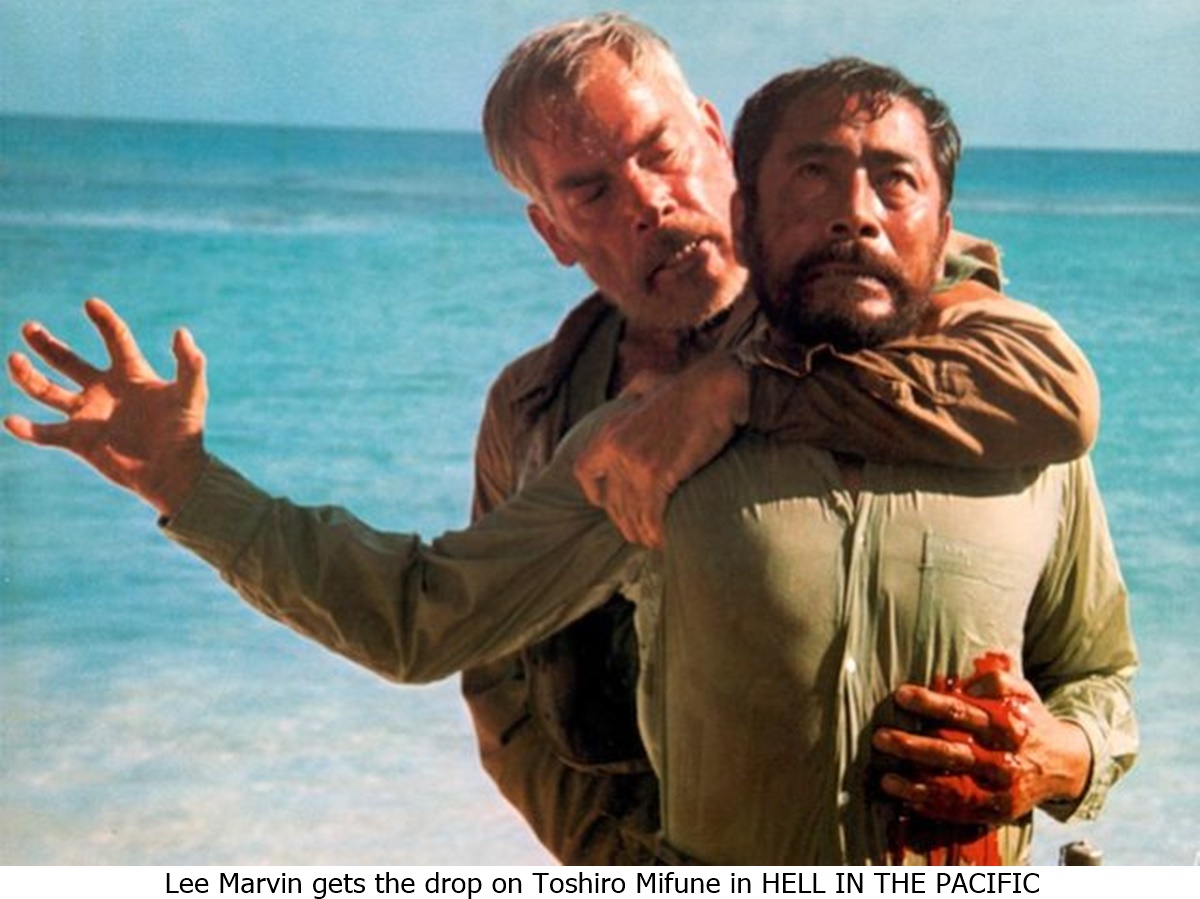
hell 1While recently chatting with John Boorman about his latest (and perhaps final) film Queen and Country for a San Francisco Chronicle feature, the talk turned to Hell in the Pacific. Made in 1968, a year after the tense, striking, wholly inventive thriller Point Blank established him as a directing great, the World War II drama starred the earlier film’s lead Lee Marvin and iconic Japanese leading man Toshirô Mifune as enemy soldiers stranded together on a deserted South Pacific island. It was a fraught shoot. Boorman and Marvin experienced real terror shortly before filming commenced when a plane they were on nearly crashed into a volcano. The director cut his knee and it became badly infected. Mifune, an actor Boorman had admired in so many Akira Kurosawa films, refused to take direction.

Looking back on it, Boorman describes Hell in the Pacific, which was shot on the Pacific Ocean island of Palau, as a kind of teaching moment that began when he was in Tokyo working on the script and realized that that he did not have an ending that satisfied him. He saw Kurosawa and explained the problem. Did the legendary auteur have any ideas?

“He thought for a long time, then he said, ‘They meet a girl,” Boorman laughs. “I have to say there are moments when I wish I’d taken his advice.”

Even if Mifune had been more cooperative, Marvin hadn’t been working through the trauma of returning to the same area of the world where he’d fought (and nearly been killed) during World War II, and his leading men could actually understand each other’s language, Boorman realizes in retrospect that the shoot still would have been challenging. And it didn’t need to be.

“I shot it on a very, very remote island,” he says. “We lived on a ship and went to work on this beach every day in a tank landing craft. I could have shot it in Hawaii and lived in a comfortable hotel. I’m not as foolish as that anymore.

“Sadly, the lesson I learned there was don’t make it too hard for yourself.” –Pam Grady

Share this:

  • Share on Facebook (Opens in new window) Facebook
  • Share on X (Opens in new window) X
  • Email a link to a friend (Opens in new window) Email
  • Print (Opens in new window) Print
  • Share on LinkedIn (Opens in new window) LinkedIn
  • Share on Tumblr (Opens in new window) Tumblr
  • Share on Reddit (Opens in new window) Reddit
  • Share on Pinterest (Opens in new window) Pinterest
Like Loading...

A search for the truth: Bennett Miller on FOXCATCHER

21 Friday Nov 2014

Posted by cinepam in Interviews

≈ Leave a comment

Tags

Bennett Miller, Channing Tatum, Foxcatcher, Mark Ruffalo, Steve Carell

FOXCATCHER

“There is an old Chinese proverb: “There is your truth, my truth, and the truth.”

Director Bennett Miller has made three narrative features—Capote, Moneyball, and now Foxcatcher—inspired by real people and real events. How does he know when he has found his particular truth?

“It’s almost too good a question, because if I could answer that perfectly, maybe I wouldn’t make movies,” Miller says.

“I was seeking some sort of experience of what feels truthful to me about these sorts of relationships. For me, movies are most compelling when you can look at them and say, ‘That’s right. That’s life as I know it. That illuminates something I’m familiar with that had never been expressed.’”

Foxcatcher spins an American tragedy out of a true-crime tale, the 1996 murder of Olympic wrestling gold medalist Dave Schultz (Mark Ruffalo) by John Du Pont (Steve Carell), a deeply disturbed heir to an old money dynasty. Miller’s film traces the path to the killing beginning with Du Pont luring Dave’s younger brother Mark (Channing Tatum), who, like his sibling, won a wrestling gold medal at the 1984 games, to his Pennsylvania estate, Foxcatcher Farms, to train.

“I came to believe certain things about the story, including how lost and lonely John DuPont was and the discomfort of the lie he was living and the inability to process the unacceptable that life confronted with him as he tried to play this role,” says Miller.

“Those moments when you see him trying to charade as a coach in front of his mother, and not have one person acknowledge it is a different kind of loneliness. He was so friendless.”

Miller points out that there is a difference between what is factual and what is the truth. The latter is what he attempts to present in “Foxcatcher.” The film is not documentary; it is drama.

“There are all kinds of little details. This particular thing happened to a different wrestler, but this kind of thing happened to Mark. It’s a similar type of thing, but this works better in the story,” Miller says.

“This is cinema. It’s a narrative film and you’ve got actors playing roles and it’s necessarily fictionalized. There’s no way around it, period…There is some kind of truth to be derived from this story that can only be derived via cinema. Film can do something no other medium can do and in order to do it, it does employ artifice. That doesn’t diminish the validity of the truth that the medium can expose.

“Where do I draw the line? To the best of my ability, there’s nothing within the movie that violates the sense of who these characters were and the decisions that they made and the events that happened, so it’s essentially true. That’s my feeling about it.”—Pam Grady

Share this:

  • Share on Facebook (Opens in new window) Facebook
  • Share on X (Opens in new window) X
  • Email a link to a friend (Opens in new window) Email
  • Print (Opens in new window) Print
  • Share on LinkedIn (Opens in new window) LinkedIn
  • Share on Tumblr (Opens in new window) Tumblr
  • Share on Reddit (Opens in new window) Reddit
  • Share on Pinterest (Opens in new window) Pinterest
Like Loading...

Review: JOHN WICK’s bloody good time

24 Friday Oct 2014

Posted by cinepam in Interviews

≈ Leave a comment

Tags

Alfie Allen, Ian McShane, John Wick, Keanu Reeves, Michael Nyqvist

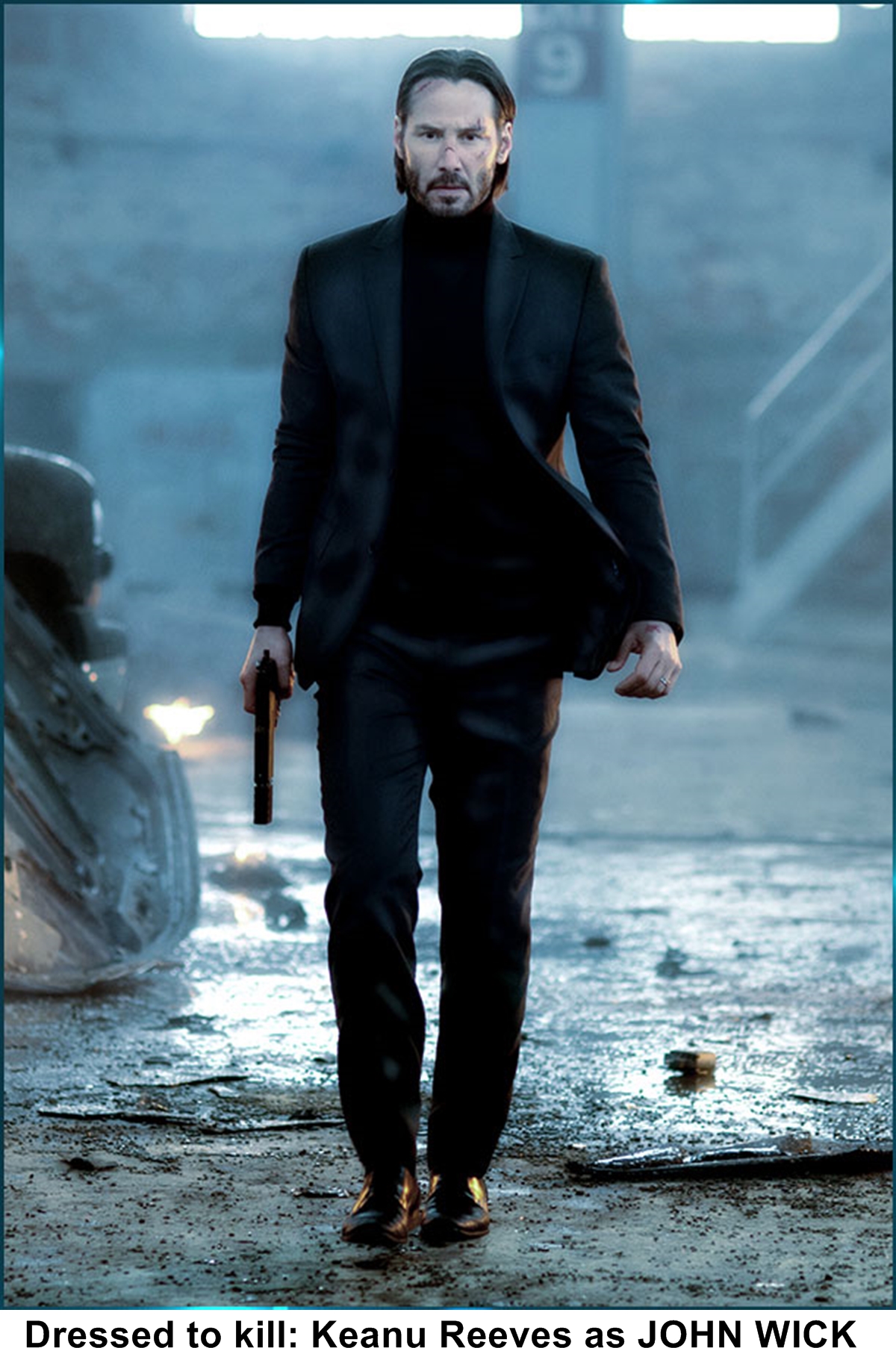
John Wick2“I once saw him kill three men in a bar with a pencil. A pencil! He gave them all lead poisoning.” OK. I made that last line up, but if Russian mobster Viggo Tarasov (Michael Nyqvist) had uttered such a thing while explaining just how dangerous fresh-out-of-retirement hit man John Wick (Keanu Reeves) is it wouldn’t be out of place in the over-the-top world of John Wick. A live-action cartoon—perhaps an Itchy & Scratchy episode with Reeves as the most insanely efficient Itchy in the world and Tarasov and his henchmen the hapless Scratchys—it is a thoroughly enjoyable exercise in grandiose action and ultra ultra-violence. Gallon upon gallon of fake blood flows in this palate cleanser before Oscar season gets underway.

Reeves turned 50 in September, but when it comes to old man Wick and his prey, Tarasov’s spoiled brat millennial son Iosef (Game of Thrones‘ Alfie Allen), there is no contest. It is all Viggo can do to try to protect his boy by unleashing his army of mobsters (including his right-hand man, played by Dean Winters aka Allstate’s “Mayhem”—are we sensing a theme here?) and putting out a general, $2-million contract on Wick’s life. Wick anticipates Viggo’s actions and just doesn’t care. Mistaking the recent widower for an ordinary New Jersey suburbanite, Iosef broke into his house to steal Wick’s cherry ’69 Mustang and killed his puppy, a parting gift from John’s dead wife Helen (Bridget Moynahan). For that, Iosef and anyone who tries to shield him will pay with their lives as Wick transforms himself into an impeccably dressed grim reaper.

Screenwriter Derek Kolstad and director Chad Stahelski have created a world in which civilians barely exist amidst operatic and very public outbursts of violence. When Wick reenters a life of crime, he returns to an entire universe where one guy (John Leguizamo) runs a mob chop shop, another (David Patrick Kelly) specializes in body disposal and crime scene cleanup, a priest (Munro M. Bonnell) protects mob cash, and John is just one among many assassins.

There is even a hotel, the Continental, that caters exclusively to the criminal class, overseen by Winston (the great Ian McShane) who enforces the joint’s one hard rule—no conducting business on the premises—from his booth in the hotel’s ’40s-syle supper club. It’s all wackily retro and a little daft, a world in which  Krugerrands (“coin”) are the means of exchange. These guys are so old-fashioned that they’ve probably never even heard of bitcoins and still think of Silk Road as an ancient Asian trade route.

Those Wick doesn’t shoot he attacks with a full-body assault, fists and legs flying. However morose the grieving character is, it’s been years since Reeves has had a role that is this much pure fun. Once Wick’s quest for vengeance is underway, the action is nearly non-stop and Reeves is the ball of kinetic energy at the center of the storm. He wears middle age as well as he does his designer suits. John Wick is a lean, mean, killing machine.

The body count is high. The plot is ludicrous. The humor is pitch black, mostly unintentionally so. No one will mistake John Wick for art, but it’s a bloody good time—emphasis on the bloody. —Pam Grady

Share this:

  • Share on Facebook (Opens in new window) Facebook
  • Share on X (Opens in new window) X
  • Email a link to a friend (Opens in new window) Email
  • Print (Opens in new window) Print
  • Share on LinkedIn (Opens in new window) LinkedIn
  • Share on Tumblr (Opens in new window) Tumblr
  • Share on Reddit (Opens in new window) Reddit
  • Share on Pinterest (Opens in new window) Pinterest
Like Loading...

A search for the perfect voices: Casting THE BOXTROLLS

03 Friday Oct 2014

Posted by cinepam in Interviews

≈ Leave a comment

Tags

Anthony Stacchi, Ben Kingsley, Elle Fanning, Graham Annable, Isaac Hempstead Wright, The Boxtrolls

 snatcher

A starry cast that includes Ben Kingsley, Elle Fanning, Nick Frost, Tracy Morgan, Jared Harris, and Richard Ayoade gives voice to The Boxtrolls—the latest enchanting stop-motion animated featured from Laika, the studio behind Coraline and Paranorman—the tale of tiny, tinkering monsters that live underground; the city that fears them; and Archibald Snatcher (Ben Kingsley), the villain that hunt and exploits them. For directors Graham Annable and Anthony Stacchi, casting those famous voices and aligning voice with character were key in ensuring The Boxtrolls‘ success.

The filmmakers had a huge wish list of voices, but Annable and Stacchi realized that it wasn’t enough to simply think an actor was right for the part. They had to be sure, and so they put each voice to the test.

“We knew very early on that we liked the Bran Stark character from Game of Thrones, Isaac Hempstead Wright, we liked his voice,” says Stacchi of the actor who would eventually voice Eggs, the human child raised by boxtrolls. “We edited all the dialogue we could get from Game of Thrones and from interviews that Isaac had done, then we cut it over drawings of the Eggs character and paintings of the character and even sculpture of that character to see how it felt with that voice coming out of that body.

“As soon as we felt pretty strongly about that, we tried the pairings of the characters he would be talking to the most. We had always wanted to work with Elle Fanning, since her sister Dakota worked on Coraline, so we started cutting dialogue between Eggs and Winnie just using Elle Fanning’s voice from different movies and interviews that she had done. If it felt good – like they were coming from a different place and they felt good the way there were talking together. Isaac sounded like a naïve boy who’d been raised by monsters somehow and Elle Fanning sounded like the daughter of the richest man in town, even though their dialogue wasn’t making sense, it made you feel the relationship.”

Kingsley was number one on the directors’ wish list, but even his voice had to pass muster, Annable and Stacchi choosing from his five-decade long career his most adult (not to mention most profane and scabrous) role to test and see if he was right for their family film.

“We cut a lot of Don Logan from Sexy Beast yelling at poor Isaac Hempstead Wright,” Stacchi laughs. “Since the dialogue does not make sense, you can feel the pure quality and the power of the voice.”

“A lot of people come back to us and say, ‘We didn’t even realize that was Sir Ben Kingsley until the end of the film,’” adds Annable. “For me, that’s great in that I think his voice became that character. You really get that experience. It’s much more like the old classic animated movies like Pinocchio and Dumbo. The voice actors aren’t cast for their name and reputation. They’re cast, because they fit the character in the film.” —Pam Grady

Share this:

  • Share on Facebook (Opens in new window) Facebook
  • Share on X (Opens in new window) X
  • Email a link to a friend (Opens in new window) Email
  • Print (Opens in new window) Print
  • Share on LinkedIn (Opens in new window) LinkedIn
  • Share on Tumblr (Opens in new window) Tumblr
  • Share on Reddit (Opens in new window) Reddit
  • Share on Pinterest (Opens in new window) Pinterest
Like Loading...

Taking PRIDE in their accomplishment: Screenwriter Stephen Beresford & inspiration Jonathan Blake

29 Monday Sep 2014

Posted by cinepam in Interviews

≈ 2 Comments

Tags

Dominic West, Jonathan Blake, Lesbians & Gays Support the Miners, Pride, Stephen Beresford

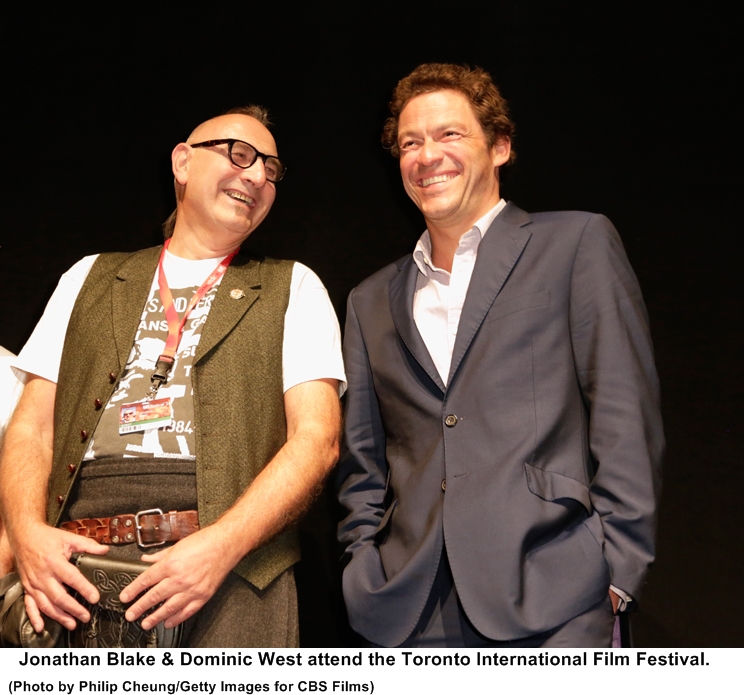
Toronto International Film Festival Screening And After Party For "Pride"Stephen Beresford first met Jonathan Blake when he was doing research for his screenplay that would eventually turn into this year’s feel-good dramedy Pride. It’s been a dream project for Beresford, 42, who first heard the story of Lesbians & Gays Support the Miners (LGSM) and the unusual alliance the London group formed with Welsh miners during the 1984-85 British coal strike over 20 years ago. Blake, 65, who grappled with what was thought to be a death sentence—an HIV diagnosis—during his involvement with LGSM, made such an impression on the screenwriter that he became one of the script’s main characters, played in the movie by The Wire‘s Dominic West.

The relationship didn’t end with Beresford’s research. A story lost to the mists of history lives again in Pride and both Beresford and Blake have been active in promoting the film. Recently, the affable Brits traveled to San Francisco to attend a San Francisco Pride screening and to spend a day meeting the press to talk about the movie and the real-life events that inspired it.

Q: Stephen, how did you first learn about Jonathan’s story?

Stephen Beresford: [When I was researching the film,] I would look at photographs, and go, ‘Who’s that?’ And there was a photograph of somebody dancing, and it was Jonathan. That was one of the first moments when I thought that Jonathan was an important part of the story. And, of course talking to Jonathan and hearing the story. Some stories just step to the front, and his did.

Q: What was your reaction when Stephen first approached you to talk about events that happened nearly 30 years ago, Jonathan?

Jonathan Blake: I was surprised, but I was very happy to speak. Shut me up! It’s my story, so I don’t find it unusual. It’s unusual that people want to hear it, but that was fine. Basically, we chatted and that was fine. Then I get this phone call from him saying, ‘I need to come and see you. If you remember, I came and interviewed you for this film. Well, I’ve written it and not only is the screenplay finished, but it’s going to be produced and I need to come and have a talk with you.’ So the doorbell rings and I open the door and there is this tall man standing there and he says, ‘You don’t remember me, do you?’ He basically says, ‘There was something in your story that just sparked my imagination and I’ve written a character and he’s called Jonathan.’ That was basically it. I thought, ‘Oh, wow! This is extraordinary.’

But again, I didn’t really think anything about it and then a few months later and they are actually now in production, I get another phone call from him. ‘The director and actor who is going to play you would like to meet you.’ Stephen arrives with a bunch of flowers, amazing flowers, cabbages roses and cabbages, an amazing mix. The doorbell rings again and there is [director] Matthew Warchus and there is Dominic West standing there, an idol, The Wire, fantastic!

It was wonderful, Matthew was brilliant. He just came in, my partner was there, Nigel, and he just asked us questions. He just wanted to know how we got into political activism, what life was like, all this, just so Dominic could hear, and then later on we walked around the garden, and Dominic and I chatted. But it was very easy, it just seemed so totally natural. It’s weird. And then seeing the movie was extraordinary. It was very difficult the first time. But they have done it such justice. It just has the feel of the time and there’s an energy there, and the intention is there. They’ve been really truthful to what we were about and what the whole thing was about. That’s very special. We’ve been very fortunate.

Q: What I have find extraordinary about it is that you take a story that essentially does not have a happy ending. The strikers didn’t win. AIDS is about to sweep through the gay community, yet the audience leaves the theater feeling uplifted and you never resort to that sentimentality that kills so many films.

Stephen Beresford: It’s probably why the material appealed to me. I love things that are uplifting and have heart and are human. I love people. Even the worst people have something in them, a human nature that I respond to. I’ve always felt like that. I like that kind of stuff, but I don’t like sentimentality, so it’s great that the story has those dark elements. That’s sort of, I think, what drew me to it. There’s a message in it, which I love, which is that failure is not an excuse. They do fail, both groups, in a sense, you could say, but it’s not excuse for not doing it.

I’m very attracted to, in a sense, history, when we talk about history—Chou En-lai said very famously, when asked what were the effects of the French Revolution, ‘It is too early to tell.’ I kind of feel that way myself. We’re fond of saying, ‘Well, that was the 20th century. That’s that in a box, and now we’re something else.’ But it isn’t true, so who knows if the strike failed? Things can change. I like the idea that we’re part of a dialogue. What we perceive to be a failure may actually be a part of a journey to something else.

Q: It’s also very attractive, because it’s two groups you wouldn’t expect to have anything in common finding common ground, simply by being human beings.

Stephen Beresford: And that thing of finding that our struggles have common cause is a very important lesson, really. It’s beneficial to those people who don’t want us to band together and find solidarity, for us to believe that we’re all divided. It’s much easier—I think that on so many different issues, if we divide on race lines or if we divide on class lines or if we divide on gender lines, if we think, ‘Well, men aren’t interested in feminism,’ well, that’s great, because it keeps feminism in its exact place. If we’re interested in equality, then what man could not be interested in feminism? What white person could not be interested in racism? Once we start to think about those terms, it’s interesting what can be achieved.

Jonathan Blake: We live in such an atomized world. Everything is broken down. You can be an activist from your own front room, but you’re not with a group. You may be thinking that you’re changing the world, because you can click a button, but it’s being with other people who are like-minded people, touching them, smelling them, that’s what makes the difference. That’s, hopefully, what people, certainly youth, will get from this film. It is by coming together that things can happen.

Q: Jonathan, can you remember your initial reaction when it was first proposed that you help these miners?

Jonathan Blake: Basically, one was just right up for it. It was such an important point. Here was Thatcher and this government wanting to smash this union. What has come out latterly is the fact that she had planned and worked on it all along. There was a miners’ strike in 1972, which brought down the Tory government. Thatcher never forgave them for that, so she was out for revenge. This wasn’t just about smashing the union. This was real revenge on the miners that brought down the government. We knew that this was so important. As an activist and part of the Left, there was no question.

The fact that this small mining community was there was wonderful. There was real excitement. There was also trepidation. What had we got ourselves into? When we actually got there and met them—Mike Jackson, the secretary of the group, tells this wonderful story and sort of reminded me that when we arrived there, we were really kind of nervous before we go in. As the doors open when we’re walking in, there’s this awful hush. You just think, ‘Oh, shit! Do we run now or what?’ Then one person started applauding and then the room started applauding. We were just welcomed. It was amazing. We had such fun. In all that bleak time, they were so generous and warm. They were going through hardship, but you would never know. It was just extraordinary and life-changing, absolutely life-changing.

Q: And you were already HIV-positive.

Jonathan Blake: Yes. I was diagnosed in October 1982, so it was very early on. For me, it was also great, because it kept me busy. I didn’t have time to think about the virus and illness and getting ill. There was stuff to do. It was a real boon for me. I never expected to, a., live this long, or b., to see this magnificent creation that is Pride. I feel really blessed.

Q: Stephen, it’s been 20 years since you first heard the story and started pondering doing something with it. How does it feel now that it’s a reality?

Stephen Beresford: It took three years to make the film from beginning to end and 20 years to get someone to take it seriously. Looking back on it now, if I had done some of the work I needed to do in three years over 20 years, it would have been a much easier time. What’s interesting is everything was so intense—I was on set all day, every day; I was in on casting; everything, so it was like I never had a moment in which to stop and realize that this was happening..

Then one day we were filming in Wales and I came in a little later, like 6:10 in the morning,and they’d turned over the first shot of the day. I got out of my car and I looked up the road and there was silence. They’d just started and then I heard the band playing and they marched down the street. As I watched them, I had an extraordinary jolt back to a memory of sitting in my office in South London, a funny room with no windows and I remembered physically typing the words, ‘A brass band appears through the mist.’ I’m watching it happen. I thought, ‘Well, I wrote that sentence, and that sentence has made the band, the mist, the village, everything, they’re all here doing that, because I wrote those words and put them in that order.’ That’s an incredible feeling. –Pam Grady

Share this:

  • Share on Facebook (Opens in new window) Facebook
  • Share on X (Opens in new window) X
  • Email a link to a friend (Opens in new window) Email
  • Print (Opens in new window) Print
  • Share on LinkedIn (Opens in new window) LinkedIn
  • Share on Tumblr (Opens in new window) Tumblr
  • Share on Reddit (Opens in new window) Reddit
  • Share on Pinterest (Opens in new window) Pinterest
Like Loading...
← Older posts
Newer posts →

Categories

  • Interviews
  • News
  • Reviews
  • Short Takes
  • Uncategorized

Recent Posts

  • A Stamp of Approval
  • Life is messy & so is ‘Megalopolis’
  • A star discovers too late there are worse things than aging in the black comic body horror ‘The Substance’
  • A young teen nurses a crush when he finds himself among ‘Big Boys’
  • The stunt man becomes the star as Ryan Gosling becomes THE FALL GUY

Archives

Blog at WordPress.com.

  • Subscribe Subscribed
    • Cinezine Kane
    • Join 48 other subscribers
    • Already have a WordPress.com account? Log in now.
    • Cinezine Kane
    • Subscribe Subscribed
    • Sign up
    • Log in
    • Report this content
    • View site in Reader
    • Manage subscriptions
    • Collapse this bar
 

Loading Comments...
 

    %d