
• About

Cinezine Kane

Cinezine Kane

Monthly Archives: April 2019

Spoiler-free review: AVENGERS: ENDGAME

26 Friday Apr 2019

Posted by cinepam in Reviews

≈ Leave a comment

Tags

Avengers: Endgame, Chris Evans, Robert Downey Jr., Stan Lee

AvengersEndgame5c9a7b9646625

No spoilers here about Avengers: Endgame. No in-depth review, either, since it would be far too easy to fall into spoiler territory. Instead just a few observations:

A three-hour runtime could easily have been punishing (and it might be—to your bladder), but directors Anthony and Joe Russo have delivered an epic that is light on its feet: Action-packed, full of suspense relieved by liberal doses of humor, and emotionally resonant, this is what action adventure storytelling should be and so often isn’t.

In a large ensemble full of memorable performances, Robert Downey Jr. and Chris Evans stand out, respectively burnishing the legends of Howard Stark/Iron Man and Steve Rogers/Captain America with turns that emphasize their characters’ humanity. This might be just another day at the office for Evans, whose Captain America has always been imbued with a huge dose of empathy along with sorrow for what he lost during the decades he spent in suspended animation. His superb emotional performance is hardly surprising. Downey, on the other hand—Howard Stark has always been a smug, snarky character hovering on the insufferable. While he doesn’t exactly lose those traits in Endgame, he does evolve. Thanos (Josh Brolin) did a number on him in Infinity Wars and it shows in an altogether warmer, more open, and a somewhat humbled (if not humbler) Howard Stark.

Endgame also pays a fond farewell to Marvel’s Stan Lee with his final cameo appearance. Mr. Lee might’ve died in 2018 at 95, but he is going to live forever through his comic books and through his movies. As an adieu to his physical being, his Endgame cameo is tops, a funny moment in the movie that pays homage to Lee’s humor and zest for life.

That’s it. To say more would be to fall too close to spoiler territory. Not going there. Does Avengers: Endgame live up to the hype? Yes, yes is does. –Pam Grady
 

Share this:

  • Share on Facebook (Opens in new window) Facebook
  • Share on X (Opens in new window) X
  • Email a link to a friend (Opens in new window) Email
  • Print (Opens in new window) Print
  • Share on LinkedIn (Opens in new window) LinkedIn
  • Share on Tumblr (Opens in new window) Tumblr
  • Share on Reddit (Opens in new window) Reddit
  • Share on Pinterest (Opens in new window) Pinterest
Like Loading...

Review: Roots of Syndrome in STOCKHOLM

25 Thursday Apr 2019

Posted by cinepam in Reviews, Uncategorized

≈ Leave a comment

Tags

Al Pacino, Dog Day Afternoon, Ethan Hawke, John Cazale, Mark Strong, Noomi Rapace, Robert Budreau, Sidney Lumet, Stockholm

Stockholm

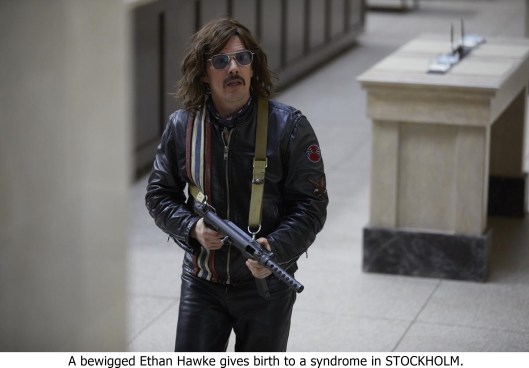
People know the name “Stockholm Syndrome,” but few know its etymology. Writer/director Robert Budreau aims to correct that with his new drama Stockholm. The condition in which hostages begin to trust and ally with their captors owes its moniker to a 1973 bank robbery turned hostage situation in the Swedish capital, recounted here–more or less. Names have been changed, and so have other details. And the lead kidnapper was most definitely not an American, which he is for the film’s purposes. But that alteration makes way for Ethan Hawke, who delivers a charismatic performance that’s not only larger than life, it’s larger than the movie. That’s not necessarily a bad thing.

Lars Nystrom (Hawke) enters the bank alone but is soon joined by his friend Gunnar (Mark Strong in bad hippie hairpiece—actually, so is Hawke, but his is supposed to be a wig). There are three hostages and the bank is surrounded by cops. Lars is a charmer. It doesn’t take him long to gain the sympathy of his captives, particularly bank officer Bianca (Noomi Rapace). Heavy-handed police tactics only encourage the hostages to trust Lars and Gunnar.

Stockholm is entertaining enough, if ultimately forgettable. Hawke is the best thing about it with the rest of the cast saddled with playing characters that are not particularly well drawn. Also, the whole problem with making a movie about the roots of “Stockholm Syndrome” is that the crime for which the condition is named pales in comparison with another caper associated with the syndrome: the 1972 robbery of a Chase Manhattan bank that inspired Sidney Lumet’s 1975 thriller Dog Day Afternoon. That movie with a livewire Al Pacino and John Cazale as his dim-witted sad sack partner set the standard for hostage taking movies where the Stockholm Syndrome comes into play. Stockholm is diverting but Lumet set a high bar that is almost impossible for other films to reach. –Pam Grady

Share this:

  • Share on Facebook (Opens in new window) Facebook
  • Share on X (Opens in new window) X
  • Email a link to a friend (Opens in new window) Email
  • Print (Opens in new window) Print
  • Share on LinkedIn (Opens in new window) LinkedIn
  • Share on Tumblr (Opens in new window) Tumblr
  • Share on Reddit (Opens in new window) Reddit
  • Share on Pinterest (Opens in new window) Pinterest
Like Loading...

Review: Terry Gilliam realizes a long-time dream with THE MAN WHO KILLED DON QUIXOTE

18 Thursday Apr 2019

Posted by cinepam in Reviews, Uncategorized

≈ Leave a comment

Tags

Adam Driver, Jean Rochefort, John Hurt, Johnny Depp, Jonathan Pryce, Terry Gilliam, The Man Who Killed Don Quixote

Quixote 2.jpg

Terry Gilliam has been tilting at windmills for 30 years, trying to get his passion project, his spin on Miguel de Cervantes’s 17th century novel Don Quixote, The Man Who Killed Don Quixote, made. Most famously, French actor Jean Rochefort donned Quixote’s helmet while Johnny Depp played commercials director Toby who becomes Quixote’s Sancho Panza in an aborted 200 production that was immortalized in the documentary Lost in La Mancha. Among the actors attached or considered for the role of Quixote in subsequent years were Gerard Depardieu, Robert Duvall, Gilliam’s fellow Python Michael Palin, and the late John Hurt (diagnosed with pancreatic cancer just prior to what was supposed to be a 2016 production start state) with Ewan McGregor and Jack O’Connell cast as Toby. This was a production clearly never meant to be, yet sometimes, giants are vanquished and miracles do happen as The Man Who Killed Don Quixote arrives in theaters with Gilliam’s Brazil star Jonathan Pryce as the grizzled Quixote and Adam Driver as Toby, the ad man begging for comeuppance.

The film represents probably the only opportunity to ever see Driver do an impression of vaudeville and early movie star Eddie Cantor, which he does with an inspired performance of “If You Knew Susie” that would be worth the price of admission alone even if Gilliam’s 30-years-in-the-making dream project was an utter failure. Which it isn’t, far from it. It was a given that The Man Who Killed Don Quixote would be an eyepopping production. It couldn’t help but be that, not with Gilliam’s longtime cinematographer Nicola Pecorini’s gorgeous photography, Benjamín Fernández and Gabriel Liste’s exquisite production design, and resonant locations in Spain, Portugal, and the Canary Islands that evoke both the 17th century of Quixote’s time and our modern era. What couldn’t be anticipated was just how well Gilliam succeeds in telling his story. Those three decades and all the cast changes have not gone for naught. This is the director’s most satisfying film since The Fisher King 28 years ago.

Driver is one of those rare actors that doesn’t need to be liked, which a good thing, since Toby is such a pill: arrogant, rude, craven, betrayer of his boss (Stellan Skarsgård), and just a general pain in the ass. On location in Spain where he is shooting his latest commercial, he stumbles on a DVD of his student film, a Don Quixote story shot in a nearby village. Nostalgia coupled with a need to escape his current circumstances sends him on a visit back to that ancient town where he discovers that his old leading lady Angelica (Joana Ribeiro) has gone away and become an escort, while the cobbler (Pryce) who was his Quixote has fallen into the delusion that he is the character. Reunited with Toby, he’s found his Sancho Panza.

What follows is a kind of wondrous delirium. Reality and fantasy intertwine, complete with cameos from a gallery of Gilliam monsters. Toby resists and embraces his new role, displays cowardice and courage, and wrestles with the idea that his little student film changed the course of people’s lives, and not for the better. Pryce and Driver, even at loggerheads, share a delicious chemistry. Pryce is excellent, imbuing Quixote with warmth and a gentle daftness, while Driver is magnificent as he portrays Toby’s evolution from a brat to a human being who just might reclaim his soul.

Thirty years from idea to execution is a long time to embrace a dream. It was worth the wait to see its reality. Bravo, Terry Gilliam. –Pam Grady

Share this:

  • Share on Facebook (Opens in new window) Facebook
  • Share on X (Opens in new window) X
  • Email a link to a friend (Opens in new window) Email
  • Print (Opens in new window) Print
  • Share on LinkedIn (Opens in new window) LinkedIn
  • Share on Tumblr (Opens in new window) Tumblr
  • Share on Reddit (Opens in new window) Reddit
  • Share on Pinterest (Opens in new window) Pinterest
Like Loading...

Categories

  • Interviews
  • News
  • Reviews
  • Short Takes
  • Uncategorized

Recent Posts

  • A Stamp of Approval
  • Life is messy & so is ‘Megalopolis’
  • A star discovers too late there are worse things than aging in the black comic body horror ‘The Substance’
  • A young teen nurses a crush when he finds himself among ‘Big Boys’
  • The stunt man becomes the star as Ryan Gosling becomes THE FALL GUY

Archives

Blog at WordPress.com.

  • Subscribe Subscribed
    • Cinezine Kane
    • Join 48 other subscribers
    • Already have a WordPress.com account? Log in now.
    • Cinezine Kane
    • Subscribe Subscribed
    • Sign up
    • Log in
    • Report this content
    • View site in Reader
    • Manage subscriptions
    • Collapse this bar
 

Loading Comments...
 

    %d