• About

Cinezine Kane

Cinezine Kane

Category Archives: Reviews

F9: Stuff blows up when it is brother versus brother

24 Thursday Jun 2021

Posted by cinepam in Reviews

≈ Leave a comment

Tags

Charlize Theron, Chris "Ludacris" Bridges, F9, Helen Mirren, Jason Statham, John Cena, Jordana Brewster, Justin Lin, Michelle Rodriguez, Nathalie Emmanuel, Tyrese Gibson, Vin Diesel

Movies in the Fast & Furious franchise really ought to come with a warning. Not about the extravagant violence and sky-high body counts, but about the sheer idiocy that defines these movies. Oh, they are entertaining and frequently hilarious in their doltish way but watching them is a good way to kill off brain cells. F9, the dumbest entry in moviedom’s dumbest franchise, will murder many.

Like Michael Corleone once lamented, “Just when I thought I was out, they pull me back in,” so it is with Dom Toretto (Vin Diesel). Living in exile on an isolated farm with Letty (Michelle Rodriguez) and his young son, Little Brian (yes, “Little” Brian – as if anyone would mistake a small child for the late Paul Walker after whose character he’s named), he has put his old life behind him. At least, until Roman (Tyrese Gibson), Tej (Chris ‘Ludacris’ Bridges), and Ramsey (Nathalie Emmanuel) show up to enlist Dom and Letty into a new caper with the fate of the world in balance. Those snobs at MI6 or IMF have got nothing on these gearheads charged with recovering a device that could alter the world order – and with putting to right Dom Toretto’s world.

The first hint that something biblical is on the menu happens when Dom is still on the farm, putting Little Brian to bed, telling the boy that God lives in his heart. Then he says, “I live in your heart.” Does this mean Dom is God? In his own mind, certainly. But the theme continues when it turns out that the nemesis he must vanquish this time out is his own brother Jakob (once and future WWE fighter John Cena). The Cain-and-Abel vibe is unmistakable, sibling rivalry turned into sibling warfare (and often sibling hand-to-hand combat, that is when they aren’t trying to outdrive each other). Flashbacks reveal the heart of the beef between these warring brothers with daddy issues.

The Dom and Jakob reunion is not the only one in F9, as this is a film that assembles as much of the crew as possible, both friends – including Dom and Jakob’s sister Mia (Jordana Brewster), Han (Sung Kang), and Sean (Lucas Black) – and Dom’s foe Cipher (Charlize Theron, slumming to the point where the Academy might want its Oscar back). Even Deckard Shaw’s (Jason Statham) thieving mum, Queenie, shows up, Helen Mirren adding a touch of regal class to this live-action cartoon. (To catch sight of Statham, stay for the end credits.) F9 is not the end of the franchise, but if it had finished here, it would have been given a proper burial.

Instead, the will soldier on, despite the fact that there are really only so many ways you can crash cars and director Justin Lin and the writers are clearly beginning to run out of ideas on that score. The non-driving Ramsey learns on the fly, steering a big box truck down the narrow streets of Edinburgh, Scotland, the vehicle equipped with high power magnets, so that the chase becomes one of high-powered, explosive bumper cars. So far, so funny, but then the magnet gag keeps getting repeated. And, sure, that helps pad out the running time, but it loses steam through rote repetition. A more inspired (and lunatic) bit plants Roman and Tej in a rocket-equipped car – and, well, cue the Space X jokes.

F9 left me yearning for the return of SCTV and Joe Flaherty and the late John Candy’s “Farm Report” where a pair of cinephile farmers acted as the rural answer to Gene Siskel and Roger Ebert. They would have cut to the chase and distilled F9 to its very essence: “Stuff blowed up real good.” Yes, yes, it did. –Pam Grady
Share this:

  • Share on Facebook (Opens in new window) Facebook
  • Share on X (Opens in new window) X
  • Email a link to a friend (Opens in new window) Email
  • Print (Opens in new window) Print
  • Share on LinkedIn (Opens in new window) LinkedIn
  • Share on Tumblr (Opens in new window) Tumblr
  • Share on Reddit (Opens in new window) Reddit
  • Share on Pinterest (Opens in new window) Pinterest
Like Loading...

Grief, guilt, and revenge animate resonant RIDERS OF JUSTICE

14 Friday May 2021

Posted by cinepam in Reviews

≈ Leave a comment

Tags

Anders Thomas Jensen, Andrea Heick Gadeberg, Lars Brygmann, Mads Mikkelsen, Nicolas Bro, Nikolaj Lie Kaas, Riders of Justice

A soldier returns from duty in Iraq or Afghanistan after his wife’s death in a train accident and turns into a merciless avenger when he becomes convinced that his spouse was actually collateral damage in a vicious conspiracy. That Death Wish trope activates the plot in this Danish drama that reunites filmmaker Anders Thomas Jensen with frequent collaborators Mads Mikkelsen and Nikolaj Lie Kaas, but things are never that simple-minded with Jensen. Instead of a revenge thriller, Riders of Justice is a violent, sometimes darkly funny but also surprising and warm observation of people grappling with grief, guilt, and the human impulse to make sense out of the incomprehensible.

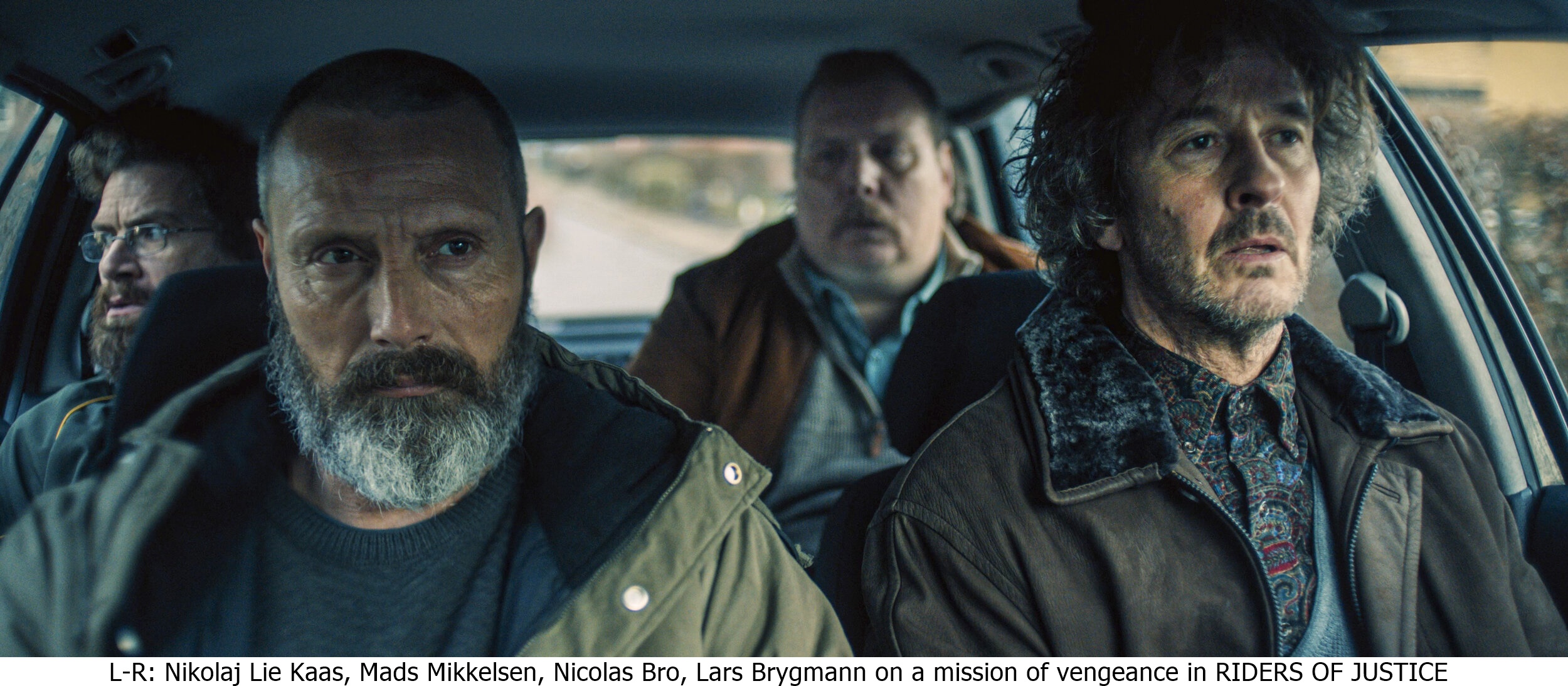
A young girl’s wish for a blue bicycle for Christmas is what sets the film in motion. She has nothing to do with anyone else in the film. She doesn’t even live in Denmark, but her stated desire is the first link in a chain reaction that explodes into madness. Markus (Mikkelsen) adds another link with his decision to stay at his military post rather than return home for a visit with his family. Data scientist Otto (Kaas) forms one more link as a survivor of the train accident. But perhaps the most important link is the member of the Riders of Justice motorcycle gang who left his wheels home and took the train on that fateful afternoon.

While Markus and Otto are convinced that somehow the motorcycle gang is responsible for what the authorities deem an accident, they are each, in their own way grappling with guilt that implicates them in the event. Markus’ wife and daughter Mathilde (Andrea Heick Gadeberg) would not have been on the train had he come home. Otto has survivor’s guilt and not only for this one event.

Together, they are a mess. Otto at least has a support system in fumbling colleagues Lennart (Lars Brygmann) and Emmenthaler (Nicolas Bro). They rally around Markus and Mathilde, too, but Markus is too much inside his own head to accept emotional support or to give it. He is useless to Mathilde, unable to offer the solace she desperately needs.

There are many pleasures in Riders of Justice, from the arresting performances of Mikkelsen, Kaas, and the rest of the cast to Jensen’s nuanced, complex screenplay to the chaos unleashed on the bikers by Markus and his oddball band of science geek brothers.

But what is most entrancing is watching Markus, Mathilde, Otto and his colleagues, and others drawn into their orbit slowly come together for far more emotionally resonant reasons than simple vengeance and seeing Markus – a man apparently dead inside long before he lost his wife – gradually return to the land of the living.

Riders of Justice is a rare film. Movies with this much brutal action are not supposed to leave audiences feeling warm and fuzzy about humanity. With the aid of his wonderful ensemble, especially Mikkelsen, in this latest work, Jensen manages exactly that. –Pam Grady

Riders of Justice is playing in theaters.

Share this:

  • Share on Facebook (Opens in new window) Facebook
  • Share on X (Opens in new window) X
  • Email a link to a friend (Opens in new window) Email
  • Print (Opens in new window) Print
  • Share on LinkedIn (Opens in new window) LinkedIn
  • Share on Tumblr (Opens in new window) Tumblr
  • Share on Reddit (Opens in new window) Reddit
  • Share on Pinterest (Opens in new window) Pinterest
Like Loading...

Statham, Ritchie reunite for WRATH-ful thriller

06 Thursday May 2021

Posted by cinepam in Reviews

≈ Leave a comment

Tags

Guy Ritchie, Jason Statham, Wrath of Man

Jason Statham stars as H in director Guy Ritchie’s WRATH OF MAN, A Metro Goldwyn Mayer Pictures film. Photo credit: Metro Goldwyn Mayer Pictures © 2021 Metro-Goldwyn-Mayer Pictures Inc. All Rights Reserved

Wrath of Man is a homecoming of sorts, Jason Statham’s first film since 2005’s Revolver with Guy Ritchie, the director with whom he started his career with the one-two punch of Lock, Stock and Two Smoking Barrels (1998) and Snatch (2000). An adaptation of a 2004 French film, Le convoyeur, the reunion between an auteur of ultra-violence and his stoic muse is a diverting wallow in high body count cinema.

Ritchie is well past the era when his films were inventive and as darkly funny as they were bloody, but he can still produce a satisfying (if ridiculous) thriller. This one begins with the suspense meter already set at 11 with a high-octane action sequence set in the streets of Los Angeles that introduces a faceless heist gang with at least one trigger-happy member. From there, it develops into the story of H (Statham), a new British employee at a Southern California armored car company who barely passes his gun qualification only to show exactly how deadly his aim is when a shipment he is guarding comes under fire. He clearly is not the average schlub he claims to be (as if his reserved demeanor and six-pack abs didn’t already give that away).

Eventually Wrath of Man settles into a three-pronged story. There is the origin story of H defining who he is, really, and why he wanted a job far below his particular skill set. There is the story of the criminal gang that includes war vets Jackson (Burn Notice‘s Jeffrey Donovan) and wild card Jan (Scott Eastwood), who seem to be operating out of the notion that because they served their country, the world now owes them. And there is the armored car company where absurd nicknames like Bullet (Mindhunter‘s Holt McCallany), Boy Sweat Dave (Josh Hartnett), and Hollow Bob (Rocci Williams) abound to substitute for anyone having a distinct personality.

To Ritchie’s credit, he keeps things moving and puts the “thrill” in thriller, acts of extravagant brutality bursting forth at regular intervals. One area where he and co-screenwriters Marn Davies and Ivan Atkinson fall short is on creating three-dimensional characters. H comes closest, thanks to Statham’s truculent charm and more fully realized motivation for H’s actions.

That the entire plot rests on one very big coincidence makes the whole movie vaguely farcical (although never humorous). But as vicious time waters go, Wrath of Man fills the bill for suspenseful, if superficial entertainment. It’s the cinematic equivalent of junk food, nothing but empty calories, but satisfying a certain urge for mindless, savage amusement. – Pam Grady

Share this:

  • Share on Facebook (Opens in new window) Facebook
  • Share on X (Opens in new window) X
  • Email a link to a friend (Opens in new window) Email
  • Print (Opens in new window) Print
  • Share on LinkedIn (Opens in new window) LinkedIn
  • Share on Tumblr (Opens in new window) Tumblr
  • Share on Reddit (Opens in new window) Reddit
  • Share on Pinterest (Opens in new window) Pinterest
Like Loading...

Celebratory Hector Babenco doc streams in virtual film series highlighting 2021 international Oscar picks

20 Wednesday Jan 2021

Posted by cinepam in News, Reviews

≈ Leave a comment

Tags

Babenco: Tell Me When I Die, Barbara Paz, For Your Consideration: A Celebration of World Cinema, Hector Babenco, Kiss of the Spider Woman, Pixote, Willem Dafoe


For her feature documentary directing debut, Brazilian actress Barbara Paz, did not have to travel far, only to the other side of the marital bed as she turns her lens on her husband, filmmaker Hector Babenco. A joint project between spouses, Babenco: Tell Me When I Die, Brazil’s 2021 international feature film Oscar entry, is an incandescent examination of an auteur’s life and work and a deep dive into an artist’s reckoning with his own mortality as Babenco – who died in 2016 at 70 – wages a losing battle against cancer. Despite that, the film is not maudlin nor is it an elegy. It is a wife’s love letter to her spouse and a celebration of his art.

By the time, Babenco tells his wife, “I’ve already lived my death; now all that is left is to make a film about it,” the Argentinean-born director, who adopted Brazil as his home, has been living with dying for decades. He was only 38, riding high on the strength of his 1981 critically acclaimed drama of the Brazilian favelas Pixote and his Oscar-nominated 1985 Hollywood debut Kiss of the Spider Woman, when he was first diagnosed with cancer. At one point, in the first years of the disease, he was given four to six months to live. Yet, not only did Babenco survive, he thrived for three more decades.

Images in Babenco: Tell Me When I Die are a luminous black-and-white, even the clips from Babenco’s films and behind-the-scenes footage of the director at work rendered so. His last film, 2014’s My Hindu Friend parallels the filmmaker’s real-life situation, as Willem Dafoe (an associate producer on Babenco: Tell Me When I Die) plays a filmmaker facing death. In the documentary, Babenco similarly struggles with his failing health, but his illness is only one facet of the film. Paz takes the measure of her husband’s life: his youth in Argentina, his life as an artist, his love of film. She also limns a devoted couple’s story as they face the biggest challenge of their relationship. It is not a straightforward biography; playful, surreal touches abound as Paz celebrates Babenco’s life in a rich, impressionistic style that bits her subject and his oeuvre.

Babenco: Tell Me When I Die does not yet have a US distributor, but it is screening Jan. 22-Feb. 11 as part of the California Film Institute (CFI)/Smith Rafael Film Center’s 17th annual For Your Consideration: A Celebration of World Cinema. The virtual program comprised of over two dozen of the 93 films eligible for the international feature Oscar this year is available for streaming nationwide on the CFI website. –Pam Grady

Share this:

  • Share on Facebook (Opens in new window) Facebook
  • Share on X (Opens in new window) X
  • Email a link to a friend (Opens in new window) Email
  • Print (Opens in new window) Print
  • Share on LinkedIn (Opens in new window) LinkedIn
  • Share on Tumblr (Opens in new window) Tumblr
  • Share on Reddit (Opens in new window) Reddit
  • Share on Pinterest (Opens in new window) Pinterest
Like Loading...

Oh to be in GREENLAND at the end of the world

18 Friday Dec 2020

Posted by cinepam in Reviews

≈ Leave a comment

Tags

apocalypse, Chris Sparling, Gerard Butler, Greenland, Morena Baccarin, Ric Roman Waugh, Roger Dale Floyd

Oh to be in GREENLAND at the end of the world

They call the comet “Clarke” in the new movie Greenland. How sweet. What a cute name for a comet so long that astronomists cannot even see its tail. As it hurtles closer and closer, the media quotes the scientific consensus that the space object will come so near Earth that anyone looking up will be able to see it in the sky, even in daylight – but it is harmless. Even as pieces start breaking off, speeding toward Earth, the world is reassured the shards will land harmlessly in the ocean.  Of course, were that to happen, there would be no drama and no movie.

That scenario of an event that begins innocuously enough only to threaten all life on Earth is not new. Even Lars Von Trier had a go at the scenario with Melancholia and managed to turn an action trope into an existential drama about a family facing the enormity of apocalypse. But Greenland stars Gerard Butler, he of the Fallen series, so it is an action movie – about a family… trying to catch a plane.

No joke. Clarke is about to cause an extinction level event. For structural engineer John Garrity (Butler), Allison (Morena Baccarin), and young son Nathan (Roger Dale Floyd), their own shot at survival is to make their way to Greenland and a place in one of the sweet underground bunkers the US government has set up there. Originally among the chosen few selected for a spot, when through circumstance, their official ride falls through, it is a race through the night to catch a plane that John hears about through random, end-of-the-world gossip.

Greenland is a film that raises so many questions. Why Greenland? The US has bases all over the world and within the United States, so why are the only bunkers in that Danish territory? Why was Garrity picked, among all the many structural engineers in the US, as a designated survivor? Was there a secret lottery? And how often is the apocalypse-survival master list updated? Why would parents entrust their diabetic child to carry his own insulin in a backpack with his blanket and toys? Why is the media so calm while reporting their own impending deaths? Why did Morena Baccarin take a role that mostly consists of crying and near-hysteria? Is the middle of a pandemic the best time to release a movie about an event with dire, world-altering consequences?

Those and many more questions are bound to come up as one watches a film in which the consequences are high stakes, but the action needed to reach an ultimate conclusion is unconvincing. Director Ric Roman Waugh (Angel Has Fallen) handles the action scenes competently enough, but Chris Sparling’s script is weak.  He’s cobbled together a series of unfortunate events that add roadblocks to the Garrity family’s ultimate goal, too many not entirely believable. Also, since there is so little attention paid to character, beyond John is stoic and capable, Allison is emotional, and little Nathan is precocious, it is hard to care whether they make it to Greenland or not. Why this family? Why not that other family? The stakes are high, but Greenland is more of a video game—and not a very exciting one at that—than a movie. And the outcome is never in doubt. Everybody dies. Well, almost. –Pam Grady

Share this:

  • Share on Facebook (Opens in new window) Facebook
  • Share on X (Opens in new window) X
  • Email a link to a friend (Opens in new window) Email
  • Print (Opens in new window) Print
  • Share on LinkedIn (Opens in new window) LinkedIn
  • Share on Tumblr (Opens in new window) Tumblr
  • Share on Reddit (Opens in new window) Reddit
  • Share on Pinterest (Opens in new window) Pinterest
Like Loading...

THE LAST VERMEER sketches out Dutch artist’s postwar peril

19 Thursday Nov 2020

Posted by cinepam in Reviews

≈ Leave a comment

Tags

art history, Claes Bang, courtroom drama, Guy Pearce, The Last Vermeer, war crimes, World War II

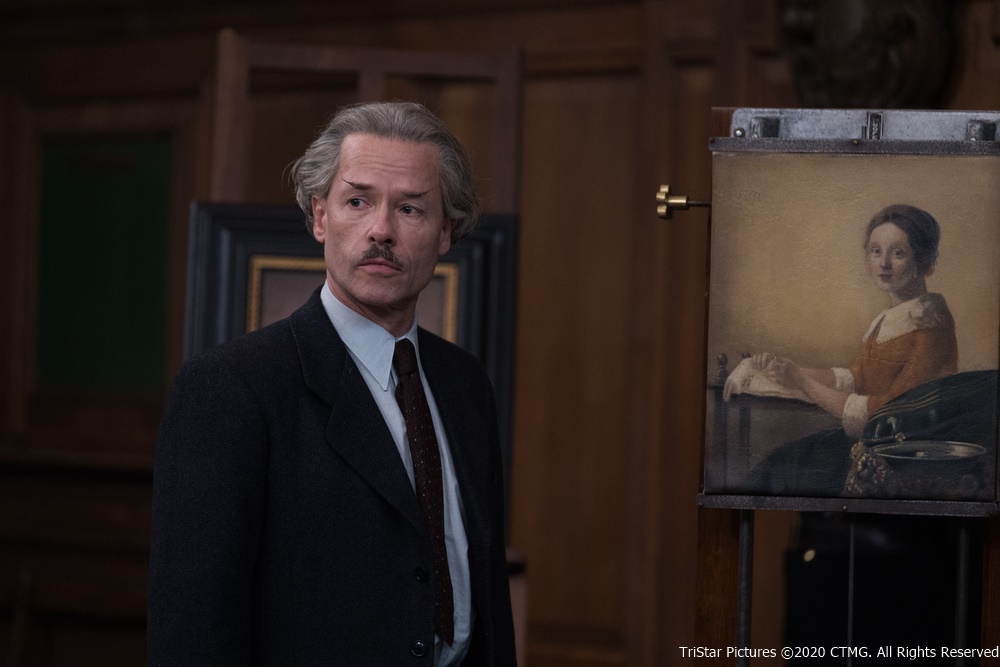
Guy Pearce as Han Van Meegeren in TriStar Pictures’ THE LAST VERMEER.

Guy Pearce, who played Andy Warhol in the Edie Sedgwick biopic Factory Girl, plays yet another 20th-century artist in Dan Friedkin’s The Last Vermeer, Dutch painter and art dealer Han van Meegeren. Imbuing the character with equal parts charm, arrogance, exuberance, and a deep well of humor that never deserts him even as van Meegeren faces the gallows, the actor is riveting in this delicious slice of historical drama.

In the Netherlands in the immediate aftermath of World War II, the Dutch judicial system is running full speed to punish those who collaborated with the Nazis. Among the targets of the investigations is van Meegeren, who sold one of the country’s national treasures, a rare work by 17th-century master Johannes Vermeer, to Nazi leader Hermann Goering. Captain Joseph Piller (Claes Bang, The Square), a former Resistance fighter, is the man leading the inquiry. At first certain of the artist’s collaboration with the enemy, that conviction wavers in the face of van Meegeren’s spirited defense that casts his actions in a vastly different light.

At times, The Last Vermeer takes on the suspenseful tones of a thriller as Piller finds himself at odds with a judicial bureaucracy that has already made up its mind and is out for blood. But eventually the film settles into an involving courtroom drama. That van Meegeren’s guilt has been predetermined is understandable. Even without the receipt of sale for the looted Dutch masterpiece, the artist’s opulent lifestyle in a country where most of the population has suffered deprivation and hardship simply looks bad. How was he able to keep his fortune in a country occupied by Nazis? In defending him, Piller has his work cut out for him, and part of the pleasure in watching the film, is watching that defense unfold. The question of van Meegeren’s actual relationship with the German high command lingers tantalizingly over the proceedings. Is he innocent? Guilty? A trickster who is both at once?

In contrast to Pearce’s ebullience, Bang offers a sober portrayal of a man trying to do the right thing. A Jewish man who covertly fought the Nazis, Piller is well aware of what collaboration with them meant, even if collaboration in this instance was selling a piece of art and not overtly aiding the Nazis’ war/genocidal efforts. A man of conscience, he seeks justice, not revenge, which puts him at odds with the prevailing mood. His insistence on following the case wherever it leads sets him against an unforgiving system. He is the beating heart of the film, a hero of the resistance who is still fighting the good fight.

Based on van Meegeren’s tribulations after the war and adapted from Jonathan Lopez’s book, The Last Vermeer shines a tantalizing light on a small chapter of World War II. Weaving together biography, the force of two strong personalities, and the legend of a Dutch master, it is a potent blend of drama with the history of art and war. –Pam Grady

The Last Vermeer opens in theaters November 20.

Share this:

  • Share on Facebook (Opens in new window) Facebook
  • Share on X (Opens in new window) X
  • Email a link to a friend (Opens in new window) Email
  • Print (Opens in new window) Print
  • Share on LinkedIn (Opens in new window) LinkedIn
  • Share on Tumblr (Opens in new window) Tumblr
  • Share on Reddit (Opens in new window) Reddit
  • Share on Pinterest (Opens in new window) Pinterest
Like Loading...

A monster in the White House in ’70s-era THE WEREWOLF OF WASHINGTON

16 Friday Oct 2020

Posted by cinepam in Reviews

≈ Leave a comment

Tags

Dean Stockwell, Milton Moses Ginsberg, The Werewolf of Washington

The Nixon administration and its misdeeds inspired this queasy horror comedy set in the august halls of the White House. Writer/director Milton Moses Ginsberg could have gone for a more on-the-nose scenario with vampires sucking blood out of bodies and the body politic, but instead he unleashes a malevolent hound on the Oval Office. In this curio from 1973, playing on the Metrograph‘s virtual screen Oct. 16-22, Dean Stockwell is the hapless assistant press secretary for whom things get a little hairy at the full moon.

It is the director’s cut that the Metrograph is screening and Ginsberg has added a note to the beginning of the film that it has taken him 40 years to come to terms with Nixon’s presidency and find the right cut to The Werewolf of Washington. The statement seems innocuous enough until you watch this slim – only 70 minutes – but wild feature and are left to wonder what ended up getting cut and what might have been restored at some point. This film is bonkers.

Among the few oblique references to the actual Nixon administration is newly minted deputy Jack Whitter’s (Stockwell) address in the Watergate apartment complex. A one-time reporter who used to cover the White House and dated the president’s (Biff McGuire) daughter Marion (Jane House), Jack leaves his latest post in Hungary to take the new job. But he brings a little bit of Eastern Europe back with him in the form of a curse, something Jack only becomes aware of at the first full moon after his arrival.

Ginsberg juggles two narratives, one a satire of Washington politics, with a boorish blowhard (no, really) installed in the Oval Office. McGuire is terrific as a crass pol who never listens to anyone and blusters his way through every situation. In one of the film’s funniest moments, the president is bowling in the bowels of the White House when his ball gets stuck in the return. He insists that Jack accompany him down the lane to retrieve it. The site of McGuire and Stockwell gingerly making their way down adjoining gutters is hilarious.

The rest of the movie is taken up with Jack and his problem. He tries to explain it to Marion’s fiancé (Beeson Carroll), a Navy psychiatrist, only to be met with derision. As the body count around Washington mounts, Jack’s panic mounts, but no one will take him seriously. He is tortured and cannot stop staring at his hands, but the president and others are not sympathetic. Instead, they question Jack’s masculinity.

A two-time acting award winner at the Cannes Film Festival in 1959 for Compulsion and 1962 for Long Day’s Journey Into Night and a future Oscar nominee in 1989 for Married to the Mob, Stockwell attacks his role here full-throttle. He makes grand use of those expressive eyebrows of his as he begins his transformation, signaling another wild night out on the town. It is not a subtle performance, but Jack is a role that cries out for over the top and the actor delivers.

In the waning term of our own century’s shambolic presidency, a scant two-and-a-half weeks before the election and two weeks before Halloween, the time is right for the return of this monster mashup. It’s a howler. – Pam Grady

Share this:

  • Share on Facebook (Opens in new window) Facebook
  • Share on X (Opens in new window) X
  • Email a link to a friend (Opens in new window) Email
  • Print (Opens in new window) Print
  • Share on LinkedIn (Opens in new window) LinkedIn
  • Share on Tumblr (Opens in new window) Tumblr
  • Share on Reddit (Opens in new window) Reddit
  • Share on Pinterest (Opens in new window) Pinterest
Like Loading...

A woman warrior claims her destiny in MULAN

04 Friday Sep 2020

Posted by cinepam in Reviews

≈ Leave a comment

Tags

Crystal Rao, Liu Yifei, Mulan, Niki Caro, Rosalind Chao, Tzi Ma

Disney blinked and more’s the pity. Mulanis a rip-roaring, sweeping epic, action-packed, involving, and colorful. It deserves to be on the big screen. But hemorrhaging money as COVID imposes its misery on the happiest place on earth, the company is hoping to recoup some of its losses with a $30 surcharge to its Disney+ subscription. It’s a small screen, after all.

A quasi-remake of Disney’s 1998 animated tale, this live-action Mulan dispenses with songs, the dragon, and other elements of that first adaptation of the Chinese folk tale. In this version of the story, a young girl, Mulan (Crystal Rao), is already practicing her warrior moves, influenced by her father Zhou’s (Tzi Ma) stories of his experiences on the battlefield and in thrall to the sword that his prized possession.

She grows into a beautiful young woman (Liu Yifei), but even as her father warns her that a female warrior would bring disgrace to the family and her mother Li (Rosalind Chao) reminds her that a woman brings honor to her family when she makes a good marriage, Mulan never loses that independent streak. Her chance comes when the government seeks conscripts to defend the kingdom from the nomad would-be usurper Bori Khan (Jason Scott Lee) and his horde. Disguising herself as a male, Mulan goes off to war.

Mulan Is at its lightest in the film’s training camp scenes. A soldier’s life is something she has anticipated and trained for her all her life. Skill sets her male counterparts are just learning she already possesses. She is awkward out of necessity – not only does she not know the world or experiences of boys, but she does not dare do or say anything that might give her away. The deception tugs at her conscience even as her heart tells her that this is her destiny.

Director Niki Caro, who rose to prominence with Whale Rider (2002) before going on to make such films as North Country (2005) and The Zookeeper’s Wife (2017), takes the reins of the most expensive movie ever made by a woman and every bit of that $200 million is apparent on screen. The battle scenes are tense and thrillingly choreographed. Mandy Walker’s cinematography is crisp and luminous. Grant Major’s production design, Anne Kuljian’s set decoration, and Bina Daigeler’s costume design blend into a kaleidoscope of often jewel-toned color, adding a sense of richness even to Mulan’s modest home village.

Mulan represents Disney’s latest step away from the princess-in-need-of-rescue narrative that was the company’s bread and butter for so many years. As portrayed by Rao and Liu, the girl who will be a warrior is a strong, resilient young person with the courage and fortitude to make her dreams a reality. A fierce conviction that the battlefield is where she belongs and that it is her duty and her destiny to protect her family and her country animate her. Mulan has lessons to teach the patriarchal society she was born into – and to a contemporary society watching her ancient battles on screen. –Pam Grady

Share this:

  • Share on Facebook (Opens in new window) Facebook
  • Share on X (Opens in new window) X
  • Email a link to a friend (Opens in new window) Email
  • Print (Opens in new window) Print
  • Share on LinkedIn (Opens in new window) LinkedIn
  • Share on Tumblr (Opens in new window) Tumblr
  • Share on Reddit (Opens in new window) Reddit
  • Share on Pinterest (Opens in new window) Pinterest
Like Loading...

JAZZ ON A SUMMER’S DAY basks in new restoration

12 Wednesday Aug 2020

Posted by cinepam in Reviews

≈ Leave a comment

Tags

Anita O'Day, Bert Stern, Chuck Berry, Dinah Washington, Jazz on a Summer's Day, Louis Armstrong, Mahalia Jackson, Newport Jazz Festival, Thelonious Monk

Louis Armstrong

Photographer Bert Stern, best known for his pioneering ad work –he was the “original mad man,” according to his official bio – and glamorous portraits of Marilyn Monroe, made only one film in his career, Jazz on a Summer’s Day. That documentary, freshly restored to 4K, is enough, though, to make one regret that Stern – who died in 2013 – chose to stick to still photography.

Jazz on a Summer’s Day is Stern’s impressionistic chronicle of the 1958 Newport Jazz Festival. At its core, the film is a record of the performances that include sets from jazz greats Jimmy Giuffre, Thelonious Monk, Anita O’Day, Sonny Stitt, Gerry Mulligan, Big Maybelle Smith, George Shearing, Dinah Washington, Chico Hamilton, Louis Armstrong, as well as rock ‘n’ roll pioneer Chuck Berry, and gospel singer Mahalia Jackson. For anyone who loves the best of music from that era, this is bliss, from Giuffre’s instrumental that opens the film to Dinah Washington’s soulful rendition of “All of Me” (during which she playfully joins in on vibraphone during the song’s instrumental break) to Armstrong’s energetic “Tiger Rag” to Jackson climaxing the film with a soulful “Lord’s Prayer.”

America's Cup

Beyond the world of the stage, Stern sought to capture the full essence of Newport on that tuneful weekend, roaming the town and the concert grounds with his camera. A Dixieland band riding in an open jalopy brings its joyful noise to the city’s streets, horns blaring. Stern follows along, later catching the young musicians playing on the beach at sunset. Children frolic in their yards and at a carnival.

Sailing trials for the America’s Cup were at Newport that weekend, too, and Stern is there, flying along overhead or skimming along the water with the boats. The images of a trio of yachts bobbing on the water cross-cut with Thelonious Monk performing “Blue Monk” are indelible.

The camera ventures into the festival audience capturing young lovers dancing, parents grooving along with their children, and the rapt faces of entranced fans. Pianist George Shearing appears in one of these asides, a huge smile on his face as he mimes playing a keyboard while Louis Armstrong wails on stage. The only sound in the film is the music itself, announcements from the stage, and the occasional off-camera remark, typically a conversation between festival organizers. The cinematography is a rich kaleidoscope of sounds and pictures.

Mahalia Jackson

Stern was 29 when he shot Jazz on a Summer’s Day, and already one of America’s premier photographers. For this project, he dispensed even with light meters, he and his fellow camera people Courtney Hafela and Ray Phealan using their own judgment when it came to setting exposures. They deliberately broke rules – shooting directly into stage lights, for example.

When Stern was done that weekend, he came away with a collection of gorgeous, color-saturated images. Jazz on a Summer’s Day is visually spectacular, never more so than 62 years after it was shot. IndieCollect’s 4K restoration amplifies the film’s beauty, the complement to its aural enchantments. The doc was always glorious, now its shimmering qualities have been enhanced. It is a pure delight.  –Pam Grady

Jazz on a Summer’s Day opens virtually at CinemaSF and BAMPFA on Aug. 12 and the Roxie Theater on Aug. 14.

Share this:

  • Share on Facebook (Opens in new window) Facebook
  • Share on X (Opens in new window) X
  • Email a link to a friend (Opens in new window) Email
  • Print (Opens in new window) Print
  • Share on LinkedIn (Opens in new window) LinkedIn
  • Share on Tumblr (Opens in new window) Tumblr
  • Share on Reddit (Opens in new window) Reddit
  • Share on Pinterest (Opens in new window) Pinterest
Like Loading...

A Neeson family affair: MADE IN ITALY

07 Friday Aug 2020

Posted by cinepam in Reviews

≈ Leave a comment

Tags

father and son, James D'Arcy, Liam Neeson, Lindsay Duncan, Made in Italy, Micheál Richardson, Valeria Bilello

Made+In+Italy+Still+1The echoes of two actors’ shared reality lend unexpected emotional resonance to this engaging Tuscany travelogue, actor James D’Arcy’s (Agent Carter, Homeland) feature writing/directing debut. What might have been a slight relationship drama between a fractured father and son takes on real weight when the father is played by Liam Neeson and the son by his own progeny, Micheál Richardson. In a story that touches on a young adult feeling like he can never measure up to a celebrated parent, Richardson proves that is not an issue in the Neeson household.

There are eerie parallels in the situation between Jack (Richardson) and Robert (Neeson) and that of the actors that play them. Jack lost his mother and Robert his wife in a car crash when the boy was a child, just as a skiing accident claimed Richardson’s mother and Neeson’s wife, Natasha Richardson, when Micheál was in middle school.

In Jack and Robert’s case, the death opened a chasm between them that neither now knows how to breach. Robert, a respected artist, simply stopped creating as grief consumed him. Jack, only seven when his mom died, can barely remember her or a time when he belonged to a happy family. He brings his father to their old Tuscan villa not to strengthen any familial bond but because he needs money and selling the property is his only prayer of getting it.

There is no mystery about where all this is going, but that scarcely matters. The views are stunning, the villa at the top of a hill overlooking a verdant valley. In contrast, the long-neglected villa is decrepit and full of weasels, but somehow no less charming for it. Selling the property is clearly the height of insanity, but can Jack see that?

Valeria Bilello (Sense8) plays Natalia, a restaurateur who catches Jack’s eye, while Lindsay Duncan is Kate, a realtor tasked with selling the house who just happens to be age appropriate for Robert. Father and son returned to England after the tragedy, never to look back until now. What remains unsaid could not be clearer: In Robert’s inability to cope with his loss head-on only made a bad situation that much worse for father and son. Jack, in his desire, for quick cash has inadvertently backed his father and himself into a long-delayed reckoning with the hole in their lives.

A syrupy score and an over-reliance on Italian pop grate on the soundtrack, but mostly Made in Italy floats on the strengths of its glorious setting, the amiability of its storytelling, and the strengths of its performances. In particular, Neeson father and son are terrific, a coup of casting for a first-time director that pays off in the rich emotional shadings they bring to their roles –Pam Grady

Made in Italy is playing in drive-ins, theaters, and digital and cable VOD platforms.


Share this:

  • Share on Facebook (Opens in new window) Facebook
  • Share on X (Opens in new window) X
  • Email a link to a friend (Opens in new window) Email
  • Print (Opens in new window) Print
  • Share on LinkedIn (Opens in new window) LinkedIn
  • Share on Tumblr (Opens in new window) Tumblr
  • Share on Reddit (Opens in new window) Reddit
  • Share on Pinterest (Opens in new window) Pinterest
Like Loading...
← Older posts
Newer posts →

Categories

  • Interviews
  • News
  • Reviews
  • Short Takes
  • Uncategorized

Recent Posts

  • More fast fashion than couture: THE DEVIL WEARS PRADA 2
  • A Stamp of Approval
  • Life is messy & so is ‘Megalopolis’
  • A star discovers too late there are worse things than aging in the black comic body horror ‘The Substance’
  • A young teen nurses a crush when he finds himself among ‘Big Boys’

Archives

Blog at WordPress.com.

  • Subscribe Subscribed
    • Cinezine Kane
    • Join 48 other subscribers
    • Already have a WordPress.com account? Log in now.
    • Cinezine Kane
    • Subscribe Subscribed
    • Sign up
    • Log in
    • Report this content
    • View site in Reader
    • Manage subscriptions
    • Collapse this bar

Loading Comments...

    %d