• About

Cinezine Kane

Cinezine Kane

Category Archives: Reviews

Review: Trapped in THE CANYONS

08 Thursday Aug 2013

Posted by cinepam in Reviews

≈ Leave a comment

Tags

Bret Easton Ellis, James Deen, Lindsay Lohan, Paul Schrader, The Canyons

canyonsThe weird thing about Lindsay Lohan in The Canyons is that she looks more like Elizabeth Taylor than she did in the Lifetime movie Liz & Dick. The sad thing about Lindsay Lohan in The Canyons is that at 26 she is channeling the middle-aged, blowsy version of Taylor. Director Paul Schrader argues in Film Comment that the camera loves Lohan the way it once did Marilyn Monroe. Based on his own work with her in The Canyons that is mostly untrue, but even if it was, so what? The camera loves John Stamos. That doesn’t make him a movie star. And not even Monroe at her most luminous could have saved The Canyons. If Lohan hoped to reignite any flickering embers left among the ashes of her career from her tottering walk on stiletto heels down Hollywood’s seamier side, she is bound to be disappointed.

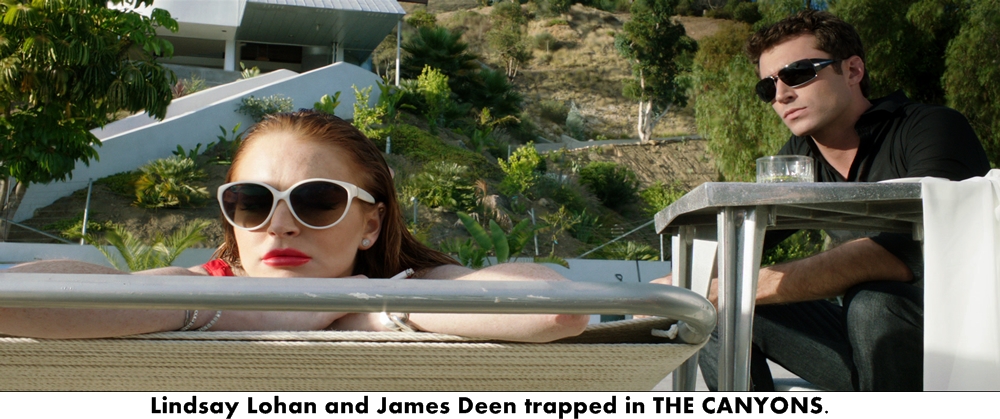
Lohan is Tara, kept by one man, trust fund psychopath Christian (porn star James Deen), but in love with another, struggling actor Ryan (Nolan Funk). Christian is controlling, a boyfriend who constantly monitors his girlfriend’s activity and who exercises the prerogatives of ownership by inviting strangers over for hookups. (He whines to his psychiatrist, played by Gus Van Sant, that he feels “objectified” when Tara tries to take control during one of their encounters, the single funniest line in the movie.) Even to a casual observer, Christian is a dangerous man, but that doesn’t stop Tara from still carrying a torch for the ex she dumped, because he was poor. She couldn’t help out, because, you know, getting a job would be just too tragic.

No one is very good in the movie, but to be fair to Lohan and the other actors, they are trapped in Bret Easton Ellis’ ludicrous, cliche-ridden screenplay. Nearly 30 years after the publication of his first novel Less Than Zero, Ellis remains obsessed with Hollywood’s rich and fatuous. Less Than Zero made a crap movie, too, but at least it had Robert Downey Jr. going for it. There is no one of his caliber here in a cast that struggles to breathe life into barely there characters. Schrader himself seems hardly invested in the material, except for a few golden moments, such as one scene between Tara and Christian by their pool where Lohan really does look every inch the movie star.

The most striking element of The Canyons is actually its opening title sequence, a catalog of dead movie theaters, images that recur from time to time throughout the movie and then again at the end credits. There is something impressive, even majestic about those ruins, which cannot be said for the movie’s tired melodrama. The images also seem like an admission on Schrader’s part that the film itself is a kind of ruin and not the lifeline he, Lohan and Ellis thought it would be. –Pam Grady

Share this:

  • Share on Facebook (Opens in new window) Facebook
  • Share on X (Opens in new window) X
  • Email a link to a friend (Opens in new window) Email
  • Print (Opens in new window) Print
  • Share on LinkedIn (Opens in new window) LinkedIn
  • Share on Tumblr (Opens in new window) Tumblr
  • Share on Reddit (Opens in new window) Reddit
  • Share on Pinterest (Opens in new window) Pinterest
Like Loading...

Review: DOWNLOADED dissects Napster

02 Friday Aug 2013

Posted by cinepam in Reviews

≈ Leave a comment

Tags

Alex Winter, Chris Blackwell, DJ Spooky, Don Ienner, Downloaded, Henry Rollins, Hilary Rosen, JP Barlow, Lars Ulrich, Lawrence Lessig, Mike D, Sean Parker, Seymour Stein, Shawn Fanning

It was the shot heard around the world, or would have been had it been an actual shot and not a bunch of 1s and 0s that changed forever how people consume music: Napster, the peer-to-peer file-sharing app that allowed users to share music over the internet. Alex Winter’s Downloaded spins the tale of this short-lived tech pioneer that revolutionized the music business and wreaked havoc on a record industry hopelessly out of touch with new technology. Napster itself would be destroyed by founders Shawn Fanning and Sean Parker’s youthful ignorance – or contempt of – copyright laws, as the company faced legal action not just from record companies, but also from artists like Metallica and Dr. Dre.

Winter’s documentary is a thorough dissection of a phenomenon, a kind of Rashomon, if you will, that gives voice to a chorus of differing viewpoints. Among those interviewed are Fanning, Parker and others involved with Napster; record industry executives, including Hilary Rosen, one-time head of the Recording Industry Association of America, former Sony Music head Don Ienner. Island Records founder Chris Blackwell and Sire Records co-founder Seymour Stein; and musicians, including Metallica’s Lars Ulrich, The Beastie Boys’ Mike D, Henry Rollins and DJ Spooky (who also composed the film’s music). Other precincts heard from include Electronic Frontier Foundation co-founder (and Grateful Dead lyricist) JP Barlow and Harvard Law professor Lawrence Lessig.

Downloaded is a history lesson as well as a valuable case study on how not to conduct business in either the virtual or real worlds, as mistakes made by both Napster and the record industry had ugly consequences. From a musician’s viewpoint, the more cynical will note that what Winter’s film really emphasizes is how the more things change, the more things stay the same: Whether a record label or Napster (or newer services, such as Spotify, if Thom Yorke and other musicians’ complaints about paltry payments are accurate), good luck collecting those royalties. – Pam Grady

Downloaded director Alex Winter will be in attendance Saturday night, Aug 3 at San Francisco’s Roxie Theater. For more info, visit roxie.com.

Share this:

  • Share on Facebook (Opens in new window) Facebook
  • Share on X (Opens in new window) X
  • Email a link to a friend (Opens in new window) Email
  • Print (Opens in new window) Print
  • Share on LinkedIn (Opens in new window) LinkedIn
  • Share on Tumblr (Opens in new window) Tumblr
  • Share on Reddit (Opens in new window) Reddit
  • Share on Pinterest (Opens in new window) Pinterest
Like Loading...

Jazz Hot? Jazz Not. A Not So GREAT GATSBY

10 Friday May 2013

Posted by cinepam in Reviews

≈ Leave a comment

Tags

Baz Luhrmann, Cab Calloway, Leonardo DiCaprio, The Great Gatsby

There are a lot of things that you can say about Baz Luhrmann’s take on The Great Gatsby: It is cheesy as a block of Velveeta. It is a triumph of art direction over common sense; art directed, in fact, to death. (And not a natural death, either. The whole movie is a crime scene.) Leonardo DiCaprio is miscast, playing Gatsby in the same exaggerated manner that he played notorious eccentric Howard Hughes in The Aviator, making Daisy’s attraction to him mystifying. Perhaps in a better movie the actor’s odd choice to underline the fact that Gatsby is a stalker might have worked, but not in the context of Luhrmann’s glittering empty vessel. Well over two hours long, The Great Gatsby is one of those movies that aspires to be an epic, but only manages to be an epic bore.

It is also a movie that offers a tease, and this may be the worst thing about it: There is a bandleader at Jay Gatsby’s parties who is clearly supposed to be Cab Calloway, the body language is so exact. And yet there is no Cab Calloway on the soundtrack. This is a Jazz Age drama with no apparent love for the era beyond its fashions. Of course, given what’s on the soundtrack, it is entirely possible that Luhrmann simply misread it as the Jay-Z Age. He no doubt hopes that Beyoncé‘s old man will help lure the young ones into a movie that is not youthful at all. Calloway’s effervescent jazz might not have aided that cause either, but it would have injected life into a movie that desperately needs some. – Pam Grady

Share this:

  • Share on Facebook (Opens in new window) Facebook
  • Share on X (Opens in new window) X
  • Email a link to a friend (Opens in new window) Email
  • Print (Opens in new window) Print
  • Share on LinkedIn (Opens in new window) LinkedIn
  • Share on Tumblr (Opens in new window) Tumblr
  • Share on Reddit (Opens in new window) Reddit
  • Share on Pinterest (Opens in new window) Pinterest
Like Loading...

GANGSTER SQUAD: Style and Spatter

11 Friday Jan 2013

Posted by cinepam in Reviews

≈ Leave a comment

Tags

Anthony Mackie, Emma Stone, Gangster Squad, Giovanni Ribisi, Josh Brolin, Michael Pena, Nick Nolte, Robert Patrick, Ruben Fleischer, Ryan Gosling, Sean Penn

GANGSTER SQUADGangster Squad gets points for style. It looks great in its depiction of postwar Los Angeles as a sleek, glamorous snake pit of crime and sin, never more so than when the camera lingers on Ryan Gosling’s Jerry Wooters, a cheerfully cynical, impeccably tailored lounge lizard of a police detective, a man who spends his off hours soaking up nightclub ambiance. Too bad that more thought went into costume design, art direction and recreating landmarks of the era than into Will Beall’s shallow and often ludicrous adaptation of Paul Lieberman’s “Tales from the Gangster Squad,” a 2008 Los Angeles Times true-crime series.

At least Gangster Squad gets the players’ names right, but very little else, as it reduces an irresistible saga of crime and punishment to blood-spattered fantasy. By this film’s reckoning, World War II combat veterans have returned so damaged by their experience that – whether cop or criminal – they are good for little else than killing people (it is Josh Brolin as Gangster Squad head Sgt. John O’Mara who puts forth that absurd theory), corruption in Los Angeles is but a brief 1940s phenomenon (oh really?), and gangster Mickey Cohen – the mob kingpin Sean Penn plays with such rage that he often appears to be close to stroking out – is so out of control that he is as apt to kill his own people as his enemies. It is also a movie that rewrites history purely to amp up the level of brutality.

Working with a property set in a time period during which film noir flowered, an era that novelist James Ellroy has claimed as his own, director Ruben Fleischer has a strong grasp of the period. Again, this is a movie that looks good. Perhaps he hoped that with enough outsized violence and a stellar enough cast – that in addition to Gosling, Brolin and Penn, includes Emma Stone, Nick Nolte, Michael Pena, Robert Patrick, Giovanni Ribisi, and Anthony Mackie – he could muscle through the deficiencies in the script. No dice. Like so many of the movie’s characters and nameless extras, Gangster Squad is dead on arrival, the victim of ludicrous plotting, rice-paper-thin characters and often pointless bloodshed.

If you must get your Mickey Cohen fix – and why not? The real guy was a fascinating character – skip Gangster Squad. Instead, watch L.A. Confidential, Curtis Hanson’s seductive 1997 Ellroy adaptation that casts Paul Guilfoyle as the notorious mobster or Barry Levinson’s stylish, James Toback-penned 1991 crime drama Bugsy in which Harvey Keitel steps into Cohen’s shoes in a bravura, Oscar-nominated performance. Or rent The Racket, a 1951 noir starring Robert Mitchum as a kind of one-man gangster squad, one of the few honest cops on a corrupt force, who squares off against mob boss Robert Ryan, a psychopath in the same mold as Penn’s Cohen (albeit one who appears to have a better handle on his blood pressure). Skipping Gangster Squad does mean missing Gosling swanning about in his exquisite threads (he does wear clothes well), but it also means missing an empty exercise in cutthroat style. – Pam Grady

Share this:

  • Share on Facebook (Opens in new window) Facebook
  • Share on X (Opens in new window) X
  • Email a link to a friend (Opens in new window) Email
  • Print (Opens in new window) Print
  • Share on LinkedIn (Opens in new window) LinkedIn
  • Share on Tumblr (Opens in new window) Tumblr
  • Share on Reddit (Opens in new window) Reddit
  • Share on Pinterest (Opens in new window) Pinterest
Like Loading...

Beloved: Like mother, like daughter when it comes to romance

17 Friday Aug 2012

Posted by cinepam in Reviews

≈ Leave a comment

Tags

Beloved, Catherine Deneuve, Chiara Mastroianni, Christophe Honore, Louis Garrel, Ludivine Sagnier, Milos Forman

Beloved begins as a candy-colored consumer fantasy in a Paris shoe store as pop singer Eileen warbles a French rendition of “These Boots Are Made For Walkin’” on the soundtrack. Ludivine Sagnier and her fellow salesgirls and their customers go about their business in a shop that sells nothing but the pointy-toed, spike-heeled footwear known colloquially as “fuck-me pumps,” an ebullient scene that suggests that what follows will be a cinematic bonbon. But Beloved is a Christophe Honore movie, the writer/director who made the melancholic Dans Paris and Love Songs. This romantic musical that charts the ups-and-downs over four decades in the lives of a mother and daughter follows in that downbeat, darkly humorous and ultimately resonant vein.

The movie begins in 1964 with Sagnier starring as Madeleine, a full-time shoe saleswoman and part-time prostitute whose short-lived marriage to Jaromil (Rasha Bukvic), a Czech doctor, results in an unhappy stay in Prague and a daughter. Back in Paris, she remarries, but the bond she shares with Jaromil is unshakeable.

As the story enters the 1990s, Catherine Deneuve and the great Czech director Milos Forman take over as Madeleine and Jaromil, while Deneuve’s real life daughter Chiara Mastroianni plays their daughter Vera. In a London club one evening with her good friend and still besotted ex Clement (Louis Garrel), she sensuously dances to the house band’s cover of Bo Diddley’s “Who Do You Love?,” attracting the attention of American drummer Henderson (Paul Schneider). When the two lock eyes, Vera’s story truly begins. She and her mother are very different, but their love lives run a parallel track. They are both obsessed with men they cannot completely have while remaining loving but indifferent to the men who are in love with them.

To say much more would be to give too much away. This is an epic drama, nearly two-and-a-half hours long that takes sharp turns into unexpected places. Like Love Songs, it is a musical in the low-key, Jacques Demy mode (underlined by The Umbrellas of Cherbourg star Deneuve’s presence) with Alex Beaupain’s songs conveying much of the story.

Honore gifts Garrel – like Mastroianni, one of the director’s regulars – with the most moving song of the bunch, a poignant ode to Clement’s impossible love for Vera. And Sagnier is wonderful in her portion of the film, as Madeleine’s charming effervescence gradually loses its fizz under the onslaught of life’s disappointments. There is no mistaking who the real stars of Beloved are, though. Deneuve and Mastroianni are glorious apart. The scenes they share are downright magical and give Honore’s title a double meaning. “Beloved” are the men they adore who perhaps don’t deserve their strong feelings, but “beloved” is also what they are to one another, feelings that are richly deserved. – Pam Grady

Share this:

  • Share on Facebook (Opens in new window) Facebook
  • Share on X (Opens in new window) X
  • Email a link to a friend (Opens in new window) Email
  • Print (Opens in new window) Print
  • Share on LinkedIn (Opens in new window) LinkedIn
  • Share on Tumblr (Opens in new window) Tumblr
  • Share on Reddit (Opens in new window) Reddit
  • Share on Pinterest (Opens in new window) Pinterest
Like Loading...

360 Degrees of Separation

10 Friday Aug 2012

Posted by cinepam in Reviews

≈ Leave a comment

Tags

Ben Foster, Fernando Meirelles, Jude Law, Peter Morgan, Rachel Weisz, Vladimir Vdovichenkov

360 has so much going for it – on paper, anyway. The Queen/Manchester United scribe Peter Morgan wrote it. City of God/The Constant Gardener director Fernando Meirelles helmed it. Among the stars in a large international ensemble are Jude Law, Rachel Weisz, Anthony Hopkins, Ben Foster, Moritz Bleibtreu and Jamel Debbouze. Great writer. Great director. Great cast. In theory, this latest variation on La Ronde that spins a web of interconnection between a disparate group of people ought to be a winner. The drama blending elements of romance and suspense is never boring, but it never catches fire either. Too many of the characters are too sketchily drawn, making their stories only intermittently compelling.

A handful of fine performances are what make 360 worthwhile. Law is particularly effective as a businessman at a trade show in Vienna who, finding his attempts to let his hair down in a foreign city thwarted, uses his down time to phone home. His marriage to Weisz looks perfect from the outside, but his voice mails to her acknowledge the gap between them. Russian actor Vladimir Vdovichenkov also makes a memorable turn as a lonely, soulful mobster, stuck in a loveless marriage and harnessed to rude and impossible boss Mark Ivanir. And Ben Foster as a twitchy sex offender trying to stay straight is creepy and poignant at the same time.

The people in 360 are citizens of the world. Their connections are forged on planes, in airports, at hotels, in support groups, on the internet. Borders are porous and a random connection can come from anywhere. The film starts and ends in Vienna and visits Bratislava, London, Paris, Denver and Phoenix. Morgan and Meirelles are trying to make a point about the global nature of humanity and how small the world has become in our age. But they have overreached in trying to balance too many characters and too many situations. What might have resonated is instead too often a bland muddle. – Pam Grady

Share this:

  • Share on Facebook (Opens in new window) Facebook
  • Share on X (Opens in new window) X
  • Email a link to a friend (Opens in new window) Email
  • Print (Opens in new window) Print
  • Share on LinkedIn (Opens in new window) LinkedIn
  • Share on Tumblr (Opens in new window) Tumblr
  • Share on Reddit (Opens in new window) Reddit
  • Share on Pinterest (Opens in new window) Pinterest
Like Loading...

Put a stake in it: ABRAHAM LINCOLN: VAMPIRE HUNTER

22 Friday Jun 2012

Posted by cinepam in Reviews

≈ Leave a comment

Tags

Abraham Lincoln: Vampire Hunter, Anthony Mackie, Benjamin Walker, Dominic Cooper, Mary Elizabeth Winstead, Rufus Sewell, Timur Bekmambetov

The other day I read one of those articles about doofuses on Twitter, you know, the ones that insist on tweeting their ignorance of stuff generally considered common knowledge, like the folks stunned and amazed to discover that the Titanic sinking isn’t just something that happened in a movie. I was thinking about that while watching Abraham Lincoln: Vampire Hunter the other night, and began to anticipate the opposite kind of tweet, the one posted by the guy who watches the movie and convinces himself that he slept through the most fascinating history lesson ever: “Abraham Lincoln freed the slaves and killed vampires? For realz? #mindblown” That tweet, at least, would be mildly entertaining as opposed to the movie, which takes itself far too seriously to be very much fun.

The movie has a joke of a title and, in its 3D presentation, throws stuff up at the screen with the wild abandon of Drive Angry or A Very Harold & Kumar 3D Christmas. Cheesiness is built into its DNA, but director Timur Bekmambetov squelches humor that might have breathed some life into the film in favor of dull earnestness. What this movie is crying out for is Evil Dead‘s lamebrain hero Ash and an actor with Bruce Campbell’s deadpan grasp of the absurd. Instead, it is stuck with a sober, familiar Abe Lincoln (albeit one with martial arts training and quite a way with a silver-tipped axe) and a bland Benjamin Walker, who looks the part but barely registers on screen next to more charismatic costars Dominic Cooper, Rufus Sewell and Anthony Mackie.

Seth Grahame-Smith (who also penned the screenplay of the recent, even more dire Dark Shadows) adapts his own novel in which he offers an alternative history, one in which the 16th president of the United States is cast as a lifelong vampire foe and the Civil War presented as less a War Between the States than a battle between the living and the undead. Slaves are food for the vampires and that supply must be maintained. It is a conflict that pits Lincoln, vampire-turned-vampire-hunter Henry Sturgess (Cooper, playing the most intriguing character in the story, someone intent on wiping out his own kind), Lincoln’s childhood friend Will Johnson (Mackie), shopkeeper Joshua Speed (Jimmi Simpson) and Lincoln’s wife Mary Todd Lincoln (a pallid Mary Elizabeth Winstead) against diabolical vampire Adam (an exuberant, scenery-chewing Sewell) and his bloodsucking tribe. It is Adam who ups the ante in the Civil War when he offers Confederate President Jefferson Davis (John Rothman) a vampire army to battle the Union forces.

Frankly, it is hard to top the horror of the actual Civil War. The addition of battalions of the undead in a fictional version of those historical events doesn’t top the terror quotient of the single bloodiest chapter in American history. But then Bekmambetov has as little sense of horror as he does a sense of humor. The whole endeavor is merely an excuse for outsized violence; adequate, if unspectacular, special effects; and one big rote action sequence after another. And it all feels a little derivative. It’s missing “the loom of destiny,” but at times, Abraham Lincoln: Vampire Hunter feels like a 19th century version of the director’s 2008 thriller Wanted in its lavish, loud and sometimes cartoonish battles. The two films even share similar climaxes. Apparently Bekmambetov enjoys playing with trains.

In the absence of humor and the absence of horror, Abraham Lincoln: Vampire Hunter is just another routine action thriller and all the drearier for it. Lincoln deserves better and so do movies audiences. – Pam Grady


Share this:

  • Share on Facebook (Opens in new window) Facebook
  • Share on X (Opens in new window) X
  • Email a link to a friend (Opens in new window) Email
  • Print (Opens in new window) Print
  • Share on LinkedIn (Opens in new window) LinkedIn
  • Share on Tumblr (Opens in new window) Tumblr
  • Share on Reddit (Opens in new window) Reddit
  • Share on Pinterest (Opens in new window) Pinterest
Like Loading...

The Big Suck: Dark Shadows

11 Friday May 2012

Posted by cinepam in Reviews

≈ Leave a comment

Tags

Chloe Grace Moretz, Dark Shadows, Eva Green, Helena Bonham Carter, Johnny Depp, Jonny Lee Miller, Michelle Pfeiffer, Tim Burton

What ails Tim Burton’s Dark Shadows reboot can be summed up in three words: Jonny Lee Miller. Not that there’s anything wrong with him. He is a fine actor let down by movie in which his character Roger Collins – a sleazebag descendent of vampire Barnabas Collins (Johnny Depp) – is so thin that he’s practically translucent. There’s no real point to the character or to casting a recognizable name to play him. There are many more missteps in this uninspired horror comedy, but the misuse of Miller is symbolic of the whole sorry enterprise. This eighth collaboration between Burton and Depp ought to be grounds for their divorce. At this point, they are only bringing out the worst in each other.

Unlike the recent 21 Jump Street – in which Depp shines in a cameo role – that simply took the premise of the original TV series of cops masquerading as high school kids and spun it into a completely new story, Dark Shadows hews closer in some aspects to the Gothic TV soap opera that inspired it. Freed from his coffin after 200 years, Barnabas returns to his Maine estate Collinwood and discovers that his once powerful family has fallen into such a state that they cannot even afford the upkeep on the mansion. The town, Collinsport, might still bear the family name, but it is Angelique Bouchard (Eva Green), the witch who cursed the family in the first place, who rules it.

Replacing the melodrama of the original series is weak comedy. The story is credited to two writers, frequent Burton collaborator John August (Big Fish, Corpse Bride, Charlie and the Chocolate Factory, as well as the upcoming Frankenweenie) and Seth Grahame-Smith (who also wrote the screenplay) and it’s an incoherent mess that appears to take a checklist approach to the supernatural elements of vampire, witch, ghost and werewolf. The tale is set in the 1970s, apparently for the sole reason of mining weak jokes from the 18th-century vampire’s fraught interactions with lava lamps, Alice Cooper, The Carpenters and Roger’s double-knit polyester leisure suits.

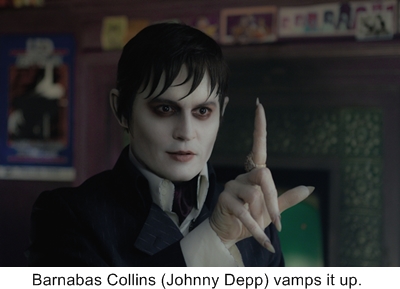
Talented actors like Miller, Michelle Pfeiffer as lady of the manor Victoria Collins Stoddard, Chloe Grace Moretz as Victoria’s surly daughter Carolyn, and Burton’s partner Helena Bonham Carter as the Collins’ drunken live-in psychiatrist Dr. Julia Hoffman are on hand to decorate the scenery, but this is Depp’s show. Once again, he’s that guy, the willful eccentric, the lovable rapscallion ever ready with a quip, and catnip for the ladies, this time despite Barnabas’ deathly pallor, ridiculous haircut and claws so lethal looking it seems apparent that the good-natured bloodsucker spends a lot of his free time sharpening them on the lid of his coffin. Barnabas is less a character than a cartoon and in Depp’s universe, only too familiar. Depp has become his own stereotype, self-consciously odd and overly broad. It’s a lazy abuse of genuine talent and it stopped being cute at least three Pirates of the Caribbeans ago.

Perhaps what is most shocking about Dark Shadows is how little imagination seems to have gone into it. At his worst, Burton’s films have always at least offered dazzle. While at times that means the movies seem more art directed than directed, they’ve also been gorgeous eye candy. Dark Shadows is downright dowdy. It’s a sad thing when the most memorable image in a Tim Burton film is Bonham Carter’s red wig.

It’s been twenty-two years since Burton and Depp first collaborated on Edward Scissorhands, a film with overflowing with visual panache and just as much heart. Dark Shadows has neither. Perhaps a vampire had at it. The movie has certainly been sucked dry of any reason for being. – Pam Grady

Share this:

  • Share on Facebook (Opens in new window) Facebook
  • Share on X (Opens in new window) X
  • Email a link to a friend (Opens in new window) Email
  • Print (Opens in new window) Print
  • Share on LinkedIn (Opens in new window) LinkedIn
  • Share on Tumblr (Opens in new window) Tumblr
  • Share on Reddit (Opens in new window) Reddit
  • Share on Pinterest (Opens in new window) Pinterest
Like Loading...

I Wake Up Dreaming 2012 Review: Une Si Jolie Petite Plage

10 Thursday May 2012

Posted by cinepam in Reviews

≈ Leave a comment

Tags

Elliot Lavine, Francois Truffaut, Gerard Philipe, I Wake Up Dreaming 2012: The French Have a Name For It!, Robert Siodmak, The 400 Blows, The Killers, Une Si Jolie Petite Plage (Such a Pretty Little Beach), Yves Allegret

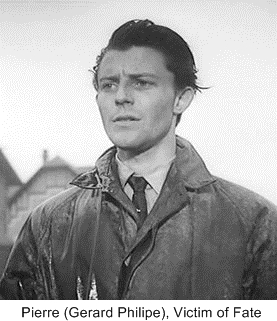
The rain never stops falling in Yves Allegret’s Une Si Jolie Petite Plage (Such a Pretty Little Beach), one of the highlights of “I Wake Up Dreaming 2012: The French Have a Name For It!.” Elliot Lavine’s latest film noir series that runs Friday, May 11 through Thursday, May 24 at San Francisco’s Roxie Theater. A resort town in the off-season provides the backdrop for a cursed man’s inexorable reckoning with fate, but even if Pierre (Gerard Philipe) arrived at the height of summer, no postcard vista or warming sunlight could cut through the gloom that is Pierre’s constant companion or alter his destiny.

Allegret’s melodrama is a triumph of mood. Like Burt Lancaster’s Swede at the start of Robert Siodmak’s The Killers, Pierre is done for and he knows it. He’s on the run, more out of reflex it seems than anything else. Why he has chosen to flee to this sad corner of Normandy is murky at first, but his reaction to Georges (Andre Valmy), a teenager working around the hotel where Pierre is hiding out provides a clue. Just what he’s done is also a little vague until the landlady starts gossiping about a sensational story in the newspaper and begins playing a certain record that only further distresses Pierre. The tale of a youth corrupted and destroyed comes out in bits and pieces, and becomes more clear once Fred (Jean Servais), another visitor from Paris arrives.

Looking at the windswept, desolate beach, it’s easy to wonder if Une Si Jolie Petite Plage was on Francois Truffaut’s mind, however subconsciously, when he was writing the end of The 400 Blows, leaving Antoine Doinel frozen on the beach, his future a question mark. Certainly, Pierre’s fortunes were sealed when he couldn’t have been very much older than Antoine. Philipe is perfectly cast as that lost boy grown into a broken man who can’t imagine any future at all.

As noirs go, they don’t come much bleaker than this. Allegret complements Pierre’s distress with the rain, the pacing, and the views of the dismal shore and village (lensed by Henri Alekan, the cinematographer who shot Jean Cocteau’s Beauty and the Beast and Wim Wenders’ Wings of Desire). The effect is to create a sense of an ending foretold and yet even knowing what is surely coming does not lessen the suspense nor alter the impact of the conclusion. This pretty little beach is a passageway to the heart of darkness and it is a trip well worth taking. — Pam Grady

Une Si Jolie Petite Plage (Such a Pretty Little Beach), screens on Sunday, May 13 as part of “I Wake Up Dreaming 2012: The French Have a Name For It!” at the Roxie Theater, 3117 16th Street, San Francisco. For tickets or further information, visit roxie.com.

Share this:

  • Share on Facebook (Opens in new window) Facebook
  • Share on X (Opens in new window) X
  • Email a link to a friend (Opens in new window) Email
  • Print (Opens in new window) Print
  • Share on LinkedIn (Opens in new window) LinkedIn
  • Share on Tumblr (Opens in new window) Tumblr
  • Share on Reddit (Opens in new window) Reddit
  • Share on Pinterest (Opens in new window) Pinterest
Like Loading...

Review: Letters from the Big Man

20 Friday Apr 2012

Posted by cinepam in Reviews

≈ Leave a comment

Tags

Christopher Munch, Jason Butler Harner, Lily Rabe, Sasquatch

Sasquatches roam the Oregon woods in writer/director Christopher Munch’s Letters from the Big Man, a drama that blends conspiracy theory, environmental concerns and a kind of offbeat romance between one of the big-footed creatures and a young woman working on a stream survey for the U.S. Forest Service. Mind you, it is not a conventional love story, more of a meeting of hearts and minds between sympathetic souls. Lily Rabe’s strong turn as the tale’s prickly heroine and the quiet devotion of “the big man” are what rivets in this low-key and leisurely paced film.

Freshly sprung from a bad relationship, Sarah Smith (Rabe) disappears for a solo trip into the fire-scarred forest where she soon can’t shake the feeling that she is being watched and followed. When she meets another solo camper, Sean (Jason Butler Harner), she assumes that it is him, but once the two go their separate ways, she can still feel eyes on her. Only gradually does the truth reveal itself, even then manifesting itself largely through her art work.

With the government out to capture one of the Sasquatch in an effort to study and exploit its DNA and various characters making a case for the wisdom of the Big Men (not to mention the philosophical musings of Sarah’s furry friend, relayed to her telepathically), Letters from the Big Man sometimes teeters on the edge of the ridiculous. Rabe is one of the elements that saves it and not just because her performance is so assured, but also because her forthright (however peevish) character demands to be taken seriously.

Then there is the lovelorn being itself. Sitting gravely in the forest, keep a respectful distance as he watches over Sarah, he is irresistible. He is a seductive fellow, working his charm not just on the object of his affection but on the audience. There are a lot of talking points in this movie about environmental degradation, the man-made destruction of nature and the evils of governments and bureaucracies, some of it extremely heavy-handed. It is a minor miracle then that Letters from the Big Man manages to charm in spite of all that. Blame it on the Sasquatch. He has a way of making it all better. – Pam Grady

Share this:

  • Share on Facebook (Opens in new window) Facebook
  • Share on X (Opens in new window) X
  • Email a link to a friend (Opens in new window) Email
  • Print (Opens in new window) Print
  • Share on LinkedIn (Opens in new window) LinkedIn
  • Share on Tumblr (Opens in new window) Tumblr
  • Share on Reddit (Opens in new window) Reddit
  • Share on Pinterest (Opens in new window) Pinterest
Like Loading...
← Older posts
Newer posts →

Categories

  • Interviews
  • News
  • Reviews
  • Short Takes
  • Uncategorized

Recent Posts

  • A Stamp of Approval
  • Life is messy & so is ‘Megalopolis’
  • A star discovers too late there are worse things than aging in the black comic body horror ‘The Substance’
  • A young teen nurses a crush when he finds himself among ‘Big Boys’
  • The stunt man becomes the star as Ryan Gosling becomes THE FALL GUY

Archives

Blog at WordPress.com.

  • Subscribe Subscribed
    • Cinezine Kane
    • Join 48 other subscribers
    • Already have a WordPress.com account? Log in now.
    • Cinezine Kane
    • Subscribe Subscribed
    • Sign up
    • Log in
    • Report this content
    • View site in Reader
    • Manage subscriptions
    • Collapse this bar
 

Loading Comments...
 

    %d