• About

Cinezine Kane

Cinezine Kane

Category Archives: Reviews

PIXELS vs. PIXELS

24 Friday Jul 2015

Posted by cinepam in Reviews, Short Takes

≈ Leave a comment

Tags

Adam Sandler, Chris Columbus, Josh Gad, Kevin James, Patrick Jean, Peter Dinklage, Pixels, Pixels short

This is Pixels, the feature: It stars Adam Sandler, an actor—to borrow a phrase from Mart Crowley’s The Boys in the Band—who doesn’t have charm. He has counter-charm. It also stars Kevin James as Paul Blart, Mall Cop gets a promotion to president of the United States. Sandler plays a one-time arcade-style video game whiz who now installs electronic equipment for a living. (The movie presents him as a loser because of his job, but screenwriters Tim Herlihy and Timothy Dowling might have stopped to consider that not everyone can grow up to write terrible screenplays.) These two, along with Josh Gad as a conspiracy nut and Peter Dinklage as a scammer-turned-jailbird, are what stands between the world and total annihilation when aliens in the form of beloved videogame characters attack. It has a few things going for it, namely Dinklage, who is clearly having a blast playing a jerk; a sly insertion of “jiggery-pokery;” Cheap Trick’s “Surrender” on the soundtrack not once, but twice; and a prologue that evokes summer days gone by back when nearly all American kids were free-range kids. But it is also at least 20 minutes too long (with a tacked on last act that merely serves to pad out the running time) and just feels too much like the usual summer bombastic apocalypse. Also, there is a missed opportunity here: Why did it not occur to anyone to recruit Jason Alexander to pay homage to the classic Seinfeld “Frogger” episode?

What inspired director Chris Columbus’ bid for big, dumb summer fun is something altogether more modest: Patrick Jean’s 2010 short Pixels. Less than three minutes long, there are no heroes, only aliens in the guise of Pac-Man, Donkey Kong, and other classic game characters invading New York. It’s sly and smart and full of more imagination in its tiny running time than anything in the feature. It’s a jewel. To watch it after seeing its new bloated companion is to be aware that just because you can make something bigger doesn’t mean that you should. When it comes to Pixels vs. Pixels, smaller is better.—Pam Grady

Share this:

  • Share on Facebook (Opens in new window) Facebook
  • Share on X (Opens in new window) X
  • Email a link to a friend (Opens in new window) Email
  • Print (Opens in new window) Print
  • Share on LinkedIn (Opens in new window) LinkedIn
  • Share on Tumblr (Opens in new window) Tumblr
  • Share on Reddit (Opens in new window) Reddit
  • Share on Pinterest (Opens in new window) Pinterest
Like Loading...

Cell Block Riot: THE STANFORD PRISON EXPERIMENT

24 Friday Jul 2015

Posted by cinepam in Reviews

≈ Leave a comment

Tags

Billy Crudup, Ezra Miller, Kyle Patrick Alvarez, Michael Angarano, The Stanford Prison Experiment, Tye Sheridan

Stanford Prison Experiment

The “cells” are in a basement of the Stanford University campus. The “guards” and “prisoners” are mostly hippie kids to whom participating in a psychology experiment probably sounded more interesting than a typical summer job. But overseen by a psychology professor who loses his objectivity, it spirals quickly out of control. Welcome to The Stanford Prison Experiment, Kyle Patrick Alvarez’s drama recreating the notorious 1971 event.

Billy Crudup is Dr. Philip Zimbardo, whose study is try to get at the root of abuse in prisons and the conflicts between prisoners and guards. The experiment was funded by the US Office of Naval Research and its timing couldn’t have been more apt: three weeks before the deadly Attica Prison riot. It begins with dehumanizing the prisoners. They are not to use their names, only their assigned numbers. Their uniforms are shapeless (and emasculating) shifts—a cross between a hospital gown and a dress. Their hair is partially hidden underneath stocking caps further blurring individual identity. The guards, too, lose their individuality, wearing identical khaki outfits that mimic actual uniforms and mirrored shades that make eye contact impossible.

The situation veers toward hysteria from the start. The guards make a sport out of mistreating the prisoners in their care. One, Christopher Archer (Michael Angarano), is nicknamed “John Wayne” by the prisoners, but he’s clearly seen Cool Hand Luke a few too many times and models his behavior on that movie’s cruel overseer played by Strother Martin. He makes it his mission to make the inmates’ stay in Stanford’s basement a living hell. The convicts push back, Daniel Culp/8612 (Ezra Miller), Peter Mitchell/819 (Tye Sheridan) and other prisoners rebel in various ways and sometimes react with impotent fury. Each move by prisoner or guard escalates tensions. None of it is real, but as conditions deteriorate, it’s easy to see how the individuals involved might forget that they are playing roles.

Angarano, Miller, and Sheridan are all standouts among a huge ensemble of some of the best of today’s young actors. A cast that also includes Thomas Mann, Johnny Simmons, Logan Miller, Ki Hong Lee, and Moises Arias, is an embarrassment of riches. The scenes in mock jail are gripping and chilling, but the most fascinating thing about The Stanford Prison Experiment is not the test subjects, but the man behind the curtain, Zimbardo. “John Wayne” is a kid who doesn’t know any better. What is the excuse of the man who designed the experiment for setting aside professional objectivity and becoming so personally involved? Crudup is terrific as a man who as slippery as any shady used-car salesman as he rationalizes his experiment and his own behavior. Zimbardo wants to make a statement about obedience and authority, but he crosses a line and ends up making as big a statement about ethical behavior.—Pam Grady


Share this:

  • Share on Facebook (Opens in new window) Facebook
  • Share on X (Opens in new window) X
  • Email a link to a friend (Opens in new window) Email
  • Print (Opens in new window) Print
  • Share on LinkedIn (Opens in new window) LinkedIn
  • Share on Tumblr (Opens in new window) Tumblr
  • Share on Reddit (Opens in new window) Reddit
  • Share on Pinterest (Opens in new window) Pinterest
Like Loading...

DOPE: Geek power

19 Friday Jun 2015

Posted by cinepam in Reviews

≈ Leave a comment

Tags

Dope, Kiersey Clemons, Rick Famuyiwa, Shameik Moore, Tony Revolori

DOPE_037_rgb

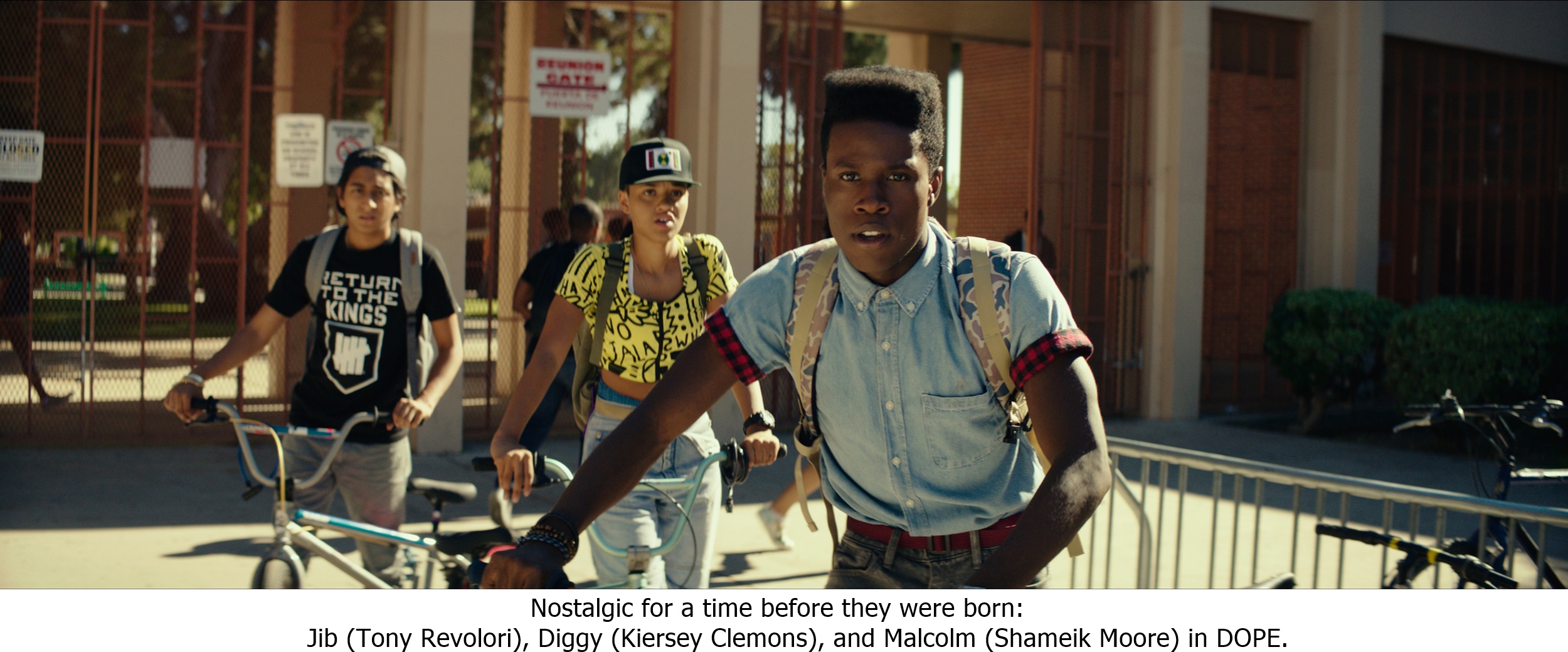
It’s Boyz n the Hood meets Revenge of the Nerds meets After Hours for three geeky teenagers navigating the mean streets of Inglewood, CA’s tough Bottoms neighborhood in Rick Famuyiwa’s delirious coming-of-age/drug dramedy Dope. A boy’s crush on a girl leads to all sorts of complications for the trio as they are challenged to prove that they are every bit as street-smart as they are book-smart.

Gangs and drugs are part of life in the Bottoms, but lifelong friends Malcolm (Shameik Moore), Diggy (Kiersey Clemons), and Jib (The Grand Budapest Hotel’s Tony Revolori) ignore that world as much as they can. They are a self-contained unit dedicated to all things ‘90s, particularly hip hop. They are college-bound kids and Malcolm is determined to get into Harvard. It is a dream firmly within his grasp until Malcolm’s crush on Nakia (Zoë Kravitz) leads him and his friends to step out of their comfort zone and attend drug dealer Dom’s (A$ap Rocky) birthday party. By the end of the evening, they are in possession of a backpack full of molly, squeezed by both Dom’s allies and rivals and petrified of being caught with the stuff by the cops.

How Malcolm and company deal with their problem is the stuff of much raucous humor and more than a little suspense. The genius of the film, though, is not in its plot, but in its sly observations. As geeks, Malcolm, Diggy, and Jib have run of the school, particularly the areas no one else bothers with in a distressed public school where few of their peers are on an academic track: the science lab, the computer room, even the band room. As geeks, they also have an air of innocuous respectability that gives them a measure of freedom.

Within the world Famuyiwa creates there is room for everything from debate over the “n” word to Malcolm’s pointed conclusions on the all-important college application personal essay. It’s funny stuff, but what pushes Dope over the top from goodness to greatness is the charm of its three young leads. –Pam Grady


Share this:

  • Share on Facebook (Opens in new window) Facebook
  • Share on X (Opens in new window) X
  • Email a link to a friend (Opens in new window) Email
  • Print (Opens in new window) Print
  • Share on LinkedIn (Opens in new window) LinkedIn
  • Share on Tumblr (Opens in new window) Tumblr
  • Share on Reddit (Opens in new window) Reddit
  • Share on Pinterest (Opens in new window) Pinterest
Like Loading...

Portraits of the Artist: LOVE & MERCY’s dazzling evocation of a troubled life

04 Thursday Jun 2015

Posted by cinepam in Reviews

≈ Leave a comment

Tags

Bill Pohlad, Brian Wilson, Elizabeth Banks, John Cusack, Love & Mercy, Oren Moverman, Paul Dano, The Beach Boys, The Wrecking Crew

LM_00304.CR2

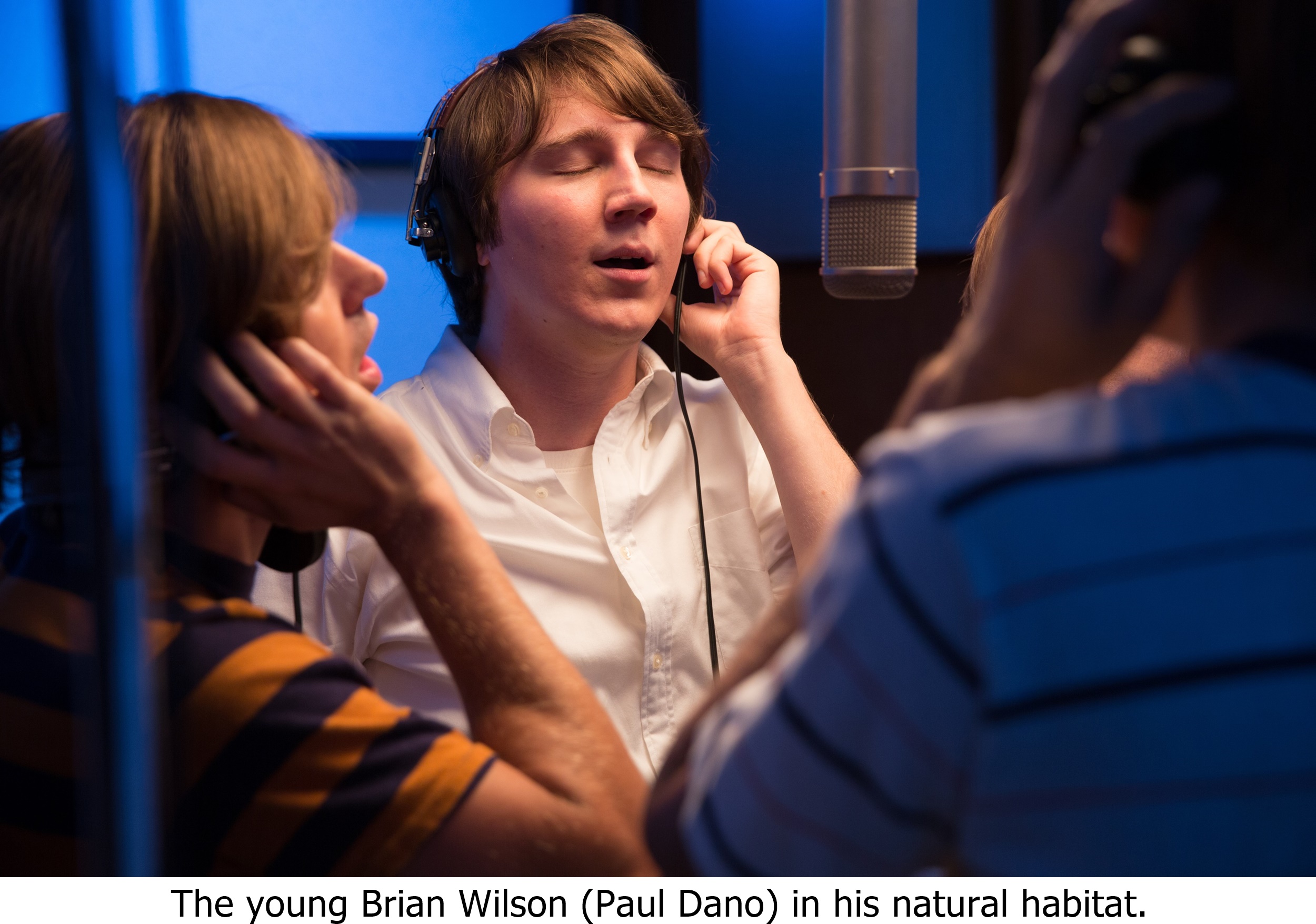
There are moments of transcendence in Love & Mercy, Bill Pohlad’s sensational depiction of two discrete chapters in Beach Boy Brian Wilson’s life. When a 1960s era Wilson (Paul Dano) is in the studio recording first Pet Sounds and then Smile, collaborating with legendary studio band The Wrecking Crew and transforming the sounds he can hear in his head into music, his joy is palpable. That makes all the more tragic scenes of a 20 years older Brian—now played by John Cusack—a shambling wreck living in terror of Dr. Eugene Landy (Paul Giamatti), the psychiatrist who controls him. As these two threads weave in and out of the drama, two portraits of Wilson emerge of a young man at the height of his creative powers able to keep the darkness at bay long enough to produce some of a singular decade’s most brilliant music and of an older man practically a walking ghost who finds a foothold in life through the intervention of a wise woman. Love & Mercy is one of the best films of the year.

This is longtime producer Pohlad’s (Into the Wild, 12 Years a Slave) only second directing job in nearly 25 years and with a brilliant assist from screenwriter Oren Moverman, he delivers a remarkably assured feature. In a way, the two sides of Love & Mercy are almost like bookends. The younger Brian’s slide toward mental illness is most obvious when he is home with his family and the other Beach Boys. His house high in LA’s hills is idyllic, but his discomfort in his own skin is apparent at the best of times. At the worst, the glimmers of a bleak near future are only too apparent. He’s stopped touring with the band by now, which can be taken as a sign, but then when he’s in the studio collaborating with the best session musicians in the business, all of that falls away. Wilson’s genius comes to the forefront and so does the happiness that eludes him in everyday life.

By the time Melinda Ledbetter (Elizabeth Banks) meets Brian in the 1980s in the Cadillac dealership where she works, the satisfaction that music gave him has long since evaporated. Landy has separated Brian from his family and his band. The doctor controls every aspect of his patient’s (and meal ticket’s) life, even arranging for chaperones when Brian starts dating Melinda. Medicated out of his gourd, Brian is no shape to protest, but as Love & Mercy morphs into a romantic drama, he has found a fierce advocate in Melinda.

The intertwining of the two parts of Wilson’s story is flawless. If the 1960s Brian’s story has more energy, well, it is the tale of a younger man and it extracts that much more oomph from all of the recording scenes between both Brian and The Wrecking Crew and Brian and the rest of The Beach Boys. The older Brian is slower and a lot sadder with a vulnerability that tugs at Melinda’s heart. Dano and Cusack look nothing alike, but nevertheless are convincing playing the same person. The two Brians possess the same sweetness. The two actors deliver among the finest performances of their careers and so does Banks.

Beach Boys fans will lap up Love & Mercy, and the film certainly adds to the mythology surrounding some of their most iconic recordings. But while the music features heavily in the soundtrack, it is not essential to be familiar with it or even necessarily like it. The drama is about the man, not his art. Love & Mercy delivers what all those old VH1 shows used to promise. It really does get behind the music. –Pam Grady

Share this:

  • Share on Facebook (Opens in new window) Facebook
  • Share on X (Opens in new window) X
  • Email a link to a friend (Opens in new window) Email
  • Print (Opens in new window) Print
  • Share on LinkedIn (Opens in new window) LinkedIn
  • Share on Tumblr (Opens in new window) Tumblr
  • Share on Reddit (Opens in new window) Reddit
  • Share on Pinterest (Opens in new window) Pinterest
Like Loading...

Review: A not so bright TOMORROWLAND

22 Friday May 2015

Posted by cinepam in Reviews

≈ Leave a comment

Tags

Brad Bird, Britt Robertson, Disneyland, George Clooney, Hugh Laurie, Kathryn Hahn, Keegan-Michael Key, Raffey Cassidy, Tomorrowland

Tomorrowland

“Tomorrowland and Tomorrowland and Tomorrowland…It is a tale told by an imagineer, full of sound and fury, signifying nothing.” Sorry, William Shakespeare, couldn’t resist the appropriation. Brad Bird is an enormously talented filmmaker as he proved with The Iron Giant, The Incredibles, Ratatouille, and even Mission Impossible: Ghost Protocol. But his gifts fail him with his latest, a libertarian fantasy of a better world that only the best and the brightest can access and where they will be free to perfect the future. The problem isn’t that Tomorrowland is a libertarian fantasy—although that is problematic—it is that there is precious little wonder to be had in a silly saga inspired by the Disneyland attraction in which a teenage girl’s optimism is the one thing that might prevent apocalypse.

Britt Robertson (Under the Dome, Cake) has the thankless task of playing the gee-whiz kid herself, Casey, the daughter of a NASA engineer, who spends most of the movie in constant amazement, her eyes so wide it’s a miracle that her eyeballs don’t pop out. Counterbalancing Casey’s sunny disposition is sour Frank Walker (a gruff George Clooney), one-time boy genius turned embittered recluse. Athena (Raffey Cassidy), an old friend of Frank’s, puts them together. Casey’s had a glimpse of Tomorrowland and is eager to visit. Frank spent part of his childhood there, but his sense of wonder is long gone. Athena knows the sands of time are running out for the world and senses that Casey is the key to reversing the situation—but only if she and Frank can make it to Tomorrowland.

Naturally, there are forces determined to keep Casey and Frank from making their way to this eden. Nix (Hugh Laurie), who runs things in this sleek, futuristic world, doesn’t even want the ne plus ultra of humanity darkening Tomorrowland’s doors, since even the elite aren’t immune to humanity’s self-destructive pathologies. Not that he’s one talk, based on how he defends his realm. For a Disney movie, there are a lot of explosions.

Most dispiriting of all is Tomorrowland itself. While Casey insists that the place is “amazing,” bits of it resemble a well-appointed airport, parts of it evoke an oil refinery, and even the sections of it that are genuinely spectacular are still a little antiseptic. It’s a museum world, not a living one. The film’s recreation of the 1964 World’s Fair and vision of the Eiffel Tower with a couple of special additions are much more awe-inspiring than this utopian world. And it’s not nearly as amusing as the junk shop Casey visits presided over by Ursula (Kathryn Hugo) and Hugo (Keegan-Michael Key)—the two best reasons to see the film, hilarious in their cameo performances—two more characters obsessed with Tomorrowland. After all the trouble, Casey and Frank take to get to the place, it is a letdown. Kind of like the movie itself.—Pam Grady

Share this:

  • Share on Facebook (Opens in new window) Facebook
  • Share on X (Opens in new window) X
  • Email a link to a friend (Opens in new window) Email
  • Print (Opens in new window) Print
  • Share on LinkedIn (Opens in new window) LinkedIn
  • Share on Tumblr (Opens in new window) Tumblr
  • Share on Reddit (Opens in new window) Reddit
  • Share on Pinterest (Opens in new window) Pinterest
Like Loading...

Review: Journalist becomes part of the TRUE STORY

17 Friday Apr 2015

Posted by cinepam in Reviews

≈ Leave a comment

Tags

Felicity Jones, James Franco, Jonah Hill, Rupert Goold, True Story

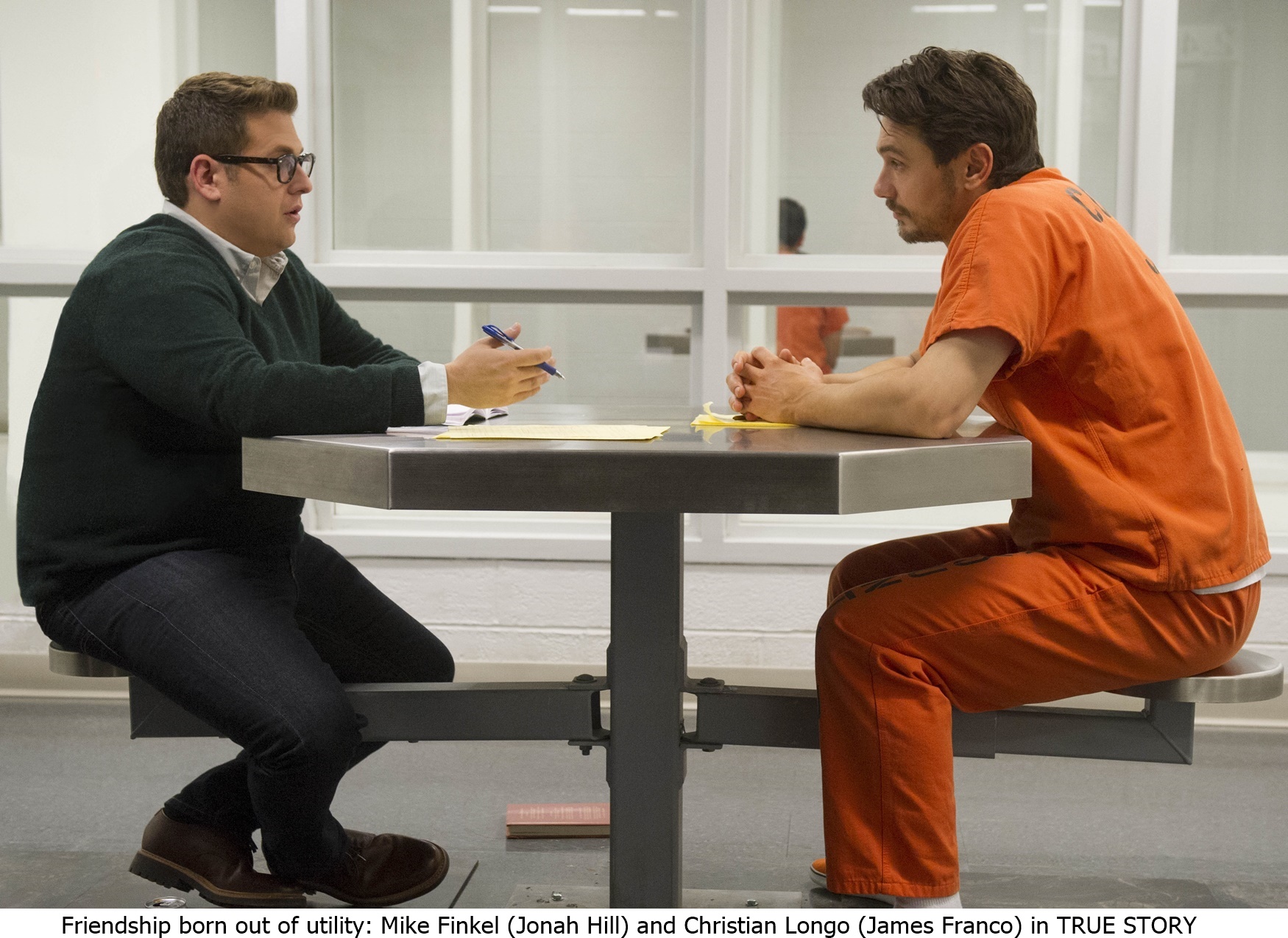
true storyIf nothing else, True Story reminds us that when he is not preciously playing at being a modern-day renaissance man, James Franco is one of the finest actors of his generation. Playing family annihilator Christian Longo, an Oregon man who killed his wife and three children, in Rupert Goold’s adaptation of journalist Michael Finkel’s memoir to chilling effect, Franco’s performance is his best since 127 Hours and the one compelling reason to see this drama that remains too firmly in Finkel’s corner to tell an effective story.

A New York Times reporter, Finkel (Jonah Hill) thinks he’s headed for a Pulitzer Prize with his latest feature, a Times magazine cover story on exploited boys in Africa. Instead, when his editors find out that he conflated characters and otherwise “improved” his story in ways that cross over into fiction, he’s fired, making him virtually unemployable as a journalist anywhere else. Retreating to his girlfriend Jill’s (Felicity Jones) Montana home to lick his wounds, the first ray of light in his new life is a phone call asking him comment on the Longo story. After his crimes, Longo lit out for Mexico where he claimed to be the NYT reporter until his capture. Intrigued, Finkel arranges to visit the alleged killer. A weird friendship is born. Finkel sees that there is a book to be gotten out of their meetings that might restore his reputation. Longo, too, realizes that there are things to be gained from continuing to see Finkel. It is a relationship of mutual utility.

Certainly, there is charm to Longo as Franco plays him, but with his dead eyes, evident narcissism and unlikely explanations for what happened to his family, the police, the prosecutors and even Jill see right through him. But not Finkel, who may think he’s about to write the next In Cold Blood, but for too long buys into Longo’s unlikely explanations. Is he fooled by Longo’s flattery (Longo claims to be a fan and asks Finkel to help him become a better writer)? Or is he fooling himself in his focus to fulfill the terms of his book deal?

Hill’s baby face, large blue eyes behind thick glasses, and Finkel’s gentle (if arrogant) demeanor suggest someone who could be duped, but is he really? The real Finkel has suggested that he became too involved in the story, but would that really make him buy into Longo’s version of events as much as he does? True Story’s major flaw is that while Longo comes into sharp focus, Finkel never does. That’s a limitation perhaps in adapting FInkel’s book, but it would have made for a sharper, richer drama if Goold and his co-screenwriter David Kajganich had thought more about what motivated Finkel. The man fired by The New York Times for writing fiction titled his comeback True Story, but is it? Is this a story of one man’s heinous crimes leading to another man’s redemption or is it a tale of two unreliable narrators seeing in each other the means to an end? –Pam Grady


Share this:

  • Share on Facebook (Opens in new window) Facebook
  • Share on X (Opens in new window) X
  • Email a link to a friend (Opens in new window) Email
  • Print (Opens in new window) Print
  • Share on LinkedIn (Opens in new window) LinkedIn
  • Share on Tumblr (Opens in new window) Tumblr
  • Share on Reddit (Opens in new window) Reddit
  • Share on Pinterest (Opens in new window) Pinterest
Like Loading...

Review: Alex Garland’s Turing test EX MACHINA

17 Friday Apr 2015

Posted by cinepam in Reviews

≈ Leave a comment

Tags

Alex Garland, Alicia Vikander, Domhnall Gleeson, Ex Machina, Oscar Isaac

Caleb (Domhnall Gleeson), a coder at BlueBook (think Google) is enjoying quite the heady week. Invited to BlueBoook founder Nathan’s (Oscar Isaac) remote mountain home, he has been tasked with performing a Turing test on the boss’s pride and joy, Ava (Alicia Vikander), the latest iteration in ongoing experiments in artificial intelligence. But having now interacted several times with the comely robot with a woman’s beautiful face, voice and shapely, metallic body, he wants to know why Nathan made Ava humanoid at all. Artificial intelligence doesn’t need a body to exist, after all. With that question, Caleb gets to the one of the flaws in writer Alex Garland’s (The Beach, 28 Days Later) tense, creepy directorial debut Ex Machina. It’s the wrong question, though. The correct question is why would a man clearly interested in building himself a high-tech blow-up doll bother with granting it intelligence at all?

Isaac suppresses his considerable charm to play the poster child of a tech overlord divorced from humanity. Nathan’s chilly, impersonal home, filled with surveillance equipment that lets him watch everything that goes on inside his house, reflects the personality of a man who knows how to say the right things (social cues no doubt gleaned from his endless spying on BlueBook’s users) to appear that he’s just a regular guy who just happens to be a billionaire genius—“appear” being the operative word. As Caleb’s week with him wears on, it’s is increasingly clear that Nathan has little use for the world the rest of humanity inhabits and for all his assertions that it is great to converse with an actual human being for a change, his contempt for Caleb is never far from the service. It is no wonder that Caleb becomes confused as he tests Ava: In a wig and with clothes to mask her robotic parts, she seems far more human than his host.

Stephen Hawking is among those that have expressed reservations about where the development of AI might lead. That question simmers beneath Ex Machina’s sleek surface as Caleb and Ava interact during the “tests.” But despite stunning visual effects that transform Vikander into a mechanical being, the vibe is less sci-fi than neo-noir. Gleeson is brilliant as a man seemingly in way over his head. But is he really the classic chump he appears to be, and if so, who is playing him: Nathan, Ava or both? And why?

The whys are what is problematic about Ex Machina. Nathan’s explanation for why he wanted Caleb to visit and perform the Turing test rings hollow. And his experiments in artificial intelligence don’t compute not only in the form they take with his female models but also in the fact that a guy with this man’s ego is not going to risk not being the smartest being in the room.

Looking past that, the film is a nifty thriller. The remote location, the sterile house where the rooms can only be accessed by key cards (and not all cards work for all rooms), the wild card that is Ava, and the growing distrust between Nathan and Caleb keep the tension humming even in the quietest scenes. Garland delivers the goods with this stylish and suspenseful first feature. –Pam Grady


Share this:

  • Share on Facebook (Opens in new window) Facebook
  • Share on X (Opens in new window) X
  • Email a link to a friend (Opens in new window) Email
  • Print (Opens in new window) Print
  • Share on LinkedIn (Opens in new window) LinkedIn
  • Share on Tumblr (Opens in new window) Tumblr
  • Share on Reddit (Opens in new window) Reddit
  • Share on Pinterest (Opens in new window) Pinterest
Like Loading...

WITNESS TO THE CITY at Roxie noir fest The French Had a Name for It

13 Thursday Nov 2014

Posted by cinepam in Reviews

≈ Leave a comment

Tags

Édouard Molinaro, Lino Ventura, Roxie Theater, The French Had a Name for It, Witness to the City (Un témoin dans la ville

Temoin

A taxi idles at the curb as Ancelin (Lino Ventura) steps away from the crime scene that he has just created, the car summoned only moments before the murder by the man he’s just killed. The murderer panics and runs away, only realizing later that his behavior called attention to itself. The cabbie will remember him, surely, a witness who must be dispatched before he can talk to the police. That is the set up of Édouard Molinaro’s tense Witness to the City (Un témoin dans la ville), one of the rare Gallic noirs playing Nov.14-17 as part of The French Had a Name for It at San Francisco’s Roxie Theater.

The streets of Paris become a hunting ground once Ancelin is able to identify amiable Lambert (Franco Fabrizi) as the driver who can finger him. What the desperate man fails to realize is the power of these new “radio” taxis that can be marshaled at the first hint of trouble. Lilliane (Sandra Milo), Lambert’s girlfriend is a dispatcher. The cabbies are a loyal bunch and protective of their own. Ancelin soon learns how fine the line is between the pursuer and pursued.

Ventura, who made his screen debut playing a gangster in Jacques Becker’s classic 1952 thriller Touchez pas au Grisbi, excelled in tough guy roles, but in Witness to the City, he proves himself equally adept at playing a sad, strange man motivated by fear. As the movie becomes a chase, the streets of Paris become a trap to be escaped, new danger lurking around every corner. Molinaro’s use of location is striking; this is not picture-postcard Paris, but the gritty, street-level view that becomes all too familiar to Ancelin. Henri Decaë’s moody cinematography and Barney Wilen’s evocative jazz score add to the pervasive sense of doom in this bleak, striking noir.—Pam Grady

To find out more about THE FRENCH HAD A NAME FOR IT, read my article at EatDrinkFilms. For tickets and further information, visit roxie.com.

Share this:

  • Share on Facebook (Opens in new window) Facebook
  • Share on X (Opens in new window) X
  • Email a link to a friend (Opens in new window) Email
  • Print (Opens in new window) Print
  • Share on LinkedIn (Opens in new window) LinkedIn
  • Share on Tumblr (Opens in new window) Tumblr
  • Share on Reddit (Opens in new window) Reddit
  • Share on Pinterest (Opens in new window) Pinterest
Like Loading...

GOTG’s secret sauce: Rocket Raccoon

04 Monday Aug 2014

Posted by cinepam in Reviews

≈ 3 Comments

Tags

Bradley Cooper, Guardians of the Galaxy, Rocket Raccoon

rocket_bradleyRacoons are funny creatures. Some people regard them as vermin and you don’t want them messing with the house pets, but they’re cute and they’re clever. Sure, they’re bandits, hence the furry masks. Now, there’s a new raccoon in town. He’s genetically modified, he talks, he walks upright, he’s whip-smart, and he’s even more larcenous than the average garden pest. He’s Rocket. He’s voiced by Bradley Cooper and he is one of the reasons Guardians of the Galaxy is one of the most entertaining movies of the year. All of the Guardians—Chris Pratt’s goofy Star-Lord, Zoe Saldana’s intense Gamora, Vin Diesel’s sweet, sweet Groot, and Dave Bautista’s vengeful Drax—are pretty special, but the wise-cracking raccoon is GOTG‘s secret sauce.

People‘s 2001 Sexiest Man Alive made his big screen debut in Wet Hot American Summer, mixed it up with Vince Vaughn and Owen Wilson in Wedding Crashers, and was a key player in the Hangover franchise. But lately Cooper’s had a more serious career: two Oscar nominations in a row for his work with director David O. Russell, Silver Linings Playbook and American Hustle; upcoming are yet another collaboration with Jennifer Lawrence, Susanne Bier’s dark drama Serena, and Clint Eastwood’s American Sniper, in which he plays Navy SEAL Chris Kyle. In November, Cooper will fulfill a long cherished dream when he steps on a Broadway stage to play deformed 19th-century legend John Merrick in a revival of The Elephant Man. It is becoming a truly serious career, but Cooper is a gifted goofball and so it is a delight to hear him embrace that so fully as Rocket.

Cooper has likened the pint-sized bounty hunter to Joe Pesci in Goodfellas. And, yes, Rocket is a motormouth with anger issues, which may relate to his small stature. Plus, Rocket has reason to be furious, thanks to his very nature. “I didn’t ask to be torn apart and put back together over and over and turned into some little monster!” is how the little raccoon puts it. But with Pesci’s Tommy DeVito, there are a lot of laughs until that rage surfaces in a violent eruption. In contrast, Rocket has a big heart beneath the bluster, expressed most profoundly in his friendship with the tree being Groot, but also emerging in the way he bonds with the other Guardians.

Rocket is also chaotic and unpredictable and snarky, but he’s ultimately a good guy and that snark makes him hilarious. Like his real-world counterparts, Rocket is maddeningly mischievous and can be truly annoying and is also ultimately disarming in his clownish charm. Guardians of the Galaxy wouldn’t be the same without him. Well cast, well rendered, and well served by director James Gunn and Nicole Perlman’s screenplay, Rocket is one of the keys to GOTG‘s success.—Pam Grady

Share this:

  • Share on Facebook (Opens in new window) Facebook
  • Share on X (Opens in new window) X
  • Email a link to a friend (Opens in new window) Email
  • Print (Opens in new window) Print
  • Share on LinkedIn (Opens in new window) LinkedIn
  • Share on Tumblr (Opens in new window) Tumblr
  • Share on Reddit (Opens in new window) Reddit
  • Share on Pinterest (Opens in new window) Pinterest
Like Loading...

Review: Chadwick Boseman channels James Brown in GET ON UP

01 Friday Aug 2014

Posted by cinepam in Reviews

≈ Leave a comment

Tags

Chadwick Boseman, Get On Up, James Brown, Mick Jagger, Nelsan Ellis, Tate Taylor

Get On UpNo wonder Mick Jagger came on board as a producer to the James Brown biopic Get On Up. Fifty years ago, he and the Rolling Stones were the closing act, coming on after The Godfather of Soul and his Famous Flames’ 18-minute set at 1964’s T.A.M.I. Show. Brown’s performance is transcendent, otherworldly. Pity the fool that had to follow that. After 50 years, Jagger is still in awe and now he pays homage to the man with this kaleidoscopic drama. Anchored by 42 star Chadwick Boseman’s incandescent performance in the central role and directed by Tate Taylor (The Help), Get On Up is a magnificent mess, overlong and its various parts never quite gelling. But whenever Boseman steps on stage (which is often), like Brown at that long ago T.A.M.I. Show, the film is electrifying.

The approach that screenwriters Jez and John-Henry Butterworth take to Brown is nonlinear. They begin with a particularly low point in his life with his glory days seemingly behind him before heading backward, weaving back and forth in time. Here he is a little boy (Jamarion and Jordan Scott), caught between an indifferent mother (Viola Davis) and an abusive father (Lennie James), and eventually abandoned to live in a brothel with his Aunt Honey (Octavia Spencer). There he is a young adult honing his act with the Flames. There is again and now he’s a superstar.

In some ways, Get On Up takes a greatest hits approach to Brown’s life, as the film tries to cram in all of the highlights: the beginning of his collaboration and friendship with singer and musician Bobby Byrd (Nelsan Ellis), the most sustained relationship of his life; a meeting with Little Richard (Brandon Smith in a scene-stealing cameo) that changes the course of his career; his first meeting with agent Ben Bart (Dan Akroyd); the T.A.M.I. Show; the Apollo; Ski Party; 1968 Boston Garden, in the wake of Martin Luther King Jr.’s assassination; Paris 1971, etc. All of Brown’s funk and soul classics are represented as well: “Please, Please, Please,” “I Got You,” “It’s a Man’s Man’s Man’s World,” “Papa’s Got a Brand New Bag,” and so much more.

At the same time, the drama contrasts Brown’s dazzling onstage persona with the fractious personality offstage. He could be petty, abusive to his wives and disrespectful to his bands. There is too much of the offstage melodrama, which becomes repetitive after a while. Like a lot of great artists, James Brown wasn’t necessarily a great guy. Establish that and move on. And moments where Boseman breaks the fourth wall to address the audience directly just don’t work. Spaced at odd intervals, those scenes don’t just break that fourth wall, they break the movie’s spell. The offstage scenes that work best are those with Little Richard, one of the few scenes where Brown is not fully in charge, and with Byrd and Bart, the two people who seem to most fully see past the bluff and into Brown’s heart.

All is forgiven every time James Brown steps on stage. Boseman’s performance overall is magnificent, but not for nothing was Brown often called “the hardest working man in show business.” No one could touch him on stage: not his voice, not his charisma, not his dance moves, or his boundless energy. Boseman has to put those last three things together while credibly lip-synching Brown’s voice. He’s flawless. Like the man he’s portraying, the actor seems to exist on a whole, other higher plane from mere mortals in Get On Up. Whatever the movie’s flaws, Boseman erases them in every musical scene. Or put it this way: Mick Jagger wouldn’t want to have to follow him, either.—Pam Grady

Share this:

  • Share on Facebook (Opens in new window) Facebook
  • Share on X (Opens in new window) X
  • Email a link to a friend (Opens in new window) Email
  • Print (Opens in new window) Print
  • Share on LinkedIn (Opens in new window) LinkedIn
  • Share on Tumblr (Opens in new window) Tumblr
  • Share on Reddit (Opens in new window) Reddit
  • Share on Pinterest (Opens in new window) Pinterest
Like Loading...
← Older posts
Newer posts →

Categories

  • Interviews
  • News
  • Reviews
  • Short Takes
  • Uncategorized

Recent Posts

  • A Stamp of Approval
  • Life is messy & so is ‘Megalopolis’
  • A star discovers too late there are worse things than aging in the black comic body horror ‘The Substance’
  • A young teen nurses a crush when he finds himself among ‘Big Boys’
  • The stunt man becomes the star as Ryan Gosling becomes THE FALL GUY

Archives

Blog at WordPress.com.

  • Subscribe Subscribed
    • Cinezine Kane
    • Join 48 other subscribers
    • Already have a WordPress.com account? Log in now.
    • Cinezine Kane
    • Subscribe Subscribed
    • Sign up
    • Log in
    • Report this content
    • View site in Reader
    • Manage subscriptions
    • Collapse this bar
 

Loading Comments...
 

    %d