• About

Cinezine Kane

Cinezine Kane

Author Archives: cinepam

Twisted BRAINSTORM highlights Not Necessarily Noir II

04 Friday Nov 2011

Posted by cinepam in Reviews, Uncategorized

≈ 1 Comment

Tags

Anne Francis, Brainstorm, Dana Andrews, Elliot Lavine, Jeffrey Hunter, Johnny Legend, Roxie Theater, William Conrad

If there is a lesson to be learned from William Conrad’s Brainstorm, screening on Saturday, November 5 at the San Francisco’s Roxie Theater as part of the Elliot Lavine-programmed Not Necessarily Noir II, it’s this: If you spy an unconscious beautiful woman locked in her car, and that car is parked on railroad tracks with a train approaching, don’t think about saving her life. Save your own and run far, far away. Rocket scientist Jim Grayam (Jeffrey Hunter) saves the pretty lady and pays a high price for his good deed in this twisted crime drama from 1965.

The woman Jim rescues is Lorrie Benson (Anne Francis) and she is the unhappy wife of Jim’s wealthy, jealous, and uber-vindicative boss Cort Benson (Dana Andrews). Greystone Mansion, the Beverly Hills estate that became a real-life crime scene in 1928 when oil heir Ned Doheny and his friend and assistant Hugh Plunkett died in a murder-suicide serves Brainstorm as the Benson’s home. The location with its dark history is appropriate as Jim – against his better judgment – falls for Lorrie. Her husband reacts with a frame job meant to portray the high-strung scientist as a a man losing his mind, which only inspires Jim to hatch an even more diabolical plot of his own. As Jim explains it to Lorrie and to comely psychiatrist Dr. Elizabeth Larstadt (Viveca Lindfors) he’s being crazy like a fox. But is he or is he a simply a deeply disturbed lunatic with a genius mind and homicidal tendencies?

As an actor, Conrad made his film debut in noir, portraying a gunsel in Robert Siodmak’s The Killers (1946) and he is probably most famous for his roles on TV’s Cannon and Jake and the Fatman. His directing career consisted mainly of episodic television and a handful of features. Brainstorm is the last of these and he retired from the field on a gloriously maniacal note. He sets a mood from that first scene of Lorrie in a deep sleep in the passenger seat of her car, catching a few winks while waiting for oblivion. Her world is off-kilter and so, soon enough, is Jim’s. That feeling only grows along with Jim’s paranoia as mad love pushes him beyond all reason. Hunter, who played Jesus in King of Kings, is better here playing an altogether different kind of martyr, sacrificing himself at the altar of his own madness.

There are other treats in store during the five-day Not Necessarily Noir II festival, including a double bill of Donald Siegel’s terrific 1964 remake of The Killers and Clint Eastwood’s tense, twisted 1971 directorial debut Play Misty for Me; a Joan Crawford double feature of Nicholas Ray’s flamboyant Western Johnny Guitar and the little-scene (and unavailable on DVD) 1955 melodrama Woman on the Beach; and an Edward D. Wood, Jr. triple bill hosted by Johnny Legend that will also include “Johnny Legend Presents WOODworld,” a special, 45-minute tribute to the grand master of irresistible schlock. – Pam Grady

Not Necessarily Noir II run Friday, November 4 through Tuesday, November 8 at San Francisco’s Roxie Theater. For further info, visit http://www.roxie.com.

Share this:

  • Share on Facebook (Opens in new window) Facebook
  • Share on X (Opens in new window) X
  • Email a link to a friend (Opens in new window) Email
  • Print (Opens in new window) Print
  • Share on LinkedIn (Opens in new window) LinkedIn
  • Share on Tumblr (Opens in new window) Tumblr
  • Share on Reddit (Opens in new window) Reddit
  • Share on Pinterest (Opens in new window) Pinterest
Like Loading...

Terror in Three Dimensions: Joe Dante on Making The Hole

07 Friday Oct 2011

Posted by cinepam in Interviews

≈ Leave a comment

Tags

Castro Theatre, Chris Massoglia, Dial M for Murder, Gremlins, Jesse Hawthorne Ficks, Joe Dante, Matinee, Midnites for Maniacs, Nathan Gamble, Small Soldiers, Teri Polo, The Hole

“Joe Dante knows a little something about fear. The director of such movies as Gremlins, Matinee, Small Soldiers and 2009’s The Hole – which makes its U.S. theatrical debut in Digital 3D as part of Jesse Hawthorne Ficks’ Midnites for Maniacs’ series at San Francisco’s Castro Theatre on Friday, October 7 – grew up on the emotion.

“When I was a kid, I was afraid of the bomb dropping, as you can see in Matinee,” he reveals in conversation at the 2009 Toronto International Film Festival where The Hole made its North American premiere. “People forget that kids in the ’50s lived with this knowledge in the back of their heads that any minute the world could end. It was just something that was carried around. We knew it like how you knew your blood worked and stuff. It was just a fact of life.”

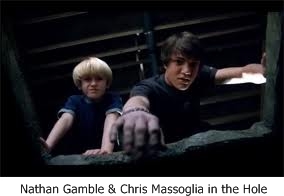
Terror is also a fact of life for the siblings at the center of The Hole, brothers Dane (Chris Massoglia) and Lucas (Nathan Gamble). Already upset because their mother Susan (Teri Polo) has uprooted them from Brooklyn’s urban bustle to apparently sleepy Bensonville, life gets more interesting and a heck of a lot scarier when they discover a padlocked door on the floor of the basement. Like modern-day Pandoras, the boys can’t resist peeking and they inadvertently unleash their own worst fears.

Ever since 1984’s Gremlins‘ phenomenal success, Dante has been a go-to guy for producers seeking a director who is good with horror and good with kids. He admits he sometimes get frustrated with the typecasting, but he is always open to a crackerjack script.

“I wish I could say that I am attracted like a moth to the flame to these stories, but that’s not really the truth,” he says. “The truth is I get offered this kind of material, because I’ve done it in the past. And obviously, I can relate to it. I have a dictum that I operate under, which is that I will not make a movie that I wouldn’t go see.

“When I was offered this picture, part of me went, ‘Another movie with kids and special effects?’ But then another part of me went, ‘Gee, this is awfully good and I know I could do something with this.’”

One of the things that struck the director about Mark L. Smith’s screenplay was that even with all the fantasy and horror elements, there was still a core of realism to Dane and Lucas’ situation.

“I could believe this family,” he says. “I could believe the way that they talk, the way that they act. These are not movie kids. This is not a Disney channel idea of life.”

When Dante was growing up in the ’50s, he loved those movies that were the manifestations of the nuclear world that he feared, movies like Them and the other radiated monster movies. The Universal horror movies from the 1930s that he watched on television he describes as his folklore and fairy tales. But he also grew up during the first wave of 3D. With The Hole he was given a chance to use the format for himself. He thought back to those old movies as he decided just how to employ the technology in his own work.

“You can’t constantly throw things at people or else it loses its effectiveness,” Dante observes. “My favorite 3D movie is Dial M for Murder, which was one of the last 3D pictures produced then, not shown in 3D originally, and it saves its breaking the frame stuff for a couple of moments and they’re very striking because there’s not a lot of other stuff like that.

“Also, it’s a movie that’s staged – it’s like a play, really – it’s staged in depth,” he adds. “There are foreground objects that mean something. There are characters standing in front of people or behind people. To me, I think that’s what the future of 3D should be. We all know that you can throw things at people and we all know that we can do breaking-the-frame gags, but I think there’s a drama to storytelling that can be enhanced by 3D. I reject the idea that it’s just for gimmicks and just for exploitation, that it’s just for throwing eyeballs at the audience.”

He had to shoot quickly, so Dante feels he only scratched the surface of 3D’s capabilities, but he is pleased with what he was able to accomplish.

“It’s not an expensive film; we didn’t have much time to make it, but I think given the subject matter, it’s as good as we could make it,” he says.

Dante is scheduled to be on hand for the Midnites for Maniacs The Hole screening and to take part in a Q&A with Jesse Hawthorne Ficks. The Castro Theatre is the perfect venue for the movie’s theatrical premiere, its cathedral-like dimensions reflecting the 64-year-old auteur’s vision of movie going.

He says, “When the lights go down in a theater, to me it’s like going to church.” – Pam Grady

________________________________________________________________

The Hole plays Midnites for Maniacs along with The Goonies and Gremlins 2: The New Batch on Friday, October 7 at the Castro Theatre, 429 Castro Street, San Francisco. For further information, visit http://www.castrotheatre.com.

Share this:

  • Share on Facebook (Opens in new window) Facebook
  • Share on X (Opens in new window) X
  • Email a link to a friend (Opens in new window) Email
  • Print (Opens in new window) Print
  • Share on LinkedIn (Opens in new window) LinkedIn
  • Share on Tumblr (Opens in new window) Tumblr
  • Share on Reddit (Opens in new window) Reddit
  • Share on Pinterest (Opens in new window) Pinterest
Like Loading...

Hillbilly Hero: Tucker and Dale director Eli Craig

01 Saturday Oct 2011

Posted by cinepam in Interviews

≈ Leave a comment

Tags

Alan Tudyk, Eli Craig, Tucker and Dale vs. Evil, Tyler Labine

When writing partners Eli Craig and Morgan Jurgenson started work on their script for what would become Tucker and Dale vs. Evil, both only had to think back to their childhoods to imagine the country setting of their story about a pair of good-natured hillbillies who find themselves under assault by a group of college kids who are certain the pair are serial killers. Jurgenson grew up in a cabin in the woods with no TV or running water. Craig, who is the son of actress Sally Field and her first husband Steven Craig, divided his childhood between urban Southern California and his father’s rural Oregon home. Just how much that influenced the pair’s screenplay wasn’t evident to Craig – who makes his feature directing debut with Tucker and Dale – until after the horror comedy that stars Alan Tudyk and Tyler Labine as the bemused bumpkins was finished.

“We built this cabin in the middle of nowhere by this lake,” he recalls during a recent phone call. “I remember he was using a chainsaw to clear out brush – I was maybe nine years old, using this bulldozer to clear out this gravel driveway – and I hear this scream.

“I hear my dad going, ‘Bees! Bees!’ He’s running with the chainsaw overhead, down toward the lake, as fast as he could, warning me about the bees. He chucked his chainsaw to the side and dove into the lake. I didn’t think of that until my fifth watching and I thought, ‘Oh my God, it’s my dad! Alan Tudyk with the chainsaw is my dad.’”

One day six years ago, Craig and Jurgenson were batting around ideas for screenplays when they came up with a simple proposition, what if The Texas Chainsaw Massacre villain Leatherface was really a good guy, just misunderstood? When Craig heard his wife, Sasha, snicker, he knew they were onto something, but at first all they had were a few elements and the basic idea.

“It wasn’t a movie. It was a funny idea to flip the typical presentation, which is the college kids go out to the woods and get slaughtered by backwoods freaks,” he says, adding that the story really began to develop when he and Jurgenson came up with the notion that Dale and one of the coeds, Allison (Katrina Bowden), should fall in love.

“I think I made a new twist on the romantic comedy genre. I even wanted the tag line to be, ‘The perfect romance, aside from the minor woodchipper incident.’ ” chuckles Craig.

“That was the key to this, selling the relationship in a way that was genuine and that the emotional context of it felt real. All this absurdity, all the chaos, comes back to the love story. To me, that was the most important element, whereas I think a lot of people focus on the gore and the horror.”

Starting with its world premiere at the 2010 Sundance Film Festival, Tucker and Dale vs. Evil was a popular draw on the festival circuit. It won the Midnight Audience Award at SXSW, the Best First Feature jury prize at Montreal’s Fant-Asia Film Festival, and Best Film at Spain’s prestigious Sitges International Film Festival. But distributors were slow to catch the growing buzz and for a while Craig despaired that the movie would ever have a chance to widen its reach. Then Magnet Releasing came through with a theatrical and VOD release. In its first weekend in theaters, the film’s positive rating stands at a healthy 88%. It’s the little movie that could, and it’s left Craig feeling like a proud papa.

“It feels a little bit like having a child,” he laughs. “In some ways it’s like parenting where you just try to aid the little guy to grow up and be himself and be himself fully. It’s really exciting to see. This film has had no opportunities. It’s had no help from anybody. It’s had no advertising. It’s had no real promotion and yet it’s found an audience.

“I’m just so proud of it. It has a voice that people have grabbed onto and made it somewhat successful, as least as an underground film. I’m very proud of it, as if it were a person.” – Pam Grady

Share this:

  • Share on Facebook (Opens in new window) Facebook
  • Share on X (Opens in new window) X
  • Email a link to a friend (Opens in new window) Email
  • Print (Opens in new window) Print
  • Share on LinkedIn (Opens in new window) LinkedIn
  • Share on Tumblr (Opens in new window) Tumblr
  • Share on Reddit (Opens in new window) Reddit
  • Share on Pinterest (Opens in new window) Pinterest
Like Loading...

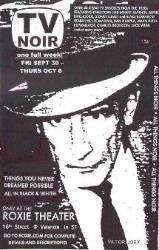
TV Noir returns to the Roxie

30 Friday Sep 2011

Posted by cinepam in News

≈ Leave a comment

Tags

Alfred Hitchcock, Dan Duryea, Elliot Lavine, John Frankenheimer, Johnny Legend, Rod Serling, Roxie Theater, Sidney Lumet, TV Noir

TV Noir is back at San Francisco’s Roxie Theater with a week-long slate of doomed men, marked women, and dark drama. Programmed by Elliot Lavine and curated by Johnny Legend, who will also be on hand every night to introduce the shows, the series runs Sept. 30-Oct. 6. The program gets off to a running start with fan favorite Dan Duryea starring as a man whose life was derailed by a little girl’s vicious fib in “The Lie,” a 1955 episode of The Star and the Story. Beverly Garland is the child all grownup and eager to make amends, but that might not be the wisest course to take with any character essayed by the shifty Duryea. That’s only the beginning. Among the week’s highlights:

“The Haunted Clown,” an episode of the series One Step Beyond: Imagine Of Mice and Men‘s Lenny as the sorriest-looking clown you’ve ever seen. Now imagine that the girl he fancies with evocative jazz score and what you’re left with is this tragic and bizarre 1960 melodrama.

The Plot Thickens: Who killed the seer during the séance? That’s the question in this bizarre little whodunit where a quiz show panel that includes Groucho Marx query the suspects and try to guess the killer. Horror maestro William Castle created this 1963 one-off that blends murder with the celebrity panel game show format of What’s My Line? or To Tell the Truth.

“The System,” an epidsode of the series Danger: In one of his earliest filmed performances, a pugnacious Eli Wallach is a “grease monkey” who refuses to listen to the smitten cigarette girl (Kim Stanley) who warns him that he’s more likely to take a beating or worse than beat the house when he tries to win big at the casino. A 27-year-old Sidney Lumet directs.

“Four O’Clock,” an episode of the series Suspicion: E.G. Marshall is a jealous husband whose plans for getting even with the wife he’s certain is having an affair take an unexpected turn in this compact thriller based on a Cornell Woolrich story. Alfred Hitchcock’s first foray into directing for television also features a young Harry Dean Stanton in a small, but memorable role.

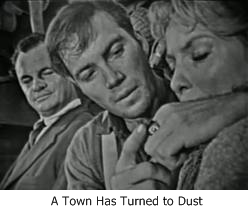
“A Town Has Turned to Dust,” an episode of Playhouse 90: In a town suffering a terrible drought, Mexican immigrants become a scapegoat leading to grotesque tragedy. John Frankenheimer directs a Rod Serling script that still has pointed things to say about xenophobia in the U.S. 53 years after its original 1958 airing. Rod Steiger and William Shatner star.

Legends of Horror Go Noir!: The October 3rd program is devoted to horror’s classic stars. It is a sublime experience to watch Bela Lugosi, Lon Chaney, Jr., Boris Karloff, Vincent Price, and Peter Lorre each take their turn in the spotlight.

“The Night America Trembled,” an episode of Studio One: Orson Welles’ infamous War of the Worlds radio broadcast is both dramatized and put into context (by Edward R. Murrow, no less) in this tantalizing production for the classic drama series. James Coburn (his on-screen debut), Vincent Gardenia, Warren Beatty, Edward Asner, and Warren Oates are among the cast.

“Secret Agent,” an episode of World of Giants: The premiere episode of this short-lived series introduces Marshall Thompson as Mel Hunter, an American spy reduced to only six inches high after an unfortunate brush with radiation. Or maybe not so unfortunate, since even though he’s so tiny that he could be killed by a falling pencil, his neat petite size makes him perfect for certain covert operations. Just watch out for that cat!

“The Big Producer,” an episode of Dragnet: Someone’s pushing pornography to L.A.’s teenagers and Sgt. Joe Friday (Jack Webb) and his partner Frank Smith (Ben Alexander) are on the case in this offbeat 1954 episode of the classic series. Martin Milner and Carolyn Jones play teens caught in scandal, but it is Ralph Moody as a movie producer reduced to publishing dirty books that is the draw. As he explains himself to Friday, he recalls a significant incident from his glory days during the silent era. While the camera records the grim reality of an abandoned Western set, the soundtrack is a symphony of the producer’s vivid memories. It is a bravura moment and a most unusual one in a series that normally rendered the world in the same black-and-white, matter-of-fact tone as Webb’s narration. – Pam Grady

_________________________________________________________________

TV Noir plays Sept. 30-Oct. 6 at the Roxie Theater, 3117 16th Street, San Francisco. For further information, visit http://www.roxie.com.
Share this:

  • Share on Facebook (Opens in new window) Facebook
  • Share on X (Opens in new window) X
  • Email a link to a friend (Opens in new window) Email
  • Print (Opens in new window) Print
  • Share on LinkedIn (Opens in new window) LinkedIn
  • Share on Tumblr (Opens in new window) Tumblr
  • Share on Reddit (Opens in new window) Reddit
  • Share on Pinterest (Opens in new window) Pinterest
Like Loading...

Visions of a Mole Man

31 Wednesday Aug 2011

Posted by cinepam in Interviews

≈ Leave a comment

Tags

John LaFlamboy, Justin DiGiacomo, Mike Bradecich, Robert Englund, The Mole Man of Belmont Avenue, Tim Kazurinsky

Mike Bradecich remembers the day his writing and filmmaking partner John LaFlamboy came to him with the idea for what would become the pair’s debut feature The Mole Man of Belmont Avenue.

“The first thing he ever told me was the two of us are landlords in this building and all the pets are disappearing, because there’s a monster in the basement,” recalls Bradecich during a June visit to San Francisco where the movie screened at Another Hole in the Head, a film festival dedicated to horror, sci-fi, and fantasy.

Bradecich laughs, “I said, ‘That’s the dumbest idea for a movie I’ve ever heard in my life.’ I was a little slow to see the potential in the idea. We kind of worked it out slowly, then I got excited.”

The partners wrote and directed the horror comedy, but also star as brothers who have inherited a Chicago apartment house from their mother. Well-meaning but incompetent, they already have their hands full just trying to keep the lights on in the building when they realize they have a problem with vermin in the form of a man-sized mole creature. They also cotton onto the fact that missing animals will be the least of it if they can’t figure out some way to vanquish this most disagreeable house pest.

“It started with the building,” says Bradecich. “John had been using the building. It’s sort of been acting as an artists’ commune. There’s also a second-hand clothing shop on the ground floor. It’s this really interesting sort of transient but very artistic place. John rented out the main room for parties and different events on a few occasions. Just being there that often and the building having such an identity  and such a flavor I think is what was the original inspiration for turning it into this residence where the pets are disappearing.”

Robert Englund, A Nightmare on Elm Street‘s Freddy Kreuger, costars as one of the tenants. Saturday Night Live  alum Tim Kazurinsky also appears as a homeless man the brothers recruit as part of their quest to conquer the Mole Man. Justin DiGiacomo, a Southern Illinois University classmate of LaFlamboy and Bradecich, plays the titular monster, his head encased in latex for 12-14 hours at a time during a sweltering July summer and fitted with white contact lenses that made him blind.

“He was literally a mole man,” says Bradecich, who adds that DiGiacomo got so far into the character that he developed a back story that explained how the Mole Man came to live underground and how the Mole People’s distinctive look evolved.

Next up for Bradecich and LaFlamboy is Haunted House: The Movie, a story based on LaFlamboy’s work as designer, director, producer, actor, and co-owner of Statesville Haunted Prison and City of The Dead, a Chicago haunted house. (“He’s the haunted house mogul of the Midwest,” says his partner.) For now, though, they are busy traveling with The Mole Man of Belmont Avenue on the festival circuit. Upcoming appearances includes stops at the Atlanta Horror Film Festival and the Chicago Horror Film Festival.

Exuberant and funny, Mole Man demonstrates the pair’s talents as actors, writers, and directors, but it is also represents the next evolution in their partnership. Friends since college where Bradecich was an English major who acted and LaFlamboy majored in theater, the two began making shorts together in 2005 with one thought in mind.

“The whole point was because we wanted to act,” Bradecich says. “The best parts we could possibly get would be the ones we were writing for ourselves.” — Pam Grady

Share this:

  • Share on Facebook (Opens in new window) Facebook
  • Share on X (Opens in new window) X
  • Email a link to a friend (Opens in new window) Email
  • Print (Opens in new window) Print
  • Share on LinkedIn (Opens in new window) LinkedIn
  • Share on Tumblr (Opens in new window) Tumblr
  • Share on Reddit (Opens in new window) Reddit
  • Share on Pinterest (Opens in new window) Pinterest
Like Loading...

Revving Up a Doc: Asif Kapadia Takes on Ayrton Senna

25 Thursday Aug 2011

Posted by cinepam in Interviews

≈ Leave a comment

Tags

Alain Prost, Asif Kapadia, Ayrton Senna, Formula One, Senna

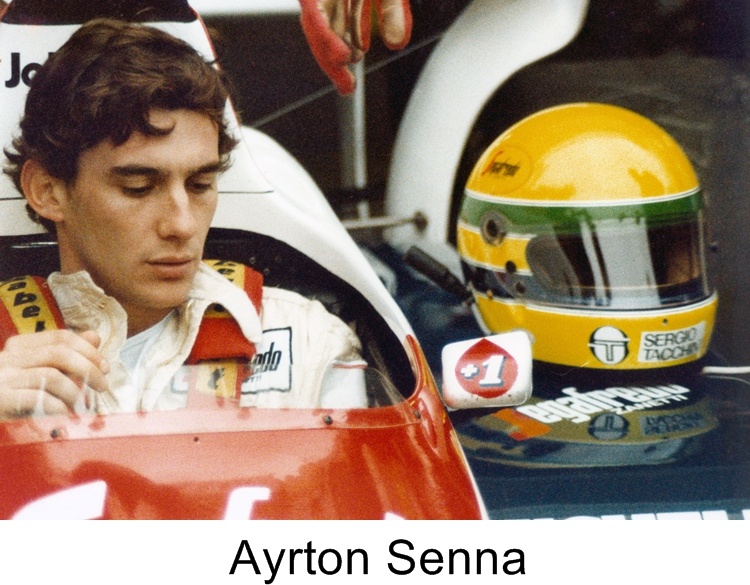
When Asif Kapadia signed on to make a documentary about three-time Formula One world champion race car driver Ayrton Senna, he and everyone else involved assumed they were going to make  the typical doc. The ratio they worked out was that Senna would include 14 minutes of archival footage of the Brazilian racing legend. The rest would be talking heads.  That was before anyone really looked at the wealth of archival material.

“There’s so much and it’s so strong,” marvels Kapadia during a promotional pit stop in San Francisco. “It seemed crazy to have someone with a plant and bookshelf behind him saying, ‘Well, Senna he was really good.’ I thought, ‘Why do we need him? We’ll just show you.”

Good call. Senna unfolds with the tension and immediacy of a Formula One race careening through the movie theater, bringing the iconic driver’s career to vivid life. Sneaking into January’s Sundance Film Festival for its US premiere with little fanfare, it was quick off the blocks, winning the Audience Award for World Cinema Documentary there. Since then, it won the Best International Feature audience prize at the Los Angeles Festival and it had the biggest theatrical opening of any documentary this year. And while it might be expected that Formula One fans would flock to it, the film’s appeal is crossing over to people with no interest in the sport and to whom the name “Ayrton Senna” previously meant nothing. To Kapadia, this success dates back to the decision to lose the talking heads.

“There came a point when it was so obvious, if in doubt, just let Senna tell you what is going on,” he says. “He should be the narrator of his own life story, not somebody else. He’s more intelligent, more eloquent, more good-looking. He can drive the car like nobody else can drive. He’s the one fighting corruption.  He’s the one who’s got the whole of Brazil following his every move. He’s perfect. He’s the perfect movie star.”

Researchers around the globe chased after material on Senna, but what really made a difference was the unprecedented access to the Formula One archive given to the production by Formula One head Bernie Ecclestone.

“We were the first people to actually set foot in his archive to get all the exclusive footage that you see in the film,” Kapadia says. “By the time we get to the last race in Emilia, there are 30 cameras on Senna everywhere he is. From one race, there are thousands of hours of material. You multiply that by a season and multiply that by 10 seasons.”

With or without that wealth of footage, Senna’s story is a compelling one with multiple facets, beginning with his rise through the Formula One ranks.

“In Formula One, the cars are not the same. They are totally different. They are totally unequal,” observes Kapadia. “The richest ones start at the front with the best of everything. The weakest ones start at the back and you’re meant to race. It’s obvious who’s going to win. The guy with the most money and the best car is up front.

“Senna’s job coming into the sport was to prove himself in a bad car to get a chance at a better car to get a chance to get into the best car. That’s what the sport is all about. It’s a really tough sport. You’ve got to be tough to make it.”

There is much more to Senna’s story than his ability to win races. He was a devout Catholic. He was a passionate advocate for safety and unafraid to take positions that put him at odds with the racing establishment. In Brazil, he was a national hero, that love affair reaching its apex at the 1991 Brazilian Grand Prix, a race he won despite problems with his gear box that forced him to drive the last laps of the race stuck in sixth gear.

“That’s the bit that still makes me cry,” says Kapadia. “There’s something about that moment where he has to do it. He cannot give up. He cannot quit, because he has to do it for everyone, all of his Brazilian fans. You just see what he means to them.”

Then there was his rivalry with his McLaren teammate Alain Prost. Every hero needs a villain and Senna found his in the Frenchman, a four-time world champion with whom he repeatedly locked horns both on and off the track. Kapadia compares their relationship to Muhammad Ali’s with George Frazier and George Forman or Bjorn Borg’s with John McEnroe.

“They’re so different as people,” he says. “They have different ways of driving, different ways of winning, different ways of dealing with people.

“Their faith made them different,” he adds. “Senna would talk about God and Prost didn’t like that. Everything about them. It was amazing to have two brilliant guys at the top of their game at the same time on the same team.”

Rivalry with Prost or any other driver could only motivate Senna so far, Kapadia believes. After spending two and a half years wading through the Formula One archive and putting the film together, gradually winnowing a seven-hour assembly to a 106-minute final cut, he has come to a conclusion about what drove Senna toward racing superstardom.

“He had to do it. He had to drive on the limit and find new limits. Push it further and further and further,” he says. “A lot of the time he wasn’t racing other people, ’cause he kind of knew he was better than them. He was racing himself, he was finding the kind of level he could achieve, in a way to get closer to God almost. It was a spiritual thing for him, to drive. It put him in a place there is no other way to be in that moment, to feel what he was feeling. He couldn’t help it. He had to do it.” – Pam Grady

Share this:

  • Share on Facebook (Opens in new window) Facebook
  • Share on X (Opens in new window) X
  • Email a link to a friend (Opens in new window) Email
  • Print (Opens in new window) Print
  • Share on LinkedIn (Opens in new window) LinkedIn
  • Share on Tumblr (Opens in new window) Tumblr
  • Share on Reddit (Opens in new window) Reddit
  • Share on Pinterest (Opens in new window) Pinterest
Like Loading...

Better Than Something Celebrates Jay Reatard

16 Tuesday Aug 2011

Posted by cinepam in Reviews

≈ 2 Comments

Tags

Better Than Something: Jay Reatard, Jay Reatard, Roxie Theater

When Better Than Something: Jay Reatard screens at San Francisco’s Roxie Theater on Wednesday, August 17, the theater will no doubt fill with fans of the late Memphis garage rocker and his music. People with little patience for raucous punk rock or who plain haven’t heard of him will stay away from the theater. That’s their loss, because Alex Hammond and Ian Markiewicz’s portrait of a talented musician and big personality is one of the best documentaries to come out this year.

It was Reatard himself who set the wheels for a feature-length doc in motion when he hired Hammond and Markiewicz to make Waiting for Something, a short about his life. When he died in his sleep four months shy of his 30th birthday, they already had a wealth of material at their disposal, not only in the extensive interviews they did with him for the earlier film, but also in his prodigious output. His career spanned half of his life and he was prolific, constantly recording (mostly on his own home equipment) and constantly touring, leaving behind a substantial audio and video record. Add to that a memorial show at South by Southwest shortly after Reatard’s death and the recollections of friends, family, and fans and the picture is complete.

One of the great thing about the documentary is that it is as accessible to someone coming cold to Jay Reatard as it is to his fans The music runs the gamut from his earliest angry teenage years to the gorgeous pop of his final LP 2009’s Watch Me Fall.  The video record is just as expansive, capturing the volatile performer at his most explosive and charismatic, whether throwing himself into his performance or its opposite, such as an instance where he angrily stomps off the stage and  afterwards throws things at his Lost Sounds band mate Alicja Trout during a show in Chicago. He could be a jerk, but he was a talented jerk – “He never pissed on my record collection,” laughs one of his friends – and he could also be charming and frequently is in the interviews recorded for the short.

Ultimately, it is those interviews – candid, smart, and self-aware –  that set Better Than Something: Jay Reatard apart from most other rock docs. In hindsight, Reatard’s desire to put  his life down on record seems prescient, but if he sensed that he wasn’t long for this world, it isn’t evident.  Whether he’s talking about his creative process or how he helped his mom raise his baby sister or taking Hammond and Markiewicz through a tour of his old neighborhood in Memphis, he is just so present. For a documentary about a dead guy, the film is very much alive. So many docs of this ilk, whether about the living or dead, tend to enshrine the subject. This one doesn’t do that. Instead, in letting Jay simply speak for himself what emerges is the farthest thing from obituary. This is a celebration. Jay’s body might have moved on, but his spirit still lives within Better Than Something: Jay Reatard. – Pam Grady  _________________________________________________________________
Better Than Something: Jay Reatard, a co-presentation of Noise Pop and the Roxie Theater, screens at 7:30 & 9:30pm on Wednesday, August 17. For tickets or further information, visit http://www.roxie.com.
Share this:

  • Share on Facebook (Opens in new window) Facebook
  • Share on X (Opens in new window) X
  • Email a link to a friend (Opens in new window) Email
  • Print (Opens in new window) Print
  • Share on LinkedIn (Opens in new window) LinkedIn
  • Share on Tumblr (Opens in new window) Tumblr
  • Share on Reddit (Opens in new window) Reddit
  • Share on Pinterest (Opens in new window) Pinterest
Like Loading...

Vigilante Vigilante: Playing Tag with the Buffers

11 Thursday Aug 2011

Posted by cinepam in Interviews, Uncategorized

≈ Leave a comment

Tags

Max Good, Nathan Wollman, Roxie Theater, Vigilante Vigilante

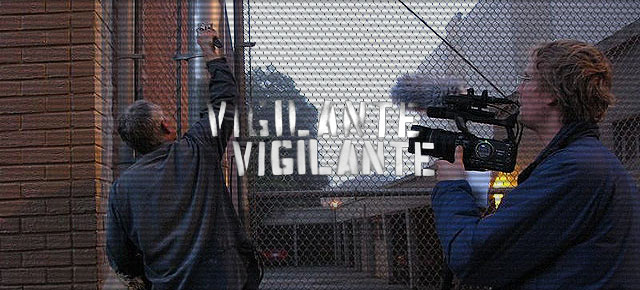
Max Good has been making graffiti for more than 15 years. He’s been aware of the “buffers” – self-appointed protectors of walls and posts who come by after the artist has gone and covers up his work, often with splashes of gray or black paint that creates a kind of graffiti of its own – from the start. When he lived in New York, he had a buffer of his own , a kind of stalker who specifically targeted Good’s stickers. He tried to stake him out, but never caught him. Then three years ago, Good moved back to Berkeley and became aware of a buffer known as the Silver Buff.

“I decided I was going to stake him out and find him, no longer how long it took,” says Good.

This time, though, to relieve the boredom of the stake out, Good who has several shorts to his credit, decided to make a film. Like his other work, it would be a short. Producing it would be Nathan Wollman, with whom he’d previously collaborated on a 2006 short Ungonquieños. But as their investigation grew, so did the film, evolving into a full-fledged feature Vigilante Vigilante.

“The process of trying to discover the identity of the Silver Buff was actually a pretty mystical process,” says Wollman. “Our imaginations got carried away so much. There were all these things we thought might have been going on or could be happening. It almost reminded me of being a little kid and playing with toys and imagining what the characters were.”

The film grew to encompass commentators on graffiti, both pro and con, graffiti artists, and other vigilantes, including Joe Connelly, a motor-mouth Los Angeleno who claims that he actually like graffiti even as he works assiduously to remove it, and Fred Radtke, an intense former Marine who patrols New Orleans and is so offended by street art that he’s actually gotten in trouble for covering up sanctioned work. But the focus remains on the Silver Buff with Good and Wollman becoming characters in the film as they hunt for and eventually confront the vigilante, a man named Jim Sharp who turns out to live in the Berkeley hills, nowhere near the area he patrols daily with his can of silver spray paint.

“He’s taken ownership over the central part of Berkeley. He sees this as his territory and he is going to police it,” says Good. “Telegraph, which is home to the Free Speech Movement and which is supposed to be a funky, populist area where people are communicating – there’s events and there’s liveliness. He comes down every morning and strips every single pole of every poster and stops the flow of communication. It’s actually pretty damaging.”

“What’s going on there is his own fantasy vision of what it is that his city should look like and it’s not a very fair vision,” adds Wollman.

To Good, Sharp and his fellow buffers are control freaks, who – while claiming that what they are doing is enforcing law and order — essentially place themselves above the law. While decrying graffiti artists for their temerity in leaving their tags on walls, they essentially behave the same way. They, too, stock up on cans of illegal spray paint. They, too, write on walls, their “erasures” of what was there forming another kind of tag.

“It’s the expression that bugs them, not the law breaking, that somebody thought they could express themselves and break the rules,” observes Good. “Yet they can do the same thing to eliminate it. It’s really confused. It’s really paradoxical and insane in a way.

“They don’t want any sign that people are questioning things or in fact are expressing themselves freely. I hate to get too out there and talk about Zen state of mind, but part of living in a society of any kind at any time in history, I believe, is dealing with the fact that you can’t control all the things that are going on in your environment.”

Wollman sees a bigger picture behind the graffiti wars, one he and Good have done their best to capture in Vigilante Vigilante. The film is a kind of discussion about class warfare, individual expression, and that need some people have to somehow master their domain.

“It’s about control,” he says. “Erasing someone’s tag off a wall is one small accomplishment for these people where they could say, ‘That was me. I did something. That’s gone now. I got rid of that. That was me.’

“I think the taggers are saying the same thing. They put up that mark and they say, ‘That was me. I did one small thing today.’ If that’s what it take to stay sane, then more power to you on either side. If that’s what your passion is, then you’re going to have to live with the consequences that those passions involve law-breaking activity. Then so be it.” – Pam Grady
_____________________________________________________________________________
Vigilante Vigilante plays the Roxie Theater, 3117 16th St, San Francisco, Friday, August 12-Thursday, August 18. Max Good and Nathan Wollman will be in attendance on Friday and Saturday evening. For showtimes, tickets, or other information, visit http://www.roxie.com.

Share this:

  • Share on Facebook (Opens in new window) Facebook
  • Share on X (Opens in new window) X
  • Email a link to a friend (Opens in new window) Email
  • Print (Opens in new window) Print
  • Share on LinkedIn (Opens in new window) LinkedIn
  • Share on Tumblr (Opens in new window) Tumblr
  • Share on Reddit (Opens in new window) Reddit
  • Share on Pinterest (Opens in new window) Pinterest
Like Loading...

Americathon: Made in 1979 for 2011

30 Saturday Jul 2011

Posted by cinepam in Reviews

≈ Leave a comment

Tags

Americathon, Animal House, Chief Dan George, Elvis Costello, Firesign Theatre, Fred Willard, Harvey Korman, Howard Hesseman, Jay Leno, John Ritter, Meat Loaf, Nancy Morgan, Neil Israel, Peter Bergman, Peter Riegert, Phil Proctor, Terry McGovern, Three's Company, Tommy LaSorda, Tunnel Vision, Zane Buzby

“Ah, a documentary!” laughs Jeremy at Lost Weekend Video when I bring Americathon, today’s selection, up to the counter.

Well, maybe not exactly, but yeah, with the debt limit ceiling about to crash on all our heads, it seems like a good time to revisit this broad political satire. Made in 1979 during the middle of an oil crisis, it was set in 1998 in a world where there was only enough energy left to power televisions. People live in their now immobile cars and the United States is flat broke. President Chet Roosevelt (a Three’s Company-era John Ritter) – a California-bred doofus descendant of Teddy and FDR who governs from a condo in Marina Del Rey – first tries to raise money with such schemes as auctioning a date with the Secretary of Agriculture and a National Marijuana Smoke-Off. When that doesn’t work, he borrows $400 billion from tycoon Sam Birdwater (Chief Dan George), who threatens to foreclose on the whole country when the loan isn’t paid back.

What’s a broke nation to do? Why hold a telethon, of course, hosted by  drug-guzzling, fading TV sitcom actor Monty Rushmore (Harvey Korman) who looks at the show as a comeback vehicle. But while marketing whiz Eric McMurkin (Peter Riegert, fresh from Animal House) diligently attempts to cobble together a winning show from an array of acts that is overly populated by ventriloquists, other forces are working to bring the country down.

That’s not so different when you think about it from what’s going on now, except there is nothing so entertaining as “Family In-Fighting” – a boxing match between Larry Miller a/k/a “Poopy Butt” (Jay Leno) and his mom – on the horizon and those that would bring this country to its knees are self-styled “patriots” not the United Hebrab Republic. (In the world of Americathon, the Israelis and the Arabs have joined together in a quest for world domination and England is the 57th state, complete with a theme park that occupies Buckingham Palace.)

When Americathon was released in August 1979, it was to dismal reviews. Roger Ebert gave it one star in the Chicago Sun-Times. The Chicago Reader‘s Dave Kehr thought the funniest thing about it was that it was financed by German tax shelter money. Janet Maslin in the New York Times was kinder. She thought buried within was a good 15-minute sketch.

Adapted from a play by the Firesign Theatre’s Phil Proctor and Peter Bergman and helmed by Tunnel Vision director Neil Israel, the movie is one of those sketch comedies that replaces plotting with a series of episodes. The cast that includes Ritter, Korman, Riegert, Leno, Fred Willard, Nancy Morgan, Zane Buzby, Howard Hesseman, Terry McGovern, then L.A. Dodgers manager Tommy Lasorda, and Meat Loaf (as well as Elvis Costello in a singing cameo) is game. There is a let’s-put-on-a-show cheesiness that’s charming and a shamelessness that’s appealing. A lot of the jokes didn’t work then and don’t work now, but there’s something disarming in the audacity of simply letting jokes fly hit or miss.

In a couple of places the movie is spookily prescient. Maybe Vietnam has not evolved into an alternative to the French Riviera, but Westerners do enjoy vacationing there. And, as a matter of fact, China has emerged as an economic powerhouse. Then again, North Dakota is not the country’s first all-gay state. Also, we don’t all live in our cars, just in houses with underwater mortgages.

As I write this, members of Congress seems hellbent on continuing with their scheme to bring this country to its knees as they play a game of chicken with the debt ceiling. We can all panic about it or mourn the country that once was or simply hide under the covers until the crisis passes (we might be cowering there for a long time). Or we can laugh. Americathon is not a work of genius, but it is suddenly topical and good for a few giggles. – Pam Grady

________________________________________________________________

Americathon is part of the Warner Bros. Home Archive Collection. It can be purchased from wbshop.com or Amazon or rented from independent video stores such as San Francisco’s Lost Weekend. Don’t even bother looking for it on Netflix or iTunes. You won’t find it.

Share this:

  • Share on Facebook (Opens in new window) Facebook
  • Share on X (Opens in new window) X
  • Email a link to a friend (Opens in new window) Email
  • Print (Opens in new window) Print
  • Share on LinkedIn (Opens in new window) LinkedIn
  • Share on Tumblr (Opens in new window) Tumblr
  • Share on Reddit (Opens in new window) Reddit
  • Share on Pinterest (Opens in new window) Pinterest
Like Loading...

Alienating Cowboys

29 Friday Jul 2011

Posted by cinepam in Reviews

≈ 2 Comments

Tags

Adam Beach, Cowboys & Aliens, Daniel Craig, Dead Man, Harrison Ford, Henry Gregson-Williams, Jon Favreau, Keith Carradine, Matthew Libatique, Paul Dano, Sam Rockwell, The Adventures of Brisco County Jr., Tremors, Walter Brennan, Walton Goggins, Wild Wild West, Zachariah

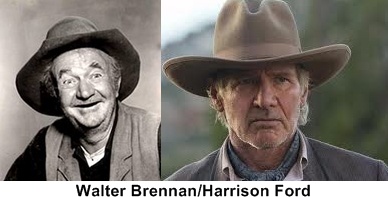
When did Harrison Ford – the once and always Han Solo and Indiana Jones – morph into Walter Brennan? True, he never takes out his teeth in Cowboys & Aliens and he never once says, “Dagnabit!” But his cranky cattle baron Woodrow Dolarhyde is not only cut from the same old coot cloth of many of Brennan’s characters, he also could be a cousin of Brennan’s My Darling Clementine villain Old Man Clanton – that is until the third act when Dolarhyde turns warmer and fuzzier. An actor who needs to be liked is a terrible thing.

In casting, at least, Cowboys & Aliens, feels very traditional. Daniel Craig makes a nice substitute for Steve McQueen. Sam Rockwell is a serviceable Jimmy Stewart type. One can easily imagine Justified‘s Walton Goggins, here seen in the supporting role of sniveling black hat Hunt, making a career out of similar parts back in the day when oaters were a cinematic staple. Cowboys & Aliens‘ Sheriff John Taggart Keith Carradine has toiled in Westerns off and on for 40 years, with credits that include guest stints on TV’s Bonanza and high-profile parts in The Long Riders, Wild Bill, and Deadwood. Paul Dano, playing Dolarhyde’s spoiled son Percy, is an inspired choice, with a face that would not be out of place among the collection of 19th -century photos in Wisconsin Death Trip.

It is unfortunate that the fine roster of talent that director  Jon Favreau assembled is in the service of this weak movie, the latest graphic novel to make the transition to screen. The tale of a community’s fight against the gold-mining space aliens that are bent on laying waste to humanity is neither offbeat nor witty enough, at least in comparison to, say, The Adventures of Brisco County Jr. and its golden orb, the mortally wounded William Blake wandering the wilderness in Dead Man, the homoerotic subtext and weirdly placed rock bands in Zachariah, or just about any episode of the old Wild Wild West TV series. And despite being from an apparently advanced civilization, the aliens seem barely more sentient than the ravenous monster earthworms from Tremors (a movie that Cowboys & Aliens resembles in some aspects, or would if it had a sense of humor).

The movie is replete with Western archetypes. Craig as amnesiac outlaw Jake Lonergan is the antihero whose brains, courage, and propensity for violence make him a natural leader. Rockwell, playing barkeep Doc, is the tenderfoot who rises to the occasion. Adam Beach’s Nat Colorado is the Native American raised among whites who is not entirely at home in either society. Ford and Dano represent the moneyed classes. Goggins’ gang would be the villains in any other movie. There is also a whole American Indian tribe. And while it is to be expected that they are all going to have to set aside their differences to fight their common enemy, the rough edges of conflict and any genuine tension are washed away as Cowboys & Aliens shifts into a kind of ‘Kumbayah” moment. It all begins to feel like one of those kids’ T-ball games where everyone gets a trophy.

Matthew Libatique’s cinematography is gorgeous and Henry Gregson-Williams contributes an appropriately evocative score. Craig is terrific. He really is the heir apparent to McQueen. He’s got the look, the charisma, and the coolness. Rockwell and Goggins also standout among the large ensemble. These are all reasons to see a film that is otherwise a waste, satisfying neither as a Western nor as science fiction. – Pam Grady

Share this:

  • Share on Facebook (Opens in new window) Facebook
  • Share on X (Opens in new window) X
  • Email a link to a friend (Opens in new window) Email
  • Print (Opens in new window) Print
  • Share on LinkedIn (Opens in new window) LinkedIn
  • Share on Tumblr (Opens in new window) Tumblr
  • Share on Reddit (Opens in new window) Reddit
  • Share on Pinterest (Opens in new window) Pinterest
Like Loading...
← Older posts
Newer posts →

Categories

  • Interviews
  • News
  • Reviews
  • Short Takes
  • Uncategorized

Recent Posts

  • A Stamp of Approval
  • Life is messy & so is ‘Megalopolis’
  • A star discovers too late there are worse things than aging in the black comic body horror ‘The Substance’
  • A young teen nurses a crush when he finds himself among ‘Big Boys’
  • The stunt man becomes the star as Ryan Gosling becomes THE FALL GUY

Archives

Blog at WordPress.com.

  • Subscribe Subscribed
    • Cinezine Kane
    • Join 48 other subscribers
    • Already have a WordPress.com account? Log in now.
    • Cinezine Kane
    • Subscribe Subscribed
    • Sign up
    • Log in
    • Report this content
    • View site in Reader
    • Manage subscriptions
    • Collapse this bar
 

Loading Comments...
 

    %d