• About

Cinezine Kane

Cinezine Kane

Author Archives: cinepam

Review: ESCAPE FROM TOMORROW’S Wild Ride

10 Thursday Oct 2013

Posted by cinepam in Reviews

≈ Leave a comment

Tags

Disney World, Disneyland, Escape from Tomorrow, Randy Moore, Roy Abramsohn

When Escape from Tomorrow premiered at January’s Sundance Film Festival the assumption was that the Park City screenings and maybe a handful of appearances at other festivals would offer audiences the only opportunity to ever see this sinister take on the Happiest Place on Earth. You just don’t mess with The Mouse and in making his film on the sly at Disneyland and Disney World, writer/director Randy Moore courted an almost certain cease-and-desist order. Apparently, miracles do happen. Escape from Tomorrow is out in theaters and available VOD, affording everyone the chance to visit one suburbanite’s visit to hell, Disney-style.

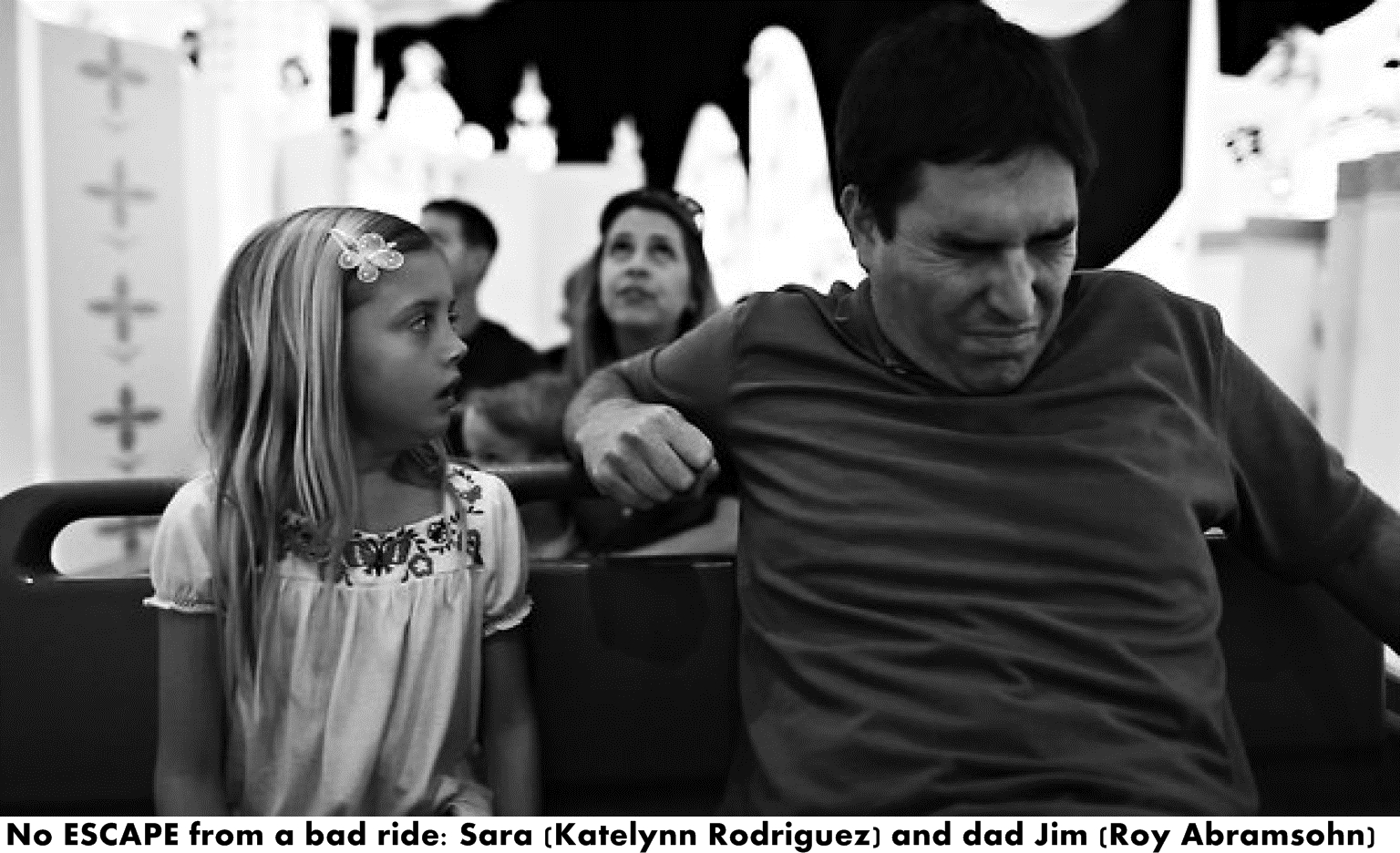
Escape from TomorrowMoore may be onto something here, finding none of the warm, family fun the Disney marketing machine promises. Instead, middle-class dad Jim (Roy Abramsohn) stumbles onto a kind of theme park noir on a visit to Disney World with his wife Emily (Elena Schuber) and young children Sara (Katelynn Rodriguez) and Elliot (Jack Dalton). Some of what befalls him is undoubtedly his own fault. Stalking French teenagers is not the wisest move and getting distracted by shiny things, like the necklace worn by an aging and tawdry former princess (Alison Lees-Taylor), can only lead to trouble. But the entire day takes on a surreal and horrifying vibe when rides turn out to be far less placid than they appear, Epcot has its own resident mad scientist (Stass Klassen) and even little Elliot appears to have malevolent intentions.

The film’s black-and-white cinematography is gorgeous, but further adds to the unease. The world of Disney robbed of color simply does not compute except maybe in Jim’s head. The genius of Escape from Tomorrow is that Moore has a finger on the pulse of something very real: The place that is a magical paradise for so many is pure torture for others, especially parents trying to make their kids happy by sacrificing themselves on the altar of long lines, endless crowds and rampant consumerism that is presided over by that squeaky-voiced pitchman Mickey. Jim’s situation is exaggerated to be sure, but part of the horror (and fun) of the movie is that at its core it is also highly identifiable. It is easy to relate to his pain. It is a small world, after all. – Pam Grady

Share this:

  • Share on Facebook (Opens in new window) Facebook
  • Share on X (Opens in new window) X
  • Email a link to a friend (Opens in new window) Email
  • Print (Opens in new window) Print
  • Share on LinkedIn (Opens in new window) LinkedIn
  • Share on Tumblr (Opens in new window) Tumblr
  • Share on Reddit (Opens in new window) Reddit
  • Share on Pinterest (Opens in new window) Pinterest
Like Loading...

Q&A: INEQUALITY FOR ALL’S Robert Reich & Jacob Kornbluth

30 Monday Sep 2013

Posted by cinepam in Interviews

≈ Leave a comment

Tags

Inequality for All, Jacob Kornbluth, Robert Reich

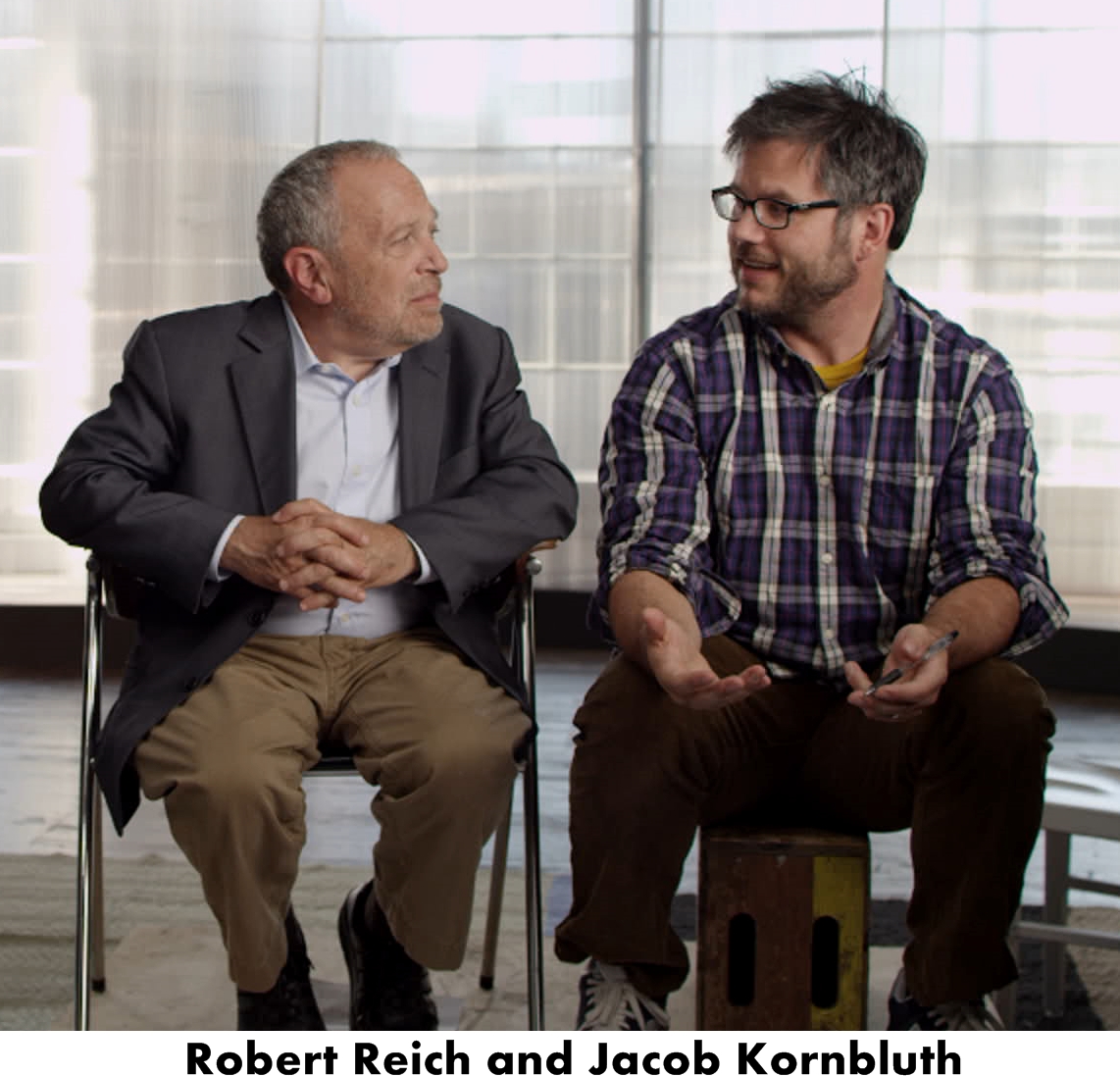
A dark, noisy nightclub may seem like an unlikely venue to find former Secretary of Labor, present UC Berkeley Chancellor’s Professor of Public Policy Robert Reich, but this is the Sundance Film Festival where actual interview suites are in short supply. Music bleeding in from upstairs and a deep bass line shaking the walls lend a surreal atmosphere as Reich and filmmaker Jacob Kornbluth talk about their documentary Inequality for All, in which the diminutive, amiable Reich diagnoses what ails the American economy and offers his prescription to fix it. The doc, which recently opened in theaters, took home a Special Jury Prize from the festival, the Sundance jurors declaring, “With clarity, humor and heart, this timely film reveals the underpinnings of an urgent threat to American democracy.” That heart is on ample display as director and subject talk about their collaboration and what they hope it accomplishes.

Q: You two started working together on short videos. How did that come about and how did that lead to the feature?

JK: What happened was I met a girl and that moved me from L.A. back to the Bay Area and I started making a film with [my brother] Josh called Love and Taxes and we cast Bob as a former IRS commissioner.

RR: It’s a comedy and I’m a ham! Of course, I just thought it would take about 10 minutes. I didn’t know anything about film, obviously. I didn’t do a very good job, but we met then and subsequently we started making these two-minute videos. Hundreds of thousands of people watched them and I’m enormously impressed with Jake.

InequalityForAll_5

JK: We got along. It was an honor to work with him, and honestly, since we started working together, it’s gotten better and better. He’s a fantastic intellect, but also a great guy. It just sort of seemed like a natural extension of us working together to make a film.

He was writing a book and the book was called Aftershock. Reading that book changed the way I thought about – it changed some of my narrative. It seemed like maybe this is a story that can affect a lot of people. I felt like a movie would make sense, because I knew that he was so good on camera and he had this ability to break down these complex issues in ways that everybody could understand.

Q: What surprised me about the film was how much humor there is in it and how humorous you are, especially since there must be times in trying to get your points across about the economy that you feel like you’re pounding your head against a brick wall.

RR: Comedy is necessary. Humor is necessary. It’s necessary for two reasons in my life: One, because if I took myself too seriously, I really would go completely crazy. I’ve been talking about and worrying about and writing about and screaming about this issue for 30 years. But also because humor is universal. The reason (former Republican Wyoming senator) Alan Simpson and I, for example, became good friends, the way I get conservative audiences to listen to me is through humor. If we can laugh together, we can actually open our minds to what each other says.

JK: And as you may know, my background is in comedy. This is my first documentary. I didn’t come at this from the sense of a serious documentarian, although I think it is a very serious film. I really connected to that area of humor that Bob has very deeply in his personality and his public life.

Q: Your amiability is certainly disarming. What you’re talking about is alarming, but there is none of the rage you’d find in something like a Michael Moore documentary.

RR: This can’t be polemic, it can’t be. Even though it uses my big lecture at Berkeley as one of its anchors, even there there’s humor. Candidly, I’ve always joked about my height. It wasn’t until we were doing this movie that I saw a relationship between my personal history, in terms of my being very short, and what I’ve been doing for the last 30 years. It may seem odd, but I hadn’t really put my own personal pieces together.

Q: You have people in the film who personalize income inequality and its surrounding issues through their life experiences. How did you go about getting those people?

JK: After thinking about that and realizing that we wanted that, what we did was we looked at people that Bob came in contact with.

RR: And several of them are people from my class. Jake was smart enough and insightful enough to know that there is some emotional reality there. These young people are struggling with their families, with balancing a checkbook, and they are also sitting in a class where the subject is the very context of what they’re struggling with.

JK: It felt nice that the people have some interaction with Bob. It made it so that it felt like the whole story was interconnected and tied together. Past that, we were looking for people who surprise you in some way. There’s certainly a story about the struggling middle class, which I feel is a very important one to tell, but also one that is hard to make feel fresh and new in a movie. We wanted people that, frankly, I could relate to, who didn’t feel like they were about to be on street. You felt like they should be making it, but weren’t.

Q: We live in an age in which so many people don’t seem to communicate, they simply shout at each other. Do you hope this film will open up some kind of dialogue?

RR: That’s our hope. We want to change the conversation. Instead of this incessant vitriol and partisanship, I have a deep faith that when people understand what the system looks like, how we got to where we are and stop playing the blame game, that it’s possible for us to have a different kind of conversation.

For years now, I come across people and I ask about what they do and how they’re feeling about their job and sometimes about how much they’re earning and health insurance and everything else, and the fact of the matter is, the typical person in this country is working harder and harder and getting less and less and has less and less job security and is having a harder time paying the bills and having a family than at any time since the Second World War. This is ridiculous, given that this is the richest country in the world and we’re richer than we’ve ever been.

Many people say, “That’s just the way it has to be. That is the way the economy is organized.” What I say in this film and Jake so eloquently conveys is that we don’t work for the economy. The economy ought to be working for us. We make the rules by which the economy functions. There is no economy in the state of nature. These are political decisions and the problem is most people don’t understand that we make the rules. – Pam Grady

Share this:

  • Share on Facebook (Opens in new window) Facebook
  • Share on X (Opens in new window) X
  • Email a link to a friend (Opens in new window) Email
  • Print (Opens in new window) Print
  • Share on LinkedIn (Opens in new window) LinkedIn
  • Share on Tumblr (Opens in new window) Tumblr
  • Share on Reddit (Opens in new window) Reddit
  • Share on Pinterest (Opens in new window) Pinterest
Like Loading...

TIFF 2013: The first and LAST OF ROBIN HOOD

13 Friday Sep 2013

Posted by cinepam in News, Uncategorized

≈ Leave a comment

Tags

Errol Flynn, Kevin Kline, Richard Glatzer, The Last of Robin Hood, TIFF, Toronto International Film Festival, Wash Westmoreland

In The Last of Robin Hood, Kevin Kline at last steps into the role he seemed destined for ever since he played The Pirates of Penzance‘s dashing Pirate King on both stage and screen back in the 1980s: that of Errol Flynn. Richard Glatzer and Wash Westmoreland’s (The Fluffer, Quinceañera) lush biopic that captures Flynn’s last days as he romances teenager Beverly Aadland (Dakota Fanning) made its Toronto International Film Festival premiere on Friday, September 6, with Kline in attendance.

During the post-screening Q&A, Kline said that he had offers to play Flynn throughout his career. He always turned them down, not finding the scripts or the character very interesting until he received (by accident) Glatzer and Westmoreland’s screenplay and was intrigued by this portrait of Flynn at the end of his life, seeking rejuvenation in the arms of a much younger woman as his career and health fade.

That, at least, is the 65-year-old actor’s story, post-Pirates of Penzance/Big Chill stardom. Picking and choosing his roles was not always in Kline’s power. As Washmoreland revealed at the Q&A, Kline did step into Flynn’s shoes once when he was a young man in this 1978 Schlitz beer ad. The future Pirate King is already a dashing swashbuckler in this spot. Resist it though he might for most of his career, Kline – back in the ’70 and now in 2013 – was simply born to play Flynn. – Pam Grady


Share this:

  • Share on Facebook (Opens in new window) Facebook
  • Share on X (Opens in new window) X
  • Email a link to a friend (Opens in new window) Email
  • Print (Opens in new window) Print
  • Share on LinkedIn (Opens in new window) LinkedIn
  • Share on Tumblr (Opens in new window) Tumblr
  • Share on Reddit (Opens in new window) Reddit
  • Share on Pinterest (Opens in new window) Pinterest
Like Loading...

Twilley Don’t Mind: YOU’RE NEXT finds the power pop “Magic”

22 Thursday Aug 2013

Posted by cinepam in Interviews

≈ 1 Comment

Tags

Adam Wingard, Dwight Twilley, Dwight Twilley Band, Simon Barrett, You're Next

Twilley Don’t Mind, the Dwight Twilley Band’s second album arrived with a thud in 1977, only managing to rise to #70 in the Billboard Charts. A single, “Looking for the Magic,” was not a radio hit, despite an earworm of a pop hook. In the nascent days of music television, the song’s accompanying video got a lot of play – Twilley and his band mate, the late Phil Seymour, were very pretty boys – but that was about the extent of it. But now “Looking for the Magic” is back in a most peculiar place as a recurring theme in Adam Wingard’s wicked new horror thriller You’re Next.

The idea of a song that keeps repeating was written into Simon Barrett’s script, a story about a family that finds itself under siege in an isolated country home when masked intruders attack in the middle of dinner.

youre next“We knew it had to be something that is going to hold up for an entire movie,” says director Adam Wingard. “I knew it had to be a classic rock song, but the problem was our budget wouldn’t allow us to pick something that was – most classic rock songs that are good have already been done in a movie and they already know that they can charge a lot of money for them. It was kind of a challenge trying to find a song that would have that classic rock feel, but it’s something that you haven’t heard before and had sort of a slightly dark atmosphere to it.”

Wingard and Barrett hunted for a song that would fit and when nothing clicked, the director turned to You’re Next‘s composer Kyle McKinnon, a man with an encyclopedic knowledge of rock music, and asked him to send 20 songs. “Looking for the Magic” was among the first McKinnon sent.

“I remember that I played it and I was at Simon’s apartment – I think I was sleeping on the couch at the time, because I was totally broke – and Simon was in the other room doing something,” Wingard says. “I listened to the song once and then I called him in. ‘Hey, listen to this.’ Immediately, when I played it for Simon, we were both like, ‘This is it. This is it.’ We just kind of went for it from that point. Me and my DP we would listen to it every day before going on set.

“There’s a weird darkness to that song, I feel like,” he adds. “There’s the way the vocals are recorded with that weird, slap-back, kind of like suicide-style reverb. It’s a little unsettling, but at the same time, it’s such a poppy song. There’s an underlying darkness. That’s why I feel that it works, because it’s not just totally ironic. It’s not totally out of place. There’s something weird there about that song.”

The song became the theme not just of the movie, but of the You’re Next set. Cast and crew had it on their iPhones. Between scenes, someone or other would be playing it.

“It became ingrained not just with the atmosphere of the movie, but even also the way that we structured all those scenes around that piece of music,” says Wingard. “It’s a very specific build. It has that little interlude to the way it starts and then it just jumps right into it. All those scenes are kind of built around that kind of structure. It kind of became impossible to find another song after that, even if we’d wanted to.”

Getting so attached to the song was a gamble and as scary for the filmmakers as anything in the movie. Wingard and Barrett, who is a producer on You’re Next as well as its writer, were committed to using the song, but licensing it was an issue. They didn’t know if they could afford it; Universal owns it and the filmmakers feared that corporate suits would not necessarily be willing to give a price break on the license to a low-budget, independent production.

“I actually reached out directly to Dwight Twilley and his wife Jan,” says Barrett. “They would call me at two in the morning to play me music while we were shooting, so I was exhausted. They were playing other songs for me and at one point, I was like, ‘We really want ‘Looking for the Magic.’ If you can talk to Universal and get us a lower price.’

“At one point, she shouted at me, “You want ‘Looking for the Magic,’ but you can’t afford the fuckin’ magic!’ That felt like the real theme of our shoot, because when you’re making a low-budget film and things are going wrong every day on set, it’s so stressful.”

Ultimately, the rights issue was worked out and a song integral to the foreboding ambiance that pervades You’re Next took its place within the film’s soundscape.

“That might have been one of the happiest moments in making this film, when we found out that a deal had been reached and we could actually afford “The Magic,’” says Barrett. “Then we we were like, ‘Oh, yeah, the movie’s going to be great.’

“We were trying to make a film that stands the test of time,” he adds.

“That’s the whole reason we wanted a classic rock song in the film,” says Wingard. “It’s something that has already proven itself to stand up. If a song is still good after 20 years, then you know it’s going to be good in another 20 years.” –Pam Grady

Share this:

  • Share on Facebook (Opens in new window) Facebook
  • Share on X (Opens in new window) X
  • Email a link to a friend (Opens in new window) Email
  • Print (Opens in new window) Print
  • Share on LinkedIn (Opens in new window) LinkedIn
  • Share on Tumblr (Opens in new window) Tumblr
  • Share on Reddit (Opens in new window) Reddit
  • Share on Pinterest (Opens in new window) Pinterest
Like Loading...

Review: Trapped in THE CANYONS

08 Thursday Aug 2013

Posted by cinepam in Reviews

≈ Leave a comment

Tags

Bret Easton Ellis, James Deen, Lindsay Lohan, Paul Schrader, The Canyons

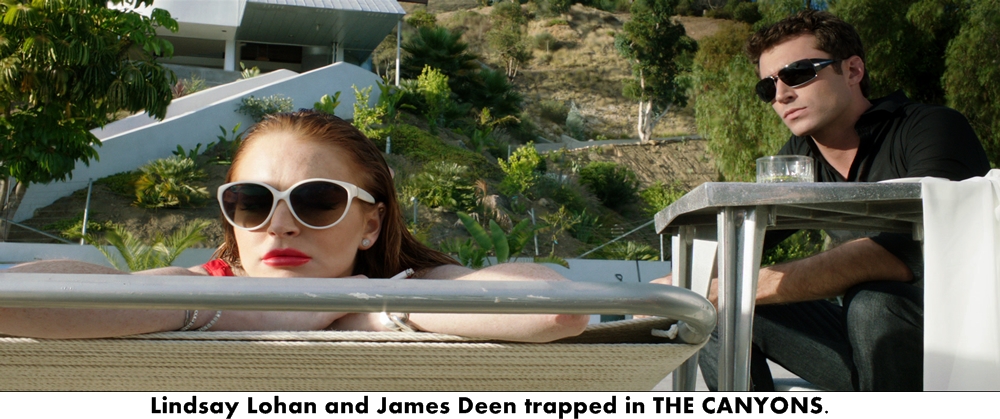
canyonsThe weird thing about Lindsay Lohan in The Canyons is that she looks more like Elizabeth Taylor than she did in the Lifetime movie Liz & Dick. The sad thing about Lindsay Lohan in The Canyons is that at 26 she is channeling the middle-aged, blowsy version of Taylor. Director Paul Schrader argues in Film Comment that the camera loves Lohan the way it once did Marilyn Monroe. Based on his own work with her in The Canyons that is mostly untrue, but even if it was, so what? The camera loves John Stamos. That doesn’t make him a movie star. And not even Monroe at her most luminous could have saved The Canyons. If Lohan hoped to reignite any flickering embers left among the ashes of her career from her tottering walk on stiletto heels down Hollywood’s seamier side, she is bound to be disappointed.

Lohan is Tara, kept by one man, trust fund psychopath Christian (porn star James Deen), but in love with another, struggling actor Ryan (Nolan Funk). Christian is controlling, a boyfriend who constantly monitors his girlfriend’s activity and who exercises the prerogatives of ownership by inviting strangers over for hookups. (He whines to his psychiatrist, played by Gus Van Sant, that he feels “objectified” when Tara tries to take control during one of their encounters, the single funniest line in the movie.) Even to a casual observer, Christian is a dangerous man, but that doesn’t stop Tara from still carrying a torch for the ex she dumped, because he was poor. She couldn’t help out, because, you know, getting a job would be just too tragic.

No one is very good in the movie, but to be fair to Lohan and the other actors, they are trapped in Bret Easton Ellis’ ludicrous, cliche-ridden screenplay. Nearly 30 years after the publication of his first novel Less Than Zero, Ellis remains obsessed with Hollywood’s rich and fatuous. Less Than Zero made a crap movie, too, but at least it had Robert Downey Jr. going for it. There is no one of his caliber here in a cast that struggles to breathe life into barely there characters. Schrader himself seems hardly invested in the material, except for a few golden moments, such as one scene between Tara and Christian by their pool where Lohan really does look every inch the movie star.

The most striking element of The Canyons is actually its opening title sequence, a catalog of dead movie theaters, images that recur from time to time throughout the movie and then again at the end credits. There is something impressive, even majestic about those ruins, which cannot be said for the movie’s tired melodrama. The images also seem like an admission on Schrader’s part that the film itself is a kind of ruin and not the lifeline he, Lohan and Ellis thought it would be. –Pam Grady

Share this:

  • Share on Facebook (Opens in new window) Facebook
  • Share on X (Opens in new window) X
  • Email a link to a friend (Opens in new window) Email
  • Print (Opens in new window) Print
  • Share on LinkedIn (Opens in new window) LinkedIn
  • Share on Tumblr (Opens in new window) Tumblr
  • Share on Reddit (Opens in new window) Reddit
  • Share on Pinterest (Opens in new window) Pinterest
Like Loading...

Review: DOWNLOADED dissects Napster

02 Friday Aug 2013

Posted by cinepam in Reviews

≈ Leave a comment

Tags

Alex Winter, Chris Blackwell, DJ Spooky, Don Ienner, Downloaded, Henry Rollins, Hilary Rosen, JP Barlow, Lars Ulrich, Lawrence Lessig, Mike D, Sean Parker, Seymour Stein, Shawn Fanning

It was the shot heard around the world, or would have been had it been an actual shot and not a bunch of 1s and 0s that changed forever how people consume music: Napster, the peer-to-peer file-sharing app that allowed users to share music over the internet. Alex Winter’s Downloaded spins the tale of this short-lived tech pioneer that revolutionized the music business and wreaked havoc on a record industry hopelessly out of touch with new technology. Napster itself would be destroyed by founders Shawn Fanning and Sean Parker’s youthful ignorance – or contempt of – copyright laws, as the company faced legal action not just from record companies, but also from artists like Metallica and Dr. Dre.

Winter’s documentary is a thorough dissection of a phenomenon, a kind of Rashomon, if you will, that gives voice to a chorus of differing viewpoints. Among those interviewed are Fanning, Parker and others involved with Napster; record industry executives, including Hilary Rosen, one-time head of the Recording Industry Association of America, former Sony Music head Don Ienner. Island Records founder Chris Blackwell and Sire Records co-founder Seymour Stein; and musicians, including Metallica’s Lars Ulrich, The Beastie Boys’ Mike D, Henry Rollins and DJ Spooky (who also composed the film’s music). Other precincts heard from include Electronic Frontier Foundation co-founder (and Grateful Dead lyricist) JP Barlow and Harvard Law professor Lawrence Lessig.

Downloaded is a history lesson as well as a valuable case study on how not to conduct business in either the virtual or real worlds, as mistakes made by both Napster and the record industry had ugly consequences. From a musician’s viewpoint, the more cynical will note that what Winter’s film really emphasizes is how the more things change, the more things stay the same: Whether a record label or Napster (or newer services, such as Spotify, if Thom Yorke and other musicians’ complaints about paltry payments are accurate), good luck collecting those royalties. – Pam Grady

Downloaded director Alex Winter will be in attendance Saturday night, Aug 3 at San Francisco’s Roxie Theater. For more info, visit roxie.com.

Share this:

  • Share on Facebook (Opens in new window) Facebook
  • Share on X (Opens in new window) X
  • Email a link to a friend (Opens in new window) Email
  • Print (Opens in new window) Print
  • Share on LinkedIn (Opens in new window) LinkedIn
  • Share on Tumblr (Opens in new window) Tumblr
  • Share on Reddit (Opens in new window) Reddit
  • Share on Pinterest (Opens in new window) Pinterest
Like Loading...

THE SECRET LIFE OF WALTER MITTY: Trailer vs. Trailer

30 Tuesday Jul 2013

Posted by cinepam in News

≈ Leave a comment

Tags

Adam Scott, Ben Stiller, Danny Kaye, Kathryn Hahn, Kristen Wiig, Patton Oswalt, Samuel Goldwin, Sean Penn, Shirley MacLaine, The Secret Life of Walter Mitty

James Thurber never wanted his short story The Secret Life of Walter Mitty made into a film. Producer Samuel Goldwyn and director Norman Z. McLeod ignored him and with their 1947 adaptation, they gifted Danny Kaye with one of his greatest roles and the world with a lively comic fantasy classic that, in addition to Kaye, starred Virginia Mayo, Boris Karloff, Fay Bainter and a bevy of Goldwyn Girls.

Now Ben Stiller is getting into the act; producing, directing and starring in his own The Secret Life of Walter Mitty due out at Christmas. His costars include Kristen Wiig, Adam Scott, Kathryn Hahn, Patton Oswalt and Shirley MacLaine. Sean Penn apparently makes an appearance, but alas for leg men everywhere, there are no showgirls. Steve Conrad (The Weather Man, The Pursuit of Happyness, The Promotion) penned the screenplay.

Thurber may have groused about Goldwyn taking his little story about a henpecked husband who imagines a life of adventure and turning it into a razzle-dazzle vehicle for Danny Kaye, but the movie is a work of comic genius that holds up after nearly 70 years. Stiller hopes that lightning strikes twice, that moviegoers will embrace his The Secret Life of Walter Mitty the same way they did Kaye’s. And he no doubt hopes it leaves as much of an imprint.

That is something for the future to decide. For now, all we can do is compare trailers. Kaye vs. Stiller. Mayo vs. Wiig. Goldwyn Girls vs. Iceland. Technicolor vs. state-of-the-art CGI. Buoyancy and slapstick vs. ??? Look for the clues contained in a scant two minutes (1:44 in the case of the 1947 version) and make your best guess. – Pam Grady


Share this:

  • Share on Facebook (Opens in new window) Facebook
  • Share on X (Opens in new window) X
  • Email a link to a friend (Opens in new window) Email
  • Print (Opens in new window) Print
  • Share on LinkedIn (Opens in new window) LinkedIn
  • Share on Tumblr (Opens in new window) Tumblr
  • Share on Reddit (Opens in new window) Reddit
  • Share on Pinterest (Opens in new window) Pinterest
Like Loading...

Trailer: Sam Rockwell in A SINGLE SHOT

25 Thursday Jul 2013

Posted by cinepam in News

≈ Leave a comment

Tags

A Single Shot, Jason Isaacs, Jeffrey Wright, Kelly Reilly, Sam Rockwell, The Way Way Back, William H. Macy

A far cry from his other role this summer as a laid-back water slide manager in The Way, Way Back, Sam Rockwell is both hunter and game in the upcoming thriller A Single Shot. Kelly Reilly, William H. Macy, Jason Isaacs, Jeffrey Wright and William H. Macy costar.


Share this:

  • Share on Facebook (Opens in new window) Facebook
  • Share on X (Opens in new window) X
  • Email a link to a friend (Opens in new window) Email
  • Print (Opens in new window) Print
  • Share on LinkedIn (Opens in new window) LinkedIn
  • Share on Tumblr (Opens in new window) Tumblr
  • Share on Reddit (Opens in new window) Reddit
  • Share on Pinterest (Opens in new window) Pinterest
Like Loading...

SAFETY LAST! at SF Silent Film Fest: Q&A with Suzanne Lloyd

19 Friday Jul 2013

Posted by cinepam in Interviews

≈ Leave a comment

Tags

Harold Lloyd, Safety Last!, San Francisco Silent Film Festival, Suzanne Lloyd

harold-lloyd-safety-last-clock12013 marks 100 years since pioneering movie comedian Harold Lloyd made his first appearance on screen as an extra. It is also the 90th anniversary of one of his greatest features, Safety Last!, in which Lloyd plays a genial department store clerk who scales the side of a Los Angeles building. Lloyd, who lost part of his right hand in a prop bomb explosion in 1919, performed his own stunts on the climb up the multistory building, one of the great feats of cinema.

Lloyd’s granddaughter, Suzanne, was a teenager when her grandmother Mildred told her that her grandfather was making arrangements to leave her a fabulous gift. That present turned out to be his legacy and she has honored that wonderful bequest by making a life’s work of restoring Harold Lloyd’s 85 surviving titles and introducing his genius to new generations through DVD, TCM and theatrically.

Suzanne Lloyd will be in San Francisco on Sunday, July 21 as the San Francisco Silent Film Festival presents Safety Last! as its closing night selection. I was lucky enough to catch up with her shortly before the festival to chat about the movie, her grandfather and his wonderful gift.

Q: You’ve been involved in all of the restorations. Your grandmother costarred in a lot of the films, including Safety Last!, along with your grandfather. So when you are working on a restoration, what does that feel like? You are not just working on film history, this is also your family history.

A: I started doing it when they were both alive. I was really young when I started on the film boxes at the estate. I was 15 ½. I was rewinding, wrapping nitrate film, checking it, checking prints, putting labels on cans, just really glamorous film stuff. It’s a responsibility, because somebody gave me their life’s work per se, their masterpieces of art. Film history is very important. It is America’s art form, which is now coveted by every country in the world.

I don’t know how he really did it, but he kind of like trained me up and taught me and had faith in me. He knew his son wasn’t well. My mother wasn’t really well, so there was nobody else to punt to. He started kind of grooming me in a very subtle, but kind of Machiavellian – I’d come home from school and he’d send me down to USC to take classes. I was still in high school and he’d take me to go and see him lecture, then he’d ask my opinion and we’d talk about it. It wasn’t like, “You’re going to do this,” but they gave me a beautiful life and they raised me as their own child. And when someone gives you a gift, you’ve got to take care of it.

Q: Did your grandfather tell you stories about making Safety Last!?

A: From the time he was actually down on the street – and it just goes to show what a filmmaker he was – to see Bill Strother [the “human fly” whose death-defying stunt inspired Safety Last!, and who appears in the movie as Harold Lloyd’s friend and roommate] climb the building and he was so petrified watching that stunt, he knew he wanted that reaction to be transferred to film. He wanted to have people react to it so strongly to say, “Oh my God! I can’t believe that person’s doing that,” and to get the feeling that we were really right there watching it like he was. When he was watching it, he said, “Oh my God, my hands were sweating” – it was exactly how the audience felt when he was shooting it. He said, “I just couldn’t watch. I kept going around the corner. It was just unbelievable to me that this man could just fall off. There was nothing to hold him, he could have died.” Then he said, “I have to film this.”

With Safety Last!, he just had to recopy that emotion that he felt. Isn’t that what movies are about, trying to tell a story and put out your emotions and make people feel it with you?

Q: It’s an amazing stunt. I know he claimed he was only ever in danger of falling three stories, but still –

A: Oh, yeah, three stories and on top of a 12-story building, OK. Let’s not get really crazy here. It’s still pretty dangerous, and for man that has half a right hand. I’ve never heard of an actor, a leading actor, being injured or as handicapped as much as he was. Just mentally, to get through that is amazing.

Q: I can’t imagine him being allowed to even attempt something like that now, “You’re the leading man and we’re not insured for that.”

A: “And you’re also the producer. Oh, and by the way, you’re missing a thumb, a first finger and half a right hand. I don’t think you’re doing any of it!”

Q: What you do you think your grandfather would say if he could see now, 100 years after his screen debut, that his films are still being seen and appreciated?

A: I think he’d be really thrilled. He’d be really thrilled. He’d be more crazy about all the digital technology, about all the computers, about all the 3D stuff that he could get his hands on, all the cameras that he could get his hands on. He wouldn’t have time to talk to us, he would be so busy. We would have to beg to have him take a breath, “Could you please sit down and eat something?” He’d have every computer. He’d just be plugged in. He would be all over the place. He would be so wild about that.

And he’d be thrilled by it. He really would be, because he was always pushing to get to kids, get to college students. He left grants to build a sound stage at USC – I built that in his honor. He gave a great grant to the American Film Institute. He gave a grant to UCLA. He gave a grant to Marymount Loyola. He was always pursuing things like that to go ahead and to see the future and pass on the torch. He was very visionary like that and pushing the edge out.

And especially how he felt about 3D. He loved 3D. He said that would be the next turning point of movies and it is. He shot over 200,000 3D photographs. He was a great photographer. I’ve done two books on his photography [3D Hollywood and Harold Lloyd’s Hollywood Nudes in 3D!].

Q: There are people who have some interests, but it sounds like he had a lot of interests.

A: He painted, too. He was an oil painter. He had a lot of interests. He was a great reader. He loved literature. He loved mathematics. He used to play with the abacus all the time and do math combinations. He loved music. He used to play music so loud in the living room that it would shake the gold leaf off the ceiling.

Q: What kind of music did he like?

A: Any kind. I can’t say he liked any kind, although he did take me to The Beatles’ concert and The Stones’ concert and The Doors, so he progressed. He loved jazz. He loved opera. He loved classical music. That was probably his favorite, but he loved show tunes. He loved singers. All of it. He’d take me to the opera. When we were in Vienna, we’d go to concerts. He loved going to musicals in New York. He loved all of it.

Q: Is there any one thing you always want people to know about your grandfather?

A: I think about how genuinely curious he was about people – I mean people in all walks of life – about what made people tick, what they were interested in, what made them be motivated. He was interested in that. It wasn’t, “I’m famous, so I’m just going to have famous friends.” He liked knowing people and people’s personalities. He came from the Midwest. He came from absolutely no money at all. He came from nowhere and he was incredibly lucky and he knew that. He genuinely had a love of life. — Pam Grady

For more information about the San Francisco Silent Film Festival, visit silentfilm.org. For more information about Harold Lloyd, visit haroldlloyd.com.
Share this:

  • Share on Facebook (Opens in new window) Facebook
  • Share on X (Opens in new window) X
  • Email a link to a friend (Opens in new window) Email
  • Print (Opens in new window) Print
  • Share on LinkedIn (Opens in new window) LinkedIn
  • Share on Tumblr (Opens in new window) Tumblr
  • Share on Reddit (Opens in new window) Reddit
  • Share on Pinterest (Opens in new window) Pinterest
Like Loading...

FIFTH ESTATE trailer: Cumberbatch channels Assange

17 Wednesday Jul 2013

Posted by cinepam in News

≈ Leave a comment

Tags

Benedict Cumberbatch, Bill Condon, Julian Assange, The Fifth Estate

Benedict Cumberbatch stars as Julian Assange in Bill Condon’s drama, opening October 18. (Just before my birthday, how did Dreamworks know a new Benedict Cumberbatch movie was exactly what I wanted?)

Share this:

  • Share on Facebook (Opens in new window) Facebook
  • Share on X (Opens in new window) X
  • Email a link to a friend (Opens in new window) Email
  • Print (Opens in new window) Print
  • Share on LinkedIn (Opens in new window) LinkedIn
  • Share on Tumblr (Opens in new window) Tumblr
  • Share on Reddit (Opens in new window) Reddit
  • Share on Pinterest (Opens in new window) Pinterest
Like Loading...
← Older posts
Newer posts →

Categories

  • Interviews
  • News
  • Reviews
  • Short Takes
  • Uncategorized

Recent Posts

  • A Stamp of Approval
  • Life is messy & so is ‘Megalopolis’
  • A star discovers too late there are worse things than aging in the black comic body horror ‘The Substance’
  • A young teen nurses a crush when he finds himself among ‘Big Boys’
  • The stunt man becomes the star as Ryan Gosling becomes THE FALL GUY

Archives

Blog at WordPress.com.

  • Subscribe Subscribed
    • Cinezine Kane
    • Join 48 other subscribers
    • Already have a WordPress.com account? Log in now.
    • Cinezine Kane
    • Subscribe Subscribed
    • Sign up
    • Log in
    • Report this content
    • View site in Reader
    • Manage subscriptions
    • Collapse this bar
 

Loading Comments...
 

    %d