• About

Cinezine Kane

Cinezine Kane

Author Archives: cinepam

A different measure of making it: T-Bone Burnett on INSIDE LLEWYN DAVIS

20 Friday Dec 2013

Posted by cinepam in Interviews

≈ Leave a comment

Tags

Bob Dylan, Coes Bros., Dave Van Ronk, David Blue, Ethan Coen, Inside Llewyn David, Joel Coen, Oscar Isaac, Phil Ochs, Ramblin' Jack Elliott, T-Bone Burnett

tboneInside Llewyn Davis, Joel and Ethan Coen’s latest, captures a moment in New York when a folk music revival was going strong inside smoky Greenwich Village clubs and on weekend afternoons in Washington Square Park. T-Bone Burnett, the lanky Texan who first worked with the Coens as their musical archivist on The Big Lebowski, won two Grammys as the music producer on O Brother, Where Art Thou?, and serves as executive music producer on the new film, was just a kid in Fort Worth when all of that was going on. In 1975, though, he joined Bob Dylan’s Rolling Thunder Revue and got to know several of those musicians from those days. While the Coens have said they were particularly inspired by the life and career of Dave Van Ronk, Llewyn could as easily have been conjured from a Ramblin’ Jack Elliott or a David Blue.

“That was a time when they were just trying to be good there,” Burnett says during a recent visit to San Francisco. “That’s a beautiful thing. That’s where everything happens, in fact. All the great things happen in small communities that aren’t thinking in grand thoughts. They’re thinking about taking care of the things that are right under their noses. All this energy converged there, so I would say in that way Llewyn wasn’t a guy who was thinking about making in that way. He’s just a guy thinking about what’s good, it seems to me. He’s just thinking like what’s good music and what’s not, according to him. That’s always what it is. It’s about taste. It didn’t seem like to me that he was a guy thinking, ‘I’ve got to make it.’

“Maybe David Blue thought he would make it,” he adds. “Phil Ochs thought he would make it. Phil Ochs put on a gold lame suit. It was mocking making it. He was doing some kind of like, ‘I’m the folk Elvis,’ and it was ironic and it was meant as a joke, but I don’t think it landed exactly the way he wanted it to, although I have a lot of admiration for Phil Ochs – for all those guys.”
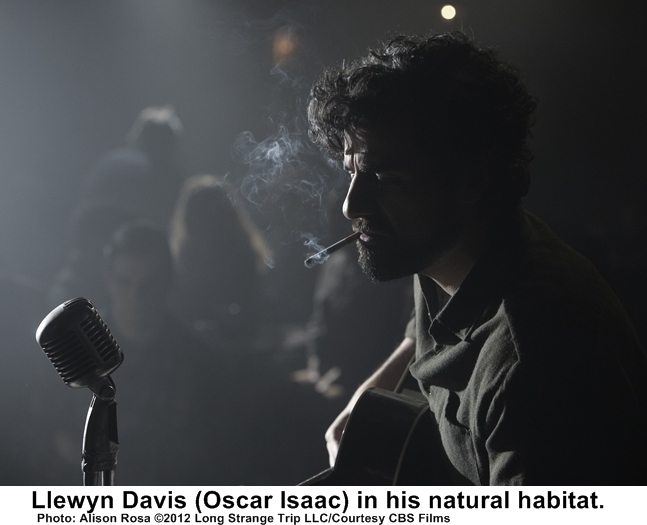
llewyn 2Certainly, if Llewyn Davis has any thoughts of success on even a modest level, he is also the one person who can ensure that that will never happen. Part of Burnett’s job in choosing the music was choosing which songs Llewyn would include in his repertoire for any given occasion, thus Child ballad #170 a/k/a “The Death of Queen Jane” becomes a key song in Llewyn’s universe.

“He goes for his big audition in Chicago and he has a chance at the big time, and the song he chooses to play is a song about a Caesarean section, so he’s not a guy who’s going out of his way to try to alter show biz,” says Burnett.

Burnett thinks that every musician, even the most successful, will find something to identify with in Llewyn Davis. Everyone, he points out, goes through periods of boom and bust. Someone who’s the most happening thing out there today is nobody again tomorrow only to rise up once more out of the ashes. What is different for Llewyn and those folk musicians back in the day is a matter of scale. Until Bob Dylan came along, the New York contingent defined success by a different measure.

“Specific to that time, I would say that one of the interesting things about it is is that was a time where there was a park, Washington Square Park, and there were all these different camps that played in the park and there was never any – all the competition was within the park,” says Burnett. “It was all for space in the park, it wasn’t for trends on Twitter or something, right? It was for square feet in a little grassy area downtown – in the country of New York, because back then the Village was the country. Nobody was thinking about being famous. They were thinking about what was good and what was authentic and they were thinking about all these kinds of questions.

“So that’s why when Dylan came along, there was all this extraordinary music everywhere. They were all infighting and he was just like Fast Eddie came to town and just ran the table. He said, ‘I’ll have some of that and that and that.’ He had no compunction – he was doing the right thing. Those people were looking backward and they were doing the right thing, too. They were going backward and preserving and he was going backward and forward at the same time. He was going backward and preserving and all of that and then he was reinventing for us now. We’re still living in his reinvention of it now.” – Pam Grady

Share this:

  • Share on Facebook (Opens in new window) Facebook
  • Share on X (Opens in new window) X
  • Email a link to a friend (Opens in new window) Email
  • Print (Opens in new window) Print
  • Share on LinkedIn (Opens in new window) LinkedIn
  • Share on Tumblr (Opens in new window) Tumblr
  • Share on Reddit (Opens in new window) Reddit
  • Share on Pinterest (Opens in new window) Pinterest
Like Loading...

ANOTHER DAY/ANOTHER TIME: CELEBRATING THE MUSIC OF “INSIDE LLEWYN DAVIS” gets Dec. Showtime premiere

22 Friday Nov 2013

Posted by cinepam in News

≈ Leave a comment

Tags

Another Day/Another Time: Celebrating the Music of "Inside Llewyn Davis", Inside Llewyn Davis, Joan Baez, Marcus Mumford, Oscar Isaac, Patti Smith, Punch Brothers, T-Bone Burnett


Oh to have been in New York on September 29th for this concert at Town Hall celebrating the new Coen Bros. film Inside Llewyn Davis and the music that inspired it. Produced by T-Bone Burnett – the executive producer of the movie’s sublime soundtrack – the show’s performers included Llewyn Davis himself, Oscar Isaac; Joan Baez; Patti Smith; Jack White; Marcus Mumford (associate music producer on the film who also performs on the soundtrack); Gillian Welch and David Rawlings; Punch Brothers; and more.

It was a once-in-a-lifetime event that only a lucky few saw. On Friday, December 13, 10PM ET/PT, the rest of us can experience a vicarious thrill of that evening when Showtime airs Another Day/Another Time: Celebrating the Music of “Inside Llewyn Davis,” a 101-minute concert documentary produced by Burnett, the Coens and Scott Rudin.

Personally, I don’t get Showtime, but I will be hitting up my friends who do. – Pam Grady

Share this:

  • Share on Facebook (Opens in new window) Facebook
  • Share on X (Opens in new window) X
  • Email a link to a friend (Opens in new window) Email
  • Print (Opens in new window) Print
  • Share on LinkedIn (Opens in new window) LinkedIn
  • Share on Tumblr (Opens in new window) Tumblr
  • Share on Reddit (Opens in new window) Reddit
  • Share on Pinterest (Opens in new window) Pinterest
Like Loading...

THE BOOK THIEF: Geoffrey Rush revels in the ordinary

17 Sunday Nov 2013

Posted by cinepam in Interviews

≈ Leave a comment

Tags

Brian Percival, Emma Watson, Geoffrey Rush, Sophie Nélisse, The Book Thief

Book ThiefIn his time, Geoffrey Rush has played troubled pianist David Helfgott, Les Misérables‘ obsessive police inspector Javert, the Marquis de Sade, Leon Trotsky, Peter Sellers and the Pirates of the Caribbean franchise’s vicious buccaneer Barbossa, among other vivid characters. In contrast, the most remarkable trait of Hans Hubermann, the character he plays in the Nazi era drama The Book Thief is that he is so very unremarkable, a quality Rush finds very attractive.

“I loved the matter-of-fact ordinariness of Hans Hubermann, just for me as an actor in terms of things I’ve played before,” he says during a recent visit to San Francisco. “The needle’s probably gone to the extreme end of the spectrum of eccentric or colorful, bold characterizations. It appealed to me to play this man who seemingly on the outside was ordinary to the point of actually being quite boring.

“He didn’t have big heroic attributes on any level or any ticks or qualities that might have made him an eccentric or unusual personality. He’s a quiet guy that got on with his life, but you realize underneath he’s politically almost a radical.”

In Brian Percival’s adaptation of Markus Zusak’s bestselling novel, Hans is a patient, good-natured man who bears his shrewish wife Rosa’s (Emily Watson) incessant carping with humor and grace and who becomes both father and teacher to Liesel (Sophie Nélisse), the foster child the family shelters. In their small German town in the months leading up to World War II, he stands out because of his stance against the Nazis. He refuses to join the Nazi Party or distance himself from the Jews that remain in town. A painter be trade, he is mostly unemployed, except for the occasional odd job.

“Hans isn’t a lazy man,” says Percival. “He doesn’t work, because he can’t work. Morally, he doesn’t want to join the Party. Anybody that didn’t join the Party at that time didn’t get work. Here’s a man who would love to be out working and painting every day, but he’s not allowed to be because of the system.”

“When I first read the novel and the screenplay, I could identify with this by thinking of a small outback town in New South Wales or somewhere in the Midwest,” adds Rush. “It’s a community, a working-class community where these events are taking place very slowly and very slyly around them. Suddenly, it’s a dividing line of are you going to join the Party or not?”

The lens that The Book Thief applies to everyday people was one of the things that appealed to Rush. This is not Schindler’s List or Defiance. There are no grand heroics in this drama, only small gestures in a town that maintains the party line as Germany rushes toward world war and holocaust.

“We are looking at, I suppose, for an English-speaking community – English, Americans, Australians or whatever – it’s a story about our former enemy on a very kind of street-level, human scale of a microcosm of what happens in average daily life to this community and their perception of the war that they were fighting,” Rush says. “They’re thinking, ‘We’ll win this and it’s great. Hitler’s reviving the economy and the country. We’ll come out of the loss and devastation of the First World War.’

“It’s not sensationalized and not a biased account of the German perspective; it’s a very honest look at the ordinariness of these people and the age of terror and anxiety that surrounded their lives for a very long period.” – Pam Grady

Share this:

  • Share on Facebook (Opens in new window) Facebook
  • Share on X (Opens in new window) X
  • Email a link to a friend (Opens in new window) Email
  • Print (Opens in new window) Print
  • Share on LinkedIn (Opens in new window) LinkedIn
  • Share on Tumblr (Opens in new window) Tumblr
  • Share on Reddit (Opens in new window) Reddit
  • Share on Pinterest (Opens in new window) Pinterest
Like Loading...

Jared Leto talks transformation in DALLAS BUYERS CLUB

08 Friday Nov 2013

Posted by cinepam in Interviews

≈ Leave a comment

Tags

Dallas Buyers Club, Jared Leto, Jean-Marc Vallée, Matthew McConaughey

Leto_DBC3Jared Leto vividly remembers the day he went to Whole Foods during a break in shooting Dallas Buyers Club just to stare at the vittles. To play Rayon, an AIDS-afflicted transgender man living as a woman, the actor-musician lost 30-40 pounds for the role by simply not eating. He also never broke character for the duration of the shoot, so he essentially was Rayon while he communed with what he couldn’t partake.

“I got three looks,” Leto recalls on a recent visit to the San Francisco Bay Area where he was feted at a screening of Dallas Buyers Club at the Mill Valley Film Festival and performed with his band 30 Seconds from Mars at a San Jose concert.

“One of them was, ‘Is that Jared? No!’ Then the other one was, ‘Who is that?’ The third was, ‘What is that?’ With a slight, ‘I don’t like that.’ It was important to get that kind of judgmental, ‘That’s disgusting. That scares me. I don’t like that.’ Then to imagine what that was like in 1985. I couldn’t imagine walking through a supermarket in full drag in 1985. You better get charming and funny real quick, or you’re gonna get your ass kicked.’”

Those nasty looks also meant that Leto was doing his job, convincing even when the cameras weren’t rolling as the character elicits similar disgust from Ron Woodroof (Matthew McConaughey) when they meet in a hospital AIDS ward in Jean-Marc Vallée’s drama. The homophobic electrician and rodeo cowboy has no use for the likes of Rayon, but when he feels firsthand the kind of rejection she has faced her whole life, it opens the door to an unexpected friendship as the two partner to try to save their own lives.

“I think she saw through that armor and saw a good person,” says Leto “I also think they needed each other. I think that played a key role there. They were both fighting for their lives. I think she also saw in Ron a father figure. She’s someone who is scorned, shunned by her own father and in some ways Ron kind of filled that role.”

Leto jokes that the only actor who works less than he does is Daniel Day-Lewis. Staying in character the way he does is draining. Since making 2009’s Mr. Nobody he had no real interest in going back in front of the cameras until he read Craig Borten and Melissa Wallack’s Dallas Buyers Club script.

“I think I got seduced by the role. Rayon is such a unique character,” he says. “I really fell in love with her and got to know this person. She was so kind and sweet and had a lot of grace and charm. She was funny and fun, very gentle and soft.”

Vallée has said that he never met Leto until after Dallas Buyers Club wrapped. The actor confirms that that assertion is true as he talks about how he started to get into character from their first Skype phone call. He remembers putting on lipstick as Vallée was introducing himself, removing his jacket to reveal a pink sweater worn off the shoulder and flirting with the director. The next day he had the job.

To better understand the role, Leto met with transgender people, studying their physicality and listening to their stories, learning from their experience. He only had a few weeks to become Rayon, so the extreme dieting started immediately. He also had to learn to walk in heels and endure body waxing.

“Once you make those commitments and the eyebrows come off, you’re like, ‘OK, here we are,” he says. “Lipstick, heels, eyelashes were a lot of external keys to some of the physicality, but I think there was a gentle spirit and kindness that were really keys [to the character] as well, that desire to be loved and to love other people.

“Staying in character was just an obvious thing for me,” he adds. “There were so many physical attributes, so many emotional things to keep track of. I couldn’t imagine letting go of all that and going, ‘Hey, bro, what’s going on?’ ‘Action!’ ‘Oh, wait, let me bring all of this back.’ I don’t think I would have done a very good job. Staying focused was essential.

“You have to do what works best for you. I don’t want there to be any difference between when the camera’s rolling and the camera’s not. I don’t want to have to act. I don’t want to have to portray. I just want to exist.”

Dallas Buyers Club has garnered raves ever since its world premiere at the Toronto International Film Festival. Leto is pleased and surprised that his performance along with McConaughey’s is the subject of much buzz as the awards season commences. He is happier still that the work he, McConaughey, Vallée and everyone else involved in making the film put in paid off in the final cut.

“I loved the story from the very beginning, and for me, the most important part is the experience I had making the film,” he says. “It was life-changing and the response that we’ve gotten is incredible. When it works, it’s so wonderful. Most of the time it doesn’t work. You make a film and it doesn’t turn out as good as you hoped. The pieces don’t fall into place. I feel really fortunate, really proud. It’s pretty fun to be celebrating this story, this tiny little movie, this impossible story of survival.” – Pam Grady

Share this:

  • Share on Facebook (Opens in new window) Facebook
  • Share on X (Opens in new window) X
  • Email a link to a friend (Opens in new window) Email
  • Print (Opens in new window) Print
  • Share on LinkedIn (Opens in new window) LinkedIn
  • Share on Tumblr (Opens in new window) Tumblr
  • Share on Reddit (Opens in new window) Reddit
  • Share on Pinterest (Opens in new window) Pinterest
Like Loading...

An Unforgettable Debut: Lupita Nyong’o on 12 YEARS A SLAVE

01 Friday Nov 2013

Posted by cinepam in Interviews

≈ Leave a comment

Tags

12 Years a Slave, Chiwetel Ejiofor, Lupita Nyong'o, Michael Fassbender, Steve McQueen

Lupita3Lupita Nyong’o makes an unforgettable screen debut in Steve McQueen’s 12 Years a Slave, playing Patsey, a slight, delicately boned woman who, day after day on the harsh Louisiana plantation where she toils, bests all the men with the sheer amount of cotton she picks. She befriends the drama’s hero, Solomon Northup (Chiwetel Ejiofor), a free man kidnapped into the nightmare of bondage. She is also the object of obsession for slave master Edwin Epps (Michael Fassbender), a position that puts her in the cross-hairs of Epps’ jealous, vengeful wife (Sarah Paulson). The role is a riveting, auspicious beginning for the recent Yale School of Drama graduate.

“She’s a star,” says McQueen. “A star is born. I went through over 1,000 girls. [Casting director] Francine Maisler and I looked through all these girls, and I was giving up hope and then one day, this tape came in. I put it on and thought, ‘This woman is beautiful. She’s amazing. Is she real?’ I couldn’t even believe that she was real. And then she came into the audition and that was it. That was solved. When all hope was lost, we found that girl. Amazing.”

In the San Francisco Bay Area recently with McQueen and Ejiofor to attend the Mill Valley Film Festival where 12 Years a Slave screened, Nyong’o was ebullient and gracious as she sat down to talk about the film and her dazzling role in it.

Q: Patsey is quite a debut. What was it like for you to start here with the likes of McQueen, Ejiofor and Fassbender?

A: It was a dream come true to work with such complex and meaty material and then to do so with such incredible artists. Steve McQueen, I watched Hunger and Shame shortly after my first audition and I fell in love with immediately and was just spellbound by his pursuit of the truth and the patience of his camera and the way in which he depends on the actors to really do the storytelling. I knew that he was a director that I would be too lucky to get an opportunity to work with. I was all game to do this project and I was so glad that they were game to work with me.

It’s all thanks to the man at the helm, Steve, the conversations happened with Steve. I had conversations one-on-one with Steve and he did the same with the other actors. I think what that creates is a mystery, a danger when you get on set, in a very safe environment, but then you’re really talking and listening, because nothing has been kind of pre-planned. Our rehearsal was kept to a minimum. I probably had a less than 15-minute rehearsal with Michael and about a 15-minute rehearsal with Chiwetel. Steve didn’t want to belabor it. He wanted to save it for the camera, so that it is as real as possible, the human exchange is as real as possible.

Q: Can you talk about researching your role? You must have started with Solomon Northup’s book.

A: Luckily for us, we had the autobiography, which gives a very specific back story as to who Patsey was. She was born in South Carolina and she was sold to Master Epps in her childhood. She was actually a favorite of the mistress and the master before she was sent out into the field. She was coddled and fed with milk and biscuits. It is not until Master Epps gets a sexual interest in her that the mistress begins to get jealous and throws her out into the field.

Other than that, I did research into the time period, but always with – I did subjective research. There’s too much out there. I was going to end up being a historian and that wasn’t the important thing. But I did research into the history and the time period, just to get all my senses involved. What food they ate, things like that. I read other accounts of slavery from the female perspective.

The last bit of research, that actually came in very handy, was into the corn husk dolls. I was daydreaming about a week before we started shooting about what else Patsey could have done in her very little free time. Because she had such nimble fingers to pick 500 pounds of cotton a day, it spoke to me of someone who must have been artistic in some way, very good with her fingers. I knew on Master Epps’ plantation they grew corn and so I thought, ‘Well, maybe she made something out of corn husks’ I looked it up online and it was historically accurate. In Louisiana, they have festivals where they recreate those things. They make crafts out of corn husks. So I shared that with Steve and he really loved the idea and he got the art department to supply me with corn husks immediately. In the end, the way Steve used the corn husk dolls in the film, it’s an externalization of the part of Patsey that couldn’t be enslaved. That was really important for me to discover.

Q: You’re also a documentary filmmaker. (In 2009, Nyong’o made In My Genes, a film that focuses on albinism in her native Kenya.) When it came to doing research, did that background make it easier to hone in on what would be relevant to you?

A: It did, but I think everything in my past has brought me to this point. At the Yale School of Drama, one of the things that we are encouraged to do with every single project, not just one based on truth, is to try and create an environment of truth for yourself that goes beyond the material, beyond the script that you’re using, so that you can play better. When you know this person inside and out then you can be spontaneous in the moment rather than too controlled.

In this case, making this film with Michael and Chiwetel, they are very spontaneous performers, so you really have to be present and listening. Doing that kind of research gives you the freedom to be that present and listening, because you know who you are.

Q: Your character endures things that are absolutely horrific. Even though you are acting and not actually going through what this woman went through, that had to be stressful. How difficult was it to inhabit Patsey’s skin?

A: Playing Patsey was not easy. I had to open my heart and my being to a lot of grief and sorrow. It was the undercurrent of everything I did in 12 Years a Slave. That wasn’t easy. It asked a lot of me, but I was honored and I felt very privileged to have the opportunity to tell this real woman’s story. What kept me sane, if you will, and what kept me light was recognizing that I was doing this in a fictional world and she lived this for real. Whenever I remembered that, it grounded me and centered me. It was like, “If she could live it, I can do it.” – Pam Grady

Share this:

  • Share on Facebook (Opens in new window) Facebook
  • Share on X (Opens in new window) X
  • Email a link to a friend (Opens in new window) Email
  • Print (Opens in new window) Print
  • Share on LinkedIn (Opens in new window) LinkedIn
  • Share on Tumblr (Opens in new window) Tumblr
  • Share on Reddit (Opens in new window) Reddit
  • Share on Pinterest (Opens in new window) Pinterest
Like Loading...

KILL YOUR DARLINGS’ Ben Foster taps his inner Burroughs

31 Thursday Oct 2013

Posted by cinepam in Interviews

≈ Leave a comment

Tags

Beat Generation, Ben Foster, Dane DeHaan, Daniel Radcliffe, Jack Huston, John Krokidas, Kill Your Darlings, William S. Burroughs

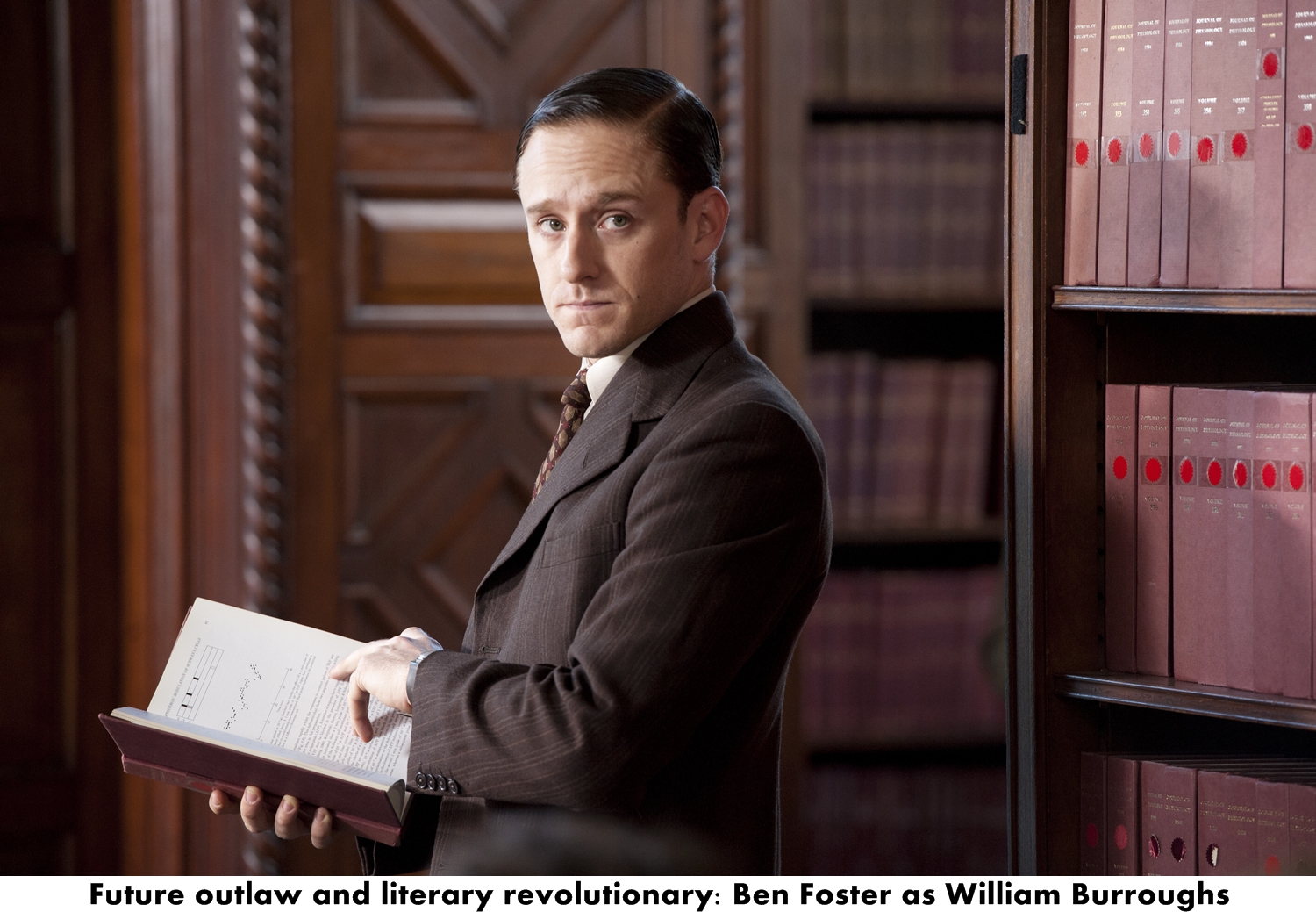
Ben Foster_Darlings1The most striking entrance in John Korkidas’ pre-Beat Generation saga Kill Your Darlings belongs to Ben Foster. Playing William S. Burroughs, the slightly older member of the Beat crowd who would go on to notoriety as an outlaw, a drug addict and the influential author of Naked Lunch, Queer and Junky, he is introduced to the teenage Allen Ginsberg (Daniel Radcliffe) inhaling from a gas mask, courtly mannered and clearly high.

“He designed his character,” says Foster at the Toronto International Film Festival where Kill Your Darlings screened as a gala presentation. “He was an awkward, shy man with an unusual appetite to question cultural norms. He was interested in the identity of explorers and philosophers and doctors and psychologists in his young period. He was constantly seeking. I think from a very fragile sense of a heart and mind, he created the character of William Burroughs, the detective, the man of authority. He created this persona.

“He was one of the most forward-thinking minds we have had. We can feel the waves of his influence today.”

Since making his big-screen debut while still a teenager in Barry Levinson’s nostalgic 1999 comedy-drama Liberty Heights, Foster has gone to forge a singular career with such memorable turns as the mute angel Cod in Michael Polish’s Northfork; sensitive, sexually ambiguous Russell on TV’s Six Feet Under; an out-of-control meth head in Alpha Dog; the mutant Angel in X-Men: The Last Stand; Russell Crowe’s vicious confederate in 3:10 to Yuma; a troubled Iraq war veteran on death-notification duty in The Messenger; and most recently as a smitten sheriff in Ain’t Them Bodies Saints. Earlier this year he made his Broadway debut replacing Shia LaBeouf as a volatile street thug in Lyle Kessler’s Orphans.

“I just like telling stories,” Foster says. “I like interesting minds. There are some good people out there. We’re all kind of, ‘Send us a smoke signal of something that doesn’t feel like it’s going to cost our hearts.’

“Korkidas is a special filmmaker,” he adds. “You find your clique. High school sucks, but you find your clique. It’s the same thing.”

Signed on a few months before Kill Your Darlings started shooting, Foster threw himself into researching the role. He was already familiar with Burroughs’ writing; now he had to get to know the man.

“As a fan, a great admirer, an appreciator of Burroughs, there is an inherent responsibility and fear that you’ll disappoint him,” Foster says. “It was a thrill, just as a human, just saying, ‘I’m going to spend some time considering this man and his life and work.’”

In addition to reading biographical material, Foster also spoke to Burroughs’ friend and literary executor James Grauerholz, who offered the actor valuable insight into the writer, particularly his sense of playfulness. More vital still was Burroughs himself captured on film in performance and interviews.

“I was more interested in the documentary footage,” Foster says. “That felt very intimate. The stuff with Warhol was wild. He’s so discontent, sitting at the table making pleasantries, trying to be an aristocrat. He is an aristocrat in a vapid world. You can see it eating his guts.

“I wish there was more film. It was a nice excuse to fall in love with him.”

Foster shares the screen with actors that in addition to Radcliffe include Jack Huston as Jack Kerouac; Dane DeHaan as Lucien Carr, Ginsberg’s Columbia University classmate and the friend who brings future Beats Ginsberg, Kerouac and Burroughs together; and Foster’s Six Feet Under costar Michael C. Hall who plays the Carr-obsessed David Kammerer. The cast is impressive; and Foster is as taken by Krokidas, whose dedication to a film that took years to get off the ground he admires and whose energy on the set he enjoyed being around.

“It’s fun to participate with someone who’s had the endurance to fight for a project,” he says. “It feels good.

“It’s a crush. It’s like falling in love, making a movie, or like camp, however you want to frame it. It’s very intimate. I wouldn’t call it hard work, but you have to be dogged in your focus, which is great. If you’re working with like minds, it’s a wonderful experience. We were fortunate to work with people like Mr. Radcliffe and Dane and Jack. We got lucky on this one. These guys are top drawer, really sweet, thoughtful, caring, intelligent young men, these guys and Michael – what I like to call lunch-pail guys, guys who bring their lunch, ready to work.” – Pam Grady

Share this:

  • Share on Facebook (Opens in new window) Facebook
  • Share on X (Opens in new window) X
  • Email a link to a friend (Opens in new window) Email
  • Print (Opens in new window) Print
  • Share on LinkedIn (Opens in new window) LinkedIn
  • Share on Tumblr (Opens in new window) Tumblr
  • Share on Reddit (Opens in new window) Reddit
  • Share on Pinterest (Opens in new window) Pinterest
Like Loading...

Angelheaded hipster: Daniel Radcliffe on KILL YOUR DARLINGS

30 Wednesday Oct 2013

Posted by cinepam in Interviews

≈ Leave a comment

Tags

Allen Ginsberg, Beat Generation, Dane DeHaan, Daniel Radcliffe, John Krokidas, Kill Your Darlings, Lucien Carr

dehaan_radcliffe1“Can I claim this?” Daniel Radcliffe asks rhetorically when questioned about working with stage veteran John Cullum, stern English teacher Professor Stevens to Radcliffe’s rebellious Columbia University freshman Allen Ginsberg in John Krokidas’ pre-Beat Generation saga Kill Your Darlings. The diminutive actor bounces out of his chair and rushes across the room to confer with with the director, who is in the middle of his own interview. After a short conference, he’s back.

“John Cullum was my idea,” he says proudly. “He’s amazing.  My friend had worked with John Cullum on Measure for Measure, Shakespeare in the Park. He was raving about him. John was looking for Professor Stevens and my friend had literally just finished working with him, so I said, ‘I saw him on stage last summer, what about him?’

“It was basically a selfish excuse, because then they got him in and I was just able to ask him about working with Richard Burton on [Camelot and Hamlet] for over 1000 performances. So it was asking him about all of that and picking his brain. Me and Dane DeHaan had a really lovely time with him. And he’s fantastic in the movie.”

That the 24-year-old Radcliffe would be so keen to hear theater lore from half a century ago is hardly surprising given the path he’s chosen since the curtain came down on Harry Potter, the franchise that made him a household name while he was still a child. On stage, he’s been the boy who blinds horses in Equus, go-getter J. Pierrepoint Finch in the musical How to Succeed in Business Without Really Trying, and most recently the titular character in the recent London revival of Martin McDonagh’s The Cripple of Inishmaan. On television, he stars opposite Jon Hamm (playing his older self) as a tyro physician in the pre-revolution Russian countryside in A Young Doctor’s Notebook.

In film, his tastes run toward the independent, as evidenced by the three films that he is promoting at the Toronto International Film Festival. In Horns, Alexandre Aja’s adaptation of Joe Hill’s novel, he plays a man suspected of murder who sprouts devil horns. Michael Dowse’s buoyant romantic The F Word, casts him as a lonely Brit in Toronto who falls hard for platonic friend Zoe Kazan. Radcliffe was a teenager and still playing Harry Potter when Krokidas cast him in Kill Your Darlings.

“The tough thing was this movie took forever to get made,” Krokidas says. “I had so many stops and starts. It was a real struggle, but the upside of that was Dan being in my life and being part of this project at some varying degree for four-and-a-half years. It let us have the time to become collaborators and really get to know each other and trust each other. This is his movie as much as it is mine.”

Based on real incidents, the drama is kind of a Beat Generation pre-history as it charts Ginsberg’s friendship with fellow Columbia student Lucien Carr (DeHaan), who profoundly influences the young poet’s approach to writing and introduces him to his eventual partners in literary revolution, William S. Burroughs (Ben Foster) and Jack Kerouac (Jack Huston). Carr also threatens all of the futures when his volatile relationship with an older man, David Kammerer (Michael C. Hall), takes a darker turn.

Radcliffe was already familiar with Ginsberg’s poetry, but knew less about the man. He found a key into the character through the diaries Ginsberg kept from a very early age. The writer’s self-assurance impressed him and also gave him insight into the friendship Ginsberg would later forge with Carr.

“He’s so confident, as a 14-year-old, in his writing about his own mind,” Radcliffe says. “When he keeps his diary, you sort of almost feel like he’s keeping it for posterity. You feel like he’s writing so that people can read it after he becomes a great man. He’s very much aware of his intellect.

“I think that’s what’s interesting about the character of Allen, he’s very confident,” he adds. “He feels like he can hold a conversation with anybody about anything. He’s hugely confident, and yet in his interactions with people and his social life, he’s incredibly shy and reserved and there’s no semblance of that very, very confident person that writes in that diary until they start talking about poetry or about books. Then he feels confident. He can enter into that conversation.

“I think that’s one of the reasons he falls in love with Lucien. He meets Lucien and Lucien is this loud, brash, outgoing, incredibly confident guy, but actually has none of the inner confidence. Lucien has no confidence in himself as a writer and that’s why he knows he has to sort of attract these other people around him. I think we’re always attracted to the qualities in other people that sometimes we don’t have ourselves and Lucien is everything Allen wants to be but isn’t.”

Whatever Kill Your Darlings‘ fortunes are at the box office, for Radcliffe it is already a significant film in his career. In a way, his situation mirrors his character’s as he made new friendships during the course of making the movie.

“Relationships are forged so quickly in the kiln of filmmaking,” he says. “ Dane’s probably the best friend I’ve made through acting … I think building chemistry with people is just a matter of being curious about them and being interested. Dane and I, we got on very well immediately and then we worked on it. You have to work to build chemistry, even stuff as simple as sitting down and sharing stupid stories from your teenage years about shit you did. You build a relationship. It involves being open with people. That’s really exciting. I only filmed with John and Dane for 24 days – although I’ve known John for a long time before that – and they’ve become two of my best friends.” – Pam Grady

Share this:

  • Share on Facebook (Opens in new window) Facebook
  • Share on X (Opens in new window) X
  • Email a link to a friend (Opens in new window) Email
  • Print (Opens in new window) Print
  • Share on LinkedIn (Opens in new window) LinkedIn
  • Share on Tumblr (Opens in new window) Tumblr
  • Share on Reddit (Opens in new window) Reddit
  • Share on Pinterest (Opens in new window) Pinterest
Like Loading...

Review: Redford battles the elements in ALL IS LOST

25 Friday Oct 2013

Posted by cinepam in Reviews

≈ Leave a comment

Tags

All Is Lost, J.C. Chandor, Robert Redford

photodazastills_1774.CR2

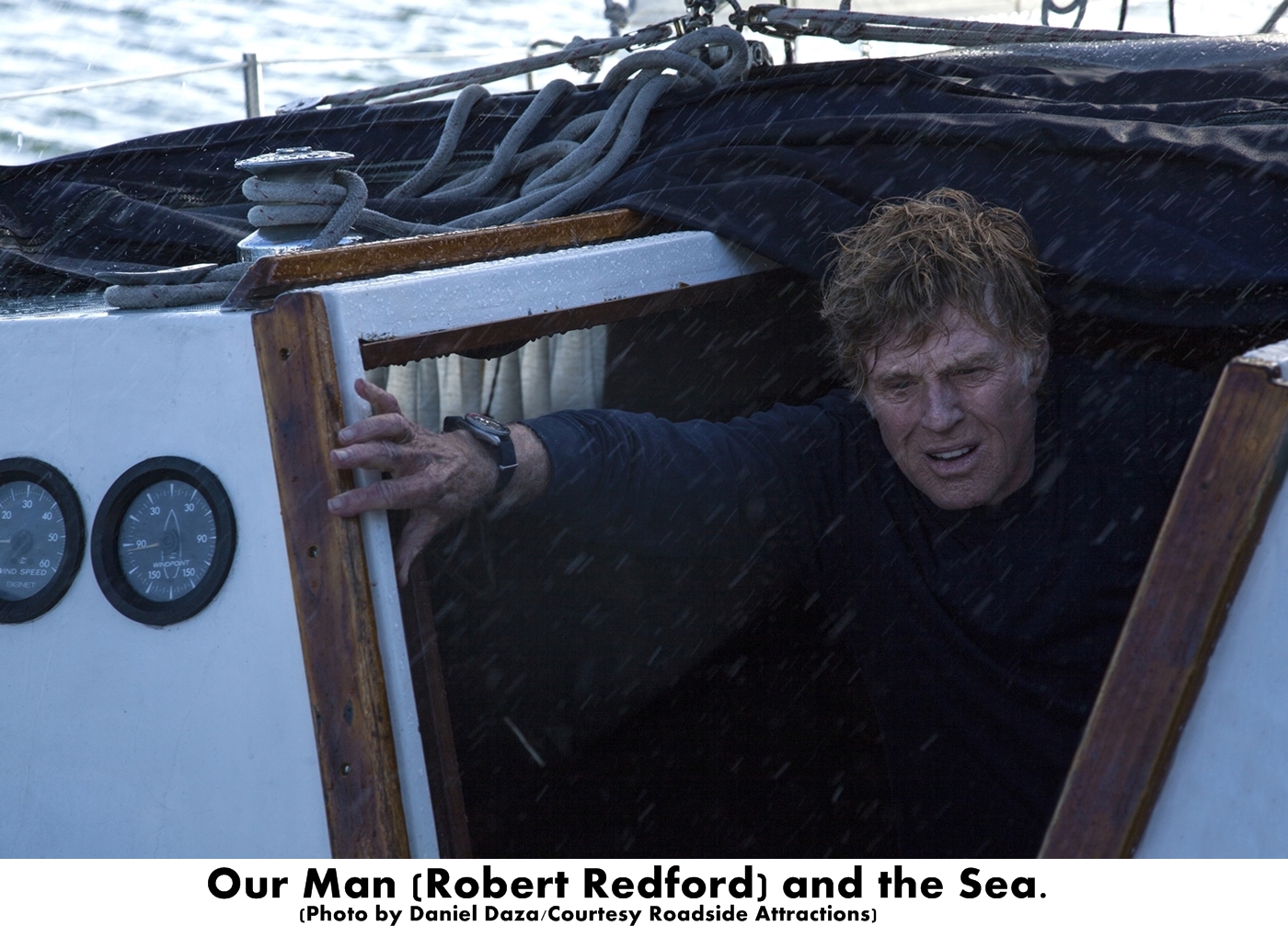
Call it The Old Hunk and the Sea. With All Is Lost, matinee idol for the ages Robert Redford sheds all vanity to play a man struggling to survive against long odds in J.C. Chandor’s first feature since he burst on the scene with 2011’s acclaimed talk fest Margin Call. The writer/director veers into a completely different direction with this thriller, a near-silent drama that offers Redford a solo spotlight. The actor answers with one of his finest performances in years.

The credits refer to the 76-year-old Redford’s character as simply “Our Man.” Apparently a well-off retiree who heeded the siren song of the sea, he is sailing alone in the Indian Ocean when catastrophe hits and his boat is damaged. There is worse to come with bad weather and even worse luck. With electrical systems down, a busted radio and no GPS, Our Man’s best chance for survival is to set a course the old-fashioned way using the sun, moon, stars and nautical charts to find a shipping lane where a passing freighter might spot him. The pleasure cruise turns into a constant battle to stay afloat so that he might make it that far.

Shot in the Pacific Ocean, the Caribbean Sea and the huge Baja, Mexico filming tank that James Cameron built when he made Titanic, All Is Lost derives plenty of suspense from the imagery alone of a small vessel against a great expanse of water. Add to that all the things that befall the boat and the advanced age of the sailor and the ingredients are in place for a first-class thriller. But Chandor takes a big risk with a story that is almost dialogue-free and a character who can’t help but remain an enigma with no name and no back story. We know little about Our Man other than that he’s elderly, still athletic and competent. It is up to Redford to make us care and he does that beautifully with a graceful performance that quietly expresses equal measures of vulnerability, strength, heart and a will to live that cannot be quenched even in the most dire of circumstances. All Is Lost is a suspenseful thriller, but what makes its special is its human drama of one man pitted against the merciless sea. – Pam Grady

Share this:

  • Share on Facebook (Opens in new window) Facebook
  • Share on X (Opens in new window) X
  • Email a link to a friend (Opens in new window) Email
  • Print (Opens in new window) Print
  • Share on LinkedIn (Opens in new window) LinkedIn
  • Share on Tumblr (Opens in new window) Tumblr
  • Share on Reddit (Opens in new window) Reddit
  • Share on Pinterest (Opens in new window) Pinterest
Like Loading...

The silence of survival: J.C. Chandor on ALL IS LOST

24 Thursday Oct 2013

Posted by cinepam in Interviews

≈ Leave a comment

Tags

All Is Lost, J.C. Chandor, Robert Redford

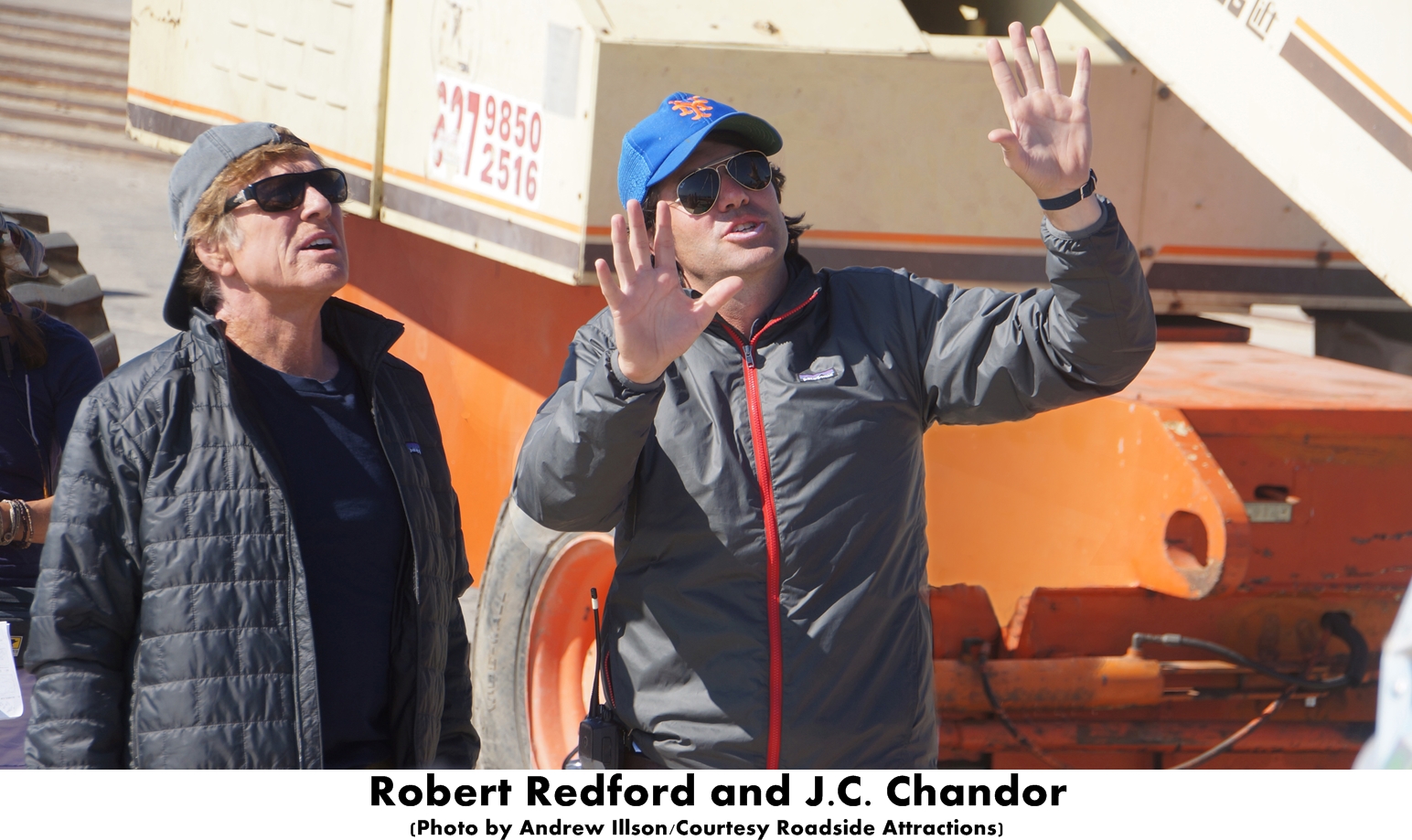
photodazastills_3569.CR2J.C. Chandor’s last film Margin Call was all talk as a large voluble ensemble that included Jeremy Irons, Kevin Spacey, Zachary Quinto and Simon Baker played Wall Street masters of the universe caught in the panic of the 2008 financial crisis. That drama went on to win the Best First Feature and Robert Altman prizes at the Independent Spirit Awards and Chandor also snagged a Best Original Screenplay Oscar nomination. How to follow-up such success? If you’re Chandor, you make a near-silent thriller, All Is Lost, focused on one man – Robert Redford in one of the great performances of his long career – battling bad luck and the elements in a quest to survive.

“It was just one of four or five ideas that I was batting around,” says Chandor during a Bay Area visit where All Is Lost screened at the Mill Valley Film Festival. “That idea became a snowball rolling down the hill. It started to gather more and more stories and pieces and visual elements. You sort of pick which one to do next based on which one’s got the most momentum.

“The way that I write is I usually see most of the movie first and then over a very short period of time, I put it down on paper. Once I had this one down on paper, it was very specific. I saw the movie from beginning to end and it was a movie that I thought I could make.”

AIL-Credit-Andrew-Illson-00303A

Redford, 76 when the film was shot, plays a man on a solo sail who runs into catastrophe in the middle of the Indian Ocean. A damaged boat and stormy weather transform what was undoubtedly a pleasure cruise into a waterlogged hell.

“It’s all of this world of this earth, but yet water is so foreign,” says Chandor, who got to know the sea well over the course of shooting in the Pacific Ocean and the Caribbean, as well as the manufactured waters of Baja Studios, the world’s largest filming tank. “Humankind over the last 6,000 years has been figuring out how to move around the world using the oceans. In a way, the sailboat had become kind of a relic of that.”

Chandor realized from the beginning that casting would be key to the success of the movie. He knew from the start that the project would only work with an actor of a certain age.

“This move with a 35-year-old, it’s sort of like, ‘Of course, he or she is fighting, they still have 70 years of good living left on the planet. They’d better be fighting,’” he says. “But Redford’s character at this point, that’s what’s so amazing. He’s fighting harder than you could imagine and presumably it’s a pretty significant uphill climb.”

Once he decided that the character called for an older man, the filmmaker was left with a very short list of names. The actor would have to be fit enough to handle the physical requirements of the role, which included climbing a 65-foot mast, lots of swimming and even more demanding stunts that would not be performed by a double. He would also have to be a gifted enough actor that he could hold an audience’s attention and convey what the character is going through without the crutch of dialogue. An outdoorsman all his life as well as a skilled performer, Redford quickly zoomed to the top of Chandor’s wish list.

“He had this perfect balance of a longstanding relationship with the audience with this belief almost that I had that there were a couple of great performances still to give, that he still had a lot to give, which is, I think, why he said yes in a way,” the filmmaker says.

“And then most importantly this kind of knife’s edge balance between being old and so fragile but also still so physically able to pull this off. Really what the film is struggling with is this character kind of coming to grips with the fact that life on earth is finite. The more and more I got into it, it started to be that there wasn’t anybody else to play the part.

“Redford can communicate in-depth thoughts and emotional kind of growth and emotional transitions non-verbally, which is an art form in itself,” he adds. “It’s not just fear or perseverance, but it’s his ability to actually communicate this sort of path from fear to perseverance, which most actors would have trouble with non-verbally. He has that gift.”

With the film about to open in theaters, the writer/director recently re-read his script for the first time in many months and realized how close the film he made came to the one he envisioned as he worked on his screenplay.

“The script is almost identical to the movie we ended up making,” Chandor says. “I just felt that there was something there that was worth telling and it could be a pretty intense emotional ride. I had some family members that thought I was a little crazy in the process of doing it, but it certainly is nice that it seems to be working. It’s exciting that we managed to pull that off.” – Pam Grady

Share this:

  • Share on Facebook (Opens in new window) Facebook
  • Share on X (Opens in new window) X
  • Email a link to a friend (Opens in new window) Email
  • Print (Opens in new window) Print
  • Share on LinkedIn (Opens in new window) LinkedIn
  • Share on Tumblr (Opens in new window) Tumblr
  • Share on Reddit (Opens in new window) Reddit
  • Share on Pinterest (Opens in new window) Pinterest
Like Loading...

Cumberbatch’s Men of Character: Assange & Tietjens

17 Thursday Oct 2013

Posted by cinepam in Interviews

≈ Leave a comment

Tags

Benedict Cumberbatch, Julian Assange, Parade's End, Rebecca Hall, The Fifth Estate

cumberbatch1It is the day after The Fifth Estate opened the 2013 Toronto International Film Festival with a premiere screening at Roy Thomson Hall and Benedict Cumberbatch is doing his duty as the film’s star promoting it. He is as thoughtful and passionate as one would expect on the film’s subject and the man he plays, WikiLeaks founder and guiding light Julian Assange.

“The guy sacrificed a lot,” Cumberbatch says. “It’s possible to have a great idea, but true sacrifice that takes real courage. That takes guts. That’s the unique thing. And he has done that. He’s in the Ecuadoran embassy still doing that.”

But while he is enthusiastic about The Fifth Estate, when the subject turns to Cumberbatch’s apparent affinity for playing offbeat characters, whether it be Assange; Sherlock Holmes; Stephen Ezard, an antisocial mathematician drawn into conspiracy in The Last Enemy; or even Dr. Frankenstein’s Creature, the actor pauses when the name Christopher Tietjens comes up as part of the list.

Cumberbatch received an Emmy nomination and won a Broadcasting Press Guild Best Actor prize for playing the character in the 2012, five-part BBC/HBO miniseries adaptation of Ford Madox Ford’s tetralogy Parade’s End. Tietjens is an aristocratic landowner and government statistician who makes a disastrous marriage with frisky socialite Sylvia (Cumberbatch’s friend and Starter for Ten costar Rebecca Hall) and who prefers to serve in the trenches rather than behind a desk during World War I. He is a man of principle at the cost of his own happiness and at risk to his own life.

“Tietjens, I love that man,” Cumberbatch says. “I’d like to be like him, I really would. I get very happy thinking about him. He’s an old-fashioned man in a modern era run by very old-fashioned people. It’s a very odd conjunction. His wife is modern, ahead of her time. The people ruling over him are just in a mess and he’s somewhere in the middle.

“I think he has such a great soul, such integrity, such true love for life, for those living around him, for his family. He has respect for those above and below his social status and class. He has respect for those above and below him in age. He loves his son, who may or may not be his, because it’s a young life. He loves his men, no matter where they’re from, because they are men spilling their blood on foreign fields for this ludicrous war that he gets drawn into on a statistical level, but he sacrifices his brain to be a body in the way of bullets, because he knows that he’s been asked to propagandize a war that’s being fought for ridiculous reasons.

“He’s a truly noble character. And he loves a woman who loves him but both of them love each other in the wrong way and he cannot escape that. He tries to be honorable to the detriment of himself. It’s sort of tragic comedy in a way. I loved playing him. I loved that experience.”

Cumberbatch is rhapsodic on the subject of Tietjens and more thoughtful and circumspect when talking about Assange. The two characters do have things in common. Neither man fits into his society (although Tietjens only becomes the subject of scandal, not an enemy of the state) and while the fictional character risks his life on the battlefield, the very real Assange risks his freedom in his pursuit of truth.

“He has a sense of humor,” the actor says of Assange. “He has to forefront some of the most potent and shattering stories of our era with those leaks. There’s not much room for comedy when you’re talking about the deaths of civilians and death squads and everything that was revealed in those war logs. And yet that was part of the dimension I wanted to bring in, that he has a sense of humor and a sense of the ridiculousness of his situation, somebody that is aware of the fact that the message has to be separate from the messenger, how the cost of what he’s done means those lines have blurred a lot.

“I wanted to give him a fair representation, really,” he adds. “I wanted to give him a three-dimensional portrait of him. It wasn’t just the mimicry. That’s the only thing I’m nervous about being criticized about is not going that distance with him.” – Pam Grady (Click here for more on Benedict Cumberbatch and The Fifth Estate.)

Share this:

  • Share on Facebook (Opens in new window) Facebook
  • Share on X (Opens in new window) X
  • Email a link to a friend (Opens in new window) Email
  • Print (Opens in new window) Print
  • Share on LinkedIn (Opens in new window) LinkedIn
  • Share on Tumblr (Opens in new window) Tumblr
  • Share on Reddit (Opens in new window) Reddit
  • Share on Pinterest (Opens in new window) Pinterest
Like Loading...
← Older posts
Newer posts →

Categories

  • Interviews
  • News
  • Reviews
  • Short Takes
  • Uncategorized

Recent Posts

  • A Stamp of Approval
  • Life is messy & so is ‘Megalopolis’
  • A star discovers too late there are worse things than aging in the black comic body horror ‘The Substance’
  • A young teen nurses a crush when he finds himself among ‘Big Boys’
  • The stunt man becomes the star as Ryan Gosling becomes THE FALL GUY

Archives

Blog at WordPress.com.

  • Subscribe Subscribed
    • Cinezine Kane
    • Join 48 other subscribers
    • Already have a WordPress.com account? Log in now.
    • Cinezine Kane
    • Subscribe Subscribed
    • Sign up
    • Log in
    • Report this content
    • View site in Reader
    • Manage subscriptions
    • Collapse this bar
 

Loading Comments...
 

    %d