• About

Cinezine Kane

Cinezine Kane

Author Archives: cinepam

RICKI AND THE FLASH: Great bar band in search of a better script

07 Friday Aug 2015

Posted by cinepam in Reviews

≈ Leave a comment

Tags

Audra McDonald, Jonathan Demme, Kevin Kline, Mamie Gummer, Meryl Streep, Rick Springfield, Ricki and The Flash

Ricki 2

Poor Rick Springfield. He must have thought he struck gold when he was cast in Ricki and The Flash opposite the doyenne of American movies, Meryl Streep, in a film directed by Jonathan Demme and written by Diablo Cody, Oscar winners all. For the frosting on the cake, the supporting cast includes Streep’s daughter Mamie Gummer, Kevin Kline, and Broadway diva Audra McDonald. This should have been another high point to Springfield’s career, at least as satisfying for him as his soap stardom on General Hospital and his 1981 number one, Grammy-winning hit, “Jessie’s Girl.” With all of the talent involved, Ricki must have seemed like a can’t-miss. But, man, does it ever.

Springfield has nothing to be ashamed of. He is one of the best parts of the film, delivering an effective performance and providing the movie with a sorely needed dose of charisma. He plays Greg to Streep’s Ricki, her guitar player and lover that she takes for granted both on stage and off. Once upon a time, she was apparently an upper-middle-class wife and mother in Indiana, but gave it all up to pursue rock stardom in California. Now 60-something, she’s estranged from her kids and ekes out a bare-bones income as a grocery cashier and lives for the nights when she sings covers at the bar where she and the Flash are the house band.

Despite the fact that her kids can’t stand her, her ex-husband Pete (Kline) gets the bright idea to fly her out to Indiana to deal with their daughter, Julie (Gummer), who has moved back home and sunk into depression after the break-up of her marriage. His wife, Maureen (McDonald), is away and he doesn’t feel equipped to handle Julie. That brings Ricki back into her family’s orbit and eventually to her son Joshua’s (Sebastian Stan) wedding. And none of it seems real. Not the manufactured family relationships or the ersatz family trauma or character behavior at odds with the real world. (Greg asking if the drinks are free at Joshua’s nuptials is one small example. Surely, even an aging, down-market rocker is familiar with the concept of an open bar. He’s been to weddings. He’s probably played a few and been a groom himself a time or two.) Most of the time, Ricki and The Flash plays like an overlong sitcom of the type that undercuts its tacky humor with sentimentality.

Perhaps predictably, for a movie coming from Demme and named for a band, the movie’s most engaging moments are when Ricki is on stage. The director whose oeuvre includes The Talking Heads film Stop Making Sense, several collaborations with Neil Young, and other music docs, is an ace at shooting performance and he captures the excitement and joy of musicians going about their business. The songs—that range from classics like “Drift Away,” the ballad made famous by Dobie Gray that becomes a duet for Ricki and Greg, to newer material like Pink’s “Get the Party Started,” performed to appeal to the bar’s younger drinkers—are well-chosen. Streep sings well and learned to play guitar for the film. Best of all, Demme surrounds her with ringers that include, in addition to Springfield, drummer Joe Vitale, keyboard player Bernie Worrell, and late bassist Rick Rosas. If Ricki was a real person, she would not be able to believe her luck at such at outfit. When The Flash is on stage, the movie is enchanting. They aren’t on stage often enough. –Pam Grady
Share this:

  • Share on Facebook (Opens in new window) Facebook
  • Share on X (Opens in new window) X
  • Email a link to a friend (Opens in new window) Email
  • Print (Opens in new window) Print
  • Share on LinkedIn (Opens in new window) LinkedIn
  • Share on Tumblr (Opens in new window) Tumblr
  • Share on Reddit (Opens in new window) Reddit
  • Share on Pinterest (Opens in new window) Pinterest
Like Loading...

THE END OF THE TOUR: Epic conversation makes for riveting drama

07 Friday Aug 2015

Posted by cinepam in Reviews

≈ Leave a comment

Tags

Although Of Course You End Up Becoming Yourself, David Foster Wallace, David Lipsky, Infinite Jest, James Ponsoldt, Jason Segel, Jesse Eisenberg

End of the Tour 1

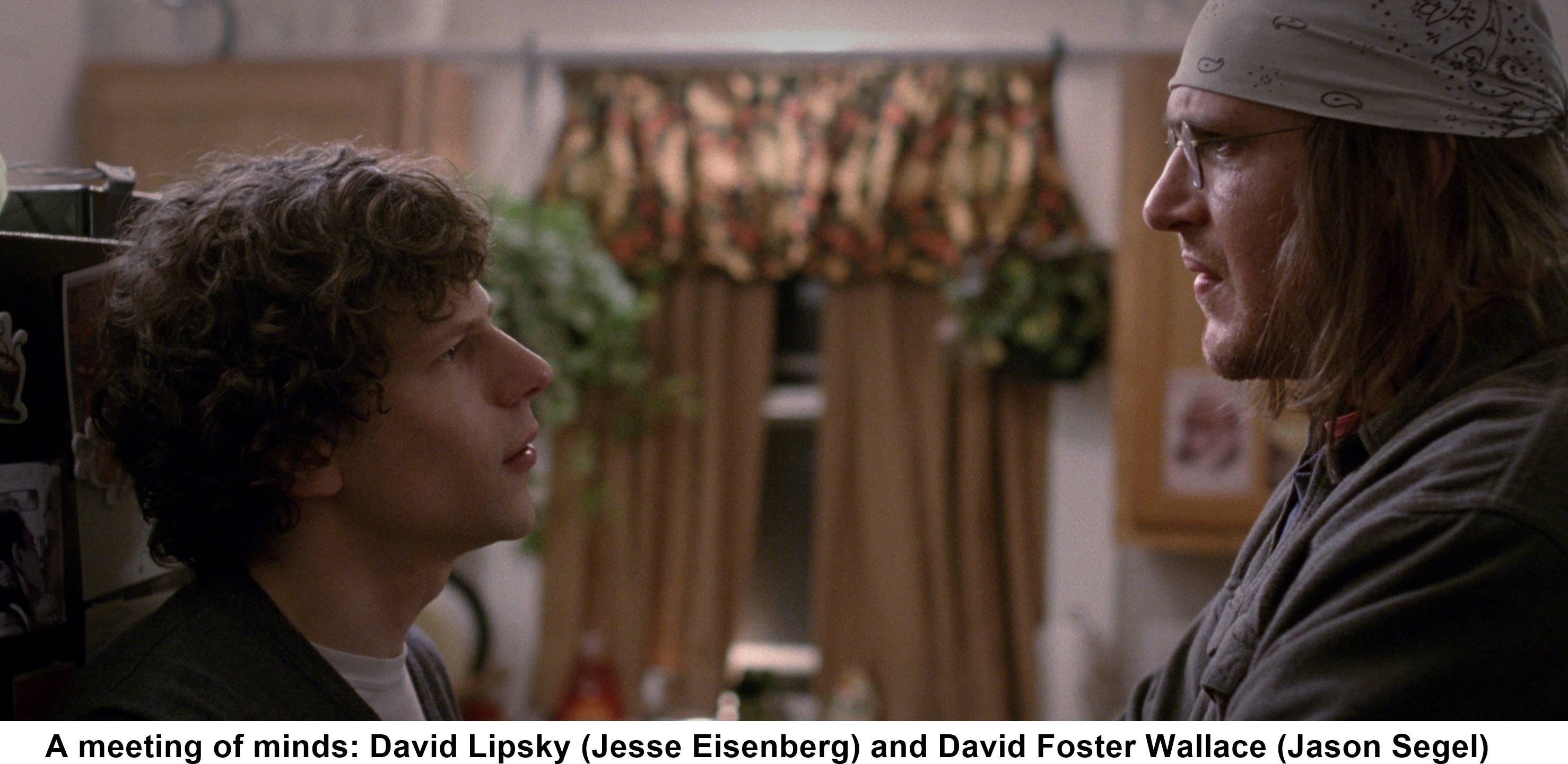
You have to wonder what David Foster Wallace was thinking when he consented to have Rolling Stone journalist David Lipsky following him for five days in 1996 as he wrapped up his Infinite Jest book tour. Of course, it was a different world then. The internet was just starting to make inroads to world domination. Print was still king and Lipsky’s employer was a player. Whatever the reason, Wallace agreed to the epic interview. It never appeared in the magazine, but after Wallace committed suicide in 2008, Lipsky turned it into a book, Although OF Course You End Up Becoming Yourself. It is that book that serves as the basis of Spectacular Now director James Ponsoldt’s riveting new drama The End of the Tour.

Jason Segel is perfectly cast as Wallace, enjoying and enduring the kind of success most writers never experience. Infinite Jest was one of those books that only comes along only once or twice in a generation, one that doesn’t just make an impact on critics and readers, but also on other writers. Lipsky (Jesse Eisenberg) understands that. It’s one of the reasons he pitches the interview to his editor (Ron Livingston). But he is also both in awe and jealous of Wallace’s achievement. Lipsky himself has just published a novel, The Art Fair, to good reviews but little fanfare. Both men are whip-smart and competitive. Wallace is a little freaked out by the enormity of his success, counting the days until the tour ends, and now he has to deal with a reporter coming at him with the dogged determination of a zealous puppy nipping at his ankles. (Whatever the size differential between Wallace and Lipsky might have been in real life, the fact that Segel towers over the diminutive Eisenberg adds another layer of complication to the relationship that develops between the two men.)

Directing his Yale playwriting teacher Donald Margulies’ screenplay, Ponsoldt sets the stage as close to reality as possible, right down to shooting in northern Michigan in the frigid winter of 2014 mirroring the conditions of the 1996 interview. Just looking at the screen in some scenes can raise goosebumps. And with that stage set, Ponsoldt lets his actors loose. Under other circumstances, the two Davids might have become friends. They have enough in common, but between Lipsky’s barely concealed envy, Wallace’s wariness, and the differences in their stations in life, that just isn’t the cards. For five days, they make do with sometimes brilliant banter. The actors are both spot-on in their performances, but this is Segel’s movie and he delivers an outstanding performance as a complex man navigating the unfamiliar territory of sudden fame. Both he and the drama are pitch-perfect in a film that pays homage not just to a great writer but to the art of conversation. –Pam Grady

Share this:

  • Share on Facebook (Opens in new window) Facebook
  • Share on X (Opens in new window) X
  • Email a link to a friend (Opens in new window) Email
  • Print (Opens in new window) Print
  • Share on LinkedIn (Opens in new window) LinkedIn
  • Share on Tumblr (Opens in new window) Tumblr
  • Share on Reddit (Opens in new window) Reddit
  • Share on Pinterest (Opens in new window) Pinterest
Like Loading...

PIXELS vs. PIXELS

24 Friday Jul 2015

Posted by cinepam in Reviews, Short Takes

≈ Leave a comment

Tags

Adam Sandler, Chris Columbus, Josh Gad, Kevin James, Patrick Jean, Peter Dinklage, Pixels, Pixels short

This is Pixels, the feature: It stars Adam Sandler, an actor—to borrow a phrase from Mart Crowley’s The Boys in the Band—who doesn’t have charm. He has counter-charm. It also stars Kevin James as Paul Blart, Mall Cop gets a promotion to president of the United States. Sandler plays a one-time arcade-style video game whiz who now installs electronic equipment for a living. (The movie presents him as a loser because of his job, but screenwriters Tim Herlihy and Timothy Dowling might have stopped to consider that not everyone can grow up to write terrible screenplays.) These two, along with Josh Gad as a conspiracy nut and Peter Dinklage as a scammer-turned-jailbird, are what stands between the world and total annihilation when aliens in the form of beloved videogame characters attack. It has a few things going for it, namely Dinklage, who is clearly having a blast playing a jerk; a sly insertion of “jiggery-pokery;” Cheap Trick’s “Surrender” on the soundtrack not once, but twice; and a prologue that evokes summer days gone by back when nearly all American kids were free-range kids. But it is also at least 20 minutes too long (with a tacked on last act that merely serves to pad out the running time) and just feels too much like the usual summer bombastic apocalypse. Also, there is a missed opportunity here: Why did it not occur to anyone to recruit Jason Alexander to pay homage to the classic Seinfeld “Frogger” episode?

What inspired director Chris Columbus’ bid for big, dumb summer fun is something altogether more modest: Patrick Jean’s 2010 short Pixels. Less than three minutes long, there are no heroes, only aliens in the guise of Pac-Man, Donkey Kong, and other classic game characters invading New York. It’s sly and smart and full of more imagination in its tiny running time than anything in the feature. It’s a jewel. To watch it after seeing its new bloated companion is to be aware that just because you can make something bigger doesn’t mean that you should. When it comes to Pixels vs. Pixels, smaller is better.—Pam Grady

Share this:

  • Share on Facebook (Opens in new window) Facebook
  • Share on X (Opens in new window) X
  • Email a link to a friend (Opens in new window) Email
  • Print (Opens in new window) Print
  • Share on LinkedIn (Opens in new window) LinkedIn
  • Share on Tumblr (Opens in new window) Tumblr
  • Share on Reddit (Opens in new window) Reddit
  • Share on Pinterest (Opens in new window) Pinterest
Like Loading...

Cell Block Riot: THE STANFORD PRISON EXPERIMENT

24 Friday Jul 2015

Posted by cinepam in Reviews

≈ Leave a comment

Tags

Billy Crudup, Ezra Miller, Kyle Patrick Alvarez, Michael Angarano, The Stanford Prison Experiment, Tye Sheridan

Stanford Prison Experiment

The “cells” are in a basement of the Stanford University campus. The “guards” and “prisoners” are mostly hippie kids to whom participating in a psychology experiment probably sounded more interesting than a typical summer job. But overseen by a psychology professor who loses his objectivity, it spirals quickly out of control. Welcome to The Stanford Prison Experiment, Kyle Patrick Alvarez’s drama recreating the notorious 1971 event.

Billy Crudup is Dr. Philip Zimbardo, whose study is try to get at the root of abuse in prisons and the conflicts between prisoners and guards. The experiment was funded by the US Office of Naval Research and its timing couldn’t have been more apt: three weeks before the deadly Attica Prison riot. It begins with dehumanizing the prisoners. They are not to use their names, only their assigned numbers. Their uniforms are shapeless (and emasculating) shifts—a cross between a hospital gown and a dress. Their hair is partially hidden underneath stocking caps further blurring individual identity. The guards, too, lose their individuality, wearing identical khaki outfits that mimic actual uniforms and mirrored shades that make eye contact impossible.

The situation veers toward hysteria from the start. The guards make a sport out of mistreating the prisoners in their care. One, Christopher Archer (Michael Angarano), is nicknamed “John Wayne” by the prisoners, but he’s clearly seen Cool Hand Luke a few too many times and models his behavior on that movie’s cruel overseer played by Strother Martin. He makes it his mission to make the inmates’ stay in Stanford’s basement a living hell. The convicts push back, Daniel Culp/8612 (Ezra Miller), Peter Mitchell/819 (Tye Sheridan) and other prisoners rebel in various ways and sometimes react with impotent fury. Each move by prisoner or guard escalates tensions. None of it is real, but as conditions deteriorate, it’s easy to see how the individuals involved might forget that they are playing roles.

Angarano, Miller, and Sheridan are all standouts among a huge ensemble of some of the best of today’s young actors. A cast that also includes Thomas Mann, Johnny Simmons, Logan Miller, Ki Hong Lee, and Moises Arias, is an embarrassment of riches. The scenes in mock jail are gripping and chilling, but the most fascinating thing about The Stanford Prison Experiment is not the test subjects, but the man behind the curtain, Zimbardo. “John Wayne” is a kid who doesn’t know any better. What is the excuse of the man who designed the experiment for setting aside professional objectivity and becoming so personally involved? Crudup is terrific as a man who as slippery as any shady used-car salesman as he rationalizes his experiment and his own behavior. Zimbardo wants to make a statement about obedience and authority, but he crosses a line and ends up making as big a statement about ethical behavior.—Pam Grady


Share this:

  • Share on Facebook (Opens in new window) Facebook
  • Share on X (Opens in new window) X
  • Email a link to a friend (Opens in new window) Email
  • Print (Opens in new window) Print
  • Share on LinkedIn (Opens in new window) LinkedIn
  • Share on Tumblr (Opens in new window) Tumblr
  • Share on Reddit (Opens in new window) Reddit
  • Share on Pinterest (Opens in new window) Pinterest
Like Loading...

Q&A: Carlos Marques-Marcet finds the distance in 10,000 KM

09 Thursday Jul 2015

Posted by cinepam in Interviews

≈ Leave a comment

Tags

10000 Km, Carlos Marques-Marcet, David Verdaguer, Natalia Tena

10000KM-3

The relationship between Barcelona couple Sergi (David Verdaguer) and his British girlfriend Alex (Natalia Tena) couldn’t be better at the start of Spanish filmmaker Carlos Marques-Marcet’s feature directing debut 10,000 Km. When Alex, a photographer, gets an opportunity to work in Los Angeles for a year, the pair vow to stay together. The internet and their cell phones allow them to text, message, and video chat, promising to make the separation easier. But real life isn’t that simple. During a recent conversation in San Francisco, Marques-Marcet talked about his film and his inspirations drawn from life and technology.

Q: This is a story specific to this technological age. Was your starting point the long-distance relationship or how technology affects those type of relationships?

Carlos Marques-Marcet: It funny. There are other movies about long-distance relationships—but those are really about long-distance love, not relationships. The person you love is abroad; you don’t really have a relationship. But now you can have a relationship.

I moved from Barcelona to Los Angeles and then I had a visit from a friend who is a photographer, who took pictures. At the same time, I was using a lot of Skype with my friends and people in Barcelona. I thought it would be nice to write a story and follow someone through photographs, discovering the city. That was the original idea and then follow all the conversations on Skype—not Skype, because we couldn’t use Skype for the movie, because Skype didn’t want any sex scenes associated with their brand, so we couldn’t use Skype. But that was a little bit the original idea.

We use cameras to say, ‘Hey, how are you?’ We use screens and cameras as a way to communicate. So, I thought why don’t we use that to make a new epistolary genre? It’s funny, I don’t know why they make all these found-footage movies and they are always just horror movies. It’s never used as a way to just show how we live.

Q: You start from a point where everything is going great for them, but then she gets an opportunity to spend a year in the States and at the same time, his work becomes more tentative. The changes in their status could have happened if they were in the same city, but you add extra pressure by separating them.

CMM: That was a big debate for us when we were writing the script. It was difficult to decide what was the conflict, because if you make a movie about a couple that is perfectly fine and then they separate, they are not going to break up. They’re perfectly fine. But at the same time, if you make a movie about a couple that is already breaking up and one moves away, well, they’re going to break up, anyway. You’re not going to make a movie about the distance. We had to find a conflict for them. I found this metaphor, it’s like a house that has cracks. You live with this crack, but then suddenly there’s a lot of humidity or it rains, the circumstances change, and at that moment, these cracks can open and break and create these problems. To me, it was a combination. Couples are not destiny. We have this idea of love, that destiny just chooses us. I don’t think it’s that. I think circumstances are very important and they shape the way we relate to each other.

Q: The fact that she’s English also plays into it. She’s been in Barcelona for seven years, but even with that and even as close as they are, there’s going to be a slight change of viewpoint.

CMM: I was interested in that. There are migrations all around the world and globalization, these inter-cultural relationships happen more and more often. If funny, because even if you think, ‘Oh, Europe,’ but Europe is almost like a fake. The British have much more in common with Americans, even though you are completely different in many ways, but there’s a bigger connection. He feels completely left out, the fact that she’s going to America. It’s a world with a [different] language. And language is important to me, also. It introduces the fact that she has the language and she’s going to that city. She integrates very easily in this new environment, while moving there would be hard for him. Learning a language—it’s a completely new world.—Pam Grady

Share this:

  • Share on Facebook (Opens in new window) Facebook
  • Share on X (Opens in new window) X
  • Email a link to a friend (Opens in new window) Email
  • Print (Opens in new window) Print
  • Share on LinkedIn (Opens in new window) LinkedIn
  • Share on Tumblr (Opens in new window) Tumblr
  • Share on Reddit (Opens in new window) Reddit
  • Share on Pinterest (Opens in new window) Pinterest
Like Loading...

FIVE MINUTES, MR. WELLES: THE THIRD MAN inspires an actor’s homage

03 Friday Jul 2015

Posted by cinepam in Short Takes

≈ 1 Comment

Tags

Carol Reed, Ed Wood, Five Minutes Mr. Welles, Graham Greene, Joseph Cotten, Orson Welles, The Third Man, Vincent D'Onofrio


With the luminous 4K restoration of The Third Man hitting theaters now, this seems like a fine time to revisit Vincent D’Onofrio’s wonderful short, Five Minutes, Mr. Welles, in which he plays the legendary actor and auteur in preparation for shooting what has become known as The Third Man’s “Cuckoo Clock” scene. The 2005 film marked D’Onofrio’s directing debut and Will Conroy spun the screenplay out of the actor’s own, meticulously researched story.

This wasn’t the first time that D’Onofrio played Welles. In 1994, he played a 1950s version of the man in Tim Burton’s Ed Wood, looking every inch the part, but voice actor Maurice LaMarche dubbed his dialogue. In a 2006 FilmStew interview, D’Onofrio admitted that he wasn’t fond of his own performance and wanted another crack at getting under the skin of a cinematic genius whose name was already synonymous with trouble by the time he took the role of The Third Man’s vicious, debonair black marketeer Harry Lime.

Carol Reed’s sublime noir reunited Welles with his friend and collaborator Joseph Cotten, cast as Holly Martins, a penniless pulp Western novelist who comes to postwar Vienna at the invitation of his old pal Lime only to arrive in time for the man’s funeral. Not satisfied with the official explanation of the hit-and-run accident that killed Harry, Martins undertakes a dangerous and clumsy investigation of his own in a city under military occupation and that has been divvied up into sections by the Americans, Soviets, British, and French. The location itself is striking, piles of rubbles sitting cheek-by-jowl next to what survives of prewar Vienna’s magnificent architecture. Long shadows fall over those exteriors and engulf the interior high ceilings, spiral staircases, and maze of sewers, Robert Krasker’s expressionistic cinematography adding to the sense of menace.

The great novelist and screenwriter Graham Greene (Brighton Rock, Our Man in Havana, The End of the Affair) wrote The Third Man’s script. What inspired D’Onofrio’s story was the discovery that it was Welles and not Greene that wrote a key piece of dialogue in which Lime makes a case for his criminal behavior by comparing the Borgias’ bloody 30-year reign over Italy with 500 years of peace in Switzerland.

That monologue is still in Welles’ future when Five Minutes, Mr. Welles opens. Alone in a room with Katherine (Janine Theriault), the assistant lent him by Universal, he is waiting to be called to the set for his next scene. But as he rehearses with her, he has trouble remembering his lines. The scene, he feels, needs something else, but she argues that there’s no time for that, and in any case, he seems stumped. This is Welles in all his magnificent contradictions, by turns charming and petulant, a man defiant in his independence, yet desperate to hang on to a job he needs if he is to have any hope of having enough money to make Othello. Katherine accuses him of acting like an aristocrat but without the money to back up his arrogance, and there is something to that.

Like The Third Man, Five Minutes, Mr. Welles is in black-and-white, the cinematography by Frank Prinzi, an Emmy winner who also shot over five dozen episodes of D’Onofrio’s series Law & Order: Criminal Intent. Composer David Mansfield adds an atmospheric score that is wholly original and yet also evokes Anton Karas’ indelible zither accompaniment to The Third Man. D’Onofrio gets his second chance at inhabiting Welles and, in the process, delivers a wonderful homage to the man and the role.

By all means, see The Third Man again or for the first time in its new restoration. It is absolutely gorgeous and nearly 70 years after its original release, it is as vital as it ever was. But spend 30 minutes with Five Minutes, Mr. Welles as well. D’Onofrio’s remarkable tribute to a classic actor and classic film deserves to be seen.—Pam Grady

Share this:

  • Share on Facebook (Opens in new window) Facebook
  • Share on X (Opens in new window) X
  • Email a link to a friend (Opens in new window) Email
  • Print (Opens in new window) Print
  • Share on LinkedIn (Opens in new window) LinkedIn
  • Share on Tumblr (Opens in new window) Tumblr
  • Share on Reddit (Opens in new window) Reddit
  • Share on Pinterest (Opens in new window) Pinterest
Like Loading...

Q&A: Benicio Del Toro plays a notorious villain in ESCOBAR: PARADISE LOST

26 Friday Jun 2015

Posted by cinepam in Interviews

≈ Leave a comment

Tags

Andrea Di Stefano, Benicio Del Toro, Escobar: Paradise Lost, Josh Hutcherson

escobar

It’s easy to see why Josh Hutcherson’s naïve Canadian surfer so willingly moves into first the orbit and then the inner circle of Colombian drug lord Pablo Escobar after his new girlfriend introduces him to her notorious uncle in actor-turned-filmmaker Andrea Di Stefano’s evocative feature debut Escobar: Paradise Lost. The kingpin is charismatic and charming, on the surface a true man of the people. It is only gradually that the young man sees what is behind the amiable mask and what he discovers is horrifying. Benicio Del Toro delivers an indelible performance as Escobar, an intricate turn that reveals the complex man behind the headlines. Getting the Oscar winner was a coup for the fledgling director, but as Del Toro explains in this interview at the 2014 Toronto International Film Festival where Escobar: Paradise Lost had an early screening, it almost didn’t happen. But once it did, it gave Del Toro the opportunity to get under the skin of one of the 20th century’s most infamous villains.

Q: Escobar kind of reminded me of Michael Corleone in this, lethally charming and absolutely lethal.

Benicio Del Toro: That’s cool. I take that as a compliment. We love Al Pacino.

Andrea Di Stefano, the director, contacted me a long time ago, through other lines, not directly, and I kind of said, ‘I don’t know if I want to get into that right now.’ So then the project was floating around and it came back around. I had befriended Josh, because I directed a short in the movie 7 Days in Havana and Josh starred in it. So there was talk, ‘Could this movie be a possibility? Yes.’ And then I remember getting a phone call saying that they were looking at Josh to play the kid, and then I got really excited, because I know him and I like him very much and he’s a very good actor. I just felt like I wouldn’t be completely alone there. That was really exciting.

Q: What was your hesitation about the project when it first came around?

BDT: First of all, it was that the story was fiction. I think at the time, maybe it was a year before we shot the film, I just didn’t feel—sometimes you get projects and you think, ‘Oh, they’re going to do this movie about Escobar, but, really, it’s another story using Escobar.’ Also, at the time, I was maybe busy doing something and just said, ‘I’m not going to do this now. I’m not really completely interested.’ But then my meeting with Andrea Di Stefano, what I really liked about the idea of going fiction was that every chance you got to base the character on truth, we would, and the script does have that, also. Once I got into it, I said, ‘There are interesting angles here that would make it more interesting than just make-believe.’ There’s a lot of things about his relationship with his family, his relationship with the people…Everything that we could, we based it on truth, which was exciting. The script had that and we brought in a little bit more, perhaps.

Q: Given those fictional aspects, how deep did your research go into the actual man?

BDT: I did as much as I could, just to really understand his trajectory. He basically starts—he was bringing in goods from somewhere, it wasn’t drugs at the time. He basically did some sort of union with the workers. He said, ‘We’ll pay you a percentage of what we bring in.’ So all the workers started loving the guy. So he starts like that and eventually he gets more powerful and then he took it to another level and made it really crazy when he went political. He tried to run for office and the other politicians started saying, ‘This guy’s a drug dealer.’ He saw the people that ran the country like other gang members. He declared war on the country and he won, and then it was hell. And there were other gangs taking advantage of this and other drug dealers taking advantage and it just became really gray. Had he not run for office, I think he would probably still be alive and Colombia would not have gone through the hell it went through. But, who knows?

Q: His ambitions were understandable. Politics can be such a dirty business that he probably thought, ‘Why not a drug dealer? Why not me?’

BDT: Well, ‘Why not me? I’ve helped the poor and you been running this for how long? 100 and some years and you haven’t looked at these people and I just built a whole neighborhood here for the poor.’ The people really liked him, because he really gave back. But he ain’t all good! He’s definitely a talented man. He was a great example of a lot of talent gone the wrong way.

I think you’re right when you say, ‘Politics is a dirty business. Another dirty guy, there’s no difference.’ And that’s not true. Two wrongs don’t make a good one—if the politicians he was talking about were wrong, because there were a lot of good politicians that he killed that could have been the hope [of the country]. Actually, the one who said, ‘He’s a drug dealer,’ was the one who had not completely taken bribes from him, and so Escobar went after him and took him down. And then the press, he went after the press. If you were a writer, ‘If you don’t write a good article about me, you’d be careful, I’ll perm my hair and come after you.’ He was like that. It’s very scary. That’s how he looked at it, but he did have some beautiful family values, very much like Michael Corleone. It’s kind of like the same story, just come up and suddenly have power. The lack of being able to give in could make any person in power into a Godzilla. Without compromise, you could just turn into a terrible dictator and run amok. Who knows? With his anger and his strive towards power, he probably could have turned into a maniac had he won and ran the country. Who knows what he would have done?—Pam Grady

Share this:

  • Share on Facebook (Opens in new window) Facebook
  • Share on X (Opens in new window) X
  • Email a link to a friend (Opens in new window) Email
  • Print (Opens in new window) Print
  • Share on LinkedIn (Opens in new window) LinkedIn
  • Share on Tumblr (Opens in new window) Tumblr
  • Share on Reddit (Opens in new window) Reddit
  • Share on Pinterest (Opens in new window) Pinterest
Like Loading...

DOPE: Geek power

19 Friday Jun 2015

Posted by cinepam in Reviews

≈ Leave a comment

Tags

Dope, Kiersey Clemons, Rick Famuyiwa, Shameik Moore, Tony Revolori

DOPE_037_rgb

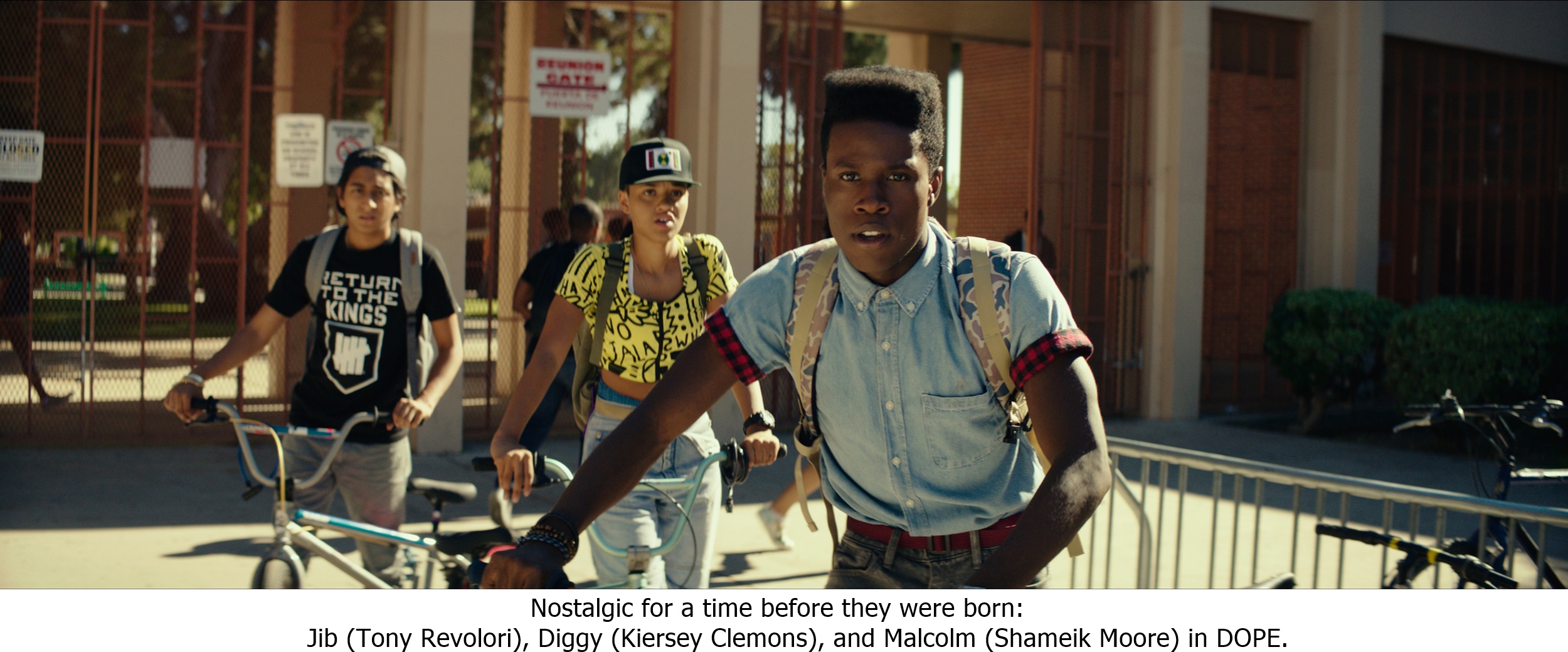
It’s Boyz n the Hood meets Revenge of the Nerds meets After Hours for three geeky teenagers navigating the mean streets of Inglewood, CA’s tough Bottoms neighborhood in Rick Famuyiwa’s delirious coming-of-age/drug dramedy Dope. A boy’s crush on a girl leads to all sorts of complications for the trio as they are challenged to prove that they are every bit as street-smart as they are book-smart.

Gangs and drugs are part of life in the Bottoms, but lifelong friends Malcolm (Shameik Moore), Diggy (Kiersey Clemons), and Jib (The Grand Budapest Hotel’s Tony Revolori) ignore that world as much as they can. They are a self-contained unit dedicated to all things ‘90s, particularly hip hop. They are college-bound kids and Malcolm is determined to get into Harvard. It is a dream firmly within his grasp until Malcolm’s crush on Nakia (Zoë Kravitz) leads him and his friends to step out of their comfort zone and attend drug dealer Dom’s (A$ap Rocky) birthday party. By the end of the evening, they are in possession of a backpack full of molly, squeezed by both Dom’s allies and rivals and petrified of being caught with the stuff by the cops.

How Malcolm and company deal with their problem is the stuff of much raucous humor and more than a little suspense. The genius of the film, though, is not in its plot, but in its sly observations. As geeks, Malcolm, Diggy, and Jib have run of the school, particularly the areas no one else bothers with in a distressed public school where few of their peers are on an academic track: the science lab, the computer room, even the band room. As geeks, they also have an air of innocuous respectability that gives them a measure of freedom.

Within the world Famuyiwa creates there is room for everything from debate over the “n” word to Malcolm’s pointed conclusions on the all-important college application personal essay. It’s funny stuff, but what pushes Dope over the top from goodness to greatness is the charm of its three young leads. –Pam Grady


Share this:

  • Share on Facebook (Opens in new window) Facebook
  • Share on X (Opens in new window) X
  • Email a link to a friend (Opens in new window) Email
  • Print (Opens in new window) Print
  • Share on LinkedIn (Opens in new window) LinkedIn
  • Share on Tumblr (Opens in new window) Tumblr
  • Share on Reddit (Opens in new window) Reddit
  • Share on Pinterest (Opens in new window) Pinterest
Like Loading...

The time Robert Chartoff saved John Boorman’s bacon

15 Monday Jun 2015

Posted by cinepam in News

≈ Leave a comment

Tags

In My Country, John Boorman, Leo the Last, Point Blank, Queen and Country, Robert Chartoff

point blankProducer Robert Chartoff passed away last Wednesday, June 10, and left quite a legacy, nearly 40 films, a list that includes They Shoot Horses, Don’t They?, the Charles Bronson thriller The Mechanic, The Gambler (both 1974 and 2014 versions), Rocky, Raging Bull, and The Right Stuff. His first credit was on John Boorman’s classic revenge neo-noir Point Blank. It was the start of a lifelong friendship. The pair collaborated two more times on the director’s 1970 comedy drama Leo the Last and his 2004 drama In My Country.

Boorman also dedicated his last film, the recent Queen and Country, to his old pal. It wasn’t purely an act of sentiment, but an acknowledgement of Chartoff’s importance as a friend and collaborator, as well as a thank you. Without an act of kindness and generosity on Chartoff’s part, Queen and Country might not exist.

The subject came up during an interview with Boorman for a piece that ran in the San Francisco Chronicle. Why the dedication? Why now, nearly 50 years since their first collaboration?

“Bob’s been a dear friend for 40 years and more,” Boorman said. “We see each regularly. We talk on the phone at least once a week. I’m very devoted to him.

“When I was trying to make this film, some of the money fell out at the last moment, about a week before we were supposed to start shooting. Bob asked me how I was doing and I said, ‘Oh, I’m a bit depressed. The money’s fallen out.’ He said, ‘How much?’ And I told him. The next day he put that money in my account. He saved the film. I’m glad to say that he’s got it back from Fox picture. He just sent it. He didn’t ask for a contract or anything. The money just appeared in my account.”

Condolences to Mr. Boorman on the loss of his friend. –Pam Grady

Share this:

  • Share on Facebook (Opens in new window) Facebook
  • Share on X (Opens in new window) X
  • Email a link to a friend (Opens in new window) Email
  • Print (Opens in new window) Print
  • Share on LinkedIn (Opens in new window) LinkedIn
  • Share on Tumblr (Opens in new window) Tumblr
  • Share on Reddit (Opens in new window) Reddit
  • Share on Pinterest (Opens in new window) Pinterest
Like Loading...

Trailer: THE STANFORD PRISON EXPERIMENT promises unexpected results

15 Monday Jun 2015

Posted by cinepam in News

≈ Leave a comment

Tags

Billy Crudup, Chris Sheffield, Ezra Miller, James Frecheville, Michael Angarano, Moises Arias, The Stanford Prison Experiment, Thomas Mann, Tye Sheridan

One of the standouts from this year’s Sundance Film Festival, where it won the Alfred P. Sloane Feature Film Prize and the Waldo Salt Screenwriting Award is Kyle Patrick Alvarez’s The Stanford Prison Experiment, a riveting drama based on a real-life psychological experiment. Twenty-four young men are assigned to be either prisoners or guards in a pretend jail on the Stanford University campus where play-acting and reality quickly begin to blur. Billy Crudup is the ambitious professor who designed the experiment, starring alongside a kind of supergroup of up-and-coming talent that includes Ezra Miller, Michael Angarano, Tye Sheridan, James Frecheville, Thomas Mann, Moises Arias and Chris Sheffield.

Share this:

  • Share on Facebook (Opens in new window) Facebook
  • Share on X (Opens in new window) X
  • Email a link to a friend (Opens in new window) Email
  • Print (Opens in new window) Print
  • Share on LinkedIn (Opens in new window) LinkedIn
  • Share on Tumblr (Opens in new window) Tumblr
  • Share on Reddit (Opens in new window) Reddit
  • Share on Pinterest (Opens in new window) Pinterest
Like Loading...
← Older posts
Newer posts →

Categories

  • Interviews
  • News
  • Reviews
  • Short Takes
  • Uncategorized

Recent Posts

  • A Stamp of Approval
  • Life is messy & so is ‘Megalopolis’
  • A star discovers too late there are worse things than aging in the black comic body horror ‘The Substance’
  • A young teen nurses a crush when he finds himself among ‘Big Boys’
  • The stunt man becomes the star as Ryan Gosling becomes THE FALL GUY

Archives

Blog at WordPress.com.

  • Subscribe Subscribed
    • Cinezine Kane
    • Join 48 other subscribers
    • Already have a WordPress.com account? Log in now.
    • Cinezine Kane
    • Subscribe Subscribed
    • Sign up
    • Log in
    • Report this content
    • View site in Reader
    • Manage subscriptions
    • Collapse this bar
 

Loading Comments...
 

    %d