 In a key moment of Wild Rose, aspiring country singer Rose-Lynn Harlan (Jessie Buckley) travels to London—probably the farthest she’s been outside of her hometown of Glasgow—to meet one of her heroes, real-life BBC The Country Show radio host Whispering Bob Harris—who tells her that if she is serious about making it in country music she needs to write her own songs. It is a suggestion that flummoxes her; she feels she has nothing to write about. She can’t see what the audience sees: Her life is a country song. And so is this movie, the story of a working-class heroine who can’t seem to get out of her own way, whose life would utterly defeat most other people, but whose hope and big dreams remain undistinguished.
The juxtaposition of Scotland and Nashville, where Rose-Lynn hopes to eventually hang her hat, may seem incongruous, but Glasgow has a thriving country scene where Rose-Lynn has been a star at a local pub, which just happens to be named Grand Ole Opry, since she was a teenager. Country (not “country ‘n western,” Rose-Lynn emphatically insists) is also music that celebrates hardscrabble lives and hers has been more hardscrabble than most. The single mother of two before she was 18 years old—her daughter Wynonna (Daisy Littlefield) is eight and her son Lyle (Adam Mitchell)—she has never settled into the role of parent, to her mother Marion’s (Julie Waters) consternation. She drinks too much, breaks promise after promise, and places her own interests front and center, always.
Recently paroled from prison after spending a year there on a drug charge, the kids are last on her list of priorities. She is a heat-seeking missile of inchoate ambition, confident in her talent if utterly clueless on how to make what passes for her life plan a reality. A job as a maid with Susannah (Sophie Okonedo) feels like a big step backward, but Susannah is the first person out of Rose-Lynn’s own circle to recognize that the young woman isn’t fooling herself. She is the real deal, whether anything come of it or not.
Wild Rose is a movie with a big heart and a big performance at its heart. Buckley, who has extensive stage musical experience and who is best known to audiences from 2016’s War and Peace and the recent Chernobyl HBO miniseries, is electrifying. Playing a personality as vivid as her flaming red hair, she is by turns empathetic, entrancing, and enraging, forthrightly portraying the unsavory aspects of Rose-Lynn’s narcissism and neglect of her children. And when it comes to the music (with many songs co-written by Buckley with screenwriter Nicole Taylor, singer-songwriter Ian W. Brown, and guitarist Simon Johnson), Buckley is the real deal. When she sings, she is simply stunning.
All roads eventually lead to Nashville and a moment of catharsis on the stage of the Ryman Auditorium, the original home of the Grand Ole Opry. But nothing in this movie is as it seems. It may have the contours of a Scottish A Star Is Born, but it confounds those expectations. What Taylor and helmer Tom Harper (Buckley’s War and Peace director) have created is more in line as a miniature portrait of what Robert Altman portrayed in his sprawling Nashville. Show business in general and Nashville in particular attract strivers and dreamers and Rose-Lynn is one of those. But she also has a life in opposition to her ambitions. It is a dilemma worthy of a heart-wrenching tune by Patsy Cline or Tammy Wynette. And it is one that won’t leave a dry eye in the house as Rose-Lynn gives voice to that song. –Pam Grady
 Rankin-Bass probably doesn’t have cause for action, but it is impossible not to feel the influence of Rudolph the Red-Nosed Reindeer in this fourth Toy Story adventure. The world Woody (Tom Hanks) stumbles on where toys go unloved and unwanted is not an island nor toy world unto itself, but a dusty antique store where toys go unloved and unwanted. For Woody, beginning to contemplate his own obsolescence and a time when no child will call him his own, the place is a revelation. If this is truly Woody’s last roundup, he goes out in a blaze of laughter and tears.
 Nicolas Brown adapts Sean B. Carroll’s book The Serengeti Rules, at once paying homage to the five scientists at the heart of it, and explicating their theories in a handsome, engaging documentary. Like so many environmental docs that have come before it, it identifies a threat to our planet, in this case, the degradation to our natural world that ensues with the loss of biodiversity. But unlike so many films of its nature, it is more hopeful in tone. The scientists know what needs to be done to cure this particular malady; the trick is getting it done. The Serengeti Rules serves as a clarion call for action.
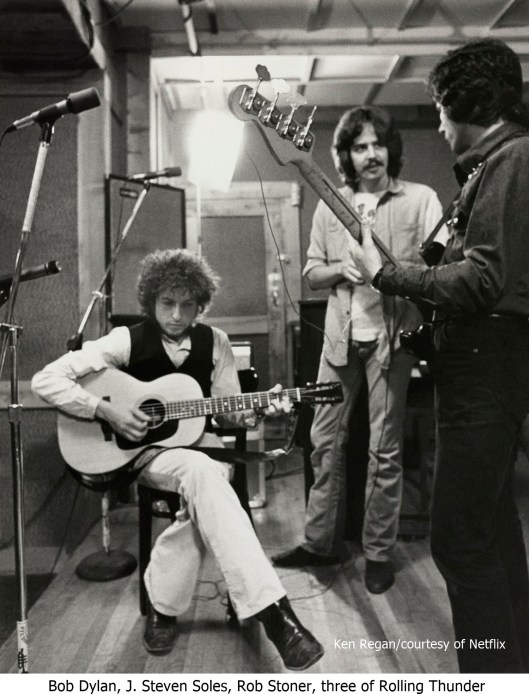 Fun fact: When Renaldo and Clara, Bob Dylan’s sole (and notoriously unsuccessful) foray into narrative filmmaking—a nearly four-hours-long fever dream combining vignettes with concert footage–opened in San Francisco in 1978, it was at the Castro Theatre. It is only fitting then that Rolling Thunder Revue: A Bob Dylan Story by Martin Scorsese that employs that same footage should have its one and only San Francisco screening before settling into its home on Netflix at the Castro. Complete with tastings of Dylan’s Heaven’s Door whiskey line, which is somehow perfect. The film, up to a point, anyway, is delicious. And so is the booze.
 Cinezine Kane