• About

Cinezine Kane

Cinezine Kane

Monthly Archives: June 2012

Put a stake in it: ABRAHAM LINCOLN: VAMPIRE HUNTER

22 Friday Jun 2012

Posted by cinepam in Reviews

≈ Leave a comment

Tags

Abraham Lincoln: Vampire Hunter, Anthony Mackie, Benjamin Walker, Dominic Cooper, Mary Elizabeth Winstead, Rufus Sewell, Timur Bekmambetov

The other day I read one of those articles about doofuses on Twitter, you know, the ones that insist on tweeting their ignorance of stuff generally considered common knowledge, like the folks stunned and amazed to discover that the Titanic sinking isn’t just something that happened in a movie. I was thinking about that while watching Abraham Lincoln: Vampire Hunter the other night, and began to anticipate the opposite kind of tweet, the one posted by the guy who watches the movie and convinces himself that he slept through the most fascinating history lesson ever: “Abraham Lincoln freed the slaves and killed vampires? For realz? #mindblown” That tweet, at least, would be mildly entertaining as opposed to the movie, which takes itself far too seriously to be very much fun.

The movie has a joke of a title and, in its 3D presentation, throws stuff up at the screen with the wild abandon of Drive Angry or A Very Harold & Kumar 3D Christmas. Cheesiness is built into its DNA, but director Timur Bekmambetov squelches humor that might have breathed some life into the film in favor of dull earnestness. What this movie is crying out for is Evil Dead‘s lamebrain hero Ash and an actor with Bruce Campbell’s deadpan grasp of the absurd. Instead, it is stuck with a sober, familiar Abe Lincoln (albeit one with martial arts training and quite a way with a silver-tipped axe) and a bland Benjamin Walker, who looks the part but barely registers on screen next to more charismatic costars Dominic Cooper, Rufus Sewell and Anthony Mackie.

Seth Grahame-Smith (who also penned the screenplay of the recent, even more dire Dark Shadows) adapts his own novel in which he offers an alternative history, one in which the 16th president of the United States is cast as a lifelong vampire foe and the Civil War presented as less a War Between the States than a battle between the living and the undead. Slaves are food for the vampires and that supply must be maintained. It is a conflict that pits Lincoln, vampire-turned-vampire-hunter Henry Sturgess (Cooper, playing the most intriguing character in the story, someone intent on wiping out his own kind), Lincoln’s childhood friend Will Johnson (Mackie), shopkeeper Joshua Speed (Jimmi Simpson) and Lincoln’s wife Mary Todd Lincoln (a pallid Mary Elizabeth Winstead) against diabolical vampire Adam (an exuberant, scenery-chewing Sewell) and his bloodsucking tribe. It is Adam who ups the ante in the Civil War when he offers Confederate President Jefferson Davis (John Rothman) a vampire army to battle the Union forces.

Frankly, it is hard to top the horror of the actual Civil War. The addition of battalions of the undead in a fictional version of those historical events doesn’t top the terror quotient of the single bloodiest chapter in American history. But then Bekmambetov has as little sense of horror as he does a sense of humor. The whole endeavor is merely an excuse for outsized violence; adequate, if unspectacular, special effects; and one big rote action sequence after another. And it all feels a little derivative. It’s missing “the loom of destiny,” but at times, Abraham Lincoln: Vampire Hunter feels like a 19th century version of the director’s 2008 thriller Wanted in its lavish, loud and sometimes cartoonish battles. The two films even share similar climaxes. Apparently Bekmambetov enjoys playing with trains.

In the absence of humor and the absence of horror, Abraham Lincoln: Vampire Hunter is just another routine action thriller and all the drearier for it. Lincoln deserves better and so do movies audiences. – Pam Grady


Share this:

  • Share on Facebook (Opens in new window) Facebook
  • Share on X (Opens in new window) X
  • Email a link to a friend (Opens in new window) Email
  • Print (Opens in new window) Print
  • Share on LinkedIn (Opens in new window) LinkedIn
  • Share on Tumblr (Opens in new window) Tumblr
  • Share on Reddit (Opens in new window) Reddit
  • Share on Pinterest (Opens in new window) Pinterest
Like Loading...

Ethan Hawke, Pawel Pawlikowski muse over THE WOMAN IN THE FIFTH

18 Monday Jun 2012

Posted by cinepam in Interviews

≈ Leave a comment

Tags

Ethan Hawke, Kristin Scott Thomas, Pawel Pawlikowski, The Woman in the Fifth

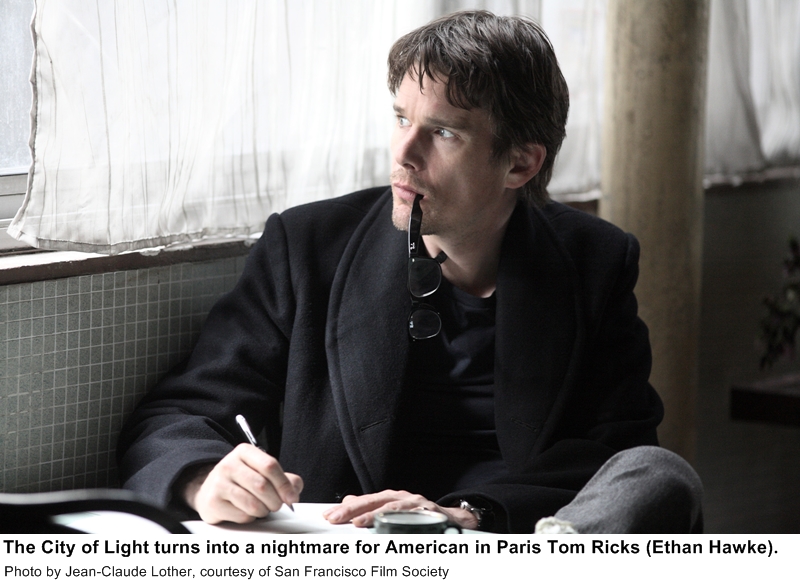
The adventures of an American in Paris, so often cast in a romantic glow in the movies, is reframed as a nightmare with erotic overtones in Pawel Pawlikowski’s sinister thriller The Woman in the Fifth. In the Polish filmmaker’s first film since his acclaimed 2004 coming-of-age drama My Summer of Love, Ethan Hawke plays Tom Ricks, a writer who travels to the City of Light to try to put his life back together and reunite with his estranged wife and young daughter. Things don’t go according to plan and after he’s robbed and left destitute, he is trapped is Paris, living a bleak existence until he meets Margit (Kristin Scott Thomas), a beautiful woman who injects some light into his life – at least that’s the way it appears at first.

At the Toronto International Film Festival where Women in the Fifth made its world premiere, Hawke and his director sat down to discuss some of the implications of a film in which things are rarely what they seem.

Q: Kristin Scott Thomas plays your lover, but at times she almost seems like your mother in some of her interactions with you, Ethan. Once that becomes apparent, then it’s easy to start reassessing Tom’s relationships with all of the women in the film. How did you keep all of the female roles straight in your head, who they were representing and who they actually were?

EH: We struggled a little bit with the title of the movie. Part of the reason why, I think, is because there’s this kind of knee-jerk thought that Kristin is the “woman in the Fifth,” and part of me started thinking that it’s more true that there are these five women: his daughter, his ex-wife, his Polish lover, Kristin and I don’t know who else.

PP: That’s four!

EH: (Laughing) Then himself! He’s the woman in the Fifth, the woman inside him. The point is that they are all these different ways of accessing aspects of himself, who we are to different people. The movie works as this kind of weird, lyrical dance of symbols, anyway. They are all something that is not exactly real. It’s a very difficult thing to verbalize, because as soon as you verbalize it, you kind of box it in.

Q: Pawel, you made a point of staying away from the more familiar landmarks of Paris, except for the Eiffel Tower, but even that is never seen full on. At one point, a chunk of it looms so close outside an apartment window that it could be an adornment in the backyard and then at times we see only the tip of it. Also, there is the visual style where everything in a scene is out of focus except for a focal point.

PP: We wanted to limit the vision of the viewer, because the hero’s vision is kind of limited. We gave Ethan these very thick glasses.

EH: I couldn’t see a thing. The movie looks the way it looks when I was doing it. I couldn’t see anything, then it would be, wow, really big!

PP: It’s a key, metaphorical, but also a literal key to the performance. He doesn’t see in depth. He sees something. He identities one thing and then doesn’t notice the layers and layers behind it. He doesn’t notice some obvious things, because he’s in his head. When you’re in your head, you only notice some things that strike you at the time.

Also, I wanted Paris to be slightly unreal. I’ve seen so many films set in Paris and I had no idea how to do it interestingly. When I went there, I kind of despaired, because I love Paris, but it’s so full of itself, it’s so obviously Paris at ever step, in every direction. It took ages to figure it out. The secret was to find strange little places in Paris that don’t look like Paris. I was looking at places that rang a bell for me, that looked like Eastern Europe from the ’70s or something.

Q: Getting back to Margit, she comes across as lover, mother and muse, a dream figure brought to life, but that’s how an outside observer sees her. How does Tom see her?

EH: It’s kind of amazing to me, as much as a symbol as you feel Kristin is, when she’s sitting there, kind of glowing and ripe asking me to come up the stairway, it’s so beautiful. When she takes him up to the roof and sings him that song, it’s some kind of other metaphor that I’m not sure – it’s not really realism either. It’s like, “What? Who says that?”

Q: He’s so lonely and she’s offering him –

EH: – some kind of solace. He is so alone. And she offers him some understanding and someone to talk poetry with, who’s read his book and says she knows him completely. I love how she says, “It’s so you,” the book. She doesn’t even know him. It’s the kind of thing people say.

PP: She’s fantasizing about him already.

EH: It’s just like women I used to date who would say, “This is just like Before Sunrise!” No, it’s not, actually. – Pam Grady


Share this:

  • Share on Facebook (Opens in new window) Facebook
  • Share on X (Opens in new window) X
  • Email a link to a friend (Opens in new window) Email
  • Print (Opens in new window) Print
  • Share on LinkedIn (Opens in new window) LinkedIn
  • Share on Tumblr (Opens in new window) Tumblr
  • Share on Reddit (Opens in new window) Reddit
  • Share on Pinterest (Opens in new window) Pinterest
Like Loading...

What’s the frequency, Kenneth? A Q&A with SAFETY NOT GUARANTEED director Colin Trevorrow

14 Thursday Jun 2012

Posted by cinepam in Interviews

≈ Leave a comment

Tags

Aubrey Plaza, Colin Trevorrow, Derek Connolly, Eternal Sunshine of the Spotless Mind, Jake M. Johnson, Karan Soni, Mark Duplass, Safety Not Guaranteed

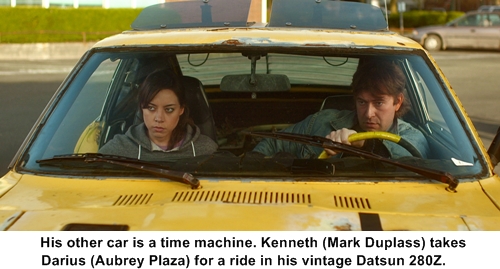
The ad that ran in Backwoods Home back in the mid-1990s began, “WANTED: Someone to go back in time with. This is not a joke.” And while screenwriter Derek Connolly and director  have fashioned their new film inspired by that classified, Safety Not Guaranteed, as a comedy, they don’t treat it as a joke. Instead, they find a lot of heart in this tale of lonely stock clerk and possibly mad, possibly genius Kenneth (the suddenly ubiquitous Mark Duplass) whose invitation to time travel draws downbeat Seattle Magazine intern Darius (Aubrey Plaza), her nerdy colleague Arnau (Karan Soni), and oily journalist Jeff (Jake M. Johnson) into his story, an unexpectedly life-altering experience for all four of them. A San Francisco Bay Area native who now lives in Vermont, Trevorrow recently returned to his former home turf to talk Safety in advance of the Sundance Film Festival hit’s theatrical release.

Q: You and Derek Connolly are writing partners. When he brought you this, how far along in the story had he gotten and were you involved with the writing at all?

A: He came to me with the script, with a draft that we then developed for a while. Derek did all of the actual writing and I think part of the job of a director is to mold the story and build a narrative that’s going to work on screen. That’s what I did, but I respect Derek’s abilities so much and I respected his voice in this so much that I really wanted to make sure that every word was his. He also gave me the gift of being able to direct this film. So we just decided, “OK, we’re both going to be producers and I’ll direct and you’ll be the writer.” It really was a collaboration, not only that part, but on set he was next to me the entire time and I would confer with him daily, even moment to moment. “What would Kenneth say here? What feels honest in this moment? What feels true?” I’m very proud of our collaboration on this movie. It’s very organic.

Q: You juggle a number of genres in the movie. Was that part of it from the start or was that something evolved as the script evolved?

A: The first draft of the script was very much a comedy, mystery, road trip movie. What we really fleshed out of it was the romantic side of it, the love story and issues of emotional time travel and how – right now, Facebook is our time machine in a lot of ways, being able to go back and find people from your past that you otherwise wouldn’t have seen. We took that, but the question of the movie was always the same, “Is this guy crazy or not?” Even though we were going to turn it into a bit more of a love story, we didn’t want to turn it into a romantic comedy where the question is, “Are these two going to end up together?” We wanted to keep the question the sci-fi question and yet still have it supported by a love story. I think in the end it makes for a movie – I don’t know if it’s tonally erratic, but there are a lot of different tones that are coming into play. For me, the big challenge was juggling all these tones and making sure that everything, like a funnel, came down to that last moment where ideally a lot of these various questions you have are going to be answered in a single sequence.

Q: The four characters in this movie are so isolated and lonely and maybe not even aware of how isolated they are until they embark on this mad project …

A: To me, it starts as a movie with a bunch of characters who all need a time machine for a different reason. It really is a movie about self-awareness in a lot of ways. The characters become more self-aware all across the board. We were trying to make a movie that was an emotional time travel film and about why we all have moments that we identify in our past that if we could just go back and change that one thing, things might be different for us. That’s a very universal thing. I find that when I ask people, “What would you do with a time machine?” when they really think about it, it comes down to something deeply personal. “I might not have said that thing to my dad that I said.” “I might not have ended that relationship the way that I did or treated that person the way that I did.” In the same way I think that Eternal Sunshine of the Spotless Mind addresses regret in a time travel kind of scenario, we could do that while also having it be fun and hilarious and have momentum and sci-fi and mystery and all those other things. – Pam Grady

Share this:

  • Share on Facebook (Opens in new window) Facebook
  • Share on X (Opens in new window) X
  • Email a link to a friend (Opens in new window) Email
  • Print (Opens in new window) Print
  • Share on LinkedIn (Opens in new window) LinkedIn
  • Share on Tumblr (Opens in new window) Tumblr
  • Share on Reddit (Opens in new window) Reddit
  • Share on Pinterest (Opens in new window) Pinterest
Like Loading...

Categories

  • Interviews
  • News
  • Reviews
  • Short Takes
  • Uncategorized

Recent Posts

  • A Stamp of Approval
  • Life is messy & so is ‘Megalopolis’
  • A star discovers too late there are worse things than aging in the black comic body horror ‘The Substance’
  • A young teen nurses a crush when he finds himself among ‘Big Boys’
  • The stunt man becomes the star as Ryan Gosling becomes THE FALL GUY

Archives

Blog at WordPress.com.

  • Subscribe Subscribed
    • Cinezine Kane
    • Join 48 other subscribers
    • Already have a WordPress.com account? Log in now.
    • Cinezine Kane
    • Subscribe Subscribed
    • Sign up
    • Log in
    • Report this content
    • View site in Reader
    • Manage subscriptions
    • Collapse this bar
 

Loading Comments...
 

    %d